Skip to product information
1 of 2

Vintage and Antique Gifts

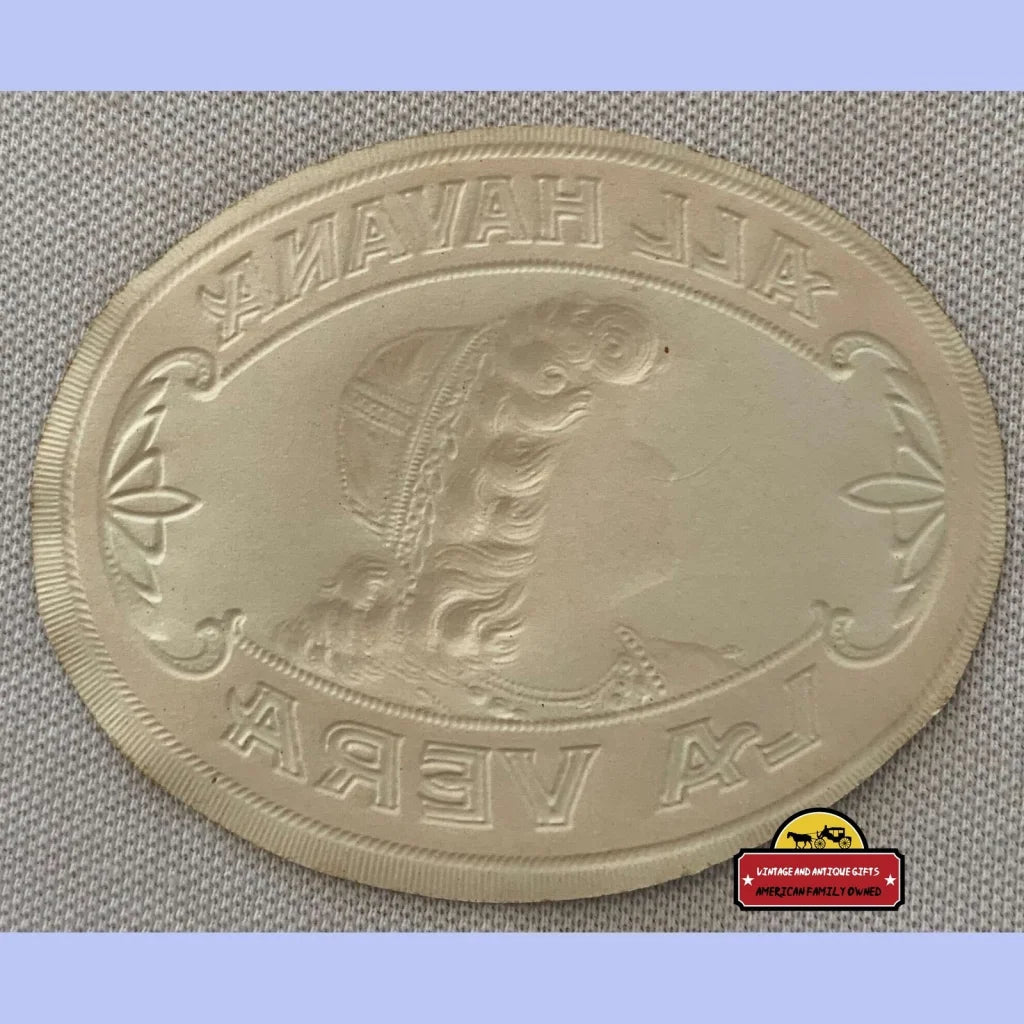
Antique La Vera All Havana Cigar Label 🎨 Embossed Chromolithograph, 1890s–1910s New Old Stock American Made

Regular price 7.00 USD
Regular price Sale price 7.00 USD
Sale Sold out
Shipping calculated at checkout.

Description

What Did a Cigar Label Know About Beauty? 🎨 More Than Almost Anyone Gave It Credit For.

There is a particular kind of object that slips through history almost unnoticed — too small to hang in a gallery, too ephemeral to be saved with intention, too commercially humble to earn a place in the museum vitrine — and yet, when you hold one a hundred and twenty years after it was made, something in you recognizes immediately that you are looking at genuine art. The La Vera All Havana cigar label is exactly that kind of object. It was made to be glued to a wooden box, sealed under lacquer, glimpsed for a moment in a tobacconist's case, and forgotten. Nobody was supposed to keep it. And yet here it is: crisp, luminous, embossed, and carrying every ounce of color and craft the lithographers poured into it sometime in the 1890s or the first decade of the 1900s, when the American cigar industry was at the absolute height of its visual ambition and nobody had yet told it that printing pictures on little ovals was not a fine art.

I have been collecting these labels for a long time now, and I will tell you honestly: the ones that stop me are the portrait labels. The landscape labels are lovely, the allegorical labels are dramatic, the factory-view labels are historically irreplaceable — but the portrait labels are the ones that feel like they were made by someone who cared about the face at the center of the composition. The woman on the La Vera label is one of those faces. She is not a goddess, not a symbol, not a cartoon — she is a portrait, rendered with genuine chromolithographic warmth, and she has been waiting in a stack of new old stock for over a century to be seen properly.


🌿 What It Is — The Object Itself, Exactly as It Survives

This is an antique La Vera All Havana cigar label — an embossed chromolithograph produced in America between approximately 1890 and 1910, part of a cache of new old stock that was never applied to a box and never saw a day of retail use. It measures 5¼ inches by 2¾ inches in the classic elongated oval format that the American cigar industry standardized for its inner lid labels during this period, the size calibrated to fit the interior face of a hinged wooden cigar box lid where a customer's eye would land first when the box was opened across the counter.

The printing itself is chromolithography — a process that begins not with a digital file, not with a photographic plate, but with a series of heavy limestone slabs, each one ground flat and drawn upon by hand with greasy lithographic crayon or tusche, each one responsible for laying down a single color when pressed against dampened paper under enormous pressure. The lithographer who designed the La Vera label worked in layers: the deep crimson ground, the warm graduated gold of the oval frame, the ivory of the lettering, the soft flesh tones of the woman's face and neck, the teal and blue of the small floral flourishes at each side, the metallic shimmer of the embossed outer border that catches the light at an angle the way a minted coin does. Each of those colors required its own stone, its own preparation, its own pass through the press, with the paper positioned precisely each time so the colors would fall in register. Done carelessly, it produces muddy overlap and shifted outlines. Done the way this label was done, it produces something that reads almost like a painting.

At the center of the composition is a woman's portrait in profile — her dark curling hair swept back and crowned with an ornate jeweled cap worked in red and gold, her gaze lifted slightly with a composed, quiet dignity that the best cigar portraiture of the period always seemed to aim for. Below her portrait, the brand name La Vera curves in bold raised ivory lettering; above her, the marketing claim All Havana arches in matching weight and style. The embossed gold-ridged outer border frames the whole, giving the label a tactile dimension you feel before you fully see it. New old stock condition — clean, unfolded, unglued, the colors as saturated today as the day the last stone came off the press.


🏭 The American Cigar Industry as Patron of the Arts — A Story It Never Told Itself

The American cigar industry of the 1890s and early 1900s was one of the great visual-arts patrons of its age, and it did not know it. The numbers alone are staggering: at the peak of the pre-World War I cigar boom, there were more than fifteen thousand registered cigar brands operating in the United States, the overwhelming majority of them small-batch operations producing anywhere from a few hundred to a few thousand cigars a week under a proprietary name in a rented room above a hardware store, in the back of a tobacconist's shop, or in a purpose-built factory employing a handful of rollers and a foreman who had learned his craft in Cuba or in the Ybor City district of Tampa, Florida — the great American cigar manufacturing capital that grew up almost overnight in the 1880s when Vincente Martinez Ybor relocated his operation from Key West and began building the largest cigar factory complex in the world on what had been empty scrubland north of the city.

Every one of those fifteen thousand brands needed labels. Labels for the boxes, labels for the individual cigars, labels for the bands, labels for the shipping crates. The label printing houses — concentrated in cities like New York, Cincinnati, Philadelphia, and Chicago, where the lithographic infrastructure was most developed — competed ferociously for this business, and competition drove quality upward in a way that benefited everyone who later became a collector of these things. A new cigar brand placing an order for box labels was, in economic terms, commissioning a small print run of original chromolithographs, each one designed from scratch, each one requiring days or weeks of skilled stone preparation, each one representing a considerable capital investment. The printer who could deliver the most striking, most richly embossed, most color-saturated result won the account. The result, across the industry as a whole, was an extraordinary flowering of commercial graphic art that has never been fully appreciated outside the collector community.

The claim All Havana on the La Vera label places it squarely within the premium tier of the market. Havana tobacco — grown in the Vuelta Abajo region of western Cuba, hand-sorted, slow-fermented, and aged under conditions that American growers spent decades trying to replicate — was the benchmark against which every other cigar leaf was measured in this period. A brand willing to stake its reputation on the All Havana claim was reaching for the upper register of the trade, and the label's visual ambition matches that aspiration exactly. The embossing, the complexity of the color palette, the quality of the portraiture — none of that was accidental, and none of it was cheap.


🎭 The Portrait Tradition — Who Was She, and Why Does It Matter?

The woman at the center of the La Vera label belongs to a long and fascinating tradition of idealized feminine portraiture in cigar art — a tradition that ran from the 1860s through at least the 1920s and produced some of the most technically accomplished chromolithography ever printed on American soil. She is not identifiable in the way a historical portrait is identifiable. She was almost certainly a composite — drawn by a staff artist at the printing house from fashion plates, photographic references, and the artist's own imagination, then refined through several proofs until the pressman and the client were satisfied that she projected exactly the right combination of elegance, exoticism, and approachable beauty.

Her jeweled cap and the slightly orientalized quality of her ornament were deliberate stylistic choices, common in the premium cigar label tradition of the 1890s and reflecting a broader Victorian and Edwardian fascination with the decorative arts of the East — a fascination that showed up in parlor furnishings, in women's fashion, and in the luxury goods trade simultaneously. A cigar with a Havana pedigree was already an imported luxury; the label's aesthetic vocabulary reinforced that sense of the exotic, the well-traveled, the sophisticated.

Lore passed down among serious cigar label collectors holds that the great lithography houses kept what they called "face books" — bound folios of portrait heads rendered at various angles and in various costumes, maintained as reference libraries that artists could draw from when designing new labels. The same face, in a different cap or with different hair, might appear across a dozen different brand labels printed by the same house over a period of years. Whether the woman on the La Vera label appears elsewhere — whether she was a stock face or a custom commission — is not something the surviving records answer definitively, but it is one of the quiet pleasures of collecting these that you begin to recognize the hands behind the faces, the individual artists whose styles recur across brands the way a master's touch recurs across the paintings of a workshop.


📜 New Old Stock — Why It Matters So Much in This Collecting Category

The phrase "new old stock" carries a specific and important meaning when it comes to paper ephemera of this age. Most cigar labels that survive today were applied — glued to boxes, varnished over, and at some later point soaked or steamed off, a process that invariably damages the paper, fades the inks, and compromises the embossing. Applied labels can be beautiful and historically significant; they just carry the marks of their working life. New old stock means the label was printed, stacked with its fellows, bundled, and stored — in a warehouse, in a printer's inventory room, in the back of a tobacconist's supply cabinet — and simply never used. It sat in darkness, protected from light and humidity by the weight of the stack above it, while the world changed around it.

When NOS labels like the La Vera surface today, they come out of the stack looking the way they looked when they left the press. The embossing is sharp because it was never pressed flat against a box lid. The inks are saturated because they were never exposed to the UV light that breaks down chromolithographic pigments over decades of display. The paper is clean because it was never coated in glue. For a collector, a framer, or anyone who intends to display this label properly, NOS condition is simply the highest point on the desirability scale. You are not acquiring a survivor. You are acquiring, as nearly as such a thing is possible with a paper object, a new impression of a hundred-and-twenty-year-old piece of art.

Local legend in the collector community holds that some of the largest surviving caches of NOS cigar labels came not from the printing houses themselves but from the estates of retired cigar salesmen — traveling men who carried sample books of labels to show prospective clients, kept duplicates of everything, and eventually stored decades' worth of printed samples in their attics and spare rooms, where they waited for estate sales and sharp-eyed pickers generations later. Whether the La Vera label's particular survival has that kind of story behind it is not documented, but the possibility is part of what gives NOS paper ephemera from this period its particular romance.


🖼️ Display Ideas

  • 🪟 Float-mount under UV-protective glass in a period-appropriate oval frame — the shape of the label and the warmth of a gilt oval frame reinforce each other beautifully, and the embossed border reads as a second frame within the frame.
  • 📚 Incorporate into a curated wall of antique trade ephemera alongside other tobacco-related paper goods — seed catalogs, seed packets, trade cards, or Victorian-era advertisement cards — for a collector's study or library wall that tells the story of the American agricultural and commercial trade in a single composed display.
  • 🥃 Display in a gentleman's bar or smoking room alongside period humidors, vintage match safes, and antique tobacco tins, where the label functions as both wall art and historical context for the collection around it.
  • 🎁 Frame as a statement gift for the serious collector who does not need another object but genuinely appreciates a museum-quality piece of American commercial art history in presentation condition.
  • 🖼️ Group three or five portrait cigar labels in matching frames in a symmetrical salon-style arrangement — the oval format and warm tonal palette of labels from this period create an extraordinarily cohesive wall installation that reads as intentional, collected, and deeply personal.
  • 🏛️ Use as a teaching piece or archival display in a museum case, historical society exhibit, or university collection focused on the history of American printing, commercial art, or the tobacco trade.

🎁 Who Collects These — and Why They Keep Coming Back

Cigar label collecting has been a recognized category of paper ephemera collecting since at least the 1960s, and it draws a remarkably broad range of people. At one end of the spectrum are the dedicated specialists — collectors who focus exclusively on labels from a particular region, a particular printing house, or a particular visual category like portraits, landscapes, or factory views, and who can tell you at a glance whether a given label was printed in Cincinnati or New York and approximately when. These are the people who have built reference libraries, who correspond with other specialists around the world, and for whom finding a clean NOS example of a previously documented label in a known series is a genuine event.

Then there are the decorators and interior designers — professionals and passionate amateurs who have discovered that antique cigar labels in the right frames transform a wall in a way that contemporary prints simply cannot replicate. The color palette of 1890s–1910s chromolithography — warm golds, deep crimsons, soft ivories, touches of teal and ultramarine — happens to map almost perfectly onto the interior palettes that sophisticated rooms have favored for the last decade and a half. The La Vera label's colors would feel at home in a room furnished with antique leather, dark wood, and brass hardware, and equally at home in a cleaner, more minimal space where a single framed piece of genuine historical art provides the warmth that the room needs.

There are also the history collectors — people who are drawn to the cigar label not primarily as a visual object but as a primary source document, a piece of evidence about how American commercial culture worked at its most ambitious and least self-conscious. The La Vera label tells you something about the aspirations of a cigar brand competing in a crowded premium market, about the capabilities of American lithographic printing at its height, about the visual vocabulary of elegance and exoticism that late Victorian and Edwardian taste shared across social classes. That is a lot of history in 5¼ by 2¾ inches.

And finally — and I think this is the group that sustains this collecting category more than any other — there are the people who simply respond to the beauty of the thing. They are not specialists, they are not decorators, they are not historians. They pick up a label like the La Vera and something in them recognizes, without needing a label or a category, that they are looking at something made with genuine skill and genuine care by people who were proud of what they could do. That recognition is the whole point.


❓ Frequently Asked Questions — The La Vera All Havana Cigar Label

What exactly is chromolithography, and why does it matter for this label's value and beauty?

Chromolithography is a printing process developed in the mid-nineteenth century that uses multiple polished limestone slabs — one per color — to build up a full-color image through successive pressings. Each stone is drawn or transferred with a single color's worth of image information; the paper is dampened and run through the press, picking up the ink from the stone's image areas, then repositioned precisely and run through again for the next color. A complex label like the La Vera might require eight, ten, or twelve separate stones and press runs to achieve its full tonal range. The result is a printed surface that has a warmth, a depth, and a slight tactile texture that photomechanical and digital printing processes simply do not replicate. The gradated flesh tones of the woman's face, the luminous glow of the gold oval frame, the precise registration of the teal flourishes against the ivory lettering — all of that required considerable skill and considerable time. It is the investment of that skill and time that makes surviving chromolithographic labels from this period genuinely valuable as artifacts of the printer's art.

What does "new old stock" mean for a paper item this age, and how can I tell?

New old stock — NOS — means the item was produced, inventoried, and stored without ever being put into use or sold to an end consumer. For cigar labels specifically, it means the label was never glued to a box, never varnished over, never soaked or steamed in the removal process that damages most applied labels. What they do not show is the water damage, color loss, thinning, or surface abrasion that characterize applied and removed labels. The La Vera label's NOS status places it in the highest desirability tier for collectors who intend to frame and display it, since the embossing and color will survive framing and display in a way that a compromised applied label often cannot.

Is the "All Havana" claim on this label historically meaningful, or just marketing language?

Both, as with most advertising claims of the period — but the historical context gives it genuine weight. Havana tobacco, specifically from the Vuelta Abajo region of Cuba's Pinar del Río province, was the benchmark premium leaf for American cigar manufacturers throughout the second half of the nineteenth century and into the early twentieth. It commanded a significant price premium over domestic leaf, and the ability to source and use it was a mark of a brand's quality positioning. The All Havana claim on a label was a statement of ingredient sourcing directed at a consumer who understood the distinction and was willing to pay for it. Whether the claim was always scrupulously accurate is a separate question that the historical record does not always answer cleanly — the period before the Pure Food and Drug Act of 1906 and its subsequent enforcement was not uniformly rigorous in trade claims — but the aspiration the label communicates was real, and it shaped the visual vocabulary of the entire label design. A brand claiming Havana provenance needed a label that looked like a premium product, and the La Vera label delivers exactly that.

How should I frame and display this label to preserve it properly?

The primary enemies of chromolithographic paper ephemera in display are ultraviolet light, humidity fluctuation, and acidic materials in contact with the paper. For long-term display, frame the La Vera label with UV-filtering glass or acrylic — the kind used for fine art printing, not standard picture-frame glass — and mount it using acid-free matboard and archival corners or hinges rather than adhesive of any kind. Keep the framed piece away from direct sunlight and from walls that experience significant humidity variation, such as exterior walls in climates with pronounced seasonal swings. Float mounting — where the label is held slightly above the mat background so its edges and embossed border are visible — is both archivally sound and visually ideal for a piece with this much dimensional interest. A framer experienced with paper ephemera will know exactly what you are asking for.

What period does this label come from, and how is that date range established?

The 1890s–1910s date range is established through a combination of printing technology markers, stylistic analysis, and the documented history of the American cigar label industry. The embossed chromolithographic technique used here was at its peak of commercial application in exactly this window — the 1880s established the technology, the 1890s refined it to its highest expression, and the 1910s and 1920s began the gradual transition toward offset lithography and photomechanical processes that would eventually displace stone lithography entirely. The visual style of the portraiture — the jeweled cap, the profile orientation, the soft tonal graduation, the combination of crimson and gold with teal accents — is characteristic of the premium label aesthetic of the McKinley and Roosevelt eras. Labels from after World War I tend to show flatter color, simpler compositions, and less elaborate embossing as cost pressures reshaped the industry. The La Vera label's complexity and richness place it confidently in the earlier part of that range.

Is a label this age fragile, and does handling it require special care?

NOS chromolithographic labels from this period are more robust than most people expect — the paper stock used by American label printers of the 1890s and 1900s was a substantial, relatively thick stock designed to accept multiple press runs without distorting, and it has aged well in storage. That said, reasonable care is always warranted with a paper object of this age and condition. Handle it at the edges rather than the face, particularly in the embossed areas where repeated pressure could gradually flatten the relief. Avoid exposing it to moisture, and store it flat in an acid-free sleeve or folder if it is not being framed immediately. The inks on a well-preserved NOS label are stable — they have been stable for over a century — but prolonged exposure to strong light will begin to shift the more fugitive colors, particularly blues and greens, over time. Frame it properly and it will outlast everyone in the room.

Why are cigar labels considered collectible rather than just decorative?

The distinction between "collectible" and "decorative" gets blurry fast with objects of genuine historical and artistic merit, and cigar labels from the chromolithographic golden age sit comfortably on both sides of the line. They are collectible in the strict sense because they are documented, categorized, and researched by a community of serious specialists who maintain reference works, price guides, and provenance records for significant examples. They are also decorative in the best sense — not merely pretty, but genuinely beautiful in ways that hold up to sustained looking. But the deeper answer is that they are primary source documents: physical evidence of how American commercial printing, visual culture, and the luxury goods trade intersected at one of the most technically accomplished and visually ambitious moments in the history of the printed image. A label like the La Vera is a window into a specific industrial and artistic moment that is not reconstructable from written records alone. That is what makes it collectible in the fullest sense of the word.

Shipping

🚚 Shipping & Handling

  • Shipping costs and timing are calculated at checkout.
  • Items curated and shipped directly by me include U.S. shipping at no additional cost, professionally packed to ensure safe arrival of your artifact.

Items from Vetted Pro Collectors
Shipping for items offered by vetted Pro Collectors is determined at checkout. All Pro Collector listings are reviewed to ensure fair, reasonable shipping practices.

For full details, please refer to our Shipping Policy.

Returns & Exchange

Product Page Return Policy

  • 60-Day Returns – Items must be in original condition.
  • Refunds – Issued after inspection (excluding shipping costs).
  • Return Shipping – Customer is responsible unless item is damaged or incorrect.
  • Damaged/Incorrect Items – Contact us within 48 hours for a replacement or refund.
  • Easy Returns – Email [email protected] or call 802-356-9872 to initiate a return.

For full details, visit our Refund Policy.

View full details