Skip to product information
1 of 1

Vintage and Antique Gifts

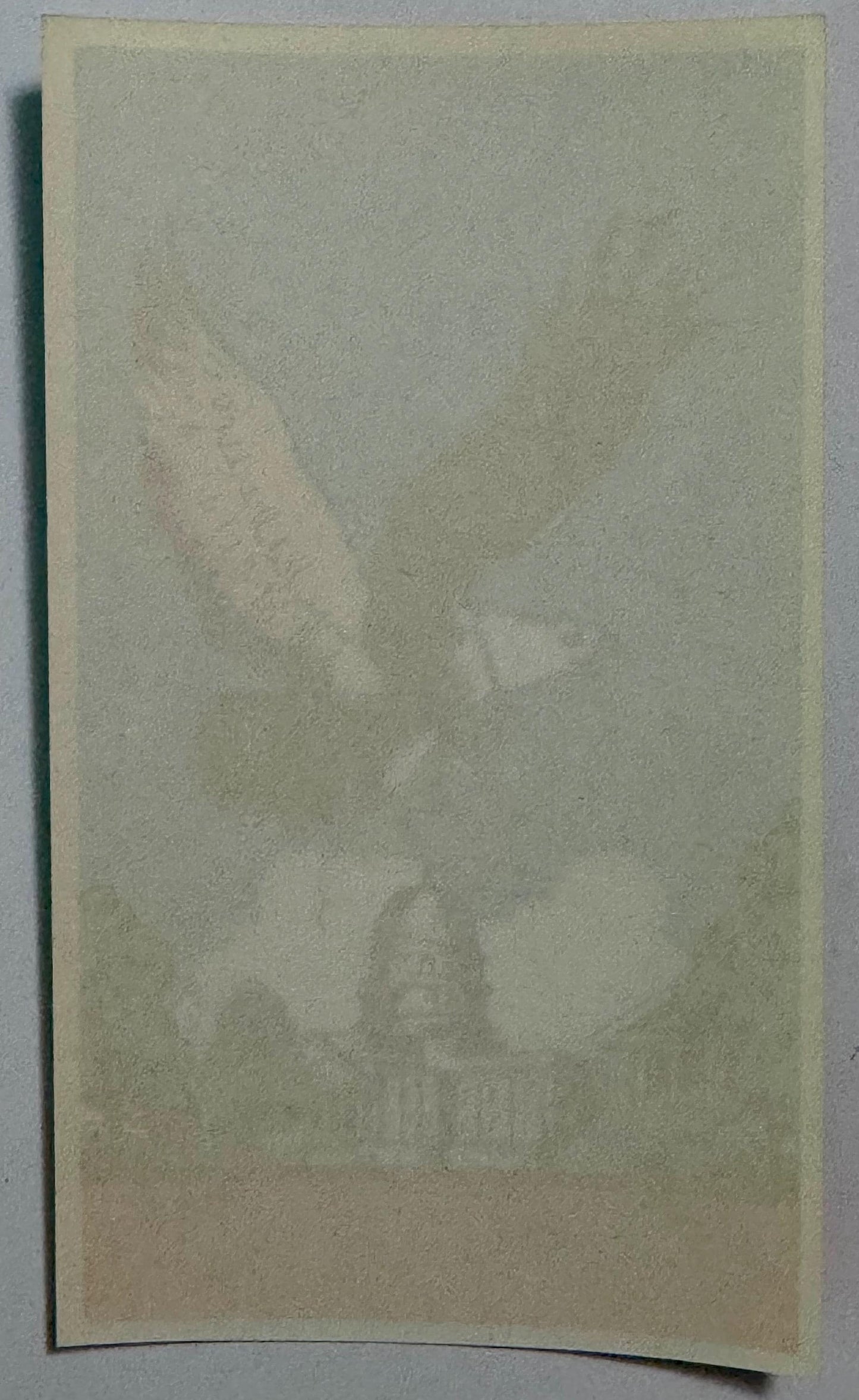
Antique Bald Eagle Capitol Building Broom Label 🦅 NOS Chromolithograph Hamburg PA Americana Art American Made

Regular price 15.00 USD
Regular price Sale price 15.00 USD
Sale Sold out
Shipping calculated at checkout.

Description

What If a Broom Label Was Never Really About the Broom? 🦅

There is a particular kind of object that survives the century not because anyone planned to save it, but because it was too beautiful to throw away — and too honest to ignore. This chromolithographic broom label from the 1910s through the 1930s is exactly that kind of object. It was printed to wrap around the handle of a working broom. It ended up outlasting the broom, the company that made the broom, possibly the building where the broom was swept, and every practical purpose it was ever assigned. What remains is the eagle. Wings spread full across a brilliant blue sky, feathers shifting from gold and amber on the right wing into deep chocolate brown on the left, the bird banking hard over a neoclassical capitol dome with the easy authority of something that does not need to explain itself. Below it, a white government building stands columned and steady, flanked by full green trees, a rolling white cloud mass pressing behind the dome, and a bold red band anchoring the whole composition at the base. Six inches tall. Three and a half inches wide. New Old Stock — never applied, never used, color still vivid, edges still clean, every feather still locked exactly as it left the press. This is not a reproduction. This is not a scan of the original. This is the original.


🏷️ What This Is, Exactly

This is an antique broom label — the kind of decorative paper label that broom manufacturers in the early twentieth century applied to the handles or bundles of their finished product as a brand identifier and point-of-sale appeal piece. The label is a full-color chromolithograph, meaning it was printed through a multi-stone or multi-plate lithographic process in which each color was applied in a separate press pass, the layers building up wet-on-dry until the image achieved the kind of depth and richness that no single-pass printing method could deliver. The chromolithographic process was the dominant commercial art medium from roughly the 1860s through the 1930s, and at its peak it employed some of the most technically skilled press operators and color separators in the world. This label is a product of that peak. It originates from Hamburg, Pennsylvania — Berks County, in the folded ridge-and-valley country of southeastern Pennsylvania — a town whose connection to the American broom industry runs deeper than most people outside the trade have ever been told. The label is New Old Stock: it was printed, bundled, and stored without ever being applied to a product. Whatever warehouse or back room held this stock was, in the end, the reason it survived at all. The color is not faded. The image is not worn. It is a time capsule pressed flat.


🌾 The Broom Industry and Why It Needed Art

The American broom industry in the late nineteenth and early twentieth centuries was not a modest trade. It was a serious manufacturing economy spread across several regional centers, each competing for shelf space in hardware stores, general mercantiles, and the growing network of dry goods chains that stitched together small-town American commerce. Broom corn — a tall sorghum variety cultivated specifically for its stiff, fibrous seed heads — was the raw material, and it flowed from midwestern farms into eastern manufacturing towns in volume. The finished brooms needed to be sold, and in an era before broadcast advertising, the label was the advertisement. It lived at the point of purchase. It caught the eye at the hardware counter. It communicated, in a single image, everything the manufacturer wanted the buyer to understand about the brand: quality, durability, pride, and — in the case of patriotic labels like this one — something larger than a household cleaning tool. The bald eagle over the capitol dome is not decorative. It is an argument. It says: this broom comes from serious people who take their work seriously, and they want you to know it.

Broom companies in this era hired real artists for this work. Not clip-art compositors or catalog-copy illustrators, but trained hands — people who understood how to use a constrained lithographic palette, often limited to five or seven colors plus black, to imply motion, shadow, and the kind of atmospheric depth that makes an image feel like it has weather in it. The eagle on this label demonstrates exactly that skill. The open beak, the outstretched talons, the differential color treatment between the two wings — one catching full light, one pulling into shadow — these are compositional decisions made by someone who understood how birds move through air and how to translate that movement into a static image that still feels kinetic a hundred years later.


🏘️ Hamburg, Pennsylvania — The Town Behind the Label

Hamburg sits in Berks County, Pennsylvania, at the foot of the Blue Mountain ridge, where the Schuylkill River bends through a gap in the Appalachian chain that the Pennsylvania Dutch and their German immigrant predecessors had been working for a century before the broom trade arrived. The borough is small by any measure — a few thousand residents at the trade's height — but its position along the Philadelphia and Reading Railroad made it a natural node for light manufacturing that needed both agricultural raw materials coming in and finished goods going out. Broom manufacturing fit that geography well. The rail connection to the broader Pennsylvania network meant that broom corn could arrive from Illinois and Kansas, and finished brooms could leave for Philadelphia, New York, and points south, in the same freight economy that moved coal, iron, and textiles through the region.

The broom trade in and around Hamburg was, by local accounts, a genuinely communal industry. Whole families worked in the broom shops — tying, wiring, sewing the corn into handles, applying labels. The work was seasonal in its rhythms but steady across the year for the established shops, and the labels were a source of genuine pride among the workers who applied them. A well-printed label on a finished broom was the visible signal that a shop was operating at a high standard, and workers in the better Hamburg shops reportedly kept misprinted or damaged labels as workshop mementos rather than discarding them.

Local legend has it that at least one Hamburg broom shop kept a framed set of its own labels on the wall of the front office — not as advertising, but as a kind of quality standard, a visual reference for what the finished product was supposed to look like. Whether the eagle label was among that display, no one living can confirm, but collectors who have worked the Berks County estate sale circuit for decades hold firmly to the story. Lore passed down among paper ephemera collectors in the greater Reading area holds that several caches of NOS Hamburg-area broom labels survived specifically because shop owners or their families held onto the uncut sheets long after the shops closed, treating them not as waste stock but as documentation of a trade that deserved to be remembered. That instinct — to hold on, to not discard — is the reason pieces like this one exist at all today.


🖨️ Chromolithography — The Art Form Inside the Trade

It is worth spending a moment on the printing process itself, because chromolithography is not a word that adequately communicates what it actually looked like to produce a label like this one. Each color in a chromolithographic print required its own stone — a flat slab of Bavarian limestone, finely ground, on which the artist or craftsman drew the color separation for that single layer of the image using greasy lithographic crayon or tusche. The stone was then etched with a mild acid solution, inked, and run through the press. The paper received one color, dried, and went back through for the next stone. A complex image like this eagle — with its graduated wing tones, its atmospheric sky, its architectural detail in the capitol dome, its botanical fullness in the flanking trees — might require seven, eight, or ten separate press passes to achieve. The registration had to be precise on every pass. A misaligned stone produced a blurry, ghosted image that went to waste. The surviving New Old Stock examples of labels like this one are, in a very real sense, the ones that passed every test.

The chromolithographic printing industry in America was heavily concentrated in a handful of cities — Cincinnati, New York, Chicago, and the printing towns of southeastern Pennsylvania among them — and the pressmen and stone grinders who worked these shops were highly skilled tradespeople who took genuine professional pride in a tight registration and a clean color build. The label you are looking at is evidence of that pride. The feather detail on the eagle's breast, the way the cloud mass reads as atmosphere rather than flat white, the gold of the wing catching what reads as actual sunlight — these are the marks of a craftsman who knew what he was doing and did it well.


🖼️ Display Ideas

  • 🪞 Frame it as standalone art. A simple black or gilt frame with an off-white mat sets the chromolithographic color palette off beautifully — this eagle reads as a finished illustration, not a commercial artifact, and it will hold its own on any wall that respects American graphic history.
  • 🗺️ Group it with other Pennsylvania or Berks County ephemera. Paired with a vintage Berks County map, a Reading Railroad timetable, or other Pennsylvania Dutch trade labels, this eagle becomes the anchor piece of a regional Americana display with genuine depth and narrative.
  • 🦅 Build a patriotic ephemera vignette. Alongside other NOS chromolithographic labels, vintage postal covers, or early twentieth-century trade cards with eagles and capitol imagery, this label contributes to a cohesive visual story about how American identity was communicated through commercial art.
  • 📚 Display in a collector's reference library. Propped against books on American chromolithography, trade card history, or Pennsylvania industrial heritage, the label works as both decorative object and primary source — a real artifact in a research context.
  • 🏛️ Americana cabinet or curiosity shelf. Nestled among other small-format patriotic objects — early political buttons, trade tokens, sheet music covers — the label's six-inch height makes it ideal for shelf display without dominating the composition.
  • 🖼️ Float-mount under UV glass. For the serious paper ephemera collector, float-mounting the label — visible on both sides, suspended in the frame — preserves it fully while making its physical presence, including its edges and paper texture, part of the display.

🎁 Who Collects These

Antique broom labels, and chromolithographic trade labels generally, have developed a serious and devoted collector community that spans several overlapping enthusiasms. Paper ephemera collectors — a category that includes trade cards, cigar labels, seed packets, fruit crate art, and the full range of printed commercial material from the nineteenth and early twentieth centuries — are the natural home audience for a piece like this one. They understand what NOS means, they know why never-applied condition matters, and they recognize the difference between a label that was stored flat versus one that spent decades rolled or folded.

Americana collectors are a second strong constituency. The eagle-and-capitol imagery on this label places it squarely in the tradition of American patriotic visual culture — a tradition that runs from the Federal period eagles of the early republic through the full-throated commercial patriotism of the Progressive Era, when manufacturers understood that the bald eagle was not just a symbol but a sales tool of the first order. Collectors who focus on this visual tradition find chromolithographic labels particularly compelling because they capture the moment when patriotic imagery was most fully integrated into everyday commercial life.

Pennsylvania collectors and regional Americana enthusiasts form a third community for whom the Hamburg, Berks County provenance adds a specific layer of meaning. The Schuylkill Valley industrial heritage — Reading Railroad, Pennsylvania Dutch manufacturing, the ridge-and-valley geography that shaped the economy of the region — has a dedicated collector and historical community that actively seeks out artifacts with genuine local connection. This label has that connection, and it is documented.

Finally, graphic design historians and illustration collectors have increasingly recognized the chromolithographic label tradition as a legitimate chapter in the history of American commercial art. The artists who designed these labels were working within real constraints — limited palette, small format, the requirement that the image read clearly at arm's length on a hardware counter — and the best of them produced work that holds up as design by any standard. This eagle holds up.


❓ Frequently Asked Questions

What does "New Old Stock" mean for a paper label like this one?

New Old Stock — NOS — means the item was produced, but never put into use. For a broom label, that means it was printed, cut, and stored without ever being applied to a broom handle or bundle. The label you are looking at left the press in its finished state and has remained in that state ever since. It is exactly what it was the day it was printed. For paper ephemera, NOS condition is the highest standard there is, because it means the color, the surface texture, and the structural integrity of the paper are all in their original state. Nothing has been done to this label except time passing, and in this case, time passed gently.

How was the chromolithographic printing process different from later printing methods?

Chromolithography is a stone-based planographic printing process in which each color requires its own flat limestone plate, hand-prepared by a craftsman who draws or transfers the color separation for that layer. The colors are built up in successive press passes, each layer adding to the image's depth and complexity. The result is a surface quality — a slight relief, a richness of color layering — that offset lithography and later photomechanical processes do not replicate. When you look at a chromolithograph under a loupe or magnifying glass, you see solid fields of ink and hand-drawn tonal gradations rather than the halftone dot patterns of later commercial printing. The eagle on this label, with its feather gradations and atmospheric sky, required the skills of a craftsman who understood both color separation and the behavior of lithographic ink on paper. That craft is visible in the finished piece.

Is the eagle image on this label a standard design, or was it custom to one broom company?

This is one of the genuinely interesting questions in broom label collecting. Some patriotic motifs — the spread eagle, the capitol dome, the shield — were available as stock designs from printing houses that served multiple manufacturers, customized only in the text or color band. Others were proprietary designs commissioned by a specific company and exclusive to their labels. Without a surviving company name on this label or matching it to a known printer's catalog, the honest answer is that the design's provenance to a specific company remains an open research question. What is certain is that the quality of the illustration — the specificity of the wing rendering, the compositional sophistication of the capitol building's placement — suggests a design that was taken seriously, whether it was stock or commissioned. The eagle does not feel generic. It feels intentional.

How should I store or display this label to preserve it long-term?

Paper ephemera of this age is best kept away from direct sunlight, high humidity, and acidic materials. For storage, an archival polyester sleeve or acid-free envelope inside a flat, rigid archival box is the standard approach among serious paper collectors. For display, UV-filtering glazing — either glass or acrylic — is strongly recommended to prevent color fading from ambient light exposure. The chromolithographic inks on labels from this era are generally quite stable if they have been stored well — which this one clearly has, given its vivid color — but UV exposure is cumulative, and protecting the piece from unnecessary light exposure is the single most important thing you can do to maintain its current condition for another century.

What makes Hamburg, Pennsylvania significant to broom label collectors specifically?

Hamburg's significance in broom label collecting comes from its position as a documented center of Pennsylvania broom manufacturing in the early twentieth century, combined with its proximity to the lithographic printing trade concentrated in southeastern Pennsylvania and the Philadelphia region. Labels produced for Hamburg-area broom companies carry a specific regional identity — Berks County, Schuylkill Valley, Pennsylvania Dutch manufacturing culture — that appeals to collectors interested in the intersection of industrial history and American graphic art. The Bergen and Berks County estate sale and antique show circuit has historically produced some of the strongest Pennsylvania paper ephemera finds, and labels with documented or strongly suggested Hamburg provenance command attention in that community specifically because the regional manufacturing story is well documented and the collector community that cares about it is active and informed.

Is the bald eagle a protected image in any way that affects collecting or resale?

Antique commercial images of the bald eagle — used as a symbolic or patriotic motif in trade labels, advertising art, and ephemera — are historical artifacts and present no legal complications for collecting, display, or resale. The Bald and Golden Eagle Protection Act governs the possession of actual eagle feathers, parts, and in some contexts live birds, but it has no application to printed representations of the eagle in commercial or artistic contexts, and certainly not to antique paper ephemera. Chromolithographic eagle imagery has been freely collected, traded, displayed, and sold in the American antiques market for generations without any legal restriction. You are buying a piece of printed paper, not a wildlife specimen.

How rare are NOS broom labels in this condition, and why did so few survive?

NOS broom labels in genuinely vivid, unapplied condition are meaningfully uncommon, and the reasons for their scarcity are straightforward. Labels were produced to be used. The default fate of a printed broom label was the broom handle, and the default fate of a labeled broom was decades of use followed by disposal. The survival of NOS stock depends almost entirely on the survival of a warehouse cache, a printer's overrun, or a shop owner's personal decision to keep what might otherwise have been discarded. These caches do surface — estate sales, barn finds, the cleared-out back rooms of old commercial buildings — but they are not common, and the ones that surface in vivid condition represent the portion of whatever was stored that was protected from moisture, light, and vermin. The lore among Berks County paper collectors that Hamburg shop owners held onto label sets as trade documentation is, if accurate, exactly the kind of preservation instinct that explains why pieces like this one exist today. Someone decided it was worth keeping. They were right.

Shipping

🚚 Shipping & Handling

  • Shipping costs and timing are calculated at checkout.
  • Items curated and shipped directly by me include U.S. shipping at no additional cost, professionally packed to ensure safe arrival of your artifact.

Items from Vetted Pro Collectors
Shipping for items offered by vetted Pro Collectors is determined at checkout. All Pro Collector listings are reviewed to ensure fair, reasonable shipping practices.

For full details, please refer to our Shipping Policy.

Returns & Exchange

Product Page Return Policy

  • 60-Day Returns – Items must be in original condition.
  • Refunds – Issued after inspection (excluding shipping costs).
  • Return Shipping – Customer is responsible unless item is damaged or incorrect.
  • Damaged/Incorrect Items – Contact us within 48 hours for a replacement or refund.
  • Easy Returns – Email [email protected] or call 802-356-9872 to initiate a return.

For full details, visit our Refund Policy.

View full details