Skip to product information
1 of 1

Vintage and Antique Gifts

Vintage Thunderbird Eagle Shield Broom Label 🦅 NOS Chromolithograph 1930s–40s Art Deco Americana American Made

Regular price 21.00 USD
Regular price Sale price 21.00 USD
Sale Sold out
Shipping calculated at checkout.

Description

What Happens When Commercial Art Disappears? 🦅 The Story Pressed Into This Chromolithograph

There is a particular kind of American making that existed for a few decades and then simply stopped — not because it failed, not because it was replaced by something better, but because the entire ecosystem that sustained it quietly folded. The broom industry was once woven into the fabric of domestic American manufacturing in a way that is genuinely difficult to imagine now. Every town of any size had its broom shop, its broom cooperative, its family-run broom works. And every broom that left those buildings wore a label — a chromolithographic label, vivid and confident and patriotic, executed by journeyman press artists whose names we will never know. This is one of those labels. And it has been waiting, quietly and perfectly, for exactly the right person to find it.

What you are holding, or about to hold, is a piece of American commercial art history that survived entirely intact — never applied, never touched by glue or grain or the rough wooden handle it was printed to adorn. It is New Old Stock in the truest sense of the phrase: it left the press, it was stored, and the world moved on without ever actually using it. That is a small miracle. And when you see the color on this thing — the depth of the chromolithographic ink, the authority of that eagle, the confidence of every line — you will understand immediately why collectors seek these out.


🏷️ What This Label Is — Every Fact, Honored

This is a New Old Stock (NOS) chromolithographic broom label dating to the 1930s through 1940s — the golden era of American label printing, when the technology of chromolithography had been fully mastered and the demand for vivid, shelf-stopping commercial imagery was at its absolute peak. The label measures 6 inches by 3.5 inches, which is the standard working dimension the American broom industry settled on — a size calculated carefully, because it had to wrap cleanly around a broom handle and read legibly at a glance from a point-of-sale display rack. Every fraction of an inch in that dimension was intentional. This was a working specification, not an aesthetic choice, and the artists worked within it the way a sonnet works within fourteen lines: the constraint sharpened everything.

The printing process itself is worth understanding before you look at the image, because it explains what you are actually seeing when you look at the color. Chromolithography is a multi-stone or multi-plate printing method in which each color is laid down separately — one pass through the press for the gold, another for the deep blue, another for the red, another for the subtle shadow tones in the feathers. A complex label like this one might have required eight to twelve separate press runs, each requiring precise registration so that the colors aligned exactly. The artists who designed these labels understood the process from the inside out, because they had to. They drew knowing how the inks would layer. They composed knowing which colors would print first and which would punch through on top. It is a technical art form masquerading as a decorative one. NOS condition means every one of those ink layers is exactly as the pressman pulled it — no fading, no cracking, no adhesive distortion, no warehouse bruising. What the press made, you are getting.


🦅 The Image — A Visual Description Worth Sitting With

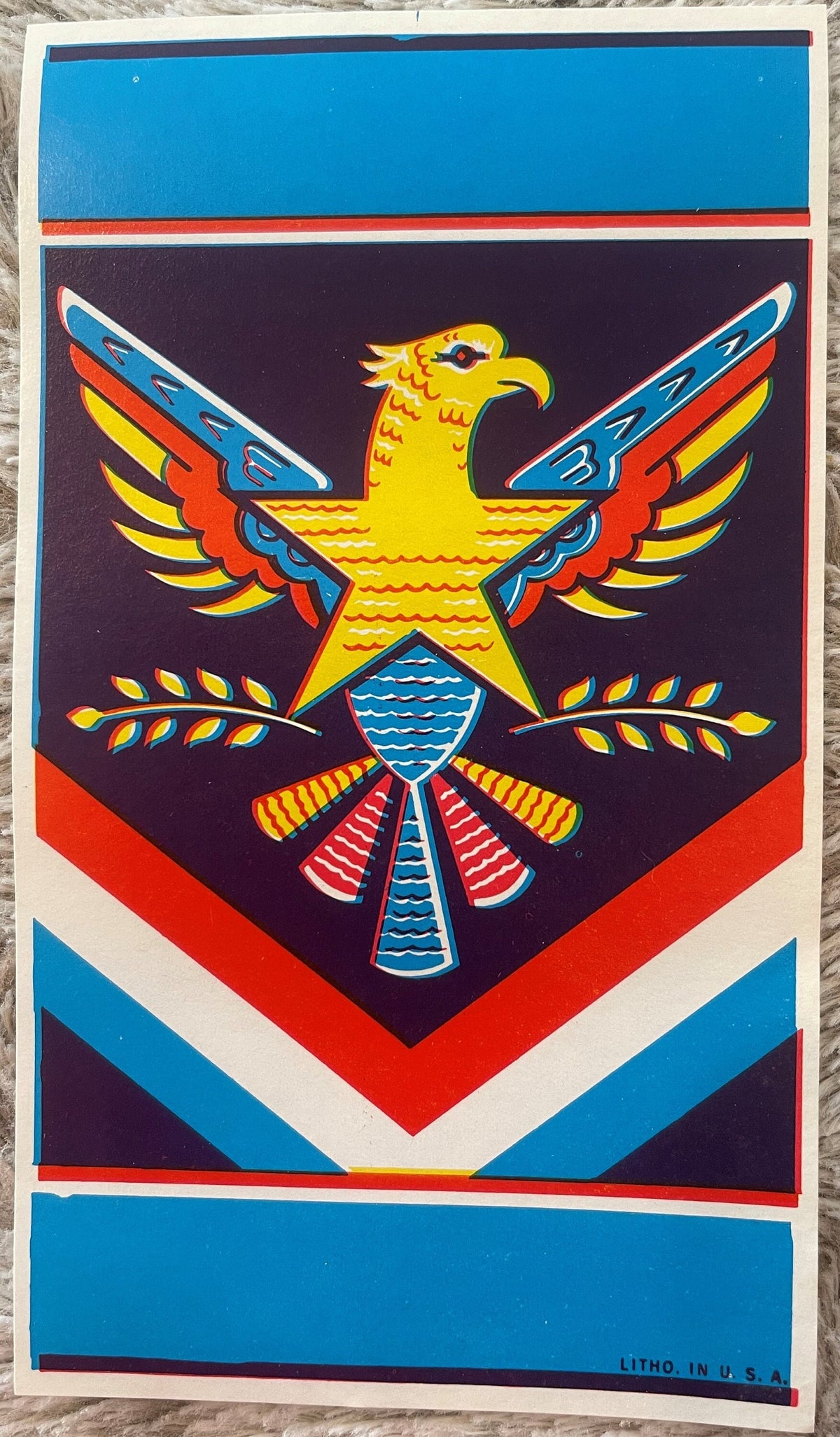
The central image commands the label the way a real eagle commands a ridgeline. A large American eagle — wingspan spread wide across the upper register of the design — is rendered in gold and yellow, the wing feathers picked out in multicolored detail: blue, red, and white layering across the plumage in a way that reads as both patriotic and genuinely ornithological. The eagle's head turns in sharp profile, that characteristic raptor silhouette with the hooked beak carrying authority in every line. The eye is rendered with the particular intensity that the best label artists knew how to land — not cartoonish, not overwrought, but present. You feel looked at.

The Thunderbird designation woven into this design bridges two visual traditions simultaneously and does so without apology. The American eagle as a federal symbol had been a commercial art staple since the nineteenth century. The Thunderbird — the great winged spirit of numerous Indigenous nations across the continent, a being of power, storm, and protection — brought a different kind of charge to the image. By the 1930s and 1940s, the Thunderbird had become a beloved motif in American Art Deco commercial design, appearing on automobiles, hotel letterhead, blankets, and yes, broom labels. The convergence of these two traditions in a single commercial label image is precisely what makes this piece feel larger than its 6-by-3.5-inch dimensions suggest. A shield element anchors the composition, grounding the aerial drama of the eagle/Thunderbird figure in the heraldic tradition — the vocabulary of official authority, domestic protection, and national pride that American households of the Depression and wartime era found genuinely reassuring on the objects they brought home.

The Art Deco influence is visible in the composition's confidence: clean edges, bold color fields, the absence of Victorian fussiness. This is the aesthetic moment when American commercial art had shed its ornate nineteenth-century inheritance and not yet surrendered to the simplified geometry of mid-century modernism. It occupies that precise and unrepeatable middle ground — technically accomplished, visually bold, emotionally legible at twenty paces.


🏭 The Broom Industry and the Visual Culture It Built

The American broom industry reached its manufacturing peak in the late nineteenth and early twentieth centuries, centered in regions where broomcorn — the specific sorghum variety whose stiff, fibrous seed heads made broom material — could be grown or easily sourced. Illinois, Oklahoma, Kansas, and pockets of the East Coast all had significant broom manufacturing operations. These were not glamorous industries. They were unglamorous, essential, and deeply local. A broom works might employ a dozen families. It might be the largest employer in a small town. It competed on price, on quality, and — increasingly, as grocery and general-store display culture developed — on visual presence. The label was the brand. In an era without television advertising, without much radio presence for household goods, the label on the broom handle was the entire marketing budget. It had to work.

This is why the printing firms that served the broom industry took the work seriously. Lithographic houses in Chicago, Cincinnati, New York, and other printing centers developed specialty expertise in broom label production. They employed artists who understood the specific demands of the form: the cylindrical display surface, the brief viewing window at the point of sale, the need for imagery that communicated quality and American-ness instantly. Patriotic imagery — eagles, shields, flags, stars — was not accidental. It was strategic. A household buying a broom in 1938 or 1944 was making a small domestic decision in a large historical context. The label artists knew that. They encoded it in ink.

Local legend has it that in some of the smaller broom-producing towns of the Midwest, the arrival of the new season's labels from the lithography house was treated almost like the arrival of new seed stock — examined carefully, compared to the previous year's run, debated at the counter of the general store by the men who ran the broom cooperative. Lore passed down among label collectors holds that certain designs were rerun for years, even decades, with only minor modifications between print runs — which is part of what makes precise dating of NOS broom labels a genuine collector's puzzle. The image stays consistent; the ink chemistry, the paper stock, and the subtle shifts in registration across press generations are what the experienced eye reads for dating clues.

Collectors who have spent time in the archives of the American Label Manufacturers Association, or who have dug through the estate sales of retired lithography-house employees, report finding working drawings for broom labels stored alongside drawings for whiskey labels, seed packets, and cigar boxes — all sharing the same drawer, the same studio, the same nameless artists. The journeyman label artist of the 1930s and 1940s worked across all of these categories without particular allegiance to any one. But the broom label, some of them apparently felt, allowed for genuine compositional ambition. The patriotic imagery gave them something to reach for.


⚡ Art Deco Americana and the Thunderbird Motif — A Cultural Moment

The 1930s were a decade in which American visual culture was actively negotiating its own identity under enormous pressure. The Depression had cracked the confidence of the Roaring Twenties. The New Deal was rebuilding a sense of collective national purpose. Public murals went up in post offices. Artists were employed by the federal government to document and celebrate American life and American landscape. In this context, the Thunderbird motif in commercial art was doing something culturally significant, even if the artists wielding it were simply following what the client and the market wanted. The Thunderbird said: power, protection, the natural world tamed and channeled, the ancient and the modern in productive conversation. For a broom label — an object attached to a domestic tool, bought by a housewife or a hardware store owner — that was a considerable amount of symbolic freight to carry. These labels carried it well.

By the 1940s, wartime patriotism amplified every eagle, every shield, every red-white-and-blue color field in American commercial art. A broom label with a commanding eagle and a heraldic shield read, in that context, as a small act of solidarity with the national purpose. Buying the right broom, from the right manufacturer, was a quiet vote for American making, American workers, American domestic life worth defending. The label artists understood this and leaned into it. The eagles on broom labels of the wartime period tend to be particularly bold — the imagery pushed just a little further, the color a little more saturated, the posture of the bird a little more commanding. This label, with its Thunderbird eagle in full gold-and-multicolor glory, fits squarely within that tradition.


🖼️ Display Ideas

  • 🖼️ Frame it alone. A simple black or natural wood frame, archival mat in cream or deep navy, and this label becomes a focused piece of Americana wall art — bold enough to hold a room, intimate enough for a study or reading nook.
  • 📚 Group it in a chromolithograph gallery wall. Pair with other NOS labels from the same era — seed packets, cigar bands, fruit crate art — for a curated salon-style display that tells the whole story of American commercial printing's golden age.
  • 🗂️ Archive it in a flat collector's portfolio. For the serious paper collector, a Mylar sleeve in an archival flat file preserves every layer of ink while keeping the piece accessible for study and display rotation.
  • 🏡 Style it in a farmhouse or Americana interior. Propped on a cookbook stand, tucked into the corner of a kitchen shelf display alongside vintage tins and wooden utensils, this label adds exactly the right note of working-history warmth.
  • Feature it in a Thunderbird or Native American motif collection. Collectors who focus on the Art Deco Thunderbird across media — blankets, pottery, hotel ephemera, automotive badges — will find this label a genuinely distinctive and displayable addition.
  • 🦅 Use it as a centerpiece in a patriotic Americana vignette. Grouped with other eagle-motif pieces from the same decade — trade cards, ribbon badges, small flag-related ephemera — it anchors a display that captures the visual language of 1930s–40s American pride without a single word of text required.

🎁 Who Collects These — And Why They Look

Broom label collectors are a specific and quietly passionate community, and they tend to arrive at the category from several different directions. There are the chromolithography collectors — people who collect the printing process itself, who track the development of American lithographic art from its Victorian origins through its Art Deco peak, and who recognize a broom label as a legitimate and often overlooked specimen of a major American art-industrial tradition. These collectors know their inks, their registration tells, their paper stocks. They handle a NOS label and feel the weight of it differently than a civilian would.

Then there are the Americana and advertising art collectors — the people whose walls and shelves carry the visual history of American commerce, who understand that a broom label is as legitimately "advertising art" as any circus poster or tobacco tin. They are drawn to the bold imagery, the patriotic vocabulary, the confident draftsmanship. They want the piece on the wall where it can do what it was designed to do: be looked at.

Thunderbird and Native American motif collectors find broom labels an unexpected and rewarding hunting ground. The Thunderbird appears across so many categories of American decorative and commercial art from the 1920s through 1950s, and tracking it through all of those categories is a collector's project of genuine breadth. A NOS broom label in this condition, with this imagery, is not something that surfaces every day.

Art Deco enthusiasts are increasingly drawn to commercial ephemera as the most honest document of what Art Deco actually looked like in American daily life — not the glamorous hotel lobbies and luxury goods, but the broom handle, the seed packet, the cigar box. This is where the aesthetic lived for ordinary people. And paper ephemera collectors — a vast and varied community — simply respond to the beauty of it: the color, the condition, the improbability of its survival. NOS paper from the 1930s and 1940s that looks this good is always worth stopping for.


❓ Frequently Asked Questions

What exactly does "New Old Stock" mean for a paper item like this label?

New Old Stock — NOS — means the item was produced for its intended use and then stored without ever being put to that use. For a broom label, the intended use was application: it would have been glued or wrapped around the handle of a finished broom, displayed at the point of sale, and eventually worn, torn, or discarded as the broom itself was used up. NOS means none of that happened. This label left the press, entered storage, and has never been applied to anything. The paper has not been stressed by adhesive. The ink has not been exposed to the oils and handling that a point-of-sale broom rack would have introduced. NOS condition for paper ephemera is genuinely significant — it represents the piece in its closest-possible state to how it left the press, which is as good as a chromolithograph can be in the twenty-first century.

How do I know this label actually dates to the 1930s–40s and not a later reproduction?

Several converging factors establish the period. First, the chromolithographic printing process itself: true stone or plate lithography of this period produces a specific ink texture, layering quality, and color saturation that modern offset reproduction does not replicate — experienced collectors and paper dealers can identify it by close examination, and often by the feel of the ink surface. Second, the paper stock: period paper from this era has a characteristic weight, texture, and aging quality (even when well-preserved, as this is) that distinguishes it from modern stock. Third, the design vocabulary: the specific convergence of Art Deco composition, Thunderbird motif, heraldic shield, and patriotic eagle in this style is precisely dateable to the commercial art conventions of the 1930s–1940s. Reproduction broom labels exist, but they are typically produced on thinner stock, with flatter ink, and without the dimensional quality that characterizes genuine chromolithographic printing.

Is this label archivally stable? Will the color hold over time?

Chromolithographic ink, once fully cured — which happens relatively quickly after printing — is quite stable. The inks used in commercial lithography of this period were oil-based and durable; they do not continue to off-gas or chemically degrade the way some later printing processes do. The primary enemies of a label like this are UV light, humidity fluctuations, and physical handling. Kept out of direct sunlight, in a stable humidity environment, and handled minimally (ideally with cotton gloves when handled at all), this label will continue to look essentially as it does now for generations. If you frame it, use UV-protective glazing. If you store it flat, use archival Mylar sleeves rather than acidic plastic. The label has already survived eighty-plus years in storage — it wants to survive another eighty, and with modest care it will.

What is the significance of the Thunderbird specifically, versus a standard eagle design?

The Thunderbird occupies a different symbolic register than the purely heraldic American eagle of federal imagery, and the artists and manufacturers who chose it knew that. The Thunderbird is a figure of immense power across the traditions of numerous Indigenous nations — a being associated with storms, protection, the great forces of the natural world. By the Art Deco era, the Thunderbird had entered the broader vocabulary of American commercial and decorative art as a symbol of dynamic energy, natural authority, and a distinctly New World identity. A label that combines the Thunderbird with the federal eagle and the heraldic shield is making a layered visual argument: this product belongs to a tradition of American power that goes deeper than any particular government or commercial moment. For a broom manufacturer competing on a crowded shelf, that was a sophisticated and effective choice. For a collector today, that layered symbolism is precisely what makes the piece interesting.

How rare are NOS broom labels from this period in this condition?

Genuinely rare, and getting rarer. The challenge with broom labels specifically is that they were produced in bulk for a trade that used them up — literally applied them to broom handles and sold them through. Overstock was not typically valued or carefully stored; when a label design was retired, the remaining stock was often discarded. NOS survival depends on a specific sequence of events: overrun at the press, careful boxing, storage in a stable environment, and then — crucially — the storage location itself surviving without being cleaned out, flooded, or simply thrown away in one of the periodic waves of "clearing out the old building." Labels that make it through all of those hazards intact, with full color and no significant paper damage, represent a small fraction of what was originally printed. A NOS Thunderbird eagle design in Art Deco style with full chromolithographic color is a find that serious collectors recognize immediately.

Can this label be safely framed without damaging it?

Yes, with appropriate materials and methods. The key principles are: archival mounting (never use rubber cement, pressure-sensitive tape, or acidic adhesives of any kind — corner mounts or hinges made from archival tissue are the collector-standard approach), UV-protective glazing (museum glass or conservation-grade acrylic will dramatically reduce light-related fading), and a mat that does not allow the glazing to contact the surface of the label directly. Many collectors choose to frame the label without any adhesive contact at all, using the mat itself to hold the piece in position — this is the reversible approach, meaning the label can be removed from the frame at any point in the future without damage. A professional framer with experience in paper ephemera will know these conventions; it is worth specifying them explicitly when you bring the piece in.

Does this label have any connection to a specific broom manufacturer or region?

The label as it survives is a stock label — produced by a lithographic printing house for sale to broom manufacturers, who would apply it to their product. This was standard industry practice: a small or medium broom works would order labels from a printer's existing catalog, sometimes with a custom line of type for their brand name added in a separate press run, sometimes using the stock design exactly as printed. The Thunderbird eagle shield design would have been available to multiple manufacturers across the industry. Lore passed down among broom label collectors holds that certain stock designs became strongly associated with particular regional markets — the Midwest broomcorn belt, the New England broom cooperatives — simply because those were the manufacturers who ordered the most of a given design. Whether this specific label was destined for a Kansas broom works, an Illinois cooperative, or a smaller Eastern operation is something the label itself does not say. That ambiguity is, in its own way, part of the story — it is a piece of the entire American broom industry, not just one shop's inventory.

Shipping

🚚 Shipping & Handling

  • Shipping costs and timing are calculated at checkout.
  • Items curated and shipped directly by me include U.S. shipping at no additional cost, professionally packed to ensure safe arrival of your artifact.

Items from Vetted Pro Collectors
Shipping for items offered by vetted Pro Collectors is determined at checkout. All Pro Collector listings are reviewed to ensure fair, reasonable shipping practices.

For full details, please refer to our Shipping Policy.

Returns & Exchange

Product Page Return Policy

  • 60-Day Returns – Items must be in original condition.
  • Refunds – Issued after inspection (excluding shipping costs).
  • Return Shipping – Customer is responsible unless item is damaged or incorrect.
  • Damaged/Incorrect Items – Contact us within 48 hours for a replacement or refund.
  • Easy Returns – Email [email protected] or call 802-356-9872 to initiate a return.

For full details, visit our Refund Policy.

View full details