Skip to product information
1 of 3

Vintage and Antique Gifts

Antique Rex #8 Broom Label 🧹 Amsterdam Broom Co New York NOS Chromolithography Advertising Ephemera American Made

Regular price 8.00 USD
Regular price Sale price 8.00 USD
Sale Sold out
Shipping calculated at checkout.

Description

What Does It Feel Like to Hold a Century of American Commerce in the Palm of Your Hand? 🧹

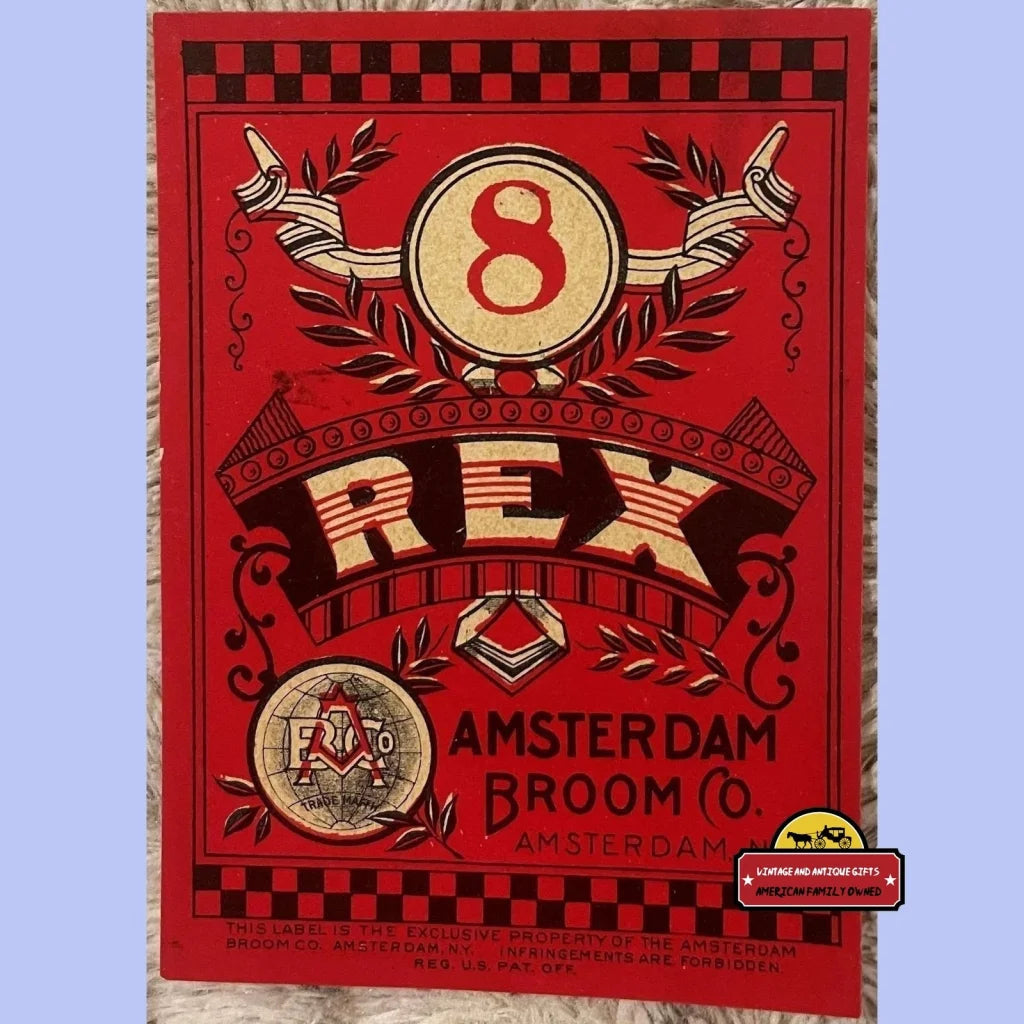
There is a particular stillness that settles over you when you hold a piece of printed ephemera that has survived a hundred years without ever fulfilling its intended purpose. No broom handle. No warehouse shelf. No farmhouse closet. Just a small, immaculate rectangle of chromolithographed paper that outlasted the industry it was made for, the building it was printed in, and very nearly the memory of the company whose name it carries in bold, triumphant type. This Rex #8 broom label from the Amsterdam Broom Company is one of those objects — quiet on the surface, electric when you start to understand what it represents. It is New Old Stock in the truest sense: made, stored, and never used. The colors are as saturated today as the day they came off the press sometime in the early 1900s. The red practically vibrates. The type casts its three-dimensional shadow as if the ink dried an hour ago. And if you look closely at the laurel sprays flanking that bold numeral 8, you begin to understand that whoever designed this label was not simply labeling a broom. They were making a visual argument — confident, almost regal — that this was a product worth seeking out by name.

That argument still lands. More than a century later, it still lands.


🧹 What This Is — The Object, Exactly

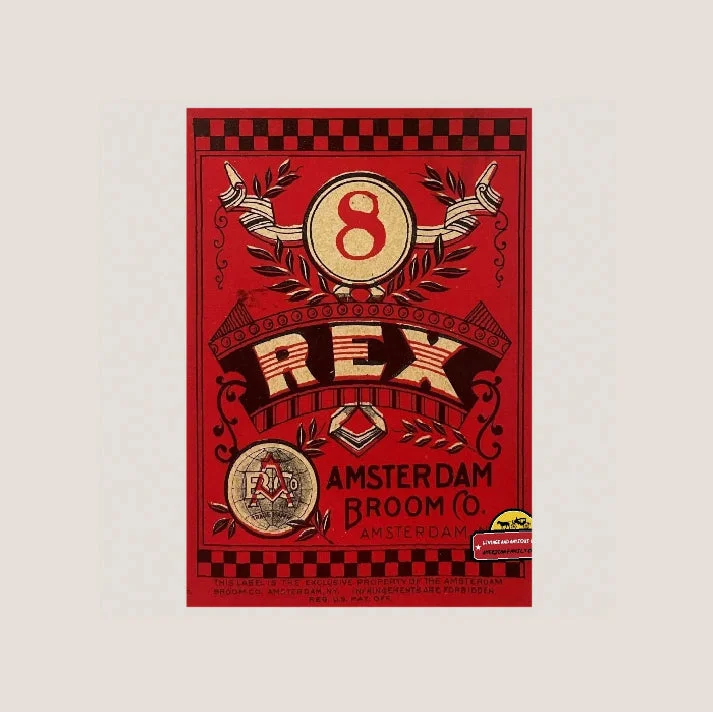
This is an original, unused New Old Stock chromolithographed paper broom label produced by the Amsterdam Broom Company of Amsterdam, New York, almost certainly between 1900 and 1920, during the peak commercial era of American printed trade ephemera. The label measures 4.5 by 3.5 inches — a compact rectangle that is deceptively busy with visual information. At the crown of the composition, a bold numeral 8 sits inside a circular medallion, flanked on either side by arching laurel sprays rendered in the classical victory-wreath tradition of nineteenth-century commercial graphic design. Below the medallion, the word REX — Latin for king — runs across a dramatic ribbon banner in black and cream letterforms, each character built with shadowing that gives the type a convincing three-dimensional presence. The background is a deep, saturated crimson red. A checkerboard border frames the top and bottom edges. Fine print along the base declares the label the exclusive property of the Amsterdam Broom Co. of Amsterdam, New York.

The printing process is chromolithography, the gold standard of commercial color printing before offset lithography displaced it through the middle decades of the twentieth century. Chromolithography required a separate stone or plate for each individual color in the composition, and a skilled pressman who understood precisely how ink layers needed to stack and register to produce the depth, warmth, and vibrancy you see here. That red is not a formula you dial up in a design program. It was mixed, tested, applied, and perfected by craftsmen whose names were never printed on anything they made. The result is a quality of color — saturated, luminous, alive — that remains distinctive to the era and the process. This label has never been applied to a broom handle, never been dampened by glue or steam, and never been exposed to the handling that would have worn away exactly the details that make it beautiful. It is pristine. It is complete. It is, in the most literal sense, as fresh as the day it was made.


🏭 The Amsterdam Broom Company — An Industry in a Single Address

The Amsterdam Broom Company was not a small operation run out of someone's barn. It was a documented commercial enterprise with roots stretching back to 1884, anchored in a three-story building on Brookside Avenue in Amsterdam, New York, and built into a recognized name in the American household goods trade under the leadership of Julius Wasserman. To understand what that means, you have to understand what the American broom industry actually was at the turn of the twentieth century — not a craft, not a cottage trade, but a mechanized, branded, fiercely competitive manufacturing sector that moved millions of units annually, competed on quality and brand recognition, and employed lithographers, designers, salesmen, and factory workers across dozens of states.

The broom itself — specifically the flat broom made from Sorghum vulgare technicum, or broom corn — was one of the most standardized household tools in American life at the turn of the century. Every home had one. Every hotel had a dozen. Every dry goods store carried them in numbered grades, with grade numbers like the #8 on this label indicating a specific quality tier, bristle density, or manufacturing specification within the manufacturer's own system. Companies competed not merely on the broom itself but on the brand attached to it, which meant labels like this one were as important to the commercial strategy as the broom corn was to the product itself. REX — the king — was not an accidental name. It was chosen to signal a premium position within the Amsterdam Broom Company's product line, and the visual vocabulary of the label — the medallion, the laurel, the ribbon banner, the dramatic red field — was assembled specifically to deliver that message at a glance across a hardware store counter or a general merchandise display.

The Amsterdam Broom Company appears to have understood something that many of its contemporaries did not articulate as clearly: that a label on a broom was an advertisement before it was an identifier, and an advertisement long after the broom itself had been worn down to the ferrule and discarded. The fine print at the base of this label — declaring it the exclusive property of the company — reflects a legal and commercial awareness that was sophisticated for its era, protecting the brand identity of the Rex line against imitation or unauthorized reproduction.


📍 Amsterdam, New York — The Town Behind the Label

Amsterdam, New York sits in Montgomery County along the south bank of the Mohawk River, roughly thirty miles west of Schenectady and forty miles northwest of Albany. By the latter half of the nineteenth century, it had become one of the most industrially productive small cities in the northeastern United States, with a manufacturing economy built on carpets, knit goods, and — yes — brooms. The Mohawk Valley corridor was ideally positioned for this kind of industrial development: accessible by rail, close enough to New York City's commercial markets to move product efficiently, and endowed with a workforce that was skilled, concentrated, and growing through successive waves of immigration.

The Amsterdam Broom Company's location on Brookside Avenue placed it within a dense network of local manufacturers and suppliers who fed and were fed by the same regional economy. Julius Wasserman built the operation into a three-story facility at a time when that scale of physical plant represented serious capital investment and serious market confidence. Local historians of Montgomery County have noted that Amsterdam's broom industry was distinct enough from its better-known carpet trade to have its own commercial identity — its own buyers, its own freight accounts, its own label designers. The broom companies were not subsidiaries of the carpet mills; they were parallel enterprises serving a different sector of the household goods market.

Local legend has it that the Amsterdam Broom Company's labels — including the Rex line — were designed and printed not in Amsterdam itself but through lithography houses operating in New York City or Albany, with finished labels shipped north by rail to Brookside Avenue in bulk quantities sufficient to last through a full production season. Lore passed down among regional collectors holds that the Amsterdam Broom Company maintained a dedicated storeroom for unused labels and packaging materials, which accounts for the survival of New Old Stock examples like this one in such extraordinary condition — never used, never dampened, never exposed to the handling and humidity of active factory production. Whether or not that specific storeroom has ever been identified or documented, the condition of surviving NOS examples is consistent with careful, climate-adjacent storage over a very long period.

Amsterdam itself underwent significant economic change through the mid-twentieth century, as the manufacturing base that had made it prosperous contracted alongside the broader deindustrialization of the Mohawk Valley. Many of the physical plants — the carpet mills, the knit goods operations, the broom factories — were demolished, repurposed, or simply left to time. What survived, in part, were the objects those factories made and the paper ephemera attached to them. A broom label stored in a back room or an old stock room could outlast the building that housed it, could outlast the company whose name it carried, could outlast everyone who ever worked in the factory where it was made. This one did.


🖨️ The Chromolithography Behind the Color — Why It Still Looks This Good

It is worth dwelling on the printing process that produced this label, because the process is inseparable from the object's visual power and its collectibility. Chromolithography — color lithography using multiple stones or plates, each carrying one color of the final image — was the dominant commercial color printing technology in America from roughly the 1860s through the early decades of the twentieth century. At its peak, it employed thousands of skilled craftsmen in printing houses concentrated in New York, Chicago, Cincinnati, and other major commercial centers, producing everything from trade cards and cigar box labels to seed packet covers and, yes, broom labels.

What made chromolithography distinctive — and what makes surviving examples so visually compelling a century later — was the quality of the pigments and the depth achievable by layering colors in precise registration. The deep red ground on this Rex #8 label is characteristic of the era's chromolithographic palette: rich, warm, and slightly glossy in a way that modern offset or digital printing rarely replicates with the same physical presence. The shadowing on the REX letterforms, the modeling on the laurel sprays, the crisp geometry of the checkerboard border — each of these required its own pass through the press, its own stone or plate, its own careful alignment. The result is not merely colorful. It is textured with the evidence of craft, of intention, of hands that understood both the technology and the visual vocabulary of American commercial design at its most confident moment.

NOS chromolithographic labels of this quality are increasingly rare precisely because they were made to be used, and the vast majority of them were. Labels that survived the entire commercial lifecycle — manufacture, storage, and then the long passage of uncollected time — without ever being applied are the exception. This one is, by any measure, an exceptional survivor.


🖼️ Display Ideas

  • 🪞 Float-frame it behind glass — a simple black or gilt float frame at 5x7 gives the label breathing room and showcases the chromolithographic color against the white mat. It is ready to hang the moment it arrives, as any flat surface in your space becomes a small gallery.
  • 🍳 Kitchen or mudroom gallery wall — antique trade and household-goods labels have a natural home in working rooms where domestic life actually happens. Grouped with other vintage household ephemera — seed labels, soap wrappers, trade cards — a Rex broom label anchors the composition with its bold red and graphic authority.
  • 📚 Framed on a library or study shelf — displayed leaning against books or set in a small easel frame on a wooden shelf, it reads as exactly what it is: a piece of printed Americana with a story behind it, for anyone curious enough to ask.
  • 🏡 Farmhouse or cottage sideboard styling — the saturated red and the vintage graphic character of this label make it a natural accent piece in a room built around reclaimed wood, ironstone, or early American decorative elements. It holds its own against larger objects without competing with them.
  • 🗂️ Archival sleeve in a flat ephemera collection — for the collector who prefers to preserve rather than display, this label lives comfortably in an archival polyester sleeve within a flat storage box alongside other NOS trade labels, chromolithographic trade cards, or New York State commercial ephemera.
  • 🎨 Graphic design or commercial art reference collection — design historians and students of American graphic history prize exactly these objects: undamaged, original, printed with the full technical ambition of the chromolithographic era. Frame it. Study it. It is a primary source.

🎁 Who Collects These

Antique broom labels — and chromolithographic trade and product labels generally — occupy a fascinating intersection of collector communities, and the Rex #8 from Amsterdam Broom Company draws from several of them simultaneously. There are the American advertising ephemera collectors, for whom the label is a textbook example of turn-of-the-century commercial graphic design at the household-goods scale: bold, confident, typographically sophisticated, and printed with a process that commands respect. There are the New York State and Mohawk Valley regional collectors, for whom Amsterdam, New York carries specific geographic and historical weight — a town with a documented industrial past and a diminishing physical record of it, which makes surviving paper ephemera bearing the Amsterdam name genuinely significant. There are kitchen antiques and domestic Americana collectors who build environments around objects that tell the story of American household life before the age of plastic packaging, and for whom a broom label printed in the era of the coal-fired kitchen stove is exactly the right note of period authenticity.

Chromolithography collectors and printing history enthusiasts seek NOS labels specifically because the condition reveals what the process was actually capable of — without the degradation that comes from adhesive, handling, or age-related exposure. A pristine NOS label is, in a very direct sense, a proof print of the commercial printer's art. And then there are the framing and interior styling collectors — people who found, at some point, that antique graphic ephemera in a simple frame does more for a room than most things sold expressly for that purpose, and who return to these objects again and again for their color, their graphic power, and their inexhaustible capacity to generate conversation. This label, with its vibrant red, its regal Latin proclamation, and its complete, undamaged condition, is built for that role.


❓ Frequently Asked Questions

Is this label genuinely from the early 1900s, or is it a reproduction?

This is an original antique chromolithographic label produced by or for the Amsterdam Broom Company of Amsterdam, New York during the early twentieth century. The printing process — chromolithography using multiple color stones or plates — was the commercial standard of the era and produces a visual and tactile character that is identifiable to anyone familiar with period printing. The paper stock, the ink depth, the registration of the color layers, and the graphic vocabulary of the design are all consistent with trade label production from the 1900–1920 period. It is New Old Stock, meaning it was manufactured, stored, and never applied to a product — but it is emphatically original, not a reproduction or facsimile.

What does "New Old Stock" mean for a label like this?

New Old Stock — NOS — refers to merchandise that was manufactured for commercial use, stored, and never actually put into service. In the context of this broom label, it means the label was printed, packaged or stored in bulk with others of its kind, and never applied to a broom handle with adhesive. It has not been soaked, creased by application, or subjected to the moisture and handling involved in active factory use. The result is a label in the same condition — or very nearly so — as it was on the day it was printed. For collectors of antique paper ephemera, NOS status is significant because it means the color, the paper surface, and the structural integrity of the label are as close to their original state as a century of storage will allow.

How vibrant are the colors, really? Will they look good framed?

The colors on this label are, in a word, striking. The deep red background that dominates the composition is characteristic of high-quality chromolithographic printing from this era — a warm, saturated crimson that photographs well but is even more present in person. The black and cream letterforms on the REX ribbon banner retain their contrast and their shadow modeling cleanly. The laurel sprays and the circular medallion are crisply rendered. Framed behind glass with even a modest mat, this label commands the kind of attention that most decorative prints — however large — do not. The graphic confidence of the design and the physical quality of the chromolithographic printing are the two things that make antique trade labels like this so compelling in a frame, and both are fully present here.

What size frame do I need?

The label itself measures 4.5 by 3.5 inches. A standard 5x7 frame with a mat cut to approximately 3.5 x 4.5 inches will display it beautifully, with the mat providing visual breathing room around the chromolithographic design. A float-frame presentation — where the label is mounted on a backing without an overlapping mat, so the edges of the label remain visible — is also an excellent option and particularly well suited to showing the complete checkerboard border that runs along the top and bottom edges. Many collectors and framers use an archival-quality foam mount or corner pockets rather than adhesive to preserve the label's condition and value during display.

Is this appropriate for archival storage rather than display?

Absolutely. Collectors who prefer to preserve paper ephemera in archival conditions rather than display it framed have excellent options here. An acid-free polyester sleeve — sometimes called a Mylar or archival sleeve — sized for a 5x7 or 4x6 format will house this label safely. Flat storage in an acid-free box, away from direct light and humidity fluctuation, is the standard archival approach for chromolithographic paper ephemera of this era. The NOS condition of this label means it enters your collection in excellent shape; proper archival storage will maintain that condition indefinitely.

What do I actually know about the Amsterdam Broom Company — is there documented history?

The Amsterdam Broom Company of Amsterdam, New York has a documented commercial history stretching back to 1884. The company was built by Julius Wasserman into a recognized name in the American household goods trade, operating from a three-story facility on Brookside Avenue in Amsterdam, a city in Montgomery County along the Mohawk River that was, at the turn of the twentieth century, one of the more industrially productive small cities in the northeastern United States. The Rex line — of which this #8 label is one grade — was a branded product line within the company's household goods portfolio. The fine print at the base of this label, asserting it as the exclusive property of the Amsterdam Broom Co., reflects the company's commercial sophistication and its awareness of brand protection during an era when label design and product branding were serious competitive considerations in the American household goods trade.

Can I give this as a gift to someone who collects New York State history or Americana?

This is an exceptionally strong gift for exactly that recipient. The combination of New York State geographic specificity — Amsterdam, Montgomery County, the Mohawk Valley industrial corridor — with the visual drama of the chromolithographic design and the rarity of NOS condition makes it the kind of object that a collector of American or New York regional history will immediately recognize as significant. It is small enough to arrive beautifully presented, substantial enough to be genuinely meaningful, and specific enough that it does not feel like a generic antique purchase. For someone building a collection around Mohawk Valley industrial history, American advertising ephemera, or the domestic material culture of the early twentieth century, a pristine NOS Rex #8 broom label from the Amsterdam Broom Company is a find — not simply a gift.

Shipping

🚚 Shipping & Handling

  • Shipping costs and timing are calculated at checkout.
  • Items curated and shipped directly by me include U.S. shipping at no additional cost, professionally packed to ensure safe arrival of your artifact.

Items from Vetted Pro Collectors
Shipping for items offered by vetted Pro Collectors is determined at checkout. All Pro Collector listings are reviewed to ensure fair, reasonable shipping practices.

For full details, please refer to our Shipping Policy.

Returns & Exchange

Product Page Return Policy

  • 60-Day Returns – Items must be in original condition.
  • Refunds – Issued after inspection (excluding shipping costs).
  • Return Shipping – Customer is responsible unless item is damaged or incorrect.
  • Damaged/Incorrect Items – Contact us within 48 hours for a replacement or refund.
  • Easy Returns – Email [email protected] or call 802-356-9872 to initiate a return.

For full details, visit our Refund Policy.

View full details