Skip to product information
1 of 11

Vintage and Antique Gifts

Vintage 1990s Sun Distributors Stock Certificates Combo A and B Sunoco Industrial Distributor Scripophily 📜

Vintage 1990s Sun Distributors Stock Certificates Combo A and B Sunoco Industrial Distributor Scripophily 📜

Regular price 16.62 USD
Regular price Sale price 16.62 USD
Sale Sold out
Shipping calculated at checkout.
Quantity

Size: 12" x 8" ~ Used and cancelled, each with a hole-punch cancellation and a transfer-agent stamp. They vary a little one to the next.

📜 A Matched Pair: One Company, Two Certificates

This listing is a set — a Class A depositary receipt and a Class B depositary receipt, both issued by Sun Distributors L.P., both engraved and printed by the American Bank Note Company, both built around the same central vignette. The Class A certificate has a blue guilloché border — that tight, repeating lathe-work pattern security printers leaned on for generations because it was nearly impossible to hand-copy. The Class B certificate carries the same pattern in green. Side by side they read as a set, which is exactly what they were: two classes of the same partnership, sold to two different kinds of investor.

Both certificates carry the same engraved scene across the top: a woman in flowing drapery seated on a plinth, one hand resting on a globe, open hills and farmland behind her on one side, a modern skyline, a freeway, and a domed arena on the other. It's the kind of allegorical "old industry meets new commerce" image security engravers leaned on again and again in this era — and a handsome piece of period engraving it is. A bold stylized "S" sits off to the side of the text block, and each certificate carries its own printed CUSIP number and a "See reverse for certain definitions" note pointing to the fine print on the back.


💰 Why Two Colors, Two Ticker Symbols

The two classes weren't just a design choice — they were two different deals. Class A interests came with a priority: holders were entitled to $1.10 a year per interest before Class B saw a dime, a guaranteed first claim on the partnership's distributions. Class B interests got the residual — whatever was left after Class A took its cut, which could run higher or lower depending on how the business did that year. That's the actual mechanical reason for the two colors and the two certificates: Class A is the steadier, income-first half, and Class B is the half with more upside — and more risk — riding on it.

Wall Street kept the two apart right down to the ticker tape. Sun Distributors Class A interests traded on the New York Stock Exchange as SDP, and Class B traded alongside it as SDPB. Hold the pair and you're holding both sides of that structure at once — the guaranteed slice and the residual slice, in one set.


🏭 From a Sunoco Sideline to Its Own Wall Street Partnership

Here's the part of the story most people miss when they see "Sunoco" attached to anything: Sun Distributors was never in the oil business. Sun Company, Inc. — the parent of the Sunoco brand — started building it in 1975 as a hedge against how wildly crude prices swing year to year. The idea was to grow something steadier alongside the refining business, so Sun Company started buying up industrial distributorships: the unglamorous middlemen who keep factories and repair shops stocked with fluid-power fittings, glass products, and maintenance supplies. Over the next decade it picked up firm after firm — Walter Norris for hydraulic and pneumatic controls, Kar Products in 1977, Unibraze, Atlas Screw, J.N. Fauver, and in the early '80s Special-T-Metals and the Keathley-Patterson Electric Company. By the mid-1980s Sun Distributors was pushing well over 100,000 different products through customers across the U.S., Canada, and Mexico — a genuinely large operation most people had never heard of, tucked inside a much more famous parent.

In August 1986, Sun Company decided to shed its non-energy businesses and put Sun Distributors up for sale. That October, Shearson Lehman Brothers teamed up with a group of the unit's own executives and bought the whole operation for $199 million in a leveraged buyout. Then, in January 1987, instead of staying a conventional corporation, the newly independent company reorganized as a master limited partnership — units went out to the public at $10 apiece the following month. That restructuring is exactly why this certificate reads "Depositary Receipt for Limited Partnership Interests" instead of "shares of stock": what you're holding is paper evidence of a partnership interest, held through a depositary, not equity in a corporation. The partnership's general partner was Lehman/SDI, Inc. (formerly Shearson/SDI) — the entity the original buyout group used to keep a controlling hand on things even after the units went public.

The company ran out of One Logan Square in Philadelphia, and it ran remarkably lean for its size — a central office of just thirteen people covering a company with thousands of employees: a chairman, four vice-presidents, four accountants, and four secretaries. Chairman Donald Marshall explained the whole business model to Forbes in one line I like a lot: big manufacturers "can't make a pump and a motor with 20 valves out of 1,000 coming out sideways," and they couldn't afford to send a salesman chasing down every small machine shop that needed one part. That's the gap Sun Distributors filled. By the time it filed its 1995 annual report, the partnership was organized into three segments — Industrial Services, Retail Merchandising, and Retail Glass Services — with close to 3,600 employees company-wide. John McDonnell came on as president in November 1994 to run the next stretch of growth.


🖋️ American Bank Note Company: The Engravers Behind the Paper

The imprint at the lower left of both certificates — American Bank Note Company — belongs to one of the oldest security-printing names in the country. The lineage runs back to 1795, to a New York firm called Murray, Draper, Fairman & Company, founded by Robert Scot, who was also the very first official engraver of the United States Mint. Through a long run of mergers, that firm eventually became the American Bank Note Company itself in 1858, and it kept growing from there — absorbing the National Bank Note Company and the Continental Bank Note Company (which held the U.S. Post Office's stamp-printing contract) by 1879. Its 1908 headquarters and printing plant in New York are both designated New York City Landmarks today. The company hit Chapter 11 in 1999 and came back out in 2002.


🔄 SunSource, Then Hillman: Where the Trail Leads

Sun Distributors L.P. didn't stay a partnership forever. On September 30, 1997, it converted into a corporation called SunSource Inc. Every Class A interest became 0.38 of an 11.6%, $25 Trust Preferred Security plus $1.30 in cash; every Class B interest became 0.25 of a share of SunSource common stock. That's the end of the road for the depositary receipts themselves — after that date, this exact paper instrument stopped being issued.

SunSource kept going for a few more years. Allied Capital bought the company in September 2001 for roughly $10.38 a share, and in March 2002 it was renamed The Hillman Companies — the hardware and key-cutting business you'll still find in hardware stores today is the direct descendant of the industrial distributor that started as a Sun Company sideline back in 1975.


✍️ The Back of the Sheet — Transfer Agents and a Cancelled Life

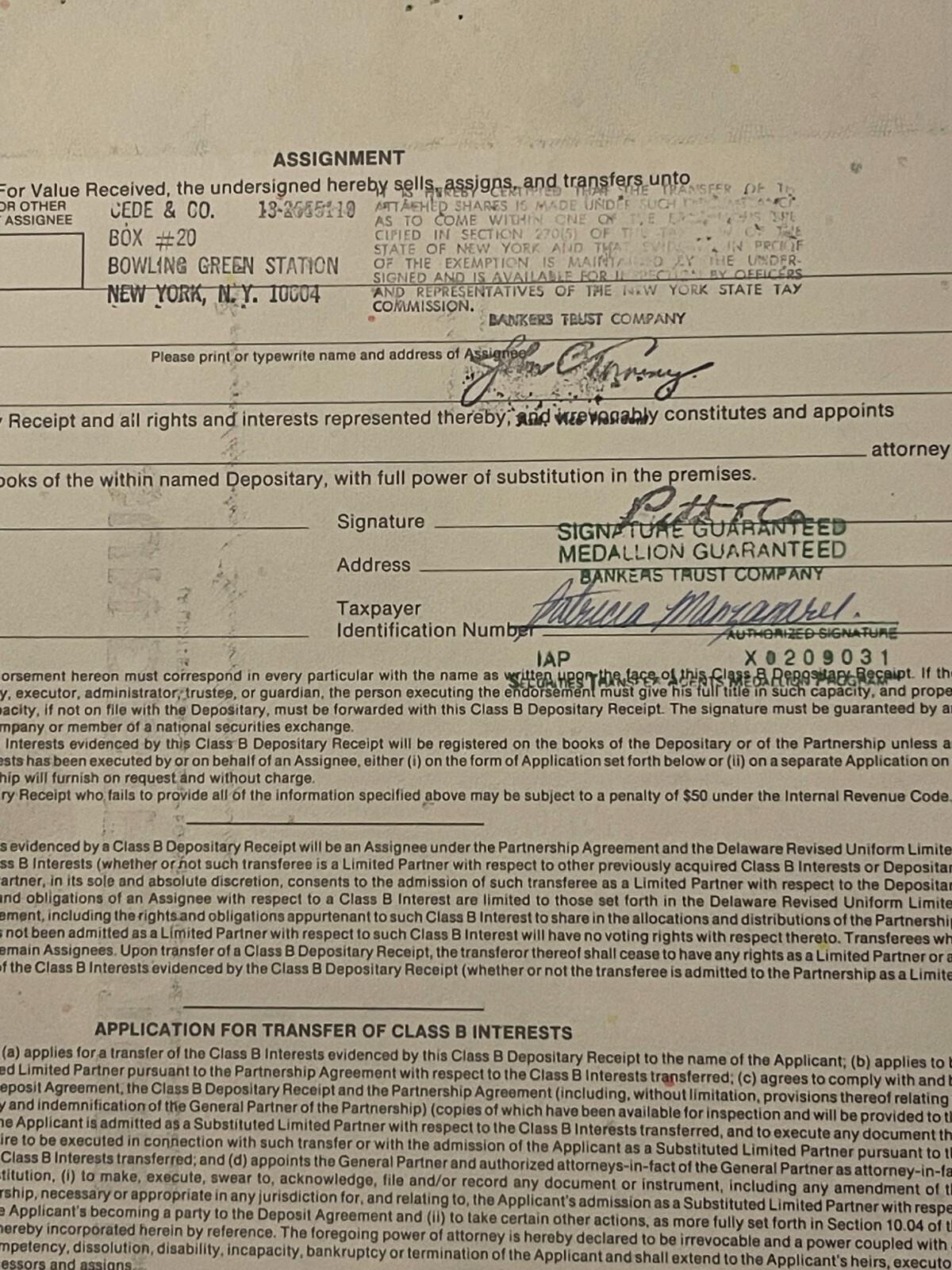
Flip either certificate over and you get the "Assignment / Application for Transfer" boilerplate — blank lines for a new owner's name, address, and taxpayer ID, and a stamped "Signature Guaranteed" block from Bankers Trust Co. over a handwritten signature. A hole-punch cancellation runs through the sheet. That's not damage; it's how a transfer agent formally retired a certificate once it was surrendered — these certificates finished their working life as financial instruments and got pulled from circulation the ordinary way, not something that fell apart in a drawer.

You'll also notice the certificates in this run don't all name the same transfer agent. Some read "Transferable in New York, N.Y. and Cleveland, Ohio," countersigned by The Shareholder Services Group, Inc., a division of American Express Information Services Co. of Boston. Others read "Transferable in New York, N.Y. and Cranford, New Jersey," countersigned by the Registrar and Transfer Company — a Cranford, New Jersey firm that had been in the transfer-agent business since 1899 and was eventually bought by Computershare in 2014. Between the two forms, the ones here are dated 1990 to 1992, which fits a partnership whose whole public life ran from that January 1987 reorganization to the 1997 SunSource conversion — these were issued and cancelled well within that window.

The Class A receipt is the hard one to find, and the matched pair even more so; the Class B turns up on its own now and then. If you want both halves of this particular Wall Street story in one place, this combo is the way to get there.

Shipping

🚚 Shipping & Handling

  • Shipping costs and timing are calculated at checkout.
  • Items curated and shipped directly by me include U.S. shipping at no additional cost, professionally packed to ensure safe arrival of your artifact.

Items from Vetted Pro Collectors
Shipping for items offered by vetted Pro Collectors is determined at checkout. All Pro Collector listings are reviewed to ensure fair, reasonable shipping practices.

For full details, please refer to our Shipping Policy.

Returns & Exchange

Take your time — you've got a full six months. If a piece isn't right for you, send it back the way it reached you and we're good.

In the first 30 days your money goes straight back the way you paid. After that it's store credit, so you can put it toward something you'd rather have.

Return shipping we sort out between us, case by case. I don't make this difficult.

If something arrives damaged, or it isn't what I said it was, send me a photo within 48 hours and I'll make it right.

Email info@vintageantiquesgifts.com or call 802-356-9872 — that's me answering, not a call center.

The only things I can't take back are custom or special-order pieces and gift cards.

View full details