Skip to product information
1 of 5

Rugistan

Afghan Kazak Hand-Knotted Runner Wool Pile Cotton Foundation Green Geometric

Afghan Kazak Hand-Knotted Runner Wool Pile Cotton Foundation Green Geometric

Regular price 450.00 USD
Regular price 699.00 USD Sale price 450.00 USD
Sale Sold out
Shipping calculated at checkout.
Size

Description

⚔️ The Bold Language of the Kazak Tradition: An Afghan Hand-Knotted Wool Runner

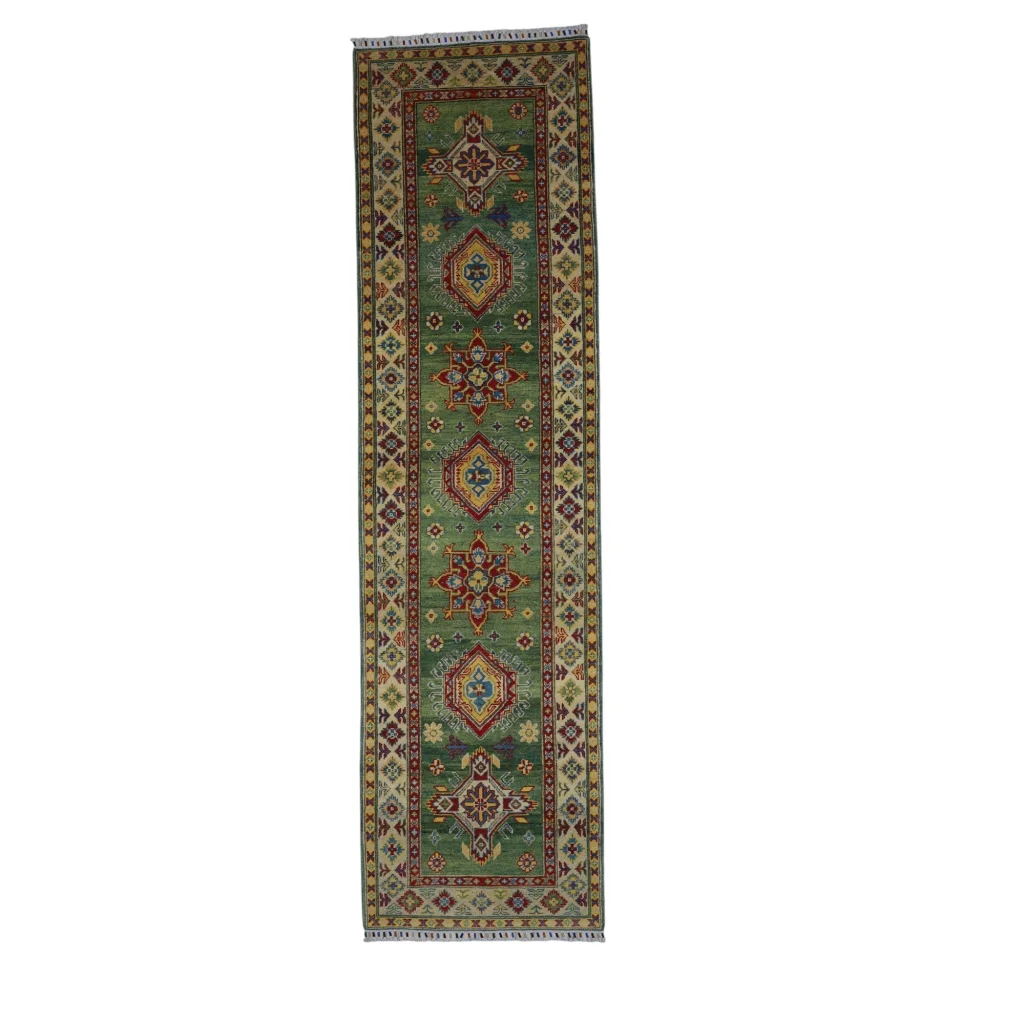
Few rug traditions announce themselves with the immediate visual authority of the Kazak design vocabulary. 🔥 Bold geometric medallions, assertive colors, tribal symbols that have traveled across centuries and continents — these are the elements that make Kazak-design rugs among the most recognizable and most sought-after in the collector and decorating world. This Afghan hand-knotted runner — wool pile on cotton foundation, 2 ft 7 in by 9 ft 8 in, in saturated green with geometric tribal patterns in red, gold, and cream — is the Kazak tradition in full voice. Rug ID KAZ-20.

🌍 The Kazak Tradition: From Caucasus to Afghanistan

The Kazak rug style originated in the Caucasus region — the mountainous territory between the Black Sea and the Caspian Sea that produced some of the boldest and most graphically powerful rugs in the world. 🏔️ The original Kazak weavers, working in what is now the Karabakh region of Azerbaijan and Georgia in the 18th and 19th centuries, developed a design language built on maximum contrast: dark grounds energized with large-scale geometric forms in saturated complementary colors, borders structured like architectural frames, pattern elements drawn from an ancient vocabulary of protective symbols and clan identifiers.

When Afghan weavers adopted the Kazak design vocabulary — a process that accelerated significantly in the latter half of the 20th century as craftspeople rebuilt weaving traditions within new geographic contexts — they brought their own material strengths to the design. 🐑 Afghan wool, from the hardy sheep of the high Afghan plateau and mountain regions, has a density and resilience that amplifies the boldness of Kazak patterning: the colors are already strong, and Afghan wool takes dye in a way that gives them additional presence and saturation.

The Afghan Kazak has become one of the most collected contemporary rug categories in the world, prized by decorators and collectors who want the visual impact of classic Kazak design backed by the material quality of Afghan wool production. 🎖️ This runner, hand-knotted with wool pile on a cotton foundation that provides dimensional stability without adding excessive weight, is a mature example of that tradition.

🎨 Color and Pattern: Reading the Design

The green ground of this runner places it within a specific and valuable subset of the Kazak palette. 🌿 While red-ground Kazak runners are the most common in the market — red being the default ground for much of the classic Kazak tradition — green-ground examples are less frequently produced and more visually distinctive. The depth of the green — a rich, warm tone with the kind of saturation that distinguishes quality Afghan dye production — creates a ground that reads as bold without becoming aggressive.

Against that green ground, the geometric tribal patterns move in red, gold, and cream. 🔶 The Kazak vocabulary includes elements drawn from the full history of Caucasian tribal design: hooked medallions, latch-hook borders, geometric stars, abstracted floral forms, and the compositional energy that comes from placing strong pattern elements in maximum contrast with an equally strong ground color. These patterns are not decorative choices made for export market appeal — they are design language inherited from generations of tribal weavers who embedded meaning and community identity into every compositional decision.

The natural fringe at both ends — emerging from the warp structure of the foundation — is the traditional finish for Kazak runners. 🧵 The fringe ages and mellows in a way that anchors the runner aesthetically to its material origins, framing the geometric field with a horizontal rhythm that completes the composition.

🧶 Construction: Wool Pile on Cotton Foundation

Every knot in this runner was tied by hand — a process that requires the weaver to set each individual pile knot against the foundation warp threads, row by row, before beating the weft in to hold the structure firm. ✋ For a piece measuring 2 ft 7 in by 9 ft 8 in, that represents a substantial investment of skilled labor — weeks of work at a loom, working through the design pattern from memory or from a simple cartoon guide, maintaining the geometric precision that gives Kazak-style work its characteristic sharpness of line.

The wool pile is the primary material of the surface — chosen for its resistance to compression under foot traffic, its ability to recover its loft after compression, and its natural lanolin content that provides inherent resistance to liquid absorption. 💧 Hand-knotted wool pile at this thickness (approximately 0.45 in) provides genuine cushioning underfoot, acoustic dampening in hard-floored hallways and entries, and the kind of visual depth that flat-woven alternatives cannot match.

The cotton foundation provides structural stability — cotton's low elasticity means the runner will hold its shape across years of use, lying flat without the tendency to creep or curl that all-wool foundations can develop in long narrow formats. 🏗️ Wool pile plus cotton foundation is the quality standard for Afghan Kazak production, and it has proven itself across decades of commercial and residential deployment.

📐 The Runner Format: Where This Piece Belongs

At 2 ft 7 in by 9 ft 8 in, this runner is sized for the classic long narrow space. 🏠 The hallway or entry is the obvious deployment — a runner at this scale fills a standard hallway generously, anchoring the passage, protecting the floor, and making a design statement at the very first step inside. Against wood or tile, the green ground contrasts clearly with the floor color and the geometric patterns read all the way to the end of the corridor.

In a kitchen running parallel to an island or counter, this runner protects the floor underfoot while providing a visual anchor for the room's longer axis. 🍳 The wool pile provides cushioning for long stretches of standing work, while the bold Kazak patterning adds genuine character that coordinates with both traditional and contemporary kitchen aesthetics — the greens and reds reading as warm and inviting against both light and dark cabinetry.

At the foot of a staircase — a classic placement for long runners — the green and geometric patterning creates visual flow that guides the eye upward. 🪜 Against neutral stair carpet or bare wood risers, the bold runner becomes a graphic element that defines the vertical transition between floors and makes the staircase itself a design feature rather than merely a structural necessity.

A dining room with a long rectangular farmhouse table can use a runner placed alongside the table — flanking the seating area on the long side, defining the dining zone without requiring a full room rug. 🍽️ The runner in this configuration creates spatial definition that works particularly well in open-plan spaces where a full area rug would disrupt the flow between zones.

🧹 Care: Keeping a Wool Runner Right

Hand-knotted wool runners reward basic, consistent care. 🌀 Vacuum regularly without a beater bar — the pile is robust, but aggressive mechanical action is unnecessary and accelerates wear on the pile tips over time. For a runner in high-traffic placement, rotate it every six to twelve months to equalize wear across the length — the ends near doorways experience more compression than the middle if not periodically rotated.

Spills blot — never rub. 💧 The wool's natural lanolin content provides some inherent resistance to liquid absorption, and most spills lift cleanly if addressed promptly with a clean dry cloth. For stains that have dried, or for periodic deep cleaning, a professional rug wash by someone experienced with wool pile is the appropriate approach.

A quality non-slip rug pad underneath serves multiple functions: prevents movement on hard floors, extends the life of both runner and floor surface, and provides additional cushioning. 🛡️ For a long runner in a hallway, a pad is essentially mandatory for safety and for the long-term health of the rug.

⚔️ A Design Tradition That Has Earned Its Place

Kazak-design runners — whether in their classic Caucasian form or in the Afghan interpretation — occupy a durable place in both the collector market and the interior design world. 🌍 They work because their design vocabulary is genuinely strong: the geometry is not decorative window dressing but a carefully evolved visual system that has proven its appeal across cultures and across centuries.

This runner brings that visual system into a long-format piece that addresses a design challenge most rooms face: what to do with narrow, high-traffic spaces that need to be both practical and genuinely beautiful. 🎨 The answer, for generations of designers and collectors, has been the hand-knotted wool Kazak runner. This one — green ground, bold geometric patterning, quality wool construction, classic proportions — is that answer, executed well.

Rug ID: KAZ-20 🏷️

Shipping

🚚 Shipping & Handling

  • Shipping costs and timing are calculated at checkout.
  • Items curated and shipped directly by me include U.S. shipping at no additional cost, professionally packed to ensure safe arrival of your artifact.

Items from Vetted Pro Collectors
Shipping for items offered by vetted Pro Collectors is determined at checkout. All Pro Collector listings are reviewed to ensure fair, reasonable shipping practices.

For full details, please refer to our Shipping Policy.

Returns & Exchange

Product Page Return Policy

  • 60-Day Returns – Items must be in original condition.
  • Refunds – Issued after inspection (excluding shipping costs).
  • Return Shipping – Customer is responsible unless item is damaged or incorrect.
  • Damaged/Incorrect Items – Contact us within 48 hours for a replacement or refund.
  • Easy Returns – Email info@vintageantiquesgifts.com or call 802-356-9872 to initiate a return.

For full details, visit our Refund Policy.

View full details