Skip to product information
1 of 3

Vintage and Antique Gifts

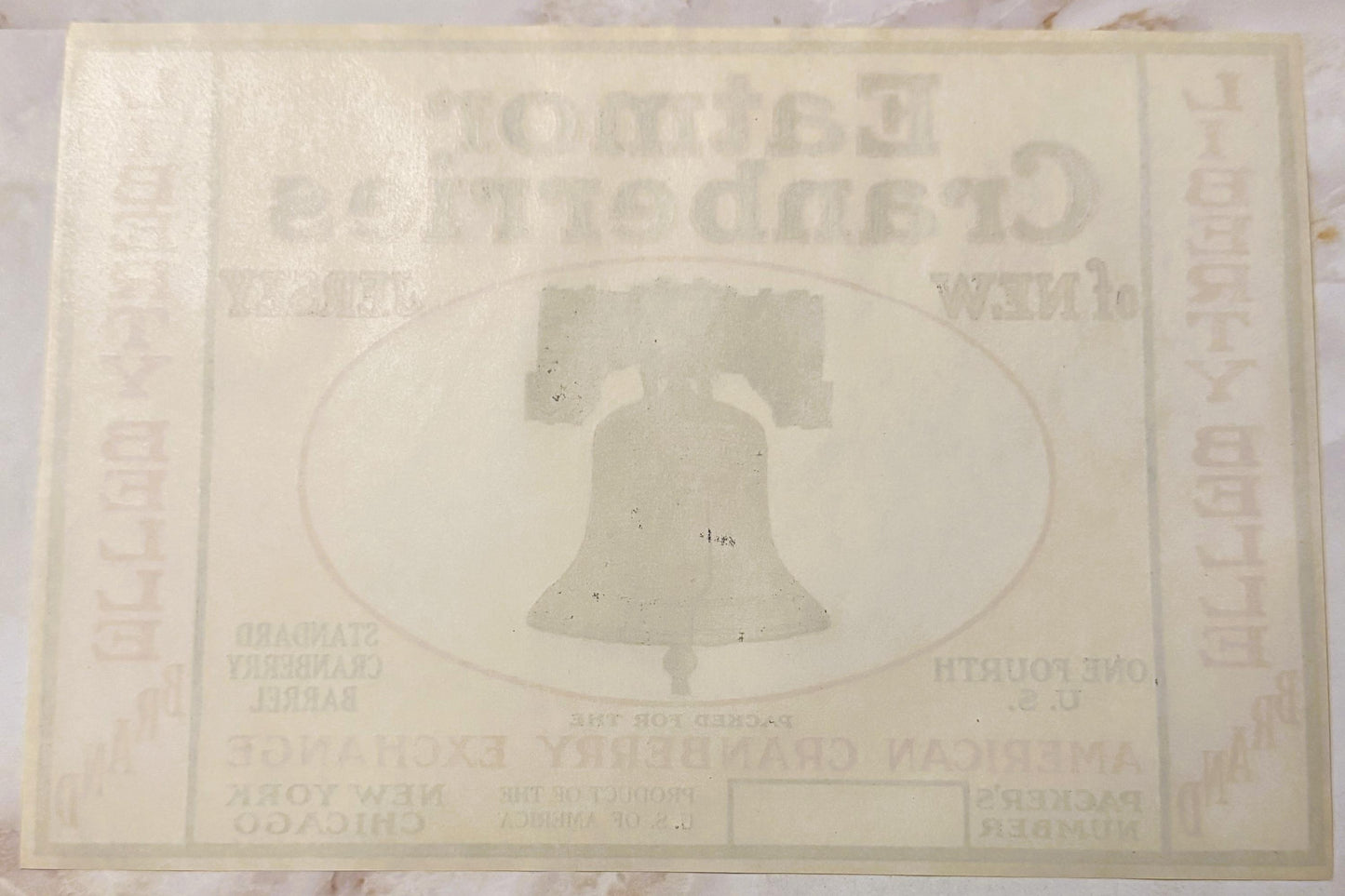
Antique Liberty Bell Eatmor Cranberries Barrel Label 🔔

Antique Liberty Bell Eatmor Cranberries Barrel Label 🔔

Regular price 13.00 USD
Regular price Sale price 13.00 USD
Sale Sold out
Shipping calculated at checkout.
Quantity

Size: 10 x 6.75 inches ~ little to no wear. They vary a little one to the next.

🔔 The Bell On The Label

Look closely at that bell before anything else, because it isn't a generic drawing — it's printed with the real bell's own casting line, "PASS AND STOW / PHILADA / MDCCLIII." That's the inscription cast into the actual Liberty Bell in 1753, by John Pass and John Stow, after the first casting — done in London by Lester and Pack in 1752 — cracked the first time it was rung. Nobody called it the "Liberty Bell" yet, either; that name came later, from abolitionists, in 1835.

What you're holding is a "One Fourth U.S. Standard Cranberry Barrel" box-end label, packed for the American Cranberry Exchange out of New York and Chicago, marked "Product of the U.S. of America." These never made it onto a box, and the colour is still as bright as the day they came off the press.

🍒 From Liberty Bell To Liberty Belle

The brand didn't start life as "Belle." Growers' Cranberry Company of New Jersey first ran LIBERTY BELL — the plain spelling — on its round barrel-head labels, then on half-barrel labels. It's only here, on the quarter-barrel picture label, that the name picks up its extra "e." Somewhere between the full barrel and the box, somebody decided the brand needed one.

The berries packed under this label were the Centennial variety, a crop Whitesbog grew in big stands, the same New Jersey bog where Elizabeth White had grown the first cultivated blueberry crop in 1916. And the first president of both Growers' Cranberry Co. and the American Cranberry Exchange was Joseph J. White of Whitesbog. Growers' itself dated back to 1895, ran a Philadelphia office, and was already shipping cranberries to Europe by 1896.

"Eatmor" on a label wasn't just a name — it was a grade. To carry it, New Jersey cranberries had to run at least 90 percent coloured, no more than 125 berries to the cup, and sound enough to survive fifteen days on the road. Some other New Jersey brands in the same collection are marked "Non Eatmor."

📦 A Quarter Of A Barrel, By Law

"Standard Cranberry Barrel" is printed here for a reason: cranberries got their own legal barrel. The Standard Barrel Act of 1915 — introduced by New Jersey congressman William E. Tuttle Jr. — took effect July 1, 1916, and it carved out a cranberry barrel separate from the ordinary dry-goods barrel, with its own stave length, head size, and capacity.

The quarter-barrel box came along later still. It wasn't introduced until 1926, didn't become the standard shipping box until 1931, and then stayed standard clear through the Second World War — about 9¾ by 10½ by 15 inches, holding roughly 25 pounds of berries. Since this label was made for that box, 1926 is the earliest year it can possibly be.

📈 The Exchange Behind The Label

Three regional growers' groups — from Wisconsin, New England, and New Jersey — had already banded together in 1907 as the National Fruit Exchange. In 1911 that structure was consolidated into the American Cranberry Exchange, with Growers' Cranberry Company of New Jersey as one of its three member companies, headquartered at 90 West Broadway in New York with a branch in Chicago — exactly as this label reads. Together they marketed cranberries out of Wisconsin, New Jersey, and Massachusetts under the Eatmor name, and in 1936 the Eatmor ads were running in Better Homes & Gardens and Good Housekeeping.

The Exchange's own 1936 advertising claimed results: nineteen years of Eatmor marketing, from 1917 to 1935, had lifted the average price of a barrel of cranberries from $6.08 to $9.95. This label was part of a busy, ongoing campaign, not packaging printed once and forgotten.

The Exchange didn't keep this name forever. It moved its headquarters from New York to New Bedford, Massachusetts around June 1951, renamed itself Eatmor Cranberries, Inc. in April 1953, and voted to dissolve in Chicago on June 10, 1957.

🏛️ Where This Brand Survives

A public collection in Wisconsin Rapids, Wisconsin holds this brand in every box size it came in, a real, documented run for New Jersey's Eatmor growers. Folks were saving these early, too: back in December 1946 a writer in the growers' magazine Cranberries noted that the old barrel labels were already being collected, some of them deposited in the Middleboro Public Library.

Shipping

🚚 Shipping & Handling

  • Shipping costs and timing are calculated at checkout.
  • Items curated and shipped directly by me include U.S. shipping at no additional cost, professionally packed to ensure safe arrival of your artifact.

Items from Vetted Pro Collectors
Shipping for items offered by vetted Pro Collectors is determined at checkout. All Pro Collector listings are reviewed to ensure fair, reasonable shipping practices.

For full details, please refer to our Shipping Policy.

Returns & Exchange

Take your time — you've got a full six months. If a piece isn't right for you, send it back the way it reached you and we're good.

In the first 30 days your money goes straight back the way you paid. After that it's store credit, so you can put it toward something you'd rather have.

Return shipping we sort out between us, case by case. I don't make this difficult.

If something arrives damaged, or it isn't what I said it was, send me a photo within 48 hours and I'll make it right.

Email info@vintageantiquesgifts.com or call 802-356-9872 — that's me answering, not a call center.

The only things I can't take back are custom or special-order pieces and gift cards.

View full details