Skip to product information
1 of 7

Vintage and Antique Gifts

Antique 1910s 1920s Titanic International Mercantile Marine Stock Certificate Blue White Star Line Parent Scripophily 📜

Antique 1910s 1920s Titanic International Mercantile Marine Stock Certificate Blue White Star Line Parent Scripophily 📜

Regular price 11.00 USD
Regular price Sale price 11.00 USD
Sale Sold out
Shipping calculated at checkout.
Style
Quantity

Size: 12 x 8 inches

What if a piece of paper could carry you back to the deck of the most famous ship that ever sailed? 🚢

There's a particular kind of quiet that settles over you when you hold a certificate like this one. It isn't just ink on paper — it's a signature of ownership in the very corporation that once owned the RMS Titanic. Long before anyone knew that ship's name would echo through history, financiers on Wall Street were buying and selling pieces of the company behind her, filing them away in ledgers, tucking them into safety deposit boxes, never imagining that a century later collectors would still be searching for exactly this kind of paper.

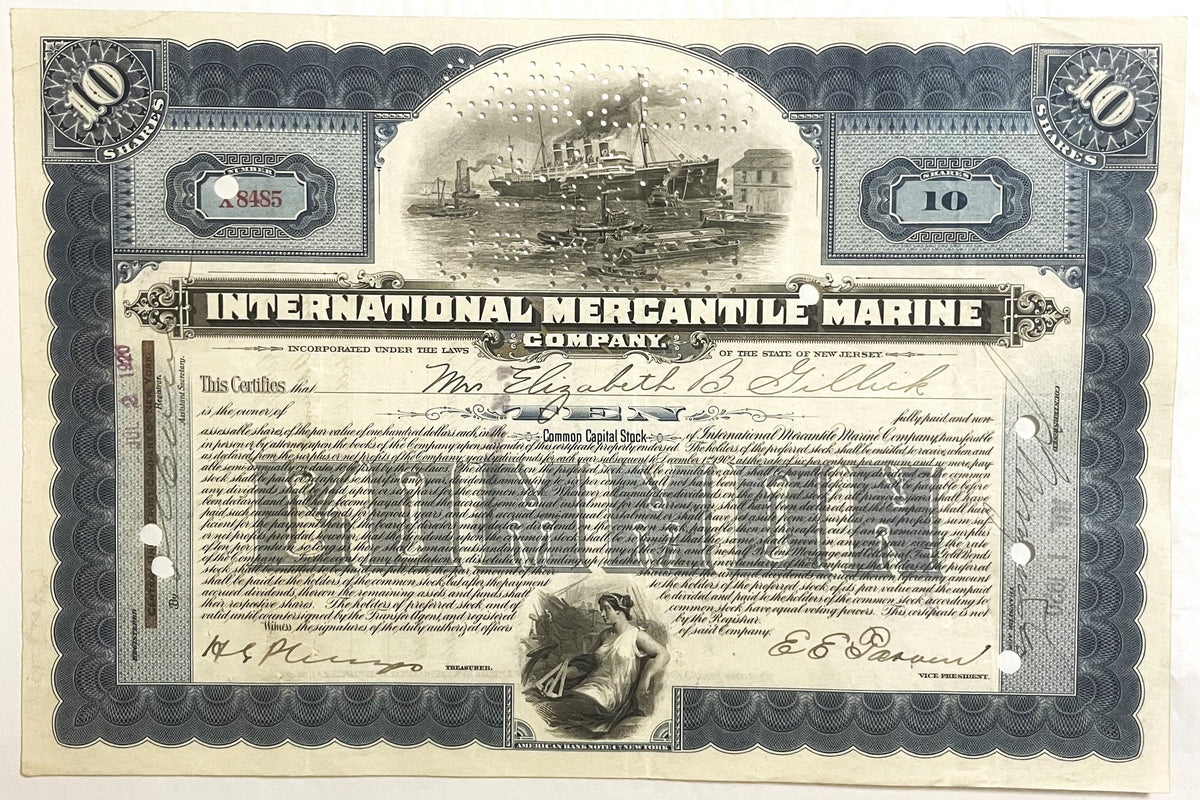
This is an original stock certificate for common capital stock of the International Mercantile Marine Company, the New Jersey-incorporated shipping trust that stood as parent company to the White Star Line — owner of the Titanic, the Olympic, and the Britannic. Engraved and printed by the American Bank Note Company of New York, the premier security printer of its age, the certificate carries the deep steel-engraved intaglio work that defined turn-of-the-century financial paper: a central harbor vignette showing a great four-funneled ocean liner flanked by working tugboats and a harborside building, rendered in rich blue and black tones against cream stock, framed by an ornate guilloche border of scalloped lathe-work patterns.

Below, a second engraved vignette depicts a reclining allegorical female figure holding what appears to be a nautical drafting or sighting instrument, a small sailing vessel worked into the scene behind her — the kind of classical, dignified imagery American Bank Note Co. was famous for weaving into its most important commissions.

The certificate's printed text identifies shares in the Common Capital Stock, par value one hundred dollars each, of the International Mercantile Marine Company, incorporated under the laws of the State of New Jersey, with Central Trust Company of New York serving as registrar and transfer agent. This is a design dating to the 1910s, the American Bank Note Company's steel-engraved intaglio style of that period being wholly consistent with what you see here.

Stock and bond paper from this era earns its markings rather than merely wearing them: things like endorsement signatures, transfer-agent stamps, revenue stamps, cancellation punches, staple holes, or pencil ledger notes. Those are marks of real use, not damage — the record of an instrument that actually moved through the financial system.


🚢 The Company That Owned the Titanic

The International Mercantile Marine Company was born of a financier's ambition almost too big to imagine — J. P. Morgan's attempt to bring the entire transatlantic passenger trade under one corporate roof. Working with shipping men Clement Griscom of the American Line and Red Star Line, Bernard Baker of the Atlantic Transport Line, J. Bruce Ismay of the White Star Line, and John Ellerman of the Leyland Line, Morgan's syndicate assembled a trust meant to challenge the rising dominance of German shipping companies on the North Atlantic. The crown jewel of the acquisition came in April 1902, when Morgan's team purchased the prestigious White Star Line after long negotiation. On October 1, 1902, JP Morgan & Co. formally announced the founding of the International Mercantile Marine Company, incorporated in New Jersey with capitalization exceeding fifty million dollars in bonds and preferred stock — an almost unthinkable sum for the era, and a signal of just how large Morgan intended this trust to become.

Ten years later, the trust's most celebrated ship would become the reason the entire company is remembered today. When the Titanic sank in April 1912, it inflicted a net financial loss on IMM of roughly two and a half million dollars after insurance settlements, on top of a quarter-million dollars in mandatory safety upgrades forced onto her sister ship, the Olympic. But the deeper wound was to reputation. The American commission of inquiry, led by Senator William Alden Smith, harshly criticized both IMM's principles and J.P. Morgan himself as the trust's architect. It's worth remembering, too, that it had already been arranged before the sinking for J. Bruce Ismay to step down as IMM's president — a piece of timing that has fueled speculation and conversation among maritime historians for well over a century. Ismay was succeeded by Harold Sanderson in 1913; Morgan himself died that same year, in March, never seeing his shipping trust fully recover from the tragedy that would forever define it in the public imagination.


🏛️ Wall Street, New Jersey Paper, and the American Bank Note Company

Every detail on this certificate points back to the financial machinery of early twentieth-century New York. The company itself was incorporated under New Jersey law — a common structural choice for the era's great industrial trusts — but its true center of gravity was Wall Street, where its shares traded and where Central Trust Company handled the registration and transfer of ownership on the company's behalf.

The engraving itself came from the American Bank Note Company, a firm whose roots reach back to 1795 under the name Murray, Draper, Fairman & Company, before its modern incorporation on April 29, 1858. American Bank Note Co. grew into the nation's foremost high-security printer, producing not only stock and bond certificates for the country's largest corporations but currency for the era's state-chartered banks and even United States postage stamps between 1879 and 1894. The company deliberately located its headquarters in New York City to stay close to the stock exchanges, brokerage houses, and banks of lower Manhattan — the very neighborhood where certificates like this one changed hands. Surviving IMM certificates from American Bank Note Co. are documented to carry this same paired-vignette design: the great harbor scene above, believed to echo the Olympic-class liners built for White Star Line — sister ships to the Titanic, each stretching 882½ feet in length — and the reclining allegorical figure below, a hallmark of the company's finest engraving work.


⚓ The Men Behind the Trust

Clement A. Griscom served as IMM's first president, the man who alongside Morgan expanded a modest navigation company into a transatlantic empire spanning the Atlantic Transport Line, the Leyland Line, the White Star Line, the Dominion Line, and half of the Holland America Line. J. Bruce Ismay took the presidency in 1904 and held it until stepping down in the wake of the Titanic disaster in 1913. Following a period of financial receivership in 1915–16, brought on when the outbreak of war disrupted the company's cash flow, Philip Franklin — who had served as receiver during those difficult years — took the helm and steered IMM through wartime shipping demand that, for a time, actually restored the company's fortunes.

Certificates like this one also record the routine machinery of Wall Street itself — brokerage houses that bought and held shares for clients under their own name, a standard practice known as "street name" registration, with transfer agents like Central Trust Company certifying every change of hands. It's a reminder that behind every grand corporate name were ordinary brokers, clerks, and investors going about the daily business of early twentieth-century finance, never suspecting that one line in their ledgers connected them to the most famous maritime disaster in history.


🌊 From Trust to Tragedy to a New Name — and Why It Still Resonates Today

IMM's story didn't end with the Titanic — it simply changed course. The company limped through the 1910s and 1920s, and by 1931 the ailing trust merged with the Roosevelt Steamship Company to form Roosevelt International Mercantile Marine Company, which went on to absorb the struggling United States Lines. Over the following decade, one by one, the original constituent lines were dissolved or folded in: the Atlantic Transport Line in 1931, the American Line in 1932, the Red Star Line sold off in 1934, and so on, until the parent company itself was renamed United States Lines in the early 1940s — the great Morgan trust quietly dissolving into a new identity, its original name fading from the public tongue even as its most famous ship never has.

That's exactly why paper like this endures in the collecting world today. Scripophily — the collecting of historic stock and bond certificates — treasures IMM material precisely because so few corporate names carry this weight of association. Every certificate is a tangible fragment of the financial machine that stood behind one of the twentieth century's defining stories, engraved by the printer trusted with the nation's currency, tied to a Wall Street brokerage culture that shaped how modern capital markets came to work. Holding one connects you not just to a shipping company, but to the golden age of transatlantic travel itself, and to the singular moment when that age's optimism met its most sobering reckoning.


🖼️ Display Ideas

  • 🖋️ Frame it alongside other maritime or Titanic-era ephemera for a compact history wall
  • 📚 Set it in a shadow box paired with a magnifying glass to invite guests to study the engraving up close
  • 🛳️ Display it in a nautical-themed study or office as a conversation-starting centerpiece
  • 🏦 Pair it with other early Wall Street or financial memorabilia to tell the story of American capital in the industrial age
  • 🎓 Use it as a teaching piece for history, economics, or maritime studies discussions
  • 🖼️ Mat and frame it simply to let the blue engraving and vignette work stand on its own

🎁 Who Collects These

Scripophily collectors seek IMM certificates specifically because of the Titanic connection — it's one of the most recognizable names in the hobby. Maritime history enthusiasts, Titanic collectors, and those fascinated by the Gilded Age of American finance all gravitate toward this piece. It also appeals to collectors of engraved Americana who appreciate American Bank Note Company's craftsmanship independent of the subject matter, as well as gift-givers looking for something with genuine historical weight for the finance professional, history buff, or maritime enthusiast in their life.


❓ FAQ

Is this really connected to the Titanic?
Yes. The International Mercantile Marine Company was the parent trust that owned the White Star Line, and therefore the Titanic, the Olympic, and the Britannic. This certificate represents ownership in that same company.

Why was the company incorporated in New Jersey if it operated out of New York?
New Jersey's corporate law was commonly used by large early twentieth-century trusts for incorporation purposes, even when the company's real financial center — trading, banking, and management — was in New York.

What does the par value of $100 per share mean?
It reflects the face value assigned to each share at issuance, the standard structure for common capital stock certificates of this era, printed directly into the certificate's engraved text.

Who printed the certificate, and why does that matter?
The American Bank Note Company of New York, the nation's leading security printer, produced it. Their steel-engraved intaglio work — used for currency, postage stamps, and the most important corporate certificates of the age — is part of what makes surviving examples so visually rich.

Why does a brokerage name sometimes appear as the registered owner instead of an individual?
Brokerage houses frequently held shares on behalf of their clients under the firm's own name, a routine Wall Street practice known as street name registration, with a transfer agent recording every change of ownership.

What do the vignettes depict?
The upper vignette shows a large ocean liner in harbor surrounded by tugboats, consistent with the Olympic-class liners built for the White Star Line. The lower vignette is a classical allegorical female figure, a decorative flourish typical of American Bank Note Company's finest engraving work.

Is this a genuinely historic document or a reproduction?
This is an original certificate from the International Mercantile Marine Company's stock issue, engraved and printed by the American Bank Note Company of New York.

Shipping

🚚 Shipping & Handling

  • Shipping costs and timing are calculated at checkout.
  • Items curated and shipped directly by me include U.S. shipping at no additional cost, professionally packed to ensure safe arrival of your artifact.

Items from Vetted Pro Collectors
Shipping for items offered by vetted Pro Collectors is determined at checkout. All Pro Collector listings are reviewed to ensure fair, reasonable shipping practices.

For full details, please refer to our Shipping Policy.

Returns & Exchange

Take your time — you've got a full six months. If a piece isn't right for you, send it back the way it reached you and we're good.

In the first 30 days your money goes straight back the way you paid. After that it's store credit, so you can put it toward something you'd rather have.

Return shipping we sort out between us, case by case. I don't make this difficult.

If something arrives damaged, or it isn't what I said it was, send me a photo within 48 hours and I'll make it right.

Email info@vintageantiquesgifts.com or call 802-356-9872 — that's me answering, not a call center.

The only things I can't take back are custom or special-order pieces and gift cards.

View full details
  • 5 stars: 3 (100%)
  • 4 stars: 0 (0%)
  • 3 stars: 0 (0%)
  • 2 stars: 0 (0%)
  • 1 star: 0 (0%)
C
Chelsea

Absolutely love this piece!! I will continue to order. The seller is amazing

a
apeygee1

I've been looking for this item and was thrilled to see it here! Love the handwritten note from the kids! Great touch, made me smile! Thanks for all you do!

Hi there! We're so glad you found the Antique Titanic stock certificate you were looking for! It's always a pleasure to bring a smile to our customers' faces. Thank you for your kind words and support! Happy collecting!

M
Mark

Excellent