Skip to product information
1 of 2

Vintage and Antique Gifts

Antique Brick's Old Homestead Mince Meat STRIP LABEL 🏡 Edgar Brick & Sons Crosswicks NJ, Letterpress NOS

Regular price 13.00 USD
Regular price Sale price 13.00 USD
Sale Sold out
Shipping calculated at checkout.

Description

What Does It Take to Feed a Nation from One Small New Jersey Village? 🥧

There is a particular kind of American story that almost nobody tells anymore — the one about the man who looked at something ordinary, decided he could do it better, and then quietly, stubbornly, built something that outlasted him by generations. Edgar Brick was that man. Crosswicks, New Jersey was that village. And this small, beautifully lettered label — cream and black, bordered in a clean rectangular frame, letterpress-printed with the kind of deliberate craft that commands attention even now — is one of the surviving artifacts of that story.

It did not come from a museum. It did not come from an estate sale or a damp cellar box. It came from old stock, exactly as it left the printer, never applied, never used. New Old Stock. A piece of early American commercial history that managed, somehow, to wait — and in waiting, preserved itself as a primary document of a trade, a family, a town, and a way of doing business that the twentieth century eventually swallowed whole.

What you are holding — or what you are about to hold — is the real thing. Not a reproduction. Not a decorative approximation. An original antique New Old Stock label for Old Homestead Mince Meat, produced by Edgar Brick & Sons of Crosswicks, Burlington County, New Jersey.


🏷️ What It Is — The Label Itself

The label is a rectangular strip, wider than it is tall — the classic proportions of a can or crock label from an era when American food packaging was a matter of letterpress craft, not offset print runs measured in millions. The stock is cream-buff paper. The ink is a deep, authoritative black. A clean double-rule border frames the entire face, giving the composition the quiet formality of a calling card from someone who has nothing to prove.

The typography is centered and justified with the kind of care that only comes from hands setting type one letter at a time. The headline reads OLD HOMESTEAD MINCE MEAT in bold display capitals. Beneath it, in a clean roman face, the full ingredient declaration: is composed of Apples, Sugar, Raisins, Currants, Candied Peels, Beef, Cane Syrup, Spices, Salt and Brandy. Below that, flush left and right in matching bold caps: EDGAR BRICK & SONS and Crosswicks, N.J. Nothing more. Nothing wasted.

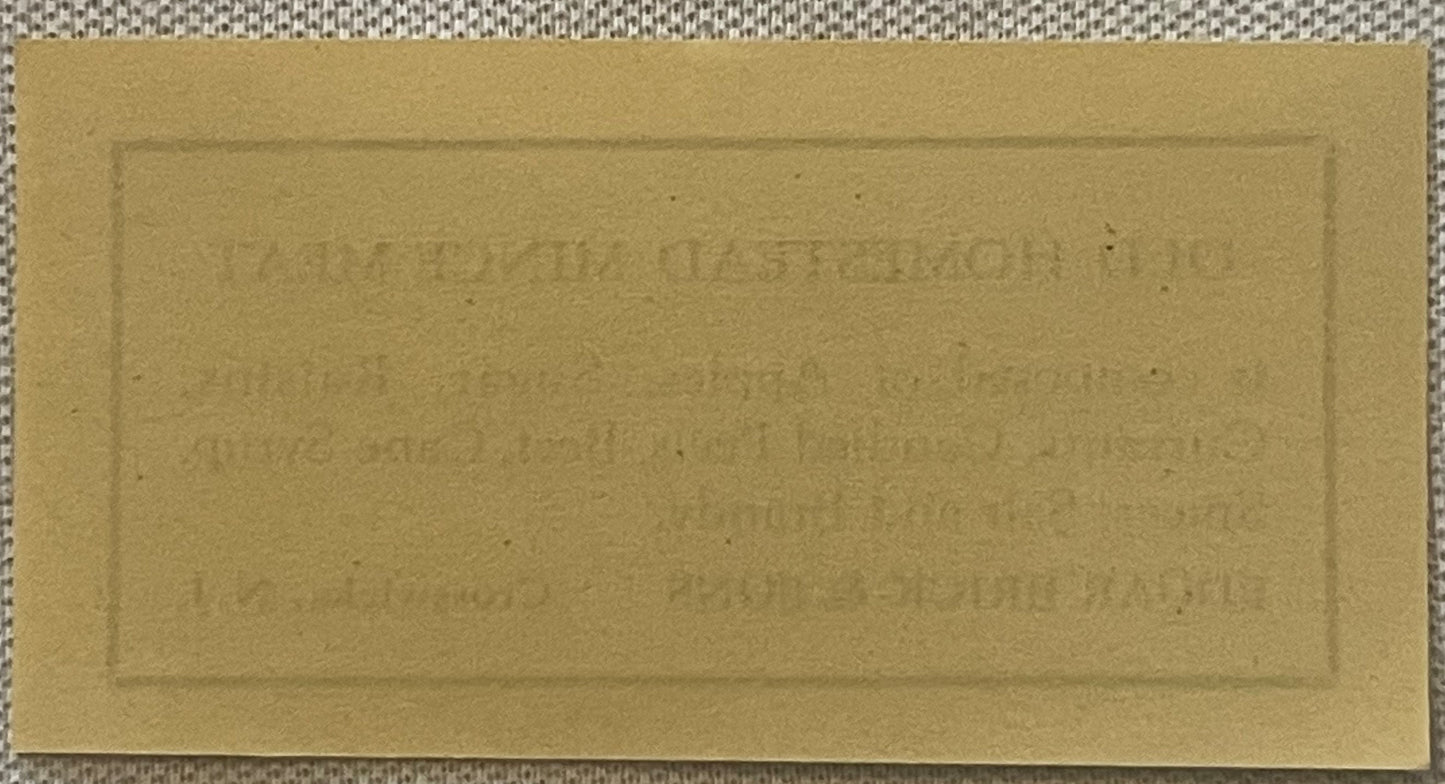
Turn the label over and you will find something that genuinely surprises collectors when they encounter it for the first time: the impression of the letterpress type is deep enough that the mirror image of the entire label — every word, every border rule — is embossed into the reverse of the paper in a ghostly, tactile negative. That is not a flaw. That is what real letterpress printing feels like. That is what it means to have ink driven into paper under pressure rather than laid on top of it. It is one of the clearest material markers of authentic period production, and it is present here in full.

The Old Homestead line was one of several named brands the Brick family produced. Archival records and collector lots confirm the firm marketed product under at least three distinct brand names — Old Homestead, Nonpareil, and Banquet Hall — each with its own label design and format. Old Homestead was their flagship consumer identity: an evocation of hearth, harvest, and homemade tradition that spoke directly to the American domestic imagination of the early twentieth century. The era most strongly supported by the collector and antiquarian record runs from the early 1900s through the 1930s, with auction houses and ephemera specialists most frequently attributing surviving Old Homestead labels to the 1920s — a decade whose complicated legal landscape becomes very relevant when you notice that last ingredient on the label. We will get to that.


🏭 The Company — From 76 Pounds to Three Million

Edgar Brick did not set out to build an empire. He set out to make a better mincemeat.

He arrived in Crosswicks in the 1850s with his wife Susan, opened a general store on Main Street, and for a period sold the same Philadelphia-made mincemeat that was standard on store shelves across the region. At some point in 1874, he apparently decided he had had enough of it. The Philadelphia product did not meet his standard — not for flavor, not for ingredients, not for the kind of honest, from-scratch cooking that his customers deserved. So he made his own.

That first year, Edgar Brick sold 76 pounds of his own mincemeat. Seventy-six pounds — a number that survives in the historical record because it is so perfectly humble an origin for what came next. Within five years the demand had outgrown the space available at the store, and he moved operations to a dedicated building. Five years after that he needed more room again. In the practical manner of rural New Jersey enterprise, he solved the problem by purchasing two local farmhouses and having them moved to the new site, joined together, and converted into the factory that would serve the company for the remainder of its history. That building still stands in Crosswicks today.

By the turn of the twentieth century, Edgar Brick & Sons had become the largest mincemeat manufacturer in the state of New Jersey. The sons — Arthur, Josiah, and Charles — were already deeply involved in the business by the time Edgar passed away in 1920, and they took the helm of the company he had built from a single storefront and a family recipe. The "& Sons" form of the firm's name, which appears on this very label, carries the weight of that succession: it is the name of a company that had already become a family institution.

The decades that followed brought the company to its greatest scale. During World War II, Edgar Brick & Sons employed forty workers and produced three million pounds of mincemeat per year — making them, at their peak, the largest mincemeat manufacturer in the United States. From one small village in Burlington County, New Jersey, a family operation was feeding the nation's holiday tables from coast to coast. That is not a small thing. That is an extraordinary American achievement, and this label is one of its physical witnesses.

The company continued under Brick family management for nearly half a century after Edgar's death — forty-eight years in all. When mincemeat consumption began to decline in the 1960s, the firm adapted, transitioning in 1968 to the production of alcoholic beverages and ceasing mincemeat manufacturing entirely. The company closed its doors in 1979. Much of the original equipment and furnishings were auctioned off. The building passed to the Hamilton Uniform Company, which operated there for a number of years. Preservation New Jersey has listed the factory among the state's most endangered historic sites — a recognition of what the structure represents, and of how much of that story has already slipped away.

Lore passed down among collectors of New Jersey food ephemera holds that the original Brick family recipes were never formally published, and that Edgar's precise proportions — particularly for the spice blend and the brandy measurement — were communicated within the family by word of mouth and never written down in any form that survived the closure. Whether or not that is precisely true, the ingredient list on this label is, in a real sense, the closest thing that exists to a public record of what went into the product. It is a recipe hiding in plain sight, printed in letterpress on cream stock, waiting to be read.


🥃 The Brandy on the Label — A Prohibition Story

Notice that final ingredient. Brandy. Printed openly, matter-of-factly, right there in the ingredient declaration, at a moment in American history when the production and sale of alcohol was a federal crime.

This was not an oversight, and it was not illegal. In 1922, a federal court ruling confirmed that culinary preparations — including mincemeat — could lawfully contain alcohol as an ingredient, even during Prohibition, provided the manufacturer held the appropriate federal permit. Edgar Brick & Sons held exactly such a permit. A companion label from the firm's Banquet Hall brand, which survives in archival lots, bears the explicit notation: PROOF ALCOHOL BY VOLUME 14 PER CENT — FEDERAL PROHIBITION PERMIT N.J. H-926.

The Old Homestead label takes a different approach. There is no permit number printed here, no alcohol-by-volume declaration, no legal notation at all — just the ingredient list, with brandy stated plainly among the spices and currants and cane syrup. That restraint is itself historically interesting. It suggests either a different label generation, a different regulatory moment, or simply a different design choice for a different product tier. It is one of the small details that makes individual surviving labels worth studying rather than simply displaying.

What is not in question is that the brandy was real, the recipe was honest, and the Brick family's mincemeat contained genuine alcohol at a time when that distinction mattered enormously — both legally and commercially. In a market full of alcohol-free Prohibition-era substitutes, a product that could legally advertise brandy in its ingredient list carried a genuine competitive distinction. The label says so. The history confirms it.


📍 The Town — Crosswicks, New Jersey

Crosswicks is one of those American places that carries far more history than its size would suggest. An unincorporated community and census-designated place in northern Chesterfield Township, Burlington County, it sits along the banks of Crosswicks Creek — roughly five and a half miles from Trenton and about seventeen miles from Philadelphia. It is, by any measure, a small place. It has always been a small place. And yet.

The village was first settled in 1677, primarily by Quakers, and holds the distinction of being the oldest of Chesterfield's three villages. Its name derives from the Lenape word Crossweeksung, meaning "house of separation" — a name that carries the memory of the Indigenous peoples who lived along this creek long before European settlement arrived. The Quaker meeting house built here in the eighteenth century still stands, one of the oldest in New Jersey.

Crosswicks also carries Revolutionary War significance that runs deeper than a historical marker. On June 23, 1778 — the day before the Battle of Monmouth — American forces engaged British troops near the bridge over Crosswicks Creek in a skirmish that forms part of the larger strategic story of the British retreat across New Jersey following the Philadelphia campaign. The creek, the bridge, the village: these are not backdrop. They are the geography of a nation being made.

Into this layered, historically dense community, the Brick family wove their own civic thread. Beyond the mincemeat factory, members of the Brick family were instrumental in bringing electricity to Crosswicks, in establishing a mill and an ice plant along Crosswicks Creek, and in forming institutions that shaped township life for generations. When the Crosswicks Community Association was organized in 1919, the founding committee included Josiah E. Brick, Charles W. Brick, and Mrs. Charles W. Brick, with Josiah Brick serving as Chairman. The family's presence in the community was not incidental to their commercial success — the two were woven together, as they so often were in small-town American enterprise of that era.

A later family member, Gertrude N. Brick (1905–1995), a lifelong Crosswicks resident, continued that tradition of civic investment as a genealogist, antiquarian, and community preservationist. She served as a founder and life trustee of the Chesterfield Township Historical Society, and her papers are now held at Rutgers University — a tangible legacy of a family whose name was synonymous with their town for more than a century.


🖨️ The Craft — Letterpress Printing in the Age of American Industry

The production method visible on this label deserves its own moment of attention, because it connects this small piece of paper to one of the great craft traditions of American commercial printing.

Letterpress printing — the process of setting individual type characters and rule borders in a composed form, inking that form, and pressing it under controlled pressure against paper — was the dominant technology of American commercial label production from the mid-nineteenth century through the early decades of the twentieth. It produced labels of extraordinary legibility and tactile presence, and it required skill: the composition of the type, the spacing of the lines, the registration of the border rules, the calibration of the impression pressure — each of these was a craft decision made by a trained hand.

The embossed reverse of this label — that ghostly, tactile impression of the entire composition visible when you turn the paper over — is the direct physical evidence of that process. The type was pressed into this paper. The border was pressed into this paper. The ink went where it went because something solid drove it there. That is letterpress. That is what distinguishes this label from anything produced by a later, offset or digital process, and it is one of the clearest markers of its period and its authenticity.

The design itself is a study in typographic restraint. No illustration, no decorative flourish beyond the double-rule border, no color beyond the black ink on cream stock. The Old Homestead label makes its entire case through typography and ingredient transparency — and in doing so, it aligns with a particular tradition of American food labeling that trusted the product to speak for itself. That confidence, in retrospect, is one of the most appealing things about it.


🖼️ Display Ideas

  • 🪵 Frame alongside a period wooden mincemeat firkin or crock for a layered, three-dimensional display of early American food-preservation culture — the label and the vessel that would have worn it.
  • 📚 Mount in a deep mat within a shadow box with a reproduction of a period mincemeat pie recipe or a vintage New Jersey township map showing Crosswicks and Burlington County.
  • 🏡 Display as part of a curated kitchen-ephemera gallery wall alongside other early American food labels, trade cards, and grocer's broadsheets from the same era.
  • 🎄 Feature in a seasonal holiday display — mincemeat pie was a cornerstone of American Thanksgiving and Christmas tradition, and this label connects directly to that culinary heritage.
  • 📜 Pair with other New Jersey food-industry ephemera — canning labels, produce broadsides, trade catalogs — as part of a regional commercial history collection.
  • 🏛️ Present in a museum-quality archival frame with UV-protective glazing as a primary document of early-twentieth-century American food packaging design and letterpress craft.

🎁 Who Collects These

Antique food labels occupy a wonderfully broad collecting landscape, and this particular piece sits at the intersection of several distinct collector communities — which is part of what makes it special.

Americana and advertising ephemera collectors are drawn to early food labels as primary documents of American commercial culture: the typography, the ingredient declarations, the brand names, the firm names and town imprints are all historical data encoded in a beautiful, portable format. Labels like this one are increasingly difficult to find in New Old Stock condition, which makes each surviving example meaningful.

New Jersey local history and regional collectors recognize Edgar Brick & Sons as one of the state's most significant food-industry stories — a Burlington County enterprise that became a national market leader. For collectors with roots in Chesterfield Township, Crosswicks, or the broader Burlington County area, a label bearing the firm's name and hometown is a piece of community heritage.

Letterpress and printing history enthusiasts value this label for its production method: the deep impression, the composed typography, the period border rules. For anyone who cares about the history of American commercial printing, this is a tangible artifact of the craft at its working peak.

Prohibition-era collectors find the brandy ingredient declaration — on a label from a period when that declaration carried genuine legal weight — to be a compelling document of that complicated chapter of American history. The Brick family's federal permit, their court-backed right to use real alcohol in their product, and the open listing of brandy on their labels: these are Prohibition-era stories that most people have never heard, and this label tells them at a glance.

Food history and culinary heritage collectors are drawn to mincemeat specifically as a window into an older American kitchen tradition — one in which fruit, meat, spices, and spirits were combined and preserved together in a preparation with medieval English roots that became deeply embedded in American holiday cooking. This label is, among other things, a recipe.


❓ Frequently Asked Questions

Is this an original antique label or a reproduction?

This is an original antique label — New Old Stock, meaning it left the printer unused and has remained unapplied. The letterpress impression is authentic, visible both on the face and as an embossed mirror image on the reverse. Reproduction Old Homestead labels and tins do exist on the collector market, so it is worth knowing the distinguishing markers: authentic period labels carry the deep tactile impression of real letterpress printing, use period paper stock, and show the kind of typographic detail that modern reproduction processes approximate but do not fully replicate. What you are looking at here is the genuine article.

How old is this label exactly?

The honest answer is that the label carries no manufacture date, and no printer's mark legible enough to pin it to a specific press run. What the collector and antiquarian record supports — across auction house catalog entries, ephemera dealer listings, and archival lot descriptions — is an attribution spanning the early 1900s through the 1930s, with the 1920s being the period most frequently cited for surviving Old Homestead labels. The "& Sons" form of the firm name is most strongly associated with the period following Edgar Brick's death in 1920, though it appeared in company use before that as well. The letterpress production method, the typographic style, and the paper stock are all consistent with early-twentieth-century American commercial printing practice. A precise year cannot be established from the label itself, and anyone who offers one without documentary evidence is speculating.

What was Old Homestead Mince Meat, and how was it used?

Mincemeat is one of the oldest preserved food preparations in the English-speaking culinary tradition — a mixture of chopped fruit, suet or beef, sugar, spices, and spirits that originated as a genuine meat-and-fruit preservation method and evolved over centuries into the sweet-savory pie filling that became a fixture of American holiday cooking. The Old Homestead formula — apples, sugar, raisins, currants, candied peels, beef, cane syrup, spices, salt, and brandy — is a classic expression of the tradition: fruit-forward, spice-rich, and finished with real brandy for both flavor and preservation. Edgar Brick began making mincemeat in 1874 because he found the commercial product available to him unsatisfactory, and the recipe his company produced over the following decades became, at the firm's peak, the most widely sold mincemeat in the United States. The brandy is not incidental — it is structural, both culinarily and historically.

Why does the label list brandy openly if this was a Prohibition-era product?

Because Edgar Brick & Sons held a federal Prohibition permit — documented on a companion brand label as Federal Prohibition Permit N.J. H-926 — that authorized them to use alcohol in culinary preparations. A 1922 federal court ruling had established that food products, including mincemeat, could lawfully contain alcohol as a functional ingredient even during Prohibition. The Brick family's product genuinely contained real brandy, they were legally authorized to use it, and they listed it openly on their labels as a mark of transparency and, arguably, of competitive pride. In a market where many manufacturers had reformulated to remove alcohol, a product that could honestly advertise brandy in its ingredients carried a distinction that their customers recognized and valued.

What can you tell me about Edgar Brick & Sons as a company?

The firm was founded in 1874 by Edgar Brick, who began making mincemeat in his Crosswicks general store after finding the commercially available product inadequate. He sold 76 pounds that first year. By the turn of the twentieth century the company had become the largest mincemeat manufacturer in New Jersey. After Edgar's death in 1920, his three sons — Arthur, Josiah, and Charles — continued the business under the family name. At its wartime peak the company employed forty workers and produced three million pounds of mincemeat annually, making Edgar Brick & Sons the largest mincemeat manufacturer in the United States. The company operated under Brick family management for forty-eight years after Edgar's death, transitioning away from mincemeat production in 1968 and closing entirely in 1979. The original factory building still stands in Crosswicks and has been listed among New Jersey's most endangered historic sites by Preservation New Jersey.

Is Crosswicks, New Jersey a real place, and why does it matter for this label?

Crosswicks is very much a real place — an unincorporated community in Chesterfield Township, Burlington County, New Jersey, first settled in 1677 by Quakers and named for the Lenape word meaning "house of separation." It sits along Crosswicks Creek, roughly five and a half miles from Trenton. It is a small village with an outsized historical footprint: a Revolutionary War skirmish was fought here in June of 1778, and the eighteenth-century Quaker meeting house built by the original settlers still stands. For collectors, the town imprint on this label matters because it places the product and the firm in a specific, verifiable geography with a documented history. "Crosswicks, N.J." is not a generic American small-town name — it is a place with a name, a story, and a family of record whose civic involvement shaped that community for more than a century. The label is, among other things, a geographical document.

How should I store or display this label to preserve it?

For long-term preservation, archival best practices apply: acid-free sleeves or enclosures for storage, and UV-protective glazing if the label is framed for display. Paper ephemera of this period responds well to stable, consistent conditions — avoiding extremes of humidity and temperature is the most important factor. For display, a deep mat in a shadow box allows the label to breathe while protecting it from handling and light exposure. Museum-quality conservation framing with archival mounting materials is the gold standard for a piece of this historical significance. Whatever display context you choose, the embossed reverse is worth making accessible — it is one of the most striking physical features of the piece and tells its own story about how this label was made.

Shipping

🚚 Shipping & Handling

  • Shipping costs and timing are calculated at checkout.
  • Items curated and shipped directly by me include U.S. shipping at no additional cost, professionally packed to ensure safe arrival of your artifact.

Items from Vetted Pro Collectors
Shipping for items offered by vetted Pro Collectors is determined at checkout. All Pro Collector listings are reviewed to ensure fair, reasonable shipping practices.

For full details, please refer to our Shipping Policy.

Returns & Exchange

Product Page Return Policy

  • 60-Day Returns – Items must be in original condition.
  • Refunds – Issued after inspection (excluding shipping costs).
  • Return Shipping – Customer is responsible unless item is damaged or incorrect.
  • Damaged/Incorrect Items – Contact us within 48 hours for a replacement or refund.
  • Easy Returns – Email [email protected] or call 802-356-9872 to initiate a return.

For full details, visit our Refund Policy.

View full details