Skip to product information
1 of 10

Vintage and Antique Gifts

Antique Brick's Old Homestead Mince Meat Labels 🏡 Edgar Brick & Sons Crosswicks NJ | 1910s–1930s Litho Set American Made

Antique Brick's Old Homestead Mince Meat Labels 🏡 Edgar Brick & Sons Crosswicks NJ | 1910s–1930s Litho Set American Made

Regular price 19.00 USD
Regular price Sale price 19.00 USD
Sale Sold out
Shipping calculated at checkout.

Description

What Does a Jar Label Tell You About a Town That Time Nearly Forgot? 🏡

There is a particular kind of quiet that settles over you when you hold something made before the world got loud. Before plastic. Before shelf-life algorithms and focus-grouped packaging. Before the word "artisanal" was invented to describe things that used to simply be called made with care. These labels — this little bundle of printed paper from Edgar Brick & Sons of Crosswicks, New Jersey — carry that quiet with them. They are not worn. They are not faded. They look, with a kind of stubborn integrity, exactly as they did the day they rolled off the press sometime in the 1910s or 1920s or early 1930s. And they have been waiting, patiently, for someone who understands what that means.

This is the kind of piece I set aside when it crosses my hands. Not because it is flashy — it isn't — but because everything about it is right. The colors hold. The paper stock is substantial. The lithographic printing is crisp. And the story layered beneath the image is the kind that a label this modest should not, by any reasonable expectation, contain. But it does. And once you know it, you won't look at this little farmhouse scene the same way again.


🏷️ What You Are Looking At: The Bundle, the Brand, and the Craft

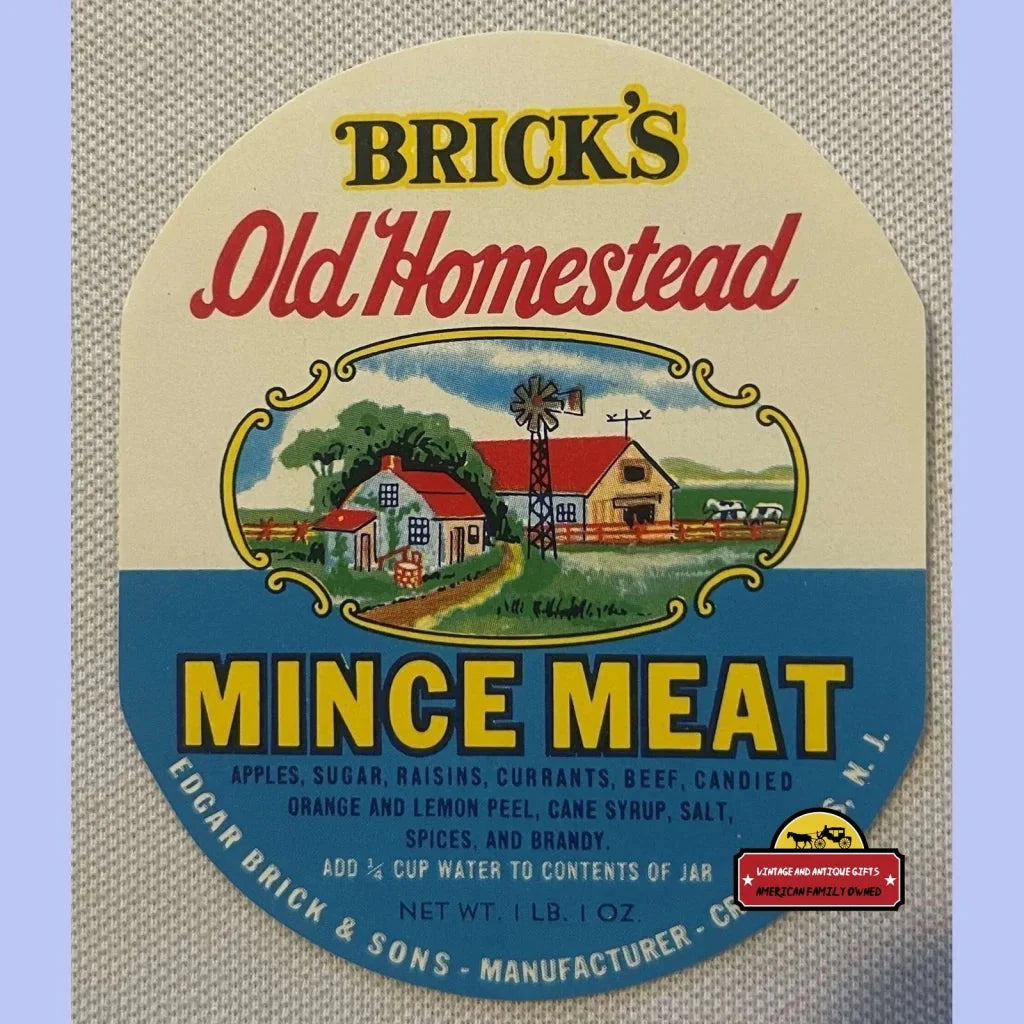
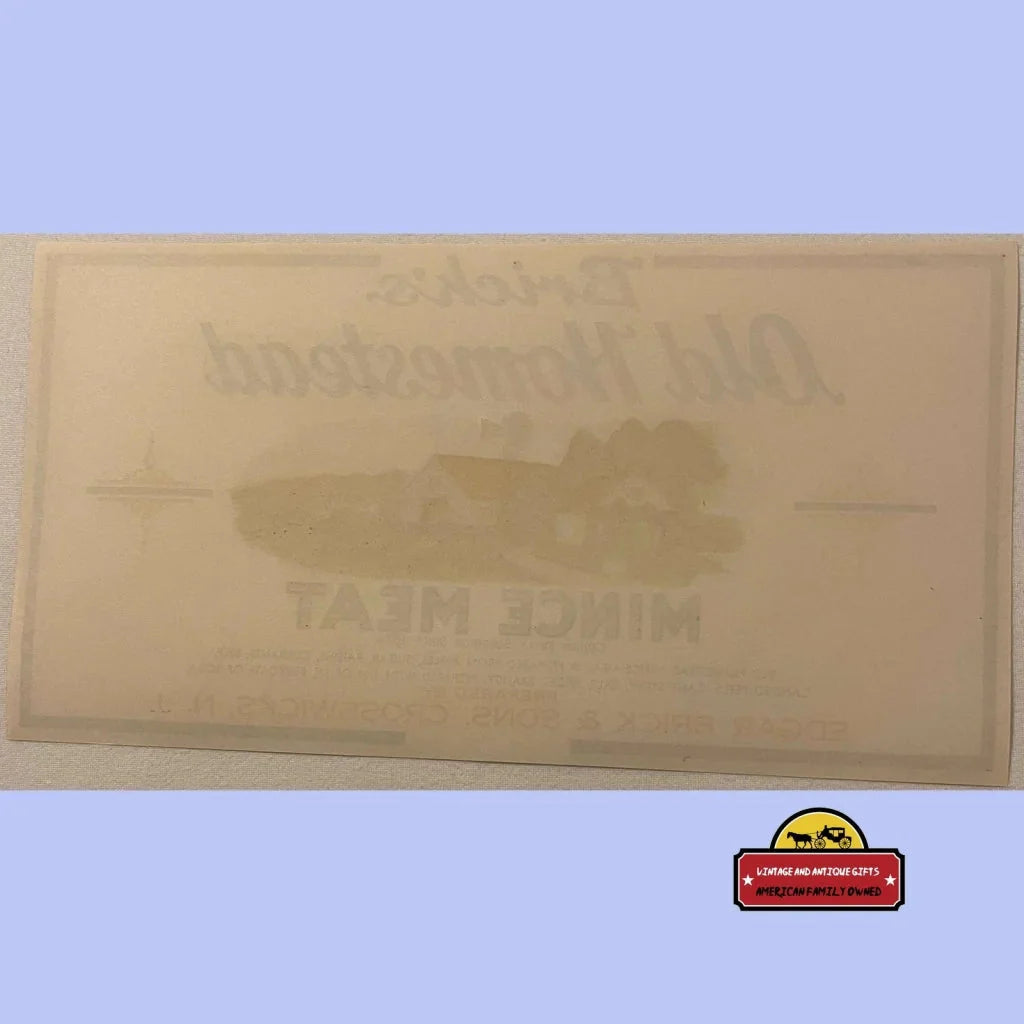
Let's begin with what this is, concretely, before we go anywhere else. This is a New Old Stock bundle — meaning unused, uncirculated, never applied to a jar — consisting of three distinct printed pieces produced for the same product: Old Homestead Mince Meat, made by Edgar Brick & Sons of Crosswicks, New Jersey. The bundle contains a rectangular paper label (the primary can or crock label), a smaller oval jar label, and a separate ingredients card — three distinct formats, three distinct print runs, all unified by the same brand identity and the same quiet pride of authorship. Each piece was printed using chromolithographic or lithographic press methods standard to the industry in the 1910s through 1930s, a process that required skilled craftsmen to prepare and align multiple color plates, achieving that warm, slightly saturated palette that modern printing has never quite been able to replicate with the same soul.

The label itself presents a farm scene — the "Old Homestead" of the name made visual and immediate, a piece of pastoral American self-presentation that would have resonated powerfully with early twentieth-century consumers navigating an increasingly urban world. The product carried a proud boast: "consistently superior since 1874." That is not a marketing slogan chosen lightly. That is a family placing its name and its town's reputation on a jar of mince meat and asking the public to hold them to it. New Old Stock of this age — a century or more of survival without having been opened, sold off, or separated from its companion pieces — is genuinely uncommon. The fact that the three-piece set has stayed together only deepens its value to the serious collector.


🏭 The Industry, the Era, and Why These Labels Existed

The American prepared food industry at the turn of the twentieth century was in a period of tremendous creative and commercial energy. The Pure Food and Drug Act of 1906 had recently reshaped what manufacturers were required to disclose about their products — which is precisely why an ingredients card as a separate printed piece makes historical sense for this era. Producers who had built their reputations on quality welcomed the transparency requirement; it was an opportunity to distinguish themselves from less conscientious competitors. A separate, beautifully printed ingredients card wasn't just compliance. It was a statement of confidence.

Mince meat itself has a history in American kitchens stretching back to colonial times — a preservation technique born of necessity, combining cooked meat, suet, dried fruits, spices, and spirits to create a shelf-stable filling for pies that could carry a household through winter. By the time Edgar Brick & Sons were producing Old Homestead Mince Meat under their 1874 dating, the product had evolved into something more refined, more standardized, and deeply associated with holiday tradition — Thanksgiving, Christmas, the kind of Sunday gathering where the table itself was a form of family testimony. For a small-town New Jersey producer to stake a claim in that market, and to sustain it across decades, speaks to genuine product quality and genuine community trust.

The label printing trade that supported these regional food companies was itself a specialized industry. Lithographic label houses — many concentrated in Philadelphia, Baltimore, and New York — produced runs for regional canners and food producers throughout the mid-Atlantic and beyond. The farm scene imagery common to labels of this type was not generic clip art; it was carefully composed, color-separated by hand, and printed in carefully registered passes through large flatbed or rotary lithographic presses. The artisans who produced these labels were proud of their craft, and the best examples — like these — show every reason why.


🏘️ Crosswicks, New Jersey: The Town Behind the Jar

Crosswicks is not a name that appears in most conversations about American food history, or American history generally. It is a small village in Burlington County, New Jersey — the kind of place that exists in the margin between the past and the overlooked. But its history is anything but marginal. Crosswicks is a pre-Revolutionary War settlement, one of the oldest communities in the state, and the streets that Edgar Brick walked when he opened his general store in the 1850s had already absorbed centuries of American life before he arrived.

Students of the Revolutionary War will know that Burlington County, New Jersey was active ground during the campaigns of 1776 and 1777. Washington's forces moved through this part of the state during the pivotal weeks that followed the crossing of the Delaware — a period that transformed the entire direction of the war. Crosswicks itself sits near the routes that Continental soldiers marched, and the village's Quaker meeting house, one of the oldest in New Jersey, still bears the evidence of those years in the form of a cannonball lodged in its wall — a detail that local historians have pointed to for generations as a tangible link to the founding era. When you understand that Edgar Brick was conducting his business on those same streets, in a community shaped by that kind of deep-rooted American memory, the Old Homestead name reads differently. This wasn't nostalgia for its own sake. This was a family embedded in a place with real roots, making a product they'd been proud of since 1874, and putting that pride on a label for the world to read.

Local legend holds that the Brick family's connection to Crosswicks extended well before Edgar's store — that the family had been part of the Burlington County community through multiple generations, the kind of multi-generational local presence that gave a business its moral authority in the era before advertising created the illusion of trust. Lore passed down among New Jersey antique collectors holds that the Brick store was a genuine anchor of the village's commercial life, the sort of establishment where neighbors ran accounts, where produce and provisions moved through on regional trade routes, and where a product like Old Homestead Mince Meat would have been as familiar to local customers as the family name on the sign above the door.


🌿 Edgar Brick & Sons: A Family Business in the American Grain

The "&Sons" in Edgar Brick & Sons is not incidental. It speaks to the model of American small enterprise that defined regional food production for most of the nineteenth and early twentieth centuries — a founder building something durable enough to hand to the next generation, a next generation willing to take it. Edgar Brick opened his general store in Crosswicks in the 1850s. By the time the Old Homestead Mince Meat label was carrying the "since 1874" claim, the business had already been through its formative years and arrived at something that the family felt confident advertising as a continuous tradition. The sons who came after him were stewards of that tradition, not just inheritors of a building and a stock list.

What we know about small regional food producers of this era tells us something important about the distribution model. Products like Old Homestead Mince Meat would have moved through a combination of local retail, regional wholesale, and potentially rail freight — Burlington County's position in the dense railway network of early twentieth-century New Jersey made regional distribution genuinely viable for a producer of almost any size. Labels printed in quantity, bundled for different container formats — the rectangular label for a crock or can, the oval for a jar, the ingredients card as a separate insert — suggest a producer thinking carefully about presentation across a range of retail contexts. This was not a cottage operation putting a handwritten tag on a product. This was a family business with professional standards and a regional reputation to protect.

Lore among Burlington County collectors holds that the Edgar Brick & Sons operation was regarded within the region as a mark of consistent quality — that "Old Homestead" on a jar was understood, by those who knew it, to mean something. That kind of word-of-mouth brand equity, built across decades in a small community, is exactly what the label's boast — "consistently superior since 1874" — was designed to extend beyond the local market. It is a slogan that only a confident and long-established business would put in print.


📜 New Old Stock and What It Means for a Collector

The term "New Old Stock" carries real weight in the world of paper ephemera and antique packaging. It means the item was produced for commercial use, but for whatever reason — overrun, a change in packaging, the closure of a business, a warehouse find — it never made it to its intended destination. It was never glued to a jar. Never handled by a grocer. Never dampened, stained, or torn in the ordinary course of commerce. It survived in exactly the condition it left the press in, and then it waited.

For labels specifically, NOS condition is a meaningful distinction. NOS labels are none of those things. They are the intention of the object, not its biography. They show you what the lithographer achieved, what the designer envisioned, what the Brick family approved when the proof came back from the print house. For display, for framing, for scholarly study, or for a collection built around American regional food history, NOS condition is simply the best possible starting point.


🖼️ Display Ideas

  • 🪟 Frame all three pieces together in a shadow box or multi-opening mat — the rectangular label, the oval, and the ingredients card create a naturally balanced grouping that tells the whole Old Homestead story at once.
  • 🍂 Style in a seasonal farmhouse kitchen vignette alongside antique crockery, a vintage pie tin, dried botanicals, or a spool of jute — the farm scene lithography anchors a harvest or holiday tableau beautifully.
  • 📚 Incorporate into a New Jersey local history display or a Burlington County heritage collection — paired with a period map of the county or a reproduction of an early Crosswicks photograph, this becomes a genuinely meaningful regional artifact.
  • 🖼️ Mount the oval label alone in a period oval frame — small oval labels from this era, framed individually, have a jewel-like presence that works in a gallery wall of antique food packaging.
  • 🏡 Use as part of a farmhouse-style bar cart or pantry display — tucked behind antique jars, apothecary bottles, or vintage canning crocks, the labels add a layer of authentic visual history that reproduction decor simply cannot replicate.
  • 🎨 Display the ingredients card separately as its own artifact of food regulatory history — it is a document as much as a label, and it reads beautifully in a simple clip frame at eye level.

🎁 Who Collects These

Antique food and grocery labels occupy a passionate corner of the ephemera collecting world, and for good reason — they sit at the intersection of graphic design history, regional Americana, food culture, and the material culture of everyday life. The collector drawn to a piece like this Edgar Brick & Sons bundle is rarely just one type of person.

New Jersey history collectors and local historians will immediately understand the significance of a Crosswicks, Burlington County business appearing on professionally produced lithographic labels. Pre-Revolutionary War village. Quaker meeting house. A family business stretching from the 1850s into the mid-twentieth century. For someone building a collection around the material history of a specific place, this bundle is documentary evidence.

Antique advertising and paper ephemera collectors — the community that gathers around trade cards, broadsides, seed packets, and country store labels — will recognize the quality of the lithographic printing and the relative rarity of a complete multi-format NOS set. Three pieces, same product, same era, never separated: that kind of completeness commands attention.

Farmhouse and cottage décor enthusiasts who collect authentic vintage pieces rather than reproduction graphics will find the farm scene imagery immediately usable and deeply satisfying. The Old Homestead name is practically made for the aesthetic.

Food history researchers and culinary heritage collectors will appreciate the ingredients card as primary source material for the history of mince meat production and the regulatory environment of the early twentieth century.

Holiday and seasonal décor collectors — mince meat is inseparable from Thanksgiving and Christmas tradition — will value this as an authentically aged artifact of the American holiday table, the kind of piece that gives a seasonal display genuine historical grounding.


❓ Frequently Asked Questions

What exactly is included in this bundle, and are all three pieces in matching condition?

The bundle consists of three distinct printed pieces: a rectangular paper label (the primary label intended for a crock or can), a smaller oval jar label, and a separate ingredients card — all produced for Old Homestead Mince Meat by Edgar Brick & Sons of Crosswicks, New Jersey. All three are New Old Stock, meaning unused and uncirculated. Please refer to the photographs for a detailed view of current condition; the photos are the most accurate representation of what you will receive.

How rare is it to find a multi-format NOS label set like this still together?

Genuinely uncommon. Labels from small regional producers of this era survived in much smaller quantities than those from major national brands simply because the print runs were smaller and the businesses they served were more vulnerable to closure and dispersal. A multi-format set — rectangular, oval, and insert card — that has remained intact through a century of potential separation is unusual even within the world of New Old Stock ephemera collecting. When print overruns from small producers did survive, they typically turned up as single-format lots: a stack of one label type, not a matched grouping. The fact that these three formats are here together, in NOS condition, is a meaningful part of what makes this bundle worth noting.

What can I learn about the actual printing process used to make these labels?

Labels of this type and era were produced using lithographic printing — a planographic process in which the image is drawn or transferred onto a flat stone or metal plate, and ink is applied based on the chemical principle that oil and water repel each other. Chromolithography, the full-color version of the process, required a separate plate for each color, with careful registration to ensure the colors aligned correctly. The warm, rich tones characteristic of early twentieth-century food labels — the kind that reproduction printing has never fully recaptured — are a direct result of this labor-intensive process. Lithographic label printing was a genuine craft trade, and the best label houses employed artists and craftsmen who took considerable pride in the work. The farm scene imagery and decorative lettering on labels like these were designed by hand, transferred to plate by skilled workers, and printed on presses that required constant operator attention.

Is Crosswicks, New Jersey a place I can visit today, and does the Brick family legacy survive there?

Crosswicks is indeed a real and visitable village in Burlington County, New Jersey — a remarkably preserved pre-Revolutionary War community that has maintained much of its historic character. The Crosswicks Friends Meeting House, one of the oldest Quaker meeting houses in New Jersey, is a notable landmark, and the village as a whole retains a quiet, deeply historical character that makes it a genuine destination for anyone interested in early American history or New Jersey heritage. As for the Edgar Brick & Sons legacy specifically — small-town business histories of the early twentieth century are not always well-documented in the standard archives, and the collector and local historian community is often the best repository of detailed family and business lore. Burlington County historical societies maintain records of the region's commercial history, and researchers interested in the Brick family's full story would find those resources a valuable starting point.

Why does the label say "since 1874" if the labels themselves date to the 1910s–1930s?

The "since 1874" claim refers to the founding date of the Old Homestead Mince Meat product or the Edgar Brick business itself — a common practice among established food producers who used their founding year as a mark of credibility and continuity. By the time these particular labels were printed, the business was already decades old and had built a regional reputation worth advertising. Using the founding year on the label was a way of telling the consumer: this product has been tested by time, by real customers, across real seasons, and it has earned its place on your table. The gap between 1874 and the 1910s–1930s print dating of the NOS labels simply reflects the long commercial life of a product that continued to be produced and labeled well into the twentieth century. That arc of continuity is, itself, part of what makes the piece historically interesting.

How should I store these labels if I'm not framing them immediately?

Antique paper ephemera of this age and type is best stored flat, in acid-free sleeves or folders, away from direct light, humidity, and temperature fluctuations. Mylar or polypropylene sleeves (not PVC) are the standard archival choice for single-piece storage. For a set like this, individual sleeves inside an acid-free portfolio or document box is ideal. If you're displaying them unframed, keep them out of direct sunlight and away from kitchen or bathroom humidity — advice that applies to most antique paper, but especially to pieces you've gone to the trouble of acquiring in NOS condition.

What makes this a good candidate for a New Jersey local history or farmhouse décor gift?

Few gifts in the antique and vintage category combine geographic specificity, visual warmth, and genuine historical depth the way a piece like this does. For someone with roots in Burlington County, a connection to Crosswicks, an interest in New Jersey history, or a love of early twentieth-century American farmhouse aesthetics, this bundle is immediately meaningful on multiple levels. It is not a reproduction. It is not a generic farmhouse graphic. It is a real artifact from a real town, made by a real family business, printed by real craftsmen, surviving a real century. That combination of authenticity and beauty is exactly what the best antique gifts offer — something that opens a story rather than closing one.


Every piece in our shop is handled with the same care we'd want for our own collection. We hunt for things that carry stories, and we try to send those stories along with them. If you have questions about this bundle that aren't answered here, reach out — we know our inventory and we're glad to share what we know. 🏡

Shipping

🚚 Shipping & Handling

  • Shipping costs and timing are calculated at checkout.
  • Items curated and shipped directly by me include U.S. shipping at no additional cost, professionally packed to ensure safe arrival of your artifact.

Items from Vetted Pro Collectors
Shipping for items offered by vetted Pro Collectors is determined at checkout. All Pro Collector listings are reviewed to ensure fair, reasonable shipping practices.

For full details, please refer to our Shipping Policy.

Returns & Exchange

Product Page Return Policy

  • 60-Day Returns – Items must be in original condition.
  • Refunds – Issued after inspection (excluding shipping costs).
  • Return Shipping – Customer is responsible unless item is damaged or incorrect.
  • Damaged/Incorrect Items – Contact us within 48 hours for a replacement or refund.
  • Easy Returns – Email info@vintageantiquesgifts.com or call 802-356-9872 to initiate a return.

For full details, visit our Refund Policy.

View full details