Skip to product information
1 of 7

Vintage and Antique Gifts

Antique 1910s 1920s Titanic International Mercantile Marine Stock Certificate Brown White Star Line 📜

Antique 1910s 1920s Titanic International Mercantile Marine Stock Certificate Brown White Star Line 📜

Regular price 11.00 USD
Regular price Sale price 11.00 USD
Sale Sold out
Shipping calculated at checkout.
Style
Quantity

Size: 12 x 8 inches

🚢 What Would You Give to Hold a Piece of the Boardroom Behind the Titanic? 📜

There's a particular kind of chill that comes from holding paper that once represented real ownership in a company most of us only know from a single, unforgettable ship. Long before anyone thought of the Titanic as a legend, she was a line item — one asset among dozens owned by a sprawling, ambitious shipping trust called the International Mercantile Marine Company. This certificate is a genuine share of that company: the corporate parent that stood behind the White Star Line, financed by the most powerful banker in America, and remembered today as one of the boldest — and most humbling — experiments in the history of American finance.

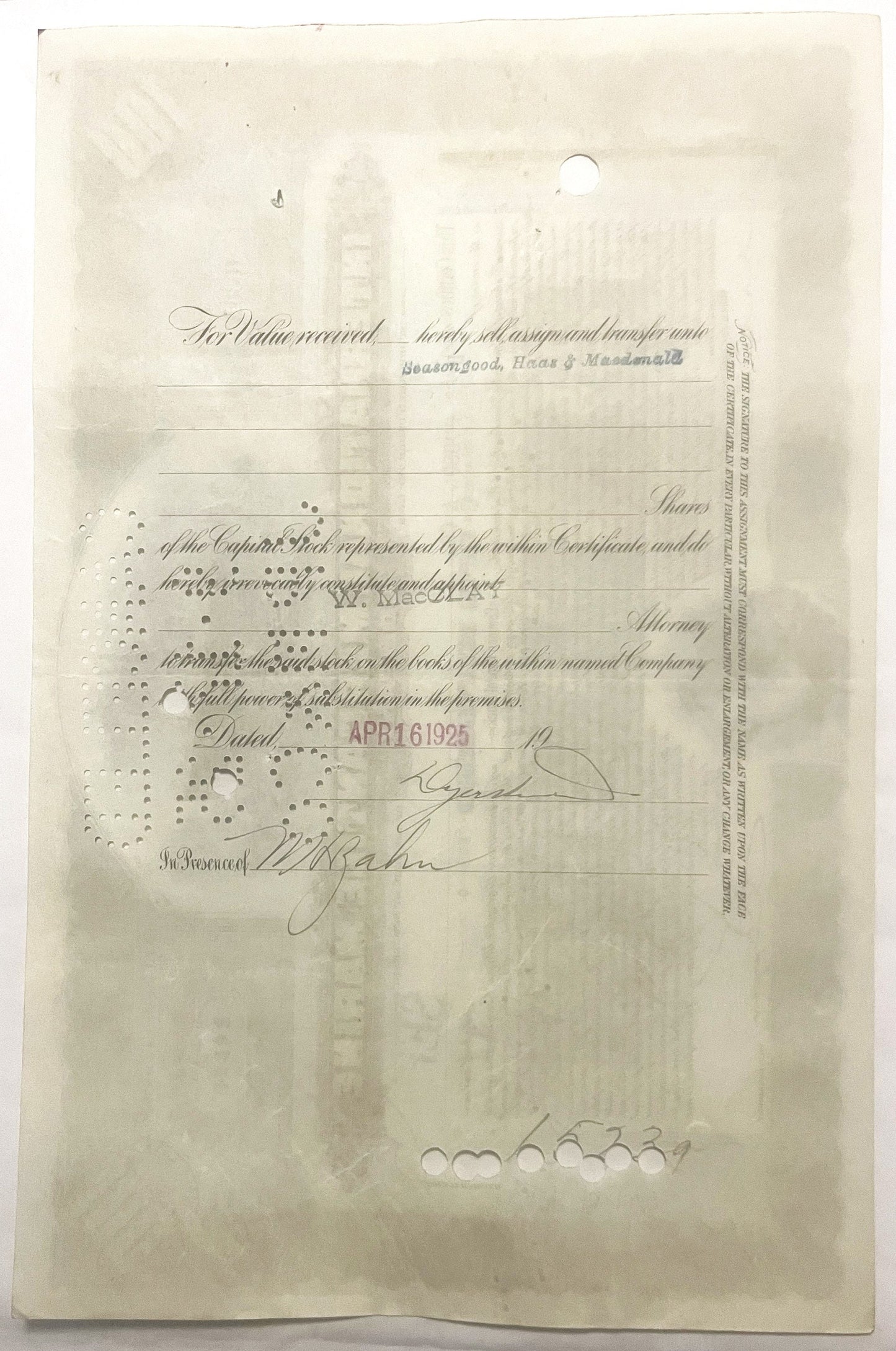
This is an original common capital stock certificate issued by the International Mercantile Marine Company, incorporated under the laws of the State of New Jersey, dating to the 1910s–1920s era of steel-engraved American corporate paper. Printed in warm brown ink on cream stock, the design is anchored by a wonderfully detailed sepia vignette of a four-stack ocean liner steaming into a busy harbor, ringed by tugboats and lighters, with a dockside building at the water's edge — the very picture of the transatlantic trade this company was built to dominate. Below the company's bold engraved name, a classical seated female figure — an allegorical maritime emblem common to fine bank-note engraving of the period — anchors the lower border, flanked by ornate scrollwork, a Greek-key motif, and the ruled numeric columns used by transfer clerks to punch in a share count. Corner medallions announce "Certificate for Less Than 100 Shares," and the certificate names its registrars — first the Central Trust Company of New York, later the Central Hanover Bank and Trust Company — the kind of institutional handoff that quietly tells you how many decades of Wall Street history a piece of paper like this has already lived through. Cancellation punches, standard practice whenever a certificate was retired from active transfer, are part of the piece's honest history rather than any flaw in it.


🏦 J.P. Morgan's Gamble on the Atlantic

To understand what you're holding, you have to understand the sheer audacity of the idea behind it. In the opening years of the twentieth century, J. Pierpont Morgan — already the most feared and admired financier in the country — set his sights on something almost nobody had tried before: buying up the ocean itself, or at least the shipping lanes that crossed it. His vision was to fold the major transatlantic passenger and freight lines into a single corporate trust, creating one dominant combine that could set prices, control capacity, and quiet the fierce competition that was cutting into everyone's profits. It was consolidation on a scale that shocked the shipping world, and it was announced with all the fanfare Morgan's name commanded.

The company was announced in London in the spring of 1902 and formally incorporated in New Jersey that fall, built on an initial capitalization north of fifty million dollars in bonds and preferred stock — real money, real ambition, and real risk stacked on top of one another. Morgan's team brought together the American Line, the Red Star Line, the Atlantic Transport Line, Britain's Leyland Line, and the crown jewel of the whole arrangement: the White Star Line. Because Morgan was American and couldn't directly own British-flagged vessels, he did the next best thing — he owned the company that owned the ships. It was a workaround that let an American banking house effectively control some of the most storied names in British shipping, and it didn't sit well with everyone across the Atlantic.


👑 The White Star Line and the Ship Everyone Remembers

Of every subsidiary folded into this trust, one name outshines all the others: the White Star Line, builder and operator of the RMS Titanic. From 1902 onward, the White Star Line was a wholly owned subsidiary of the International Mercantile Marine Company — meaning that when Titanic slipped her moorings on her maiden voyage in 1912, she sailed as the property, ultimately, of the very company whose stock certificate you're looking at here. It's a sobering thread to follow: a share certificate meant to represent nothing more than corporate ownership and dividend rights turns out to connect, quite directly, to the deck of the most famous ship in maritime history.

The connection runs even closer than the corporate books. J. Bruce Ismay, who served as president of the International Mercantile Marine Company, was also chairman of the White Star Line — and he was aboard Titanic on her final voyage. He survived the sinking, was taken aboard the rescue ship Carpathia, and arrived in New York days later to a storm of public scrutiny that followed him for the rest of his life. Few men in maritime history have had their names so permanently tied to a single voyage, and fewer still had that voyage tied so directly to a stock certificate like this one.


👥 The Men Who Built the Trust

Morgan didn't build this combine alone — he built it by convincing the men who already ran the Atlantic trade to sell him their lines and their loyalty. Clement A. Griscom, who had run the American Line and the Red Star Line, became the company's first president. Bernard N. Baker brought in the Atlantic Transport Line. John Ellerman delivered the Leyland Line. And Ismay, already at the helm of White Star, became the face of the whole enterprise once he succeeded Griscom as president in 1904. Behind the scenes, Philip A.S. Franklin rose through the ranks to become one of the company's steadiest hands, eventually stepping into leadership as the trust weathered storm after storm in the decades that followed.

It's worth pausing on what these men were actually attempting: a private banking house and a handful of shipping magnates trying to corner an entire ocean's worth of passenger and freight traffic, at a moment when steamship travel was still the only way to cross the Atlantic. It was industrial-age thinking applied to the sea — the same trust-building instinct that gave America its railroads and its steel mills, aimed now at the gangways of Southampton, Liverpool, and New York harbor.


🏙️ New York, Wall Street, and the Engraver's Hand

The certificate itself carries the fingerprints of American finance's engine room: New York City. The registrars named on the certificate — the Central Trust Company of New York and, later, the Central Hanover Bank and Trust Company — were fixtures of the Wall Street trust-company world, the institutions that kept the ledgers straight for companies exactly like this one. And the engraving craft on the piece belongs to that same downtown Manhattan tradition of fine security printing that flourished for well over a century, producing the stock certificates, currency, and postage stamps that gave American paper its unmistakable, richly engraved look — the tightly hatched steel lines, the ornamental borders, the classical allegorical figures that turned a legal document into something closer to a small engraved painting.

That craftsmanship is on full display here: the harbor vignette alone, with its layered smoke, its tugboats working the water, its dockside building rendered in fine cross-hatching, is a small master class in intaglio printing — the kind of engraving meant to be nearly impossible to forge, and beautiful enough that nobody minded looking at it twice.


📉 A Trust That Overreached — and the Long Road to Reorganization

For all its ambition, the International Mercantile Marine Company never quite delivered the dominance Morgan envisioned. The very announcement of the trust rattled the British shipping industry so badly that the British government stepped in, subsidizing Cunard Line's construction of two magnificent new ships — the Lusitania and the Mauretania — specifically to keep a British-flagged competitor strong against Morgan's combine. Meanwhile, IMM had overpaid dramatically to acquire the shipping lines in the first place, banking on profit projections that never quite materialized, and a hoped-for subsidy from the United States Congress failed to come through. The trust that was supposed to conquer the Atlantic instead spent much of its life simply trying to stay solvent.

The company limped through the following decades, and by the early 1930s it was in the midst of a major corporate reorganization — merging with the Roosevelt Steamship Company to form the Roosevelt International Mercantile Marine Company, and folding in the struggling United States Lines as its principal operating brand. The Atlantic Transport Line, one of the trust's founding pieces, was dissolved and its vessels distributed among the surviving divisions. Not long after, the White Star Line itself passed out of American hands entirely, sold to Cunard in the mid-1930s, while what remained of the American operations carried on under the United States Lines banner — the final chapter of a shipping empire that had once dreamed of owning the ocean.


💭 Lore Worth Passing Down

Collectors of this certificate have long treated it as more than paper — a physical artifact of an age when industrial power, banking, and global transportation were tightly, almost inseparably, intertwined. Morgan's vision was one of stability through consolidation: bring the great transatlantic lines under one roof, and you tame the wild competition that was eating into everyone's margins. For a moment, it worked exactly as he hoped, and IMM's reach across the shipping lanes was genuinely enormous. But that same scale exposed the company to relentless economic pressure and public scrutiny, and the story of its slow unwinding is, in its own way, as instructive as its rise. Surviving certificates like this one are treated by the people who collect them as tangible reminders of that ambitious, overreaching era — proof that even the grandest financial schemes of the Gilded Age had to answer, eventually, to the ocean's own unpredictability.


🌊 Why It Still Matters Today

A century later, this certificate sits at the crossroads of two collecting worlds that don't often overlap: scripophily — the collecting of historic stocks and bonds — and Titanic history, one of the most enduringly fascinating stories of the twentieth century. Most people who study the Titanic never get to hold anything connected to the corporate structure that actually owned her; ship's fittings and passenger ephemera survive, but the boardroom paperwork rarely does. That makes an IMM stock certificate a genuinely different kind of artifact — not a piece of the ship, but a piece of the company whose name was on her registry, financed by the banker whose name still opens doors on Wall Street, and led by the man who was standing on her deck the night everything changed.


🖼️ Display Ideas

  • 🖼️ Framed alongside a period map of the transatlantic shipping lanes for a striking maritime history wall
  • 📚 Paired with Titanic-era photographs or postcards in a curated maritime history shadow box
  • 🏦 Matted with other early American financial ephemera for a Wall Street or "Gilded Age finance" themed grouping
  • ⚓ Displayed near a model ocean liner or ship's-wheel decor piece for a nautical study or den
  • 🎓 Used as a teaching artifact for lessons on trusts, monopolies, and early twentieth-century American finance
  • 🎁 Given as a distinctive gift for the Titanic enthusiast, maritime historian, or Wall Street history buff on your list

🎁 Who Collects These

This certificate draws in a wonderfully specific crowd: Titanic historians and enthusiasts hunting for anything tied to the White Star Line's actual corporate structure; scripophily collectors who prize early twentieth-century American Bank Note Co. engraving; maritime history buffs building out a shipping-era collection; Wall Street and financial history collectors drawn to J.P. Morgan's era of trust-building; and anyone looking for a gift with real conversation value — a document that opens with "have you heard of the company that owned the Titanic?" and just keeps going from there.


❓ FAQ

Is this really connected to the Titanic?

Yes — the International Mercantile Marine Company, the issuer of this certificate, was the parent company that wholly owned the White Star Line, the operator of the RMS Titanic. J. Bruce Ismay, IMM's president, was also White Star's chairman and was aboard Titanic's final voyage.

What company issued this certificate?

The International Mercantile Marine Company, incorporated under the laws of New Jersey — a transatlantic shipping trust formed in the early twentieth century and backed by J.P. Morgan & Co.

What are the punch holes on the certificate?

Cancellation punches were standard corporate practice once a certificate was retired from active transfer — a routine part of bank and corporate record-keeping, not a flaw in the piece.

Who printed and engraved this certificate?

The certificate carries the engraving hallmarks of the fine steel-plate intaglio printing tradition associated with American security printers of downtown Manhattan in this era — the same craft used for banknotes, bonds, and postage stamps of the period.

What happened to the International Mercantile Marine Company?

After decades of financial strain, IMM was reorganized in the early 1930s and eventually merged into United States Lines; the White Star Line itself was later sold to Cunard, closing out the American ownership chapter of one of shipping history's most storied names.

What does the artwork on the certificate show?

A steel-engraved harbor scene of a four-stack ocean liner surrounded by tugboats and dockside activity, framed by ornate scrollwork borders and a classical seated allegorical figure — a hallmark of fine early twentieth-century American bank-note engraving.

Is this a good gift for a Titanic or maritime history collector?

It's an especially fitting one — a genuine corporate artifact from the company that owned the White Star Line, offering a piece of Titanic-era history beyond the more commonly available postcards or photographs.

Shipping

🚚 Shipping & Handling

  • Shipping costs and timing are calculated at checkout.
  • Items curated and shipped directly by me include U.S. shipping at no additional cost, professionally packed to ensure safe arrival of your artifact.

Items from Vetted Pro Collectors
Shipping for items offered by vetted Pro Collectors is determined at checkout. All Pro Collector listings are reviewed to ensure fair, reasonable shipping practices.

For full details, please refer to our Shipping Policy.

Returns & Exchange

Take your time — you've got a full six months. If a piece isn't right for you, send it back the way it reached you and we're good.

In the first 30 days your money goes straight back the way you paid. After that it's store credit, so you can put it toward something you'd rather have.

Return shipping we sort out between us, case by case. I don't make this difficult.

If something arrives damaged, or it isn't what I said it was, send me a photo within 48 hours and I'll make it right.

Email info@vintageantiquesgifts.com or call 802-356-9872 — that's me answering, not a call center.

The only things I can't take back are custom or special-order pieces and gift cards.

View full details
  • 5 stars: 4 (100%)
  • 4 stars: 0 (0%)
  • 3 stars: 0 (0%)
  • 2 stars: 0 (0%)
  • 1 star: 0 (0%)
m
m***x (6)

Fast delivery..Received today..great addition to my collection..it was a nice touch having your kids sign the letter..thank you..I’ll will buying again

m
m***1 (250)

This was great! The pictures just don't this justice! I was thinking it was about the size of dollar bills. It's about the size of a 8x10.

o
o***- (2906)

alles bestens - Danke

M
Mark

Exceptional