Skip to product information
1 of 7

Vintage and Antique Gifts

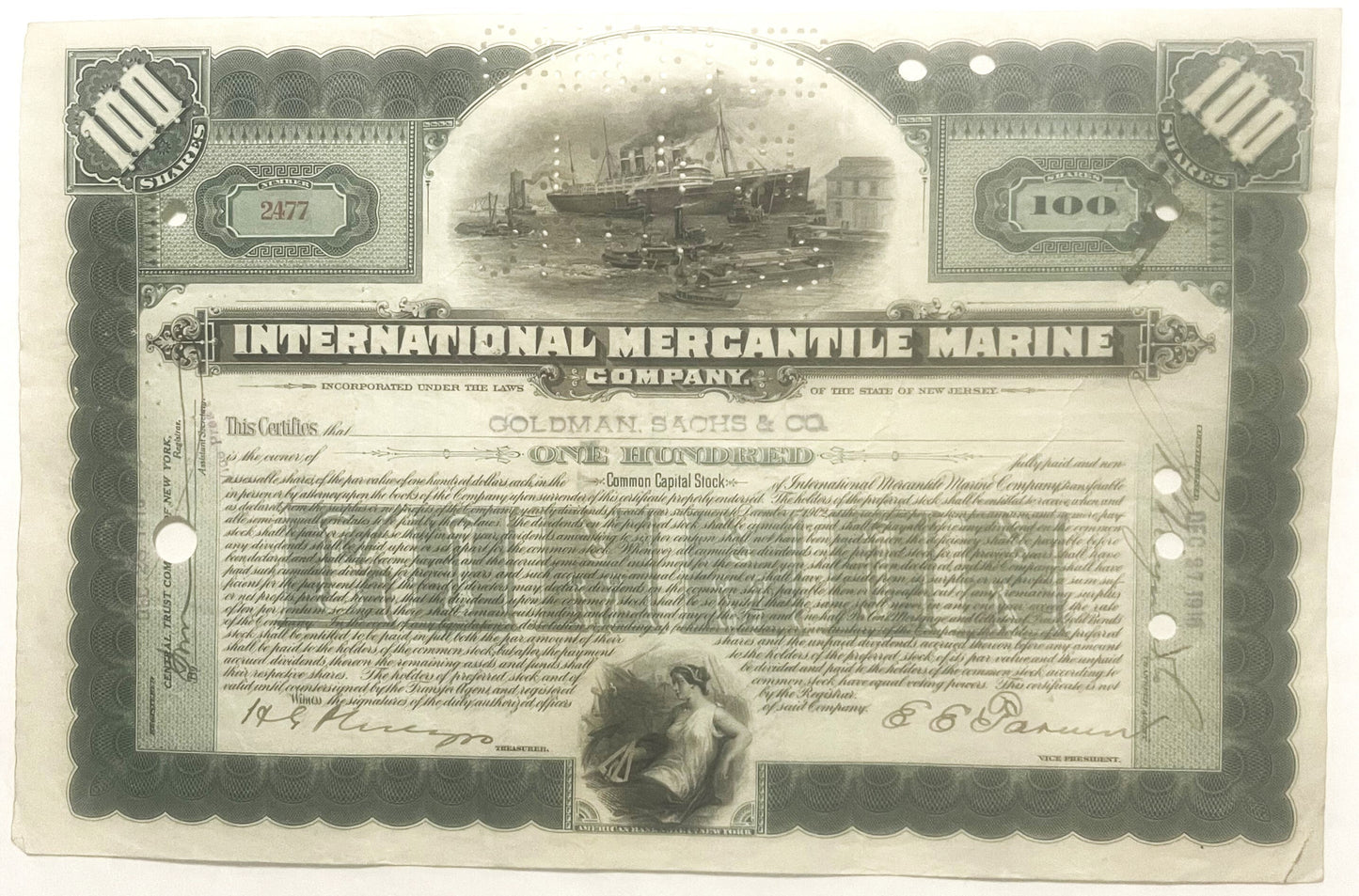
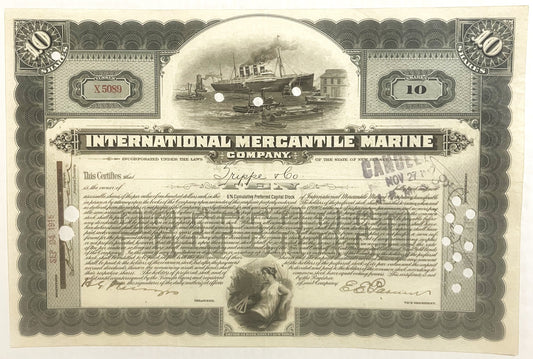
Antique 1910s-1920s Titanic International Mercantile Marine Stock Certificate 🚢 Green, White Star Line

Antique 1910s-1920s Titanic International Mercantile Marine Stock Certificate 🚢 Green, White Star Line

Regular price 12.00 USD
Regular price Sale price 12.00 USD
Sale Sold out
Shipping calculated at checkout.
Style
Quantity

Size: 12 x 8 inches

What Did It Feel Like to Hold a Piece of the Titanic's Own Company? 🚢

There's a particular kind of chill that comes from holding a stock certificate and realizing the company printed across its top wasn't just in the shipping business — it owned the Titanic. Not metaphorically. Not by association. The corporation named in bold lettering across this certificate, International Mercantile Marine Company, was the actual American parent of the White Star Line, and White Star built and operated RMS Titanic. I've handled a lot of old paper in my years chasing this hobby, but few pieces carry the particular weight of this one — a green-inked engraving from the same boardrooms that financed the most famous ship ever to sail.

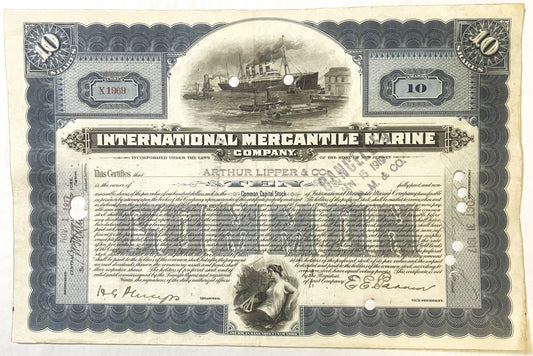
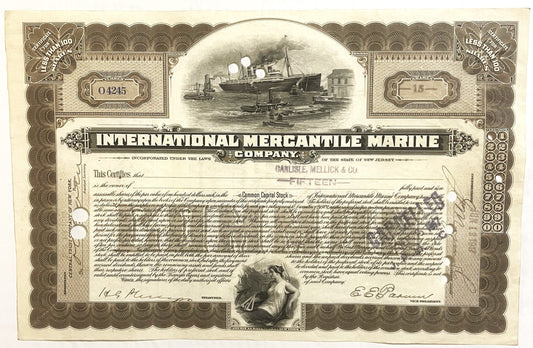
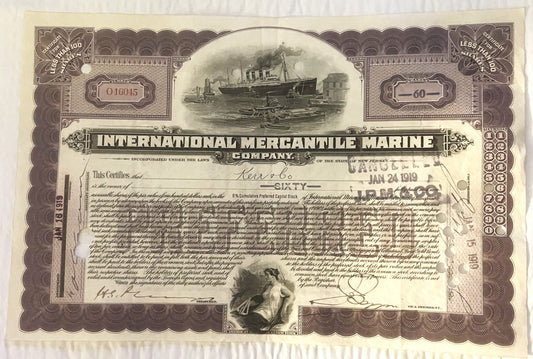
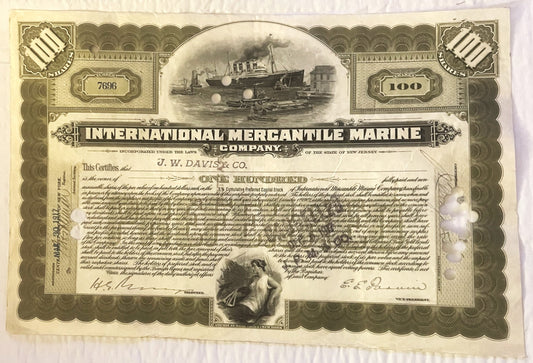
This is an original engraved stock certificate of the International Mercantile Marine Company, printed in green ink by the American Bank Note Company of New York, dating to the era of the 1910s–1920s. Across the top runs an ornate vignette of a four-stacked ocean liner in the unmistakable silhouette of the Olympic-class sisters — Olympic, Titanic, and Britannic — surrounded by tugboats, barges, and ferries working a busy harbor, with smoke pouring from her funnels and a flag snapping at her stern. Below, in a second engraved scene, a classical allegorical woman reclines against ship's rigging, a set of navigator's dividers in hand, surrounded by anchor chain and rope — the engraver's shorthand for Commerce and Navigation watching over the enterprise. Bold lettering spells out INTERNATIONAL MERCANTILE MARINE COMPANY across an ornamental banner, with the company's New Jersey incorporation noted beneath it, and the whole document is bordered in the dense, lathe-worked scrollwork that security engravers of the era used to foil counterfeiters. This example represents 100 shares of common capital stock at one hundred dollars par value, hand-signed by company officers per the practice of the day. It is an original period certificate that has survived from the company's own era.


🏦 J.P. Morgan's Shipping Trust

To understand this certificate, you have to understand the ambition behind it. In the spring of 1902, J. Pierpont Morgan — the most powerful banker in America, a man who had already reorganized the nation's railroads and forged U.S. Steel — announced in London that he was consolidating the major transatlantic steamship lines into a single combine. The International Mercantile Marine Company was incorporated in the State of New Jersey that October, and within a year it had absorbed the White Star Line, the American Line, the Dominion Line, the Atlantic Transport Line, and the Leyland Line, along with the Red Star Line, and had struck trade agreements with the two great German carriers, Hamburg-Amerika and Norddeutscher Lloyd. Newspapers of the day simply called it "the Shipping Trust" — Morgan's attempt to do to the North Atlantic passenger trade what he had already done to steel and rail.

It never quite worked the way Morgan intended. A hoped-for congressional subsidy that would have propped up American shipping under the IMM umbrella failed to pass, and the combine struggled from the start to turn the kind of profit its size promised. But it was White Star, the crown jewel of the trust, that gave IMM its lasting fame — because White Star's answer to rival Cunard's speed-record liners Lusitania and Mauretania was a trio of ships built for size and luxury rather than speed: Olympic, Titanic, and Britannic. Those are the very ships pictured steaming across the top of this certificate's vignette, their four funnels and low graceful lines instantly recognizable to anyone who has ever seen a photograph of the Titanic leaving Southampton. When Titanic went down on her maiden voyage in April 1912, she was, however British her registry and however Belfast-built her hull, an American-owned ship — owned by this company, financed by this bank, represented on paper by certificates just like this one.


⚓ The Men Who Signed the Ledgers

The names tied to International Mercantile Marine read like a roll call of the era's most consequential figures. J. Pierpont Morgan himself, architect of the trust, died in Rome in the spring of 1913 — just a year after the disaster that would forever shadow his shipping empire. Clement Griscom served as the company's first president before handing the role in 1904 to a man whose name would become inseparable from the Titanic story: J. Bruce Ismay, who ran both IMM and White Star Line and who was aboard Titanic on her maiden voyage. Ismay survived the sinking by boarding a lifeboat, and the controversy that followed him for the rest of his life — the newspapers of the day were not kind, and the whispered judgment of "women and children first" hung over him for decades — is one of the most enduring pieces of lore to come out of the whole affair. He stepped down as IMM's president the following year, succeeded by Harold Sanderson.

Perhaps the most quietly remarkable figure in the company's history is Philip A. S. Franklin, IMM's vice president, who became the public face of the company in New York during the agonizing hours after Titanic's distress calls went out — the man reporters and grieving families turned to for word of survivors as the news trickled in from sea. Franklin went on to steer the company through its darkest financial hour a few years later, was appointed receiver when IMM defaulted on its bonds, and eventually rose to the presidency himself in the early 1920s, a tenure that lasted well over a decade. His signature, in one form or another, appears across a great many IMM certificates from this period — a signature belonging to the man who, in a very real sense, held the company together through both a maritime disaster and a financial one.


🗽 New Jersey Paper, New York Piers

International Mercantile Marine was, on paper, a creature of New Jersey — incorporated there in 1902 to take advantage of the state's famously permissive corporate law, the same legal environment that had already drawn Standard Oil and dozens of other combines to file their charters in Trenton rather than New York. But the company's true home was the working waterfront of New York Harbor, where White Star, American Line, and the rest of the IMM fleet loaded and unloaded at piers along the Hudson and East Rivers, their liners jostling for space among tugboats, coal barges, and ferries in scenes exactly like the one engraved across the top of this certificate. It was this harbor — not Trenton's statehouses — that gave the company its character: immigrant families crowding the rails as the great liners approached Ellis Island, longshoremen working the docks at all hours, the low moan of ship's horns rolling across the water at dawn and dusk. Collectors of maritime scripophily often note that the harbor scene on IMM certificates is itself a small history lesson — a snapshot of the exact working waterfront that moved millions of immigrants and untold tons of freight across the Atlantic in the decades before air travel existed at all.


🌊 Receivership, War, and a Famous Sale

The company's fortunes rose and fell like the swells it sailed through. By 1914, International Mercantile Marine had defaulted on its bond payments, and by April of 1915 it entered what the financial press of the day called a "friendly" receivership — a restructuring under Philip Franklin's stewardship that righted the ship, so to speak, by 1916. What actually rescued the company financially was the very thing that had made the Atlantic crossing so perilous to begin with: the First World War. Wartime shipping demand, with Allied governments desperate for tonnage to move troops and matériel, proved to be IMM's unlikely salvation, restoring profitability to a combine that had been teetering on the edge just a few years before.

The final chapter of the White Star story came in 1927, when International Mercantile Marine sold the White Star Line outright to Britain's Royal Mail Steam Packet Company, under the direction of Lord Kylsant, for a reported seven million pounds — closing the loop on a quarter century of American ownership over one of the most storied names in British shipping. IMM itself didn't disappear; through a series of mergers and reorganizations across the following decade, the company evolved into the United States Lines, a name that would carry American flag passenger and cargo service across the Atlantic for another sixty years, before that successor company finally went bankrupt in 1986. It's a genuinely complete arc — a Morgan-built trust born at the height of the Gilded Age, tested by the worst maritime disaster in memory, saved by a world war, and finally folded quietly into history's paperwork.


🏛️ Why Collectors Still Chase This Certificate Today

Scripophily — the collecting of old stock and bond certificates — is a hobby built almost entirely on story, and no story pulls harder than this one. Among collectors of "story stocks," IMM certificates are considered close to the top of the pyramid precisely because the connection to Titanic is not a stretch or an association — it is the direct corporate ownership chain, engraved right there in the vignette. Titanic anniversaries reliably bring renewed attention to these certificates among collectors and museums alike, and it's not uncommon to see them referenced in exhibitions and documentaries about the ship, her sister vessels, and the Gilded Age financial world that built them. For anyone drawn to maritime history, Gilded Age finance, or the singular gravity of the Titanic story, an original piece of the company's own paper carries a kind of authority that no reproduction print or replica model ever quite matches — it was there, in circulation, while the story was still being written.


🖼️ Display Ideas

  • 🖋️ Framed alone under glass, letting the engraved harbor scene and the bold company lettering carry the whole wall on their own
  • ⚓ Paired with a period photograph or print of Titanic or her sister Olympic for a themed maritime history corner
  • 📚 Displayed alongside other Gilded Age financial ephemera — railroad bonds, steel trust shares — to tell the larger story of Morgan-era consolidation
  • 🏢 A conversation piece for a home office or study, especially for anyone in finance, banking, or maritime law
  • 🎓 Used as a teaching artifact for a Titanic-themed lesson, book club, or historical presentation
  • 🌊 Set on a library table or desk with a magnifying glass nearby, inviting guests to study the harbor vignette up close

🎁 Who Collects These

Titanic history buffs are the obvious audience, but the appeal runs wider. Scripophily collectors — people who build entire collections around historic stock and bond certificates — treat IMM paper as a genuine trophy piece. Maritime historians and museum professionals value it as primary-source material from the exact company that owned the ship. Collectors of J.P. Morgan and Gilded Age financial history prize it as tangible evidence of Morgan's trust-building ambitions. And a great many buyers simply want a conversation-starting gift for the ship enthusiast, history teacher, banker, or genealogy researcher in their life — something with a story so strong it doesn't need explaining twice.


❓ FAQ

Is this really connected to the Titanic, or just to a company with a similar name?

It's the real connection. International Mercantile Marine Company was the American parent of the White Star Line, and White Star Line built, owned, and operated RMS Titanic. This certificate represents ownership in that same parent company.

What is the engraving at the top of the certificate showing?

A four-stacked ocean liner in the harbor, in the style of the Olympic-class sisters — Olympic, Titanic, and Britannic — surrounded by tugboats and ferries, with an American Bank Note Company engraving style typical of high-security financial printing of the era.

Who is the woman pictured in the lower vignette?

She's an allegorical figure of Commerce and Navigation, a common device on stock and bond certificates of the period, shown here reclining against ship's rigging with navigator's dividers in hand.

What year was this certificate issued?

Certificates of this green 100-share type date to the 1910s–1920s. Individual certificates carry their own handwritten dates and serial numbers, which will vary from example to example.

Why does the certificate have punch holes or cancellation marks?

Cancellation punches were standard corporate and banking practice once a certificate was retired or reissued. Depending on the individual piece, these may appear as a company cancellation mark or as standard archival hole punches — both are original to the document and are considered part of its historical record rather than damage.

Is this a hand-signed certificate?

Certificates of this type were signed by company officers as part of standard issuance practice; the specific signatures will vary by individual certificate.

What happened to International Mercantile Marine Company?

After surviving a 1915 receivership and a wartime financial recovery, IMM sold the White Star Line in 1927 and eventually reorganized into the United States Lines, which continued transatlantic service for decades afterward.

Shipping

🚚 Shipping & Handling

  • Shipping costs and timing are calculated at checkout.
  • Items curated and shipped directly by me include U.S. shipping at no additional cost, professionally packed to ensure safe arrival of your artifact.

Items from Vetted Pro Collectors
Shipping for items offered by vetted Pro Collectors is determined at checkout. All Pro Collector listings are reviewed to ensure fair, reasonable shipping practices.

For full details, please refer to our Shipping Policy.

Returns & Exchange

Take your time — you've got a full six months. If a piece isn't right for you, send it back the way it reached you and we're good.

In the first 30 days your money goes straight back the way you paid. After that it's store credit, so you can put it toward something you'd rather have.

Return shipping we sort out between us, case by case. I don't make this difficult.

If something arrives damaged, or it isn't what I said it was, send me a photo within 48 hours and I'll make it right.

Email info@vintageantiquesgifts.com or call 802-356-9872 — that's me answering, not a call center.

The only things I can't take back are custom or special-order pieces and gift cards.

View full details
Way⭐️⭐️⭐️⭐️
  • 5 stars: 23 (100%)
  • 4 stars: 0 (0%)
  • 3 stars: 0 (0%)
  • 2 stars: 0 (0%)
  • 1 star: 0 (0%)
o
o***j (628)

Easy transaction, super fast shipping. Personal letter and packaged safely. Highly recommended seller…hope to do business again. As a fellow single dad I loved seeing the kids involved 🥰

E
Elaine

Excellent quality and superb service! Travis and his little helpers went out of their way to find a share certificate that worked for me. Received quickly and well packaged with a little something extra. A pleasure doing business with Vintagegiftsunique/Travis and I look forward to further purchases if I see something.

S
Samuel

I recently received this product as a first time buyer from Etsy and I couldn’t be happier! The quality is excellent, and it looks amazing. The owner was incredibly kind and made the whole experience a pleasure. It will look beautiful in my office! Even the kids helped with my order and signed their names! Highly recommend!

u
u***m (979)

Very cool !!! Arrived in great condition !! Thanks !

u
u***m (979)

Very cool !!! Arrived in great condition !! Thanks !

2
2***h (605)

Fast shipping

k
k***0 (738)

Item is exactly as described and as shown in photos. Expertly packaged to avoid damage from water! I highly recommend this seller - A+++++!

k
k***0 (738)

Item is exactly as described and as shown in photos. Expertly packaged to avoid damage from water! I highly recommend this seller - A+++++!

M
Matthew

Love it! Exactly as described and shipped very fast. Thank you!

c
c***a (582)

Thanks

9
9***t (15)

Thanks again.

9
9***t (15)

Thank you for the fast shipping and your quality service staff are very cool.

r
r***r (1027)

Super-fast shipping, well packaged, highly recommended eBay seller. Thanks!

r
r***. (1964)

Very fast shipping and item is exactly as described!!

n
n***t (882)

Good seller

S
Sonia

Exactly as described. Very happy.

e
e***e (134)

Good deal, great seller.

r
r***s (525)

Fantastic item, beautiful condition. Well described and quick shipping! Thanks so much!

s
signestreasures

Fascinating stock certificate. Well wrapped. Thank you so very much!!

Hello! Thank you so much for your stellar 5-star review We're overjoyed that our Titanic Stock Certificate has found a place with a true lover of antiques. Your support adds wind to our sails as we navigate the sea of vintage and antique treasures. Thanks for being a part of our journey!

M
Mark Matyas (New York, US)
Excellent!

Exceptional

Hello Mark! Thank you so much for your exceptional 5-star review! We're ecstatic that you are satisfied with your Titanic Stock Certificate. It’s always a delight to connect with our past valued customers. Your support means a lot to us!

M
Mark

Exceptional in every way ⭐️⭐️⭐️⭐️⭐️ - very pleased. Thank you…

A
Anonymous
Great!

Loved this and how quickly it came. I also love the enclosed letter from Travis and The Kids who also signed! Looking forward to my next purchase. Thank you Travis, Myles and Charlee 💕

B
Betty

I have ordered 2 times from this company and they shipped within a hour of my ordering. They are great. Betty Burns