Skip to product information
1 of 3

Vintage and Antique Gifts

Vintage 7-Up Bottle Cap 🧢 Red Dot Logo, West Jefferson NC NOS Crown Cap

Regular price 7.00 USD
Regular price Sale price 7.00 USD
Sale Sold out
Shipping calculated at checkout.

Description

🧢 Remember Reaching Into the Cooler for a Cold 7Up and Popping the Cap Right Off the Bottle?

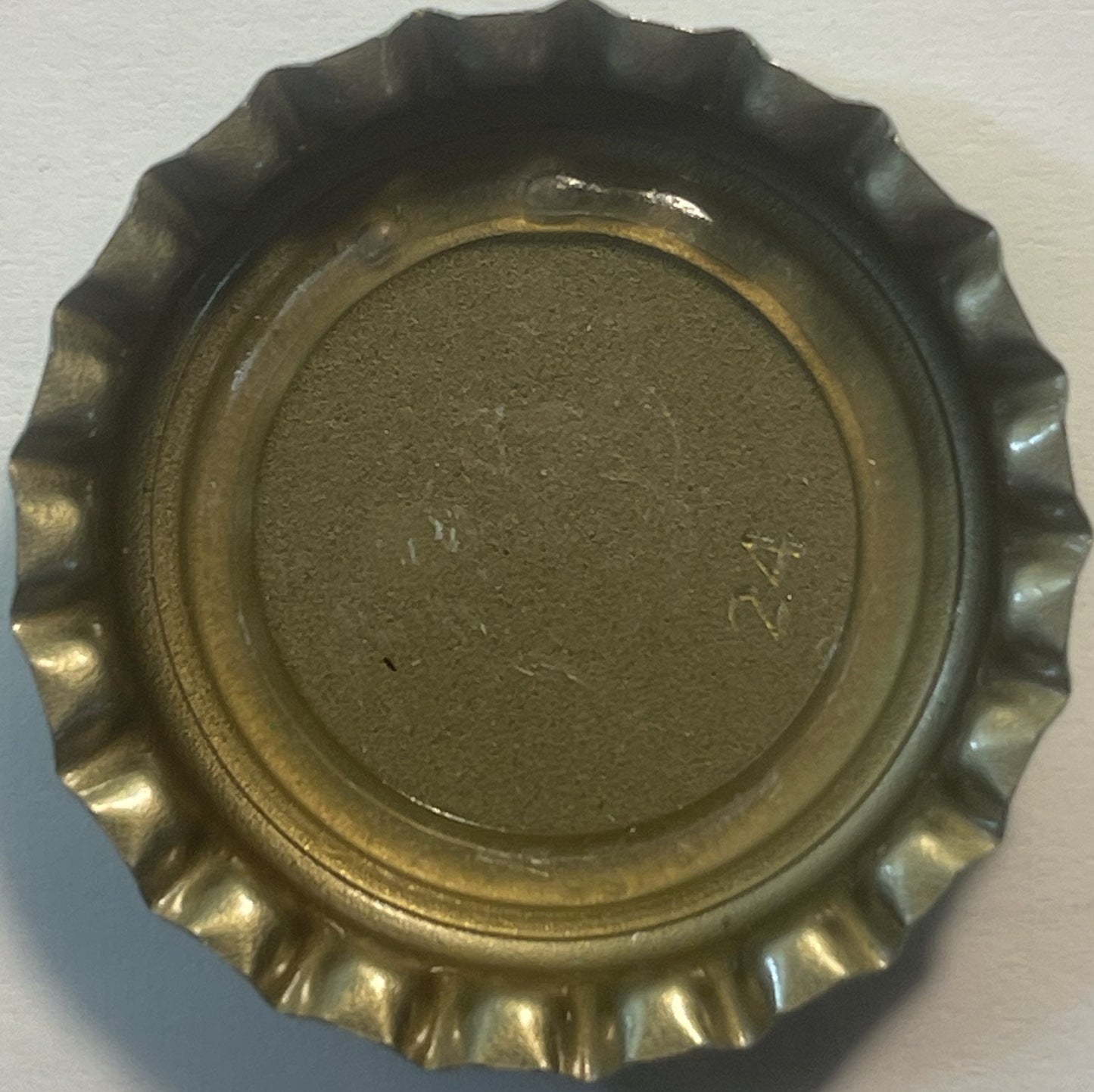
There's a particular sound that belongs to soda fountains, corner markets, and back porches on a hot afternoon — the little metallic *pop* of a crown cap giving way under an opener. For generations of Americans, that sound often came with a flash of green and white and a small red dot sliding by as the cap spun off into someone's palm or clattered onto the counter. This little lithographed crown, still carrying its crisp green field, white outlined "7UP" script, and that unmistakable red dot tucked between the numeral and the letters, is a genuine piece of that everyday ritual — preserved in new old stock (NOS) condition, never used to seal a single bottle, sitting exactly as it left the crown-making line.

This is a 7 Up bottle cap, produced for The Seven-Up Company, the St. Louis-born soft drink maker behind one of America's most recognizable lemon-lime sodas. The cap is stamped from steel and finished with lithographed color — green ground, white lettering rimmed in a darker green outline, and that bold red dot punctuating the design, with a small gold-tone registered trademark symbol trailing the wordmark. The crimped, fluted edge is the classic crown-cap profile that bottlers relied on for decades to keep carbonation locked tight inside a glass bottle. Because the manufacturer's mark pressed into this particular crown didn't strike through legibly, I won't pin an exact year to it — no honest dealer should, when the mark itself won't confirm it — but the artwork is its own kind of clue. Seven-Up didn't tuck a red dot between the "7" and the "UP" until the company simplified its wordmark, which places the design of this cap somewhere in that red-dot stretch of 7 Up history, the same graphic era so many of us remember from grocery coolers and Saturday morning television commercials. This one, as it happens, carries a story of its own: it comes down through a find made among unused stock inside a former Dr Pepper bottling plant in West Jefferson, North Carolina, tucked up in Ashe County in the Blue Ridge Mountains — the kind of small-town bottling plant that once dotted the mountain South, quietly filling glass bottles with sodas both local and national.


🥤 From "Howdy" to "Seven-Up": The Making of a Soda Empire

The story of 7 Up begins with a St. Louis advertising man named Charles Leiper Grigg, born in 1868 in a rebuilt log storeroom at Prices Branch in Montgomery County, Missouri — about as Missouri a beginning as a soda man could ask for. Grigg made his way into St. Louis working advertising jobs for outfits like Ely-Walker Dry Goods and Rice-Stix Dry Goods, drawn to the city in part by the excitement of the 1904 Louisiana Purchase Exposition, the great World's Fair that put St. Louis on the map for a generation. He wasn't new to soda pop by the time 7 Up came along, either — he'd already had a hand in inventing "Whistle" for a manufacturer owned by Vess Jones, and later developed an orange soda called "Howdy" while working for the Warner-Jenkinson flavor company.

Grigg liked the Howdy formula enough to bet on it. Along with coal merchant Edmund Ridgway and attorney Frank Y. Gladney, he bought a bottling plant of his own and, in 1920, launched the Howdy Company, named for its featured orange drink. It was a modest beginning for what would grow into a multinational soda empire. As the 1920s wore on and soda manufacturing regulations shifted, Grigg turned his attention to a lemon-flavored soft drink instead, going back to Warner-Jenkinson for help perfecting the formula. Company officials finally settled on the recipe in 1928, and Grigg filed his trademark for "Seven Up" that October, claiming the name had already been in use since early August of that year. The drink launched to the world in October 1929 — just weeks, as fate would have it, before the stock market crash that ushered in the Great Depression. Somehow, in the hardest economic decade of the century, a fizzy lemon-lime soda found its footing and never let go.

In 1936 (some retrospectives place it a year later, in 1937 — the record is a touch divided on the exact year), the Howdy Corporation formally reorganized as the Seven-Up Company, and the soda's name settled into the "7Up" styling collectors recognize today. From there, the growth was extraordinary: by the time Grigg's son, Hamblett Grigg, retired from leading the company in 1965, Seven-Up had grown to nearly 700 bottling plants operating in 60 countries around the world — an almost unbelievable expansion from a single St. Louis bottling plant purchased in 1920. By the 1940s, 7-Up had already climbed to become the third best-selling soft drink on earth, trailing only the two giants of American cola. The brand's cultural high-water mark arrived decades later with the famous "Uncola" advertising campaign of the late 1960s and 1970s, which leaned hard into 7 Up's identity as the alternative to cola — playful, green, and proudly different.


🧪 The Lithium Legend and the "Bib-Label" Mystery

Here's a piece of soda lore that's practically bottled itself into American trivia nights: for its first two decades on shelves, 7 Up actually contained lithium citrate — yes, the same compound used today as a mood stabilizer. Grigg marketed the ingredient boldly, betting that Depression-weary Americans wanted more than refreshment; they wanted a genuine "pick-me-up," and he built the drink's early identity around exactly that promise. It worked. The lithium stayed in the formula until the federal government banned lithium citrate from beverages in 1948, and by 1950 the Seven-Up Company had reformulated the drink completely, dropping the ingredient for good.

Collectors will also often hear — and repeat — the story that 7 Up's original name was "Bib-Label Lithiated Lemon-Lime Soda," a mouthful of a title that gets passed around soda-history circles as gospel. It's worth knowing that the documentary trail on that name is thinner than the legend suggests. Grigg's actual 1928 trademark filing was for "Seven Up" itself, not the "Bib-Label" title; a related filing for the term "BIB-LABEL" did surface the following year, tied to paper labeling rather than the drink's formal name, and it appears to have gone nowhere as a registered trademark. So the "Bib-Label" story is best treated the way old-timers tell campfire stories — as beloved lore passed down through the hobby rather than settled fact, which is exactly how I like to pass it along here: with the caveat attached, so the story survives honestly.


🎨 A Logo That Kept Reinventing Itself

Part of what makes 7 Up crowns and signage so collectible is that the logo itself has quite a design history. The earliest cap artwork stacked the "L"s from that "Lithiated Lemon Lime" wording over a citrusy green field with bubbles of varying sizes. By late 1929, a winged "7" rendered in bold black contours appeared, with "UP" underlined beneath it. The 1930s brought a striking Art Deco redesign — a black silhouette figure with arms raised in triumph beside a big, bubbly "7," full of period pep and optimism. By 1968, the brand had stripped things down to a clean white wordmark set against red. Then, around 1980, came the update that gives this very cap its character: the wordmark was refined again, and for the first time a small red dot with a white outline was tucked in between the "7" and the "UP" — the exact detail sitting right in the center of this crown. That red dot became one of the most enduring pieces of 7 Up's visual identity, carried through packaging, signage, and advertising for years afterward, and it's the detail today's collectors immediately recognize and search for by name.


🏔️ West Jefferson and the Blue Ridge Bottling Trade

Every regional soda story has its small-town chapter, and this cap's comes from the mountains of Ashe County, North Carolina. West Jefferson sits up in the Blue Ridge, the kind of close-knit Appalachian town where a local bottling plant would have been a fixture of daily commerce for decades — filling not just national brands like 7 Up but often local sodas and, in this case, sharing space with Dr Pepper's regional bottling operations. As the story passed down with this particular find goes, this cap turned up among a stash of genuinely unused crown caps inside a former Dr Pepper bottling plant in West Jefferson — the kind of quiet discovery that collectors dream about, a batch of caps that sat exactly where a bottling line worker left them, never crimped onto a single bottle, never opened, never thrown away. Old-timers in bottling towns like this one tell of small plants that bottled several brands under one roof depending on contracts and demand, a common practice across the mid-century soda trade in small Southern towns, where a single bottling operation might serve multiple national labels for the surrounding county. It's a wonderful bit of regional color that gives this cap a story well beyond the factory floor — a direct thread back to a specific corner of Appalachian small-town commerce.


👥 The People Behind the Pop

Charles Leiper Grigg remained the face and driving force of the company he built, living from 1868 until his death on April 16, 1940, in St. Louis — meaning he saw his soda through its launch, its Depression-era success, and its growth into a recognized national name, but didn't live to see the company's postwar global expansion. His partners deserve their own place in the story: Edmund Ridgway, the coal merchant whose capital helped get the Howdy Company off the ground, and Frank Y. Gladney, the lawyer who rounded out the founding trio. The next generation carried the torch forward — Hamblett Grigg, Charles's son, led the company through its most explosive period of growth, while Ben Wells, a son-in-law of cofounder Frank Gladney, joined the company as an advertising man in 1936 and eventually rose to company president in 1965, later serving as chairman emeritus. Howard Ridgway, son of founding partner Edmund, became the company's executive vice president in his own right. It's a genuinely family-threaded history — sons following fathers, sons-in-law joining the business — the kind of company story that gives an old advertising crown cap like this one a real human backbone behind the branding.


🌎 From a St. Louis Bottling Plant to a Global Brand — What This Cap Represents Today

The Seven-Up Company's later corporate history reads like a tour of American beverage consolidation: Philip Morris Companies acquired Seven-Up in 1978 for roughly half a billion dollars, and by 1986 the brand had split into separate U.S. and international ownership arms, later passing through Cadbury Schweppes and the Dr Pepper Snapple Group. Today, 7UP is part of the Keurig Dr Pepper portfolio here in the States, while PepsiCo carries the brand internationally — a genuinely global footprint for a soda that started with one bottling plant Grigg and his partners bought together in 1920. That's part of what makes a small crown cap like this one so satisfying to hold: it's a physical fragment from a company whose reach eventually stretched to nearly 700 bottling plants across 60 countries, boiled down to one lithographed disc of steel that once sat, unused, on a shelf in a mountain-town bottling plant waiting for a bottle that never came.


🖼️ Display Ideas

  • 🧢 Mount it on a classic wooden cap board alongside other soda-era crowns for a wall of American advertising color.
  • 🖼️ Set it in a small shadowbox paired with vintage Dr Pepper or 7 Up ephemera to tell the West Jefferson bottling-plant story visually.
  • 🔑 Have it made into a keychain or bolo tie for a wearable piece of soda fountain nostalgia.
  • 🎄 String a few together for a bottle-cap wreath or garland — a favorite craft among vintage soda collectors around the holidays.
  • 🍾 Group it with other Blue Ridge and Appalachian bottling artifacts for a regional soda history display.
  • 🏺 Drop it into a glass apothecary jar on a kitchen shelf as a small, everyday dose of Americana.

🎁 Who Collects These

Bottle cap and "breweriana" collectors are the obvious home for a piece like this, chasing down every logo variation 7 Up ever ran. Soda historians and Dr Pepper enthusiasts alike will appreciate the West Jefferson bottling-plant provenance, since crossover finds between regional and national bottlers are exactly the kind of detail that makes small-town soda history worth preserving. Collectors of Appalachian and Blue Ridge Mountain memorabilia will value the Ashe County connection specifically, while fans of mid-century advertising graphics are often drawn simply to the red-dot logo itself as a design artifact. And of course, this makes a natural gift for anyone who grew up cracking open a cold 7 Up on a summer porch — the kind of small object that instantly brings back a very specific taste, sound, and memory.


❓ FAQ

Is this cap new or used?

It's new old stock (NOS) — manufactured for use on a 7 Up bottle but never actually applied or used to seal one. It represents genuine unused inventory rather than a cap pried off a consumed bottle.

What era is this cap from?

The manufacturer's mark on the piece wasn't legible enough to confirm an exact production year, so I won't claim one. What we can say with confidence is that the red-dot logo design between the "7" and the "UP" is a graphic detail Seven-Up introduced as part of a wordmark update, placing this cap's artwork within that red-dot design era of the brand's visual history.

Is this the original "Bib-Label Lithiated Lemon-Lime Soda" cap?

That name is widely repeated in soda-collecting circles, but the actual trademark record shows Grigg filed for "Seven Up" from the start, with "Bib-Label" tied instead to a separate paper-label filing. I share the legend because it's part of the hobby's folklore, but I want you to have the fuller picture too.

Did 7 Up really contain lithium?

Yes — lithium citrate was part of the formula from the drink's 1929 launch until the federal government banned it from beverages in 1948, prompting a full reformulation by 1950.

Why is this cap connected to a Dr Pepper bottling plant?

The find comes down through a former Dr Pepper bottling plant in West Jefferson, North Carolina, a small mountain town where regional bottling operations sometimes filled bottles for more than one soda brand under one roof — a common practice in small-town Southern bottling history.

What does the red dot on the logo mean?

It's simply a design element from one of Seven-Up's wordmark refreshes, nestled between the "7" and "UP" lettering — one of the most recognizable versions of the logo among collectors today.

How should I display a single bottle cap like this?

Cap boards, small shadowboxes, keychains, and jars are all popular options — see the display ideas above for a fuller list of ways collectors like to show these off.

Shipping

🚚 Shipping & Handling

  • Shipping costs and timing are calculated at checkout.
  • Items curated and shipped directly by me include U.S. shipping at no additional cost, professionally packed to ensure safe arrival of your artifact.

Items from Vetted Pro Collectors
Shipping for items offered by vetted Pro Collectors is determined at checkout. All Pro Collector listings are reviewed to ensure fair, reasonable shipping practices.

For full details, please refer to our Shipping Policy.

Returns & Exchange

Product Page Return Policy

  • 60-Day Returns – Items must be in original condition.
  • Refunds – Issued after inspection (excluding shipping costs).
  • Return Shipping – Customer is responsible unless item is damaged or incorrect.
  • Damaged/Incorrect Items – Contact us within 48 hours for a replacement or refund.
  • Easy Returns – Email [email protected] or call 802-356-9872 to initiate a return.

For full details, visit our Refund Policy.

View full details