Skip to product information
1 of 3

Vintage and Antique Gifts

Vintage Dos Equis XX 🍺 Die-Cut Double-Sided Beer Coaster 1980s Breweriana Imported Beer Collectible American Made

Regular price 5.50 USD
Regular price Sale price 5.50 USD
Sale Sold out
Shipping calculated at checkout.

Description

When Did You First See Those Two X's on a Bar Coaster — and Realize Something New Had Arrived? 🍺

There is a very particular feeling that comes with holding a piece of bar memorabilia from the early 1980s. Not just the cardboard-and-ink reality of it, but the weight of the moment it carries — the hum of a neighborhood tavern, neon reflecting off a wet bar top, a bartender sliding something unfamiliar toward you and saying, "You have to try this one." That is the world this coaster was born into. A world where Dos Equis XX was still a discovery, still something that required explanation, still a beer that made people lean in and ask questions. This vintage die-cut Dos Equis XX coaster is not just a piece of breweriana. It is a document of that exact cultural moment — the first wave, the first impression, the beginning of something that would eventually become one of the most recognized imported beer brands in North America.

And the remarkable thing? It has survived all of it in New Old Stock condition. Crisp. Vibrant. Ready to anchor a collection or command a display.

---

🍺 What This Piece Is — The Full Picture

Let's begin with the object itself, because this coaster is genuinely unusual in the breweriana world and deserves a careful introduction. This is a vintage 1980s Dos Equis XX Imported Beer coaster, measuring 6 inches by 3 inches — already telling you it is not playing by standard coaster rules. Standard round bar coasters are utility objects. This one is a statement. It is die-cut in the shape of the XX logo itself, the wide double Roman numeral that is the brand's most iconic visual identity, and that silhouette alone sets it apart from virtually everything else on a collector's shelf.

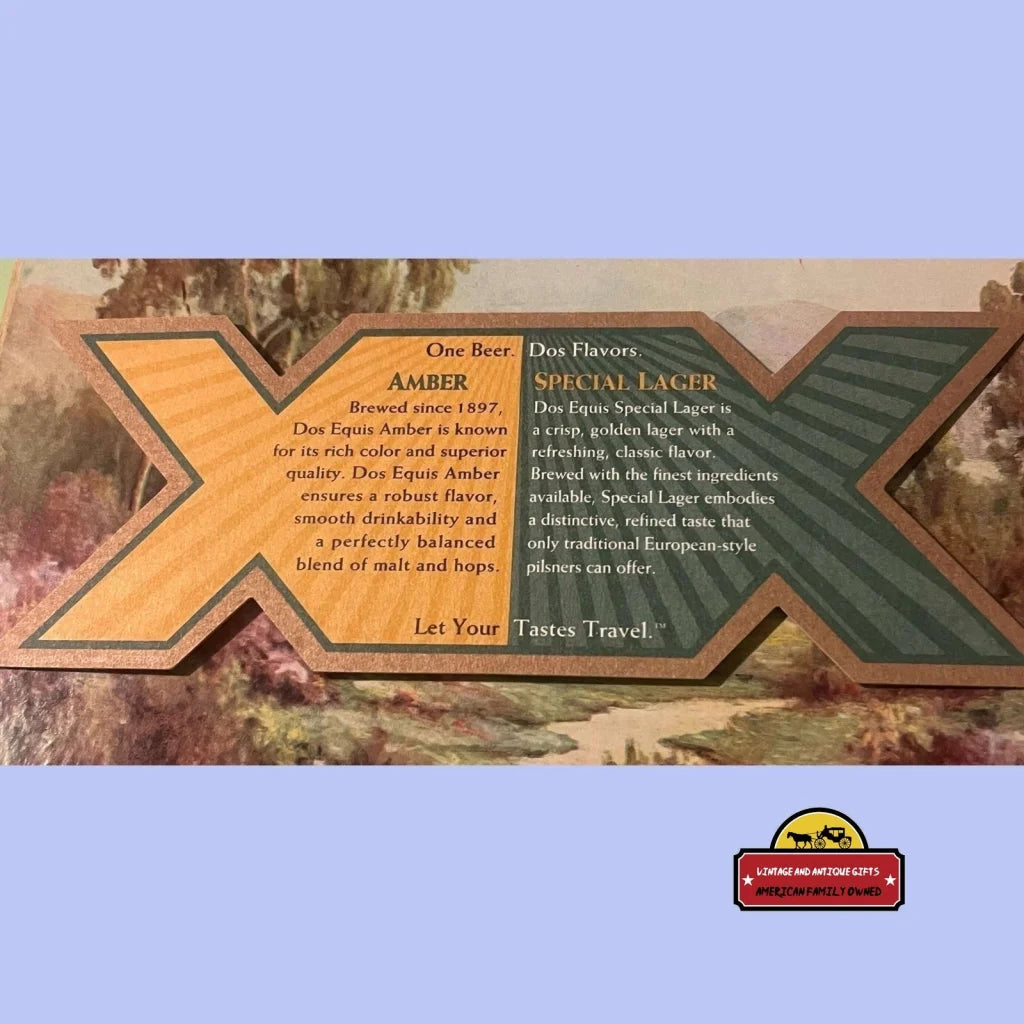
Both sides are fully printed, which is the mark of a promotional piece made with real intent. The front face carries the bold red-and-burgundy XX design, with "Dos Equis" arched above the figure and "Imported Beer" resting below it, the whole composition centered around the brand's familiar circular medallion portrait — that distinguished mustachioed gentleman who would eventually become one of advertising's most enduring archetypes. The reverse side splits the same XX silhouette into two halves: one rendered in warm amber gold, the other in deep forest green, describing the Amber and Special Lager varieties side by side. The tagline reads "One Beer. Dos Flavors." and closes with the invitation: "Let Your Tastes Travel." That last line alone is a miniature masterclass in early import beer marketing — aspirational, worldly, and absolutely of its era.

This piece is New Old Stock (NOS), meaning it was never put into active bar use. It has not been soaked through, bent, or stained by a decade of wet pint glasses. It presents with the integrity of a piece that sat in storage from the moment it left production to the moment it arrived here — a genuine survivor from the early 1980s, from the precise window that opens in 1983 when Dos Equis Lager Especial first crossed into American bar distribution. The printing is vivid, the die-cut edges are clean, and the coaster retains all the presence it had the day it was made.


🌍 From Veracruz, With German Roots — The Extraordinary History Behind the XX

The story of Dos Equis does not begin in a Mexican cantina. It begins, perhaps surprisingly, in 19th-century Germany — with a brewer named Wilhelm Hasse, who emigrated to Mexico and in 1890 founded the Moctezuma Brewery in the port city of Veracruz. Hasse brought with him the lager-brewing traditions of Central Europe — the patient cold fermentation, the amber malt profiles, the attention to clarity and balance — and he planted them in Mexican soil with remarkable results. The brewery he built would become one of the most important in Latin America, and the beer he eventually developed under the double-X name would outlast him by more than a century.

The "XX" designation has its own folklore. The most widely repeated story — and one that collectors and breweriana historians have passed down for decades — connects the double X to the turn of the twentieth century. Lore passed down among collectors holds that when Wilhelm Hasse brewed a special batch to mark the arrival of the year 1900, he stamped the barrels with two X's, the Roman numerals for the new century, as a kind of commemorative mark. The beer was called Siglo XXTwentieth Century. The double X stayed. Whether the story is strictly documented in every detail or carries some of the romantic embellishment that the best brewing legends always do, it has been told and retold for a reason: it fits. It fits the ambition of a German immigrant making his mark in a new world, and it fits the gravity of a brewery that understood it was doing something worth remembering.

Veracruz itself is essential context for understanding why this beer carries the weight it does. As Mexico's principal Gulf port city, Veracruz has been a crossroads of culture, commerce, and immigration for centuries — a place where European brewing traditions could land, take root, and merge with local ingredients and climate in ways that produced something genuinely distinct. The Moctezuma Brewery drew on that layered history. The amber variety that appears on the reverse of this very coaster — warm, malt-forward, distinctly European in its structure — is arguably the direct descendant of Hasse's original continental brewing instincts, transplanted to a tropical port and refined over generations.

By the time this coaster was produced in the early 1980s, the Moctezuma Brewery had been operating for nearly a century. Cuauhtémoc-Moctezuma, the brewing group that controlled the brand, had built it into a Mexican institution. But the American market was a different challenge entirely — a vast, brand-loyal landscape dominated by domestic lagers, where imported beer occupied a small but growing niche that had been pioneered most visibly by Heineken. The decision to bring Dos Equis across the border in 1983 was a calculated bet, and the marketing materials produced in support of that launch — including die-cut promotional coasters exactly like this one — were the front line of that campaign.

Local legend in the Texas and California bar trade holds that Dos Equis reps in the early distribution years carried stacks of die-cut coasters as their primary leave-behind — that a well-placed coaster on a bar top did more introductory work than any other promotional format because it put the XX shape directly in front of customers who had never heard the name. Whether or not that particular piece of trade lore is universally documented, anyone who has held this coaster and turned it over understands the logic immediately. The shape is a conversation starter. It was designed to be one.


📋 The Breweriana Collecting Context — Why 1980s Import Beer Coasters Matter

Breweriana — the broad category of beer-related collectibles encompassing trays, taps, signs, bottles, cans, coasters, and ephemera — has been a serious American collecting pursuit since at least the 1970s, when the first dedicated breweriana shows began drawing crowds of collectors who understood that the visual culture of American and imported beer was both historically significant and rapidly disappearing. Coasters, in particular, occupy a fascinating niche within that world. They were produced in large quantities for functional use, which means most of them were used — saturated, discarded, forgotten. The ones that survived in NOS condition are the exception, not the rule.

The 1980s import beer era is a specific and increasingly valued chapter in that collecting history. This was the decade when the American palate began its gradual, significant turn away from the homogenized domestic lager that had dominated the postwar landscape. Imported beers were the first signal of that shift — arriving on American bar tops with exotic graphics, unfamiliar shapes, and the cultural weight of Old World and Latin American brewing traditions. The coasters, tap handles, and point-of-sale materials produced during that transitional decade are now understood by serious collectors as primary documents of a pivotal moment in American drinking culture.

A die-cut coaster in a brand-logo shape is rarer within that landscape than a standard round or square format, because die-cutting added production cost and complexity. When a brewery invested in die-cut promotional materials, it was making a statement about the seriousness of its marketing intent. The fact that this Dos Equis XX coaster is cut to mirror the brand's own logo — the precise XX silhouette — makes it both a functional artifact and a piece of graphic design history. Lore passed down among import beer breweriana collectors suggests that the die-cut XX coaster was produced only during a limited early promotional window, making surviving NOS examples genuinely scarce compared to the standard round coasters that followed in later years. That story has the ring of truth: early promotional pushes tend to be the most creative, the most invested, and the least numerically abundant.


🖼️ Display Ideas

  • 🍺 Mounted in a shadow box with period bar ephemera — a vintage beer menu, a matchbook, or a period bottle label — to create a cohesive early-1980s import beer vignette that tells the whole story at a glance.
  • 🖼️ Framed under UV-protective glass as a solo graphic piece; the die-cut XX silhouette is strong enough to read as pure typography art on a bare wall, especially in a bar, kitchen, or man cave setting.
  • 🗺️ Incorporated into a regional breweriana display alongside other 1980s Texas, California, or Southwest bar collectibles to document the geography of the first Dos Equis distribution wave across the Sun Belt.
  • 📚 Displayed flat in an archival sleeve in a coaster collection binder alongside other die-cut breweriana coasters — the XX shape is immediately distinctive in any comparative display and draws the eye in any flat-lay arrangement.
  • 🍻 Paired with a vintage Dos Equis bottle or can from the same early distribution era on a dedicated brand shelf — the coaster's dual-flavor reverse design, with its amber and green halves, works beautifully as a companion piece to period packaging.
  • 🎨 Used as the centerpiece of a Veracruz or Mexican brewing heritage display, contextualized with maps, photographs, or historical text about the Moctezuma Brewery and its German-immigrant founder — a display that honors the full, layered story behind the XX.

🎁 Who Collects These

The audience for a piece like this is wonderfully broad — which speaks to how many different stories this single coaster manages to carry at once. Dedicated breweriana collectors understand immediately what they are looking at: a NOS die-cut promotional piece from a brand's first American distribution era, double-sided, in vivid condition. That combination checks every box on the serious collector's checklist — scarcity of format, age, brand significance, and condition.

Import beer and Mexican brewing history enthusiasts — and there is a growing, passionate community of them — prize early Dos Equis ephemera as documentation of a brand story that is both richer and older than most American drinkers ever knew. The connection to Wilhelm Hasse, to Veracruz, to the turn-of-the-century XX barrel stamp, to the 1983 American debut: all of it is embedded in this one small piece of cardboard and ink.

Bar and restaurant owners with a sense of history — particularly those running establishments that celebrate craft, heritage, or Latin American culture — find pieces like this invaluable for creating authentic atmosphere that no reproduction or modern print can replicate. There is no manufacturing process that produces genuine 1983. Only time does that.

Nostalgia collectors who were of bar-going age in the early-to-mid 1980s will recognize this piece with something close to a physical reaction — the sudden recall of a specific bar, a specific city, the first time someone handed them something cold and amber and said the name for the first time. That is not a minor thing. Objects that anchor memory are among the most sought-after in any collecting category.

And finally, graphic design and advertising history collectors appreciate this coaster for what it represents in the visual language of import beer marketing: the aspirational tagline, the dual-variety pitch, the die-cut format as brand statement, the "Let Your Tastes Travel" invitation that positioned Dos Equis not just as a beer but as an identity. That is sophisticated marketing for 1983, and this coaster is its physical record.


❓ Frequently Asked Questions

How do I know this coaster is genuinely from the 1980s and not a later reprint?

Several details confirm the period authenticity of this piece. The "One Beer. Dos Flavors." dual-variety messaging and the side-by-side Amber and Special Lager presentation reflect the specific early American marketing push that accompanied Dos Equis's 1983 U.S. debut — a campaign designed to introduce both varieties simultaneously to an audience unfamiliar with either. The printing style, color saturation, and cardboard stock are consistent with promotional breweriana production methods of that decade. The NOS condition — meaning the piece was never put into active bar use — means it retains the exact colors, texture, and structural integrity of the day it was produced, which makes period-accurate assessment more straightforward. The die-cut XX format is also consistent with early promotional literature from the brand's first American distribution window; later coasters moved to more standardized formats.

What exactly does "New Old Stock" mean for a paper coaster?

New Old Stock — NOS — is a term borrowed from parts and manufacturing, meaning an item was produced for its intended commercial purpose but was never actually put into use before being stored. For a bar coaster, which by its nature absorbs liquid, leaves rings, gets bent and discarded, NOS condition is genuinely remarkable. This coaster has never sat under a wet glass. It has not been folded, stained, torn, or written on. It presents with all of its original color, all of its die-cut edge crispness, and all of its printed detail intact. In the breweriana world, NOS paper and cardboard items are among the most prized precisely because the survival rate for used examples in display-quality condition is so low. What you are acquiring here is not a survivor of bar service — it is a survivor of time itself, which is a different and considerably rarer thing.

Is the die-cut XX shape fragile? How should I handle and store it?

The die-cut points of the XX silhouette are the most structurally delicate areas of the piece, as with any die-cut cardboard item where narrow extensions carry the full load of the cut. Handle this coaster by its body rather than its points, support it fully when moving it, and avoid bending or flexing. For long-term storage, an archival-quality rigid sleeve or flat storage box designed for oversized cards or flat paper ephemera is ideal — something that prevents flexing, shields against humidity, and keeps the piece flat. For display, framing under UV-protective glass not only shows it beautifully but protects the printing from light degradation over time. Avoid direct sunlight and high-humidity environments, both of which are the primary enemies of vintage paper breweriana.

Can you tell me more about the two varieties shown on the reverse — the Amber and the Special Lager?

The reverse of this coaster presents both of Dos Equis's flagship varieties in the early American distribution period: the Amber (represented in warm gold tones) and the Special Lager (represented in deep forest green). The Amber is the elder of the two in spirit — a Vienna-style lager that descends most directly from the European brewing traditions Wilhelm Hasse brought to Veracruz in 1890, malt-forward, copper-colored, with a depth of flavor that distinguished it sharply from the pale domestic lagers dominating American taps at the time. The Special Lager is a lighter, crisper profile — more accessible to an audience being introduced to import beer for the first time. The dual-variety pitch on this coaster — "One Beer. Dos Flavors." — was a deliberate marketing strategy to give distributors and bartenders two distinct entry points for different customer preferences. The coaster itself was the sales tool that explained that choice without requiring a lengthy conversation.

How does this piece fit into a broader Dos Equis or Mexican breweriana collection?

This coaster sits at a very specific and historically significant juncture in a Dos Equis collection: the first American distribution era, 1983 onward, before the brand achieved mass recognition. Pieces from this window are rarer than later promotional items because they were produced in smaller quantities for a still-developing market. Within a broader Mexican breweriana collection, this coaster connects to the Moctezuma Brewery's long history, to Veracruz's role as Mexico's great port city and cultural crossroads, and to the specific mid-1980s moment when Mexican imported beer began staking its claim on American bar culture. Pair it with period bottle caps, labels, tap handles, or point-of-sale signage from the same era and you have the beginnings of a display that documents one of the most interesting chapters in 20th-century American drinking history.

What makes this particular coaster's graphic design historically interesting?

The design choices packed into this small piece are worth unpacking carefully. The die-cut format — cutting the coaster to mirror the brand's own logo — was an unusually sophisticated promotional move for the era, turning a functional bar item into a brand impression that communicated the XX identity through shape alone, before a customer had even read a single word. The dual-sided printing maximized every surface of that promotional investment. The front carried brand identity and credibility (the medallion portrait, the "Imported Beer" designation, the prestige signaling of burgundy and red). The back carried the sales pitch (both varieties, the flavor distinction, the aspirational tagline). The phrase "Let Your Tastes Travel" is a remarkable compression of the entire import beer value proposition — adventure, sophistication, worldliness — into four words. As a document of early 1980s import beer marketing strategy, this coaster is genuinely instructive.

Is there collector community interest specifically in die-cut breweriana coasters?

Absolutely — and it has been growing steadily as 1970s-through-1990s bar ephemera moves further into the zone of genuine historical collectibility. Die-cut coasters occupy a premium niche within breweriana coaster collecting because the added production investment of the die-cutting process means they were made in smaller numbers and with more specific promotional intent than standard round or square formats. Collector shows, online breweriana communities, and dedicated auction categories have all seen increasing interest in die-cut examples from the import beer era specifically, as collectors recognize that this decade represents a transitional moment in American bar culture that is now firmly historical. A NOS example in the die-cut XX format, from the first American distribution window of one of the most recognizable imported beer brands in the world, represents a meaningful piece of that history — and the supply of such pieces is not increasing.

Shipping

🚚 Shipping & Handling

  • Shipping costs and timing are calculated at checkout.
  • Items curated and shipped directly by me include U.S. shipping at no additional cost, professionally packed to ensure safe arrival of your artifact.

Items from Vetted Pro Collectors
Shipping for items offered by vetted Pro Collectors is determined at checkout. All Pro Collector listings are reviewed to ensure fair, reasonable shipping practices.

For full details, please refer to our Shipping Policy.

Returns & Exchange

Product Page Return Policy

  • 60-Day Returns – Items must be in original condition.
  • Refunds – Issued after inspection (excluding shipping costs).
  • Return Shipping – Customer is responsible unless item is damaged or incorrect.
  • Damaged/Incorrect Items – Contact us within 48 hours for a replacement or refund.
  • Easy Returns – Email [email protected] or call 802-356-9872 to initiate a return.

For full details, visit our Refund Policy.

View full details