Skip to product information
1 of 19

Rugistan

Antique Turkish Reyhanli Ottoman Hand-Woven Kilim 19th Century Wool

Antique Turkish Reyhanli Ottoman Hand-Woven Kilim 19th Century Wool

Regular price 2,500.00 USD
Regular price 3,500.00 USD Sale price 2,500.00 USD
Sale Sold out
Shipping calculated at checkout.

Description

🌙 From the Ottoman Heartland: An Antique Turkish Reyhanli Kilim, Late 19th Century

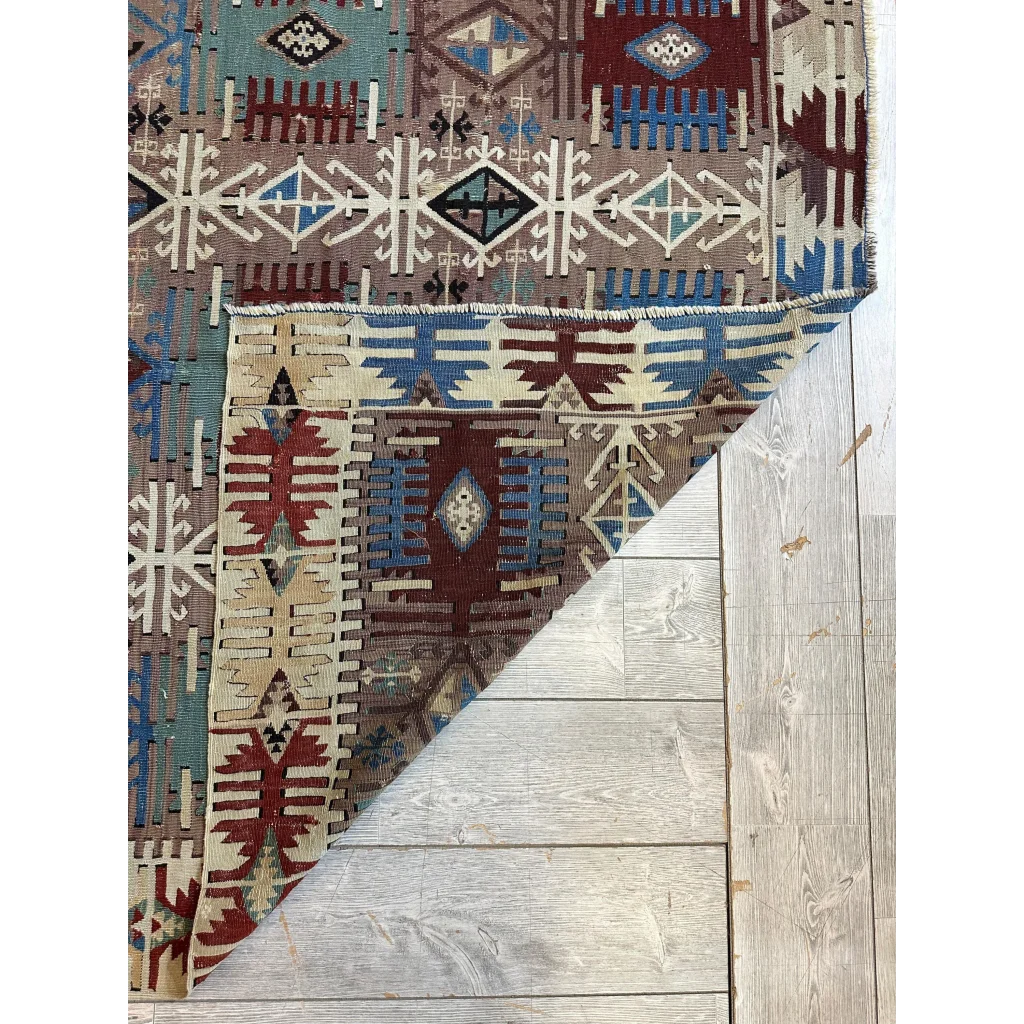
In the weaving history of the Ottoman Empire, the kilims of Anatolia occupy a place of particular importance — functional textiles elevated to objects of formal sophistication by generations of weavers who understood the geometric vocabulary of flatweave as a complete design language, not a substitute for pile construction. 🏛️ This antique Turkish Reyhanli kilim, hand-woven in the late 19th century from 100% natural wool in the Reyhanli region of what is now southern Turkey's Hatay province, is a direct artifact of that tradition. Its geometric patterns in earthy brown, blue, ivory, and black tones, woven entirely in flatweave, carry the specific visual authority of Ottoman Anatolian textile culture at its most concentrated. Rug number: K1588.

🌍 Reyhanlı and the Anatolian Kilim Tradition

Reyhanlı is a district of Hatay province in southeastern Turkey — a region with a complex and layered history that reflects its geographic position at the crossroads of Anatolian, Arab, and Levantine cultural influences. 🗺️ The kilims woven in this region drew from the broader Anatolian flatweave tradition that extended across the Ottoman heartland, producing textiles characterized by bold geometric medallion formats, strongly contrasted natural dye palettes, and the kind of disciplined, symmetrical pattern work that defines Anatolian kilim culture at its best.

The late 19th century represents the final chapter of the great Ottoman kilim tradition produced entirely within the living context of Anatolian village weaving. 📜 The political and economic disruptions of the early 20th century — the decline and collapse of the Ottoman Empire, the Turkish War of Independence, the population exchanges of the 1920s — substantially disrupted the traditional weaving communities of Anatolia. Pieces from the late 19th century, made in the decades immediately before those disruptions, are among the last produced entirely within the intact traditional context.

🧵 Kilim: The Flatweave Tradition

A kilim is a flatweave textile — woven on a loom through the interlocking of warp and weft threads to create structure and pattern simultaneously, without any additional knotted pile. 🔤 The flatweave technique produces a surface that is both the structure and the decoration: the pattern emerges entirely from colored weft threads passing through the warp, creating a textile with immediate graphic clarity, perfect reversibility, and a structural integrity that enables sophisticated geometric design.

In the Anatolian kilim tradition, the flatweave construction was not a limitation but an aesthetic choice — a discipline that forced design into geometric language and produced the specific visual quality that distinguishes kilims from pile rugs at any quality level. 🎨 The bold, angular, immediate pattern quality of the Reyhanli kilim is a direct consequence of the flatweave construction, and it is precisely that quality that makes antique Anatolian kilims so compelling in contemporary collector and design contexts.

🌿 Natural Dyes: Colors That Have Aged a Century

The dyes that color this kilim are natural — plant and mineral sources that Ottoman Anatolian weavers had used for centuries before synthetic dyes arrived in the mid-19th century. 🌱 The earthy brown tones came from tannin-rich plant sources and walnut hull; the blues from indigo and its derivatives; the ivory from undyed natural wool; the black from iron mordant processes. These natural dyes have proven their stability across more than a century — they have mellowed and warmed rather than fading, developing the specific tonal depth that distinguishes aged natural-dye textiles from anything produced with synthetic colorants.

📐 Format, Condition, and Display

At 5 ft by 8 ft 3 in, this kilim is sized for use as a primary room textile — large enough to anchor a seating arrangement or dining area, in a format that works equally well on the floor or displayed as a wall hanging. 🖼️ The flatweave construction makes wall mounting straightforward: the textile hangs flat and clean without the weight issues that pile rugs can present in vertical display.

Condition: antique, professionally cleaned and maintained. 🛡️ Both ends of the kilim are intact — a genuinely rare quality in a piece of this age, where end fraying and loss are among the most common conditions affecting antique kilims. There are minor areas of disjoining — the kilim weft occasionally separating from the warp at older stress points — no missing wool, no pattern loss, just the evidence of age and use that any honest antique textile will show. These minor areas do not affect the visual integrity or displayability of the piece. Photographs are provided and are part of the item description as they reflect true condition.

The earthy tones of the natural-dye palette — warm browns, the specific aged indigo blue, ivory, and black — work in virtually any interior that includes wood, stone, or warm neutral tones. 🏡 Against white walls as a hanging, the geometric patterns read as bold graphic art with the specific visual authority of authentic historical textile culture.

🎁 Collector Value: Late 19th Century Ottoman Kilim

Antique Turkish kilims from the late 19th century — particularly those with intact condition, natural dye palette, and documented regional attribution like Reyhanli — are among the more sought-after pieces in the antique flatweave market. 💎 The combination of authentic age, natural dyes that have mellowed beautifully across a century, intact ends, and the geometric visual authority of the Anatolian kilim tradition makes K1588 a meaningful acquisition for serious collectors and thoughtful interior designers alike.

The Ottoman Empire is history. The weaving communities that produced these kilims as living practice are largely gone. What remains are the textiles themselves — woven evidence of a material culture that expressed its deepest aesthetic values in wool and dye, on a loom, across generations. 🕰️

Rug Number: K1588 🏷️

Shipping

🚚 Shipping & Handling

  • Shipping costs and timing are calculated at checkout.
  • Items curated and shipped directly by me include U.S. shipping at no additional cost, professionally packed to ensure safe arrival of your artifact.

Items from Vetted Pro Collectors
Shipping for items offered by vetted Pro Collectors is determined at checkout. All Pro Collector listings are reviewed to ensure fair, reasonable shipping practices.

For full details, please refer to our Shipping Policy.

Returns & Exchange

Product Page Return Policy

  • 60-Day Returns – Items must be in original condition.
  • Refunds – Issued after inspection (excluding shipping costs).
  • Return Shipping – Customer is responsible unless item is damaged or incorrect.
  • Damaged/Incorrect Items – Contact us within 48 hours for a replacement or refund.
  • Easy Returns – Email info@vintageantiquesgifts.com or call 802-356-9872 to initiate a return.

For full details, visit our Refund Policy.

View full details