Skip to product information
1 of 8

Vintage and Antique Gifts

Vintage Late 1940s-50s Budd Orange Soda Label 🥤 Budd's Beverages Newport & Lebanon New Hampshire Lithograph

Vintage Late 1940s-50s Budd Orange Soda Label 🥤 Budd's Beverages Newport & Lebanon New Hampshire Lithograph

Regular price $8.00 USD
Regular price Sale price $8.00 USD
Sale Sold out
Shipping calculated at checkout.

Size: 4 1/4" x 3 3/4"

🚚 Free US Shipping — ships within one business day. International shipping calculated at checkout.

Quantity

Whatever Happened to the Soda That Made New Hampshire Taste Like Summer? 🥤

Size: 4 1/4" x 3 3/4"

There is something quietly miraculous about holding a piece of paper that was printed to sell a drink, never sold, and somehow survived the entire arc of a company's life — from its immigrant-founded beginnings clear through to its final closing day. That is exactly what you are holding when you pick up this original Budd Orange Soda label from Budd's Beverages, Inc. of Newport and Lebanon, New Hampshire. It wasn't framed. It wasn't collected on purpose. It was simply made, stacked with its brothers in a stockroom somewhere in the Sullivan County hills, and then time passed and the world kept turning and here it is — a survivor in the truest sense of the word.

I've been doing this long enough to recognize when a piece has genuine story behind it and when it's just old paper. This one has story. Real, documented, New England-rooted story — the kind that involves Polish immigrants, Depression-era soda fountains, a bowling alley on the top floor of a bottling plant, a World War II veteran who bought the whole operation, and a regional soda empire that quietly served most of New Hampshire and a healthy slice of Vermont before closing its doors for good in 1972. All of that history lives in this label. Let me tell you about it properly.


🏷️ What It Is — The Object Itself

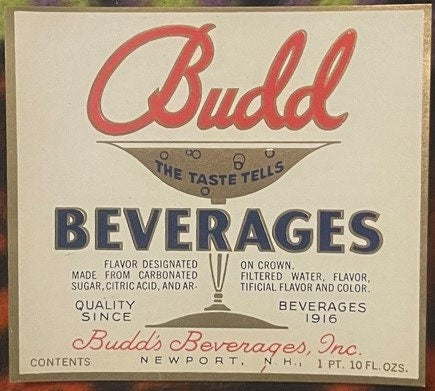
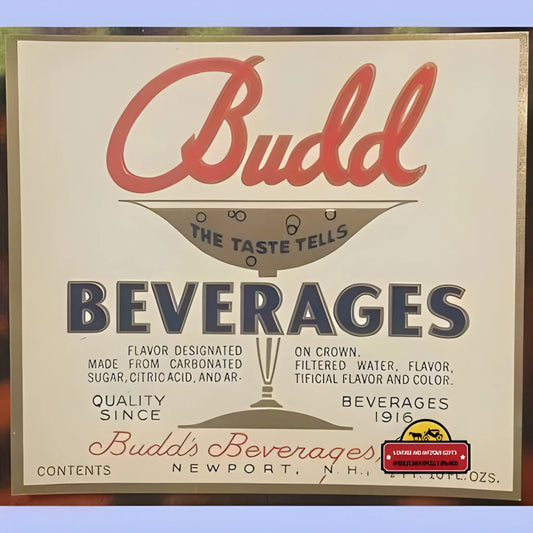
This is an original paper lithograph label for Budd Orange Soda, produced for use by Budd's Beverages, Inc., with bottling operations located in both Newport, New Hampshire and Lebanon, New Hampshire. The text printed directly on its face reads verbatim: "Budd — THE TASTE TELLS — ORANGE SODA — MADE FROM CARBONATED SUGAR, FLAVOR, CITRIC ACID — FILTERED WATER, CANE AND ARTIFICIAL COLOR — QUALITY SINCE BEVERAGES 1916 — Budd's Beverages, Inc. — CONTENTS NEWPORT, N.H., LEBANON, N.H. — 1 PT. 10 FL. OZS."

The label is a lithograph — printed in a palette of red, gold, blue, cream, and black — and centers on one of the most charming pieces of mid-century American beverage iconography I've come across: a wide, stylized champagne coupe glass, rendered in warm gold tones, brimming with carbonated bubbles drawn as open circles rising lazily toward the rim. The brand name Budd arches above it in sweeping red script, and below the glass, ORANGE SODA is set in bold, confident red block capitals that would have caught the eye on any bottle rolling off the Newport Bottling Works line.

This is a New Old Stock (NOS) example — an unissued label that never made it onto a bottle, which is precisely why it has survived in the form you see it today. The size designation — 1 pint, 10 fluid ounces, or 26 ounces — and the dual Newport / Lebanon town imprint together identify this as a specific and particularly collectible variant. Lebanon, New Hampshire is in Grafton County, some distance from Newport in Sullivan County; a label carrying both addresses documents a moment in the company's history when it was operating simultaneously from two different locations, and that second address only came along in 1948, the year the firm opened a warehouse in Lebanon.

So when was this one printed? The 1916 on its face is the founding year, not the print date, and the label itself says a good deal more. It reads Budd's Beverages, Inc., and that company didn't exist until March 31, 1948, when the old Newport Bottling Works was incorporated under the Budd name; the New Hampshire Secretary of State still has the filing. The Lebanon line points the same way, because the town's own 1961 history says they opened a warehouse in Lebanon that same year. The company was dissolved in 1973, so this sheet was printed somewhere between 1948 and the early '70s. The Lebanon branch turns up in a 1952 Lebanon High School yearbook ad ("1916 — 1952, '36 Years In Good Taste'", phone 870-W, Lebanon) and in a 1954 newspaper market guide for Lebanon and Hanover, so the late '40s and the 1950s are where I'd put it.


🏭 The Company — Budd's Beverages, Inc. and the Newport Bottling Works

The story of Budd's starts with Alexander Budnitz, who settled in Newport around 1908 and founded the business in 1916 with his son Isaac, as A. Budnitz & Son on Sullivan Street. The story collectors tell is that it began as a grocery serving Newport's Polish immigrant families. The town's own 1961 history remembers it as a soft-drink business from the very start, back in the horse-and-buggy days of the trade, when the machinery was worked by hand and deliveries went out by horse and wagon. "Budd" was the short, easy name the family went by, and by the 1940s Isaac was known in the trade as Isaac Budd. Alexander Budnitz died in Newport on June 28, 1954, at 80, still listed as the founder and president of Budd's Beverages, Inc.

By the mid-1920s the business was running as the Newport Bottling Works: Isaac Budnitz, doing business under that name, filed for the Dartmouth Dry trademark in 1926 and said it had been in use since May 12, 1925. In those years the sodas went out as Bud's Best, "bottled by the Newport Bottling Works", as their 1920s labels and ads put it. In 1929 the works moved to Sunapee Street, in 1938 it added modern syrup and bottling rooms, and after Repeal it wholesaled beer as well. The New Hampshire Historical Society has cataloged Budd's bottles from across the years: an embossed one from the Newport Bottling Works days, marked "BUDDS BEST / CONTENTS 8 FLU.OZS / NEWPORT BOTTLING WORKS / NEWPORT, N.H.", a 1961 bottle of Sun Spot orange soda that Budd's bottled in Newport, and a 1962 Budd's bottle, made by Thatcher Glass, carrying the same champagne glass and the same words as this label: "BUDD / BEVERAGES / SINCE 1916 / QUALITY PRODUCTS / 'THE TASTE TELLS'", and on the back, "BOTTLED BY BUDD'S BEVERAGES INC. NEWPORT, N. H."

By the Depression era, Budd's had built real market presence. The brand developed a roster of named sodas that extended well beyond orange: Dartmouth Dry, Fruit Bowl, and Old Sol were among the house labels that gave the company its regional identity. And Budd's was also a distribution partner for some of the era's biggest names — Moxie, Coca-Cola, and Ted's Root Beer, the root beer named for Ted Williams, the baseball legend who had a deep personal connection to New England. Being a Coke distributor in this era was no small matter; it speaks to the scale and credibility the operation had earned.

The company's service territory was genuinely regional in scope: accounts from collectors and local historians describe Budd's as serving most of New Hampshire and part of Vermont — a meaningful footprint for a family-scale bottling operation in the mid-twentieth century. The dual Newport-Lebanon imprint on this label is itself a piece of evidence for that geographic reach: Lebanon sits near the Connecticut River on the Vermont border, and operating from there extended Budd's reach directly into the Upper Valley market that straddled both states.

The family stayed at the helm a long while. Elihu M. Budd, Yale class of 1952, came into the business in 1954 after his Army service as clerk of the corporation, manager and salesman, and in 1961 Isaac Budd was still president and treasurer. The company changed hands some time after that. The most independently documented chapter of that transition comes through a Lebanon, New Hampshire obituary record for Millard F. LaJoie, born December 29, 1922, in Lebanon — a lifelong area resident, Lebanon High School alumnus, and U.S. Army veteran of World War II. His obituary records plainly that Mr. LaJoie worked for many years at Budd's Beverages in Lebanon and Newport before buying the company, which he owned and operated for several years. That single sentence, sourced from a death record rather than from any seller's marketing copy, confirms three things that matter to a collector: that the company was operating in both Newport and Lebanon simultaneously during at least part of its history; that it passed through at least one subsequent owner after its founding family; and that it was, right up to its end, a genuinely local, human-scaled enterprise run by people with deep roots in the Upper Valley. By 1971 the New Hampshire Register lists Millard La Joie as president, with ten employees at 91 Sunapee Street.

Budd's Beverages closed permanently in 1972, bringing to an end fifty-six years of New Hampshire soda-making. The label you are looking at is one of the few tangible remnants of that entire arc.


🏔️ The Town — Newport, New Hampshire and the Upper Valley

Newport is one of those New England towns that rewards knowing. It sits as the county seat of Sullivan County, positioned roughly forty-three miles west-northwest of Concord in the gentle hill country of western New Hampshire, not far from Lake Sunapee and the Connecticut River valley. By the mid-nineteenth century it was already an established mill town: three woolen mills and two tanneries were operating there by 1859, and the Sibley Scythe Company, established in 1842, was producing the scythes that — and this is the kind of detail that stops you cold — cleared jungle during the construction of the Panama Canal. Newport made tools that built the modern world, and then quietly went on making things long after the rest of the country had moved on.

The Polish immigrant community that Budnitz originally founded his business to serve was part of a broader wave of European immigration that reshaped New Hampshire's small industrial towns in the late nineteenth and early twentieth centuries. These were working families — mill workers, tradespeople, small farmers — who brought with them an appetite for community institutions: groceries that stocked familiar goods, social halls, churches, and eventually the kinds of local businesses that made a place feel like a place. Budd's Beverages was born out of that impulse. It began as a service to a community, and it grew into something the whole region claimed.

Lebanon, the second town named on this label, sits in Grafton County near the border with Vermont, where the Connecticut River defines the state line. It is Upper Valley country — a landscape of covered bridges, white church steeples, and small-city commercial blocks that has changed less than almost anywhere else in the northeastern United States. That Budd's maintained a presence in both towns speaks to the company's ambition to bridge the two distinct market areas of western New Hampshire, and it makes the dual-imprint label a genuinely geographic document, not just a branding piece.


🖼️ Display Ideas

  • 🍊 Frame it in a simple black or dark walnut float frame — the cream ground and red-and-gold lithography absolutely sing against a dark mat, and the champagne glass illustration becomes a centerpiece worthy of any kitchen, bar area, or den.
  • 🏠 Group it with other New Hampshire or New England regional soda and bottling labels in a salon-style arrangement — Moxie, local ginger ale brands, Upper Valley dairy labels — for a wall that tells the whole story of mid-century regional food culture in one composition.
  • 🥂 Display it behind a bar cart or home bar setup, where the coupe-glass illustration and the "The Taste Tells" slogan will earn every bit of the conversation it starts among guests who notice it.
  • 📚 Pair it with New Hampshire historical maps or vintage tourism ephemera — Lake Sunapee resort-era prints, White Mountains travel posters — for a layered Upper Valley vignette that grounds the label in its landscape.
  • 🏺 Place it alongside an embossed Budd's soda bottle — the New Hampshire Historical Society's collection documents the bottle form — for a tabletop display that shows both the container and its label as they would have existed together on a mid-century grocery shelf.
  • 🖼️ Use archival mounting and UV-protective glazing if you frame it — this is a piece of lithographic printing history, and protecting it ensures it passes to the next generation of collectors as beautifully as it arrived in this one.

🎁 Who Collects These

Budd's Beverages labels occupy a genuinely interesting crossroads in the American ephemera and breweriana collecting world, and I've seen them resonate with several distinct communities of collectors.

New Hampshire and New England regional collectors are the most naturally drawn to this piece — people who grew up in Sullivan County, Grafton County, or the Upper Valley, or whose families did, and for whom the Budd's name carries the specific weight of personal memory. There is a whole category of collector for whom a piece like this is not just advertising art but autobiography — a window back into a childhood summer, a specific kitchen, a particular flavor of a place that no longer exists in quite the same form.

Soda and bottling breweriana specialists are a dedicated and knowledgeable community who track regional American soda brands with the same seriousness that beer breweriana collectors apply to local breweries. The dual Newport-Lebanon imprint and the NOS status of this label make it a documented variant worth adding to a focused collection, and the New Hampshire Historical Society's institutional documentation of the brand gives it provenance weight that many regional soda labels lack.

Mid-century American graphic design and advertising art collectors will find the label's lithographic craft genuinely compelling — the confident script of the brand name, the stylized coupe illustration, the bold block-capital product name, and the clean information hierarchy all reflect the commercial printing sensibility of an era when everyday packaging was designed with real care and real skill.

Ted Williams and Red Sox memorabilia collectors occasionally find their way to Budd's pieces precisely because of the Ted's Root Beer distribution connection — it is a tangential link, but in the world of New England baseball collecting, tangential links have a long and honorable tradition.

And finally: people who simply love what American small businesses looked like before consolidation swallowed the regional soda industry. There were hundreds of companies like Budd's — local, family-scaled, place-specific, making drinks that tasted like somewhere in particular — and almost all of them are gone now. The labels are what remain. This one is a beautiful example of what that world looked like.


❓ Frequently Asked Questions

Is the 1916 date on the label the age of this label?

No — and this is one of the most important points to understand about this piece. The 1916 date is a founding date, printed on the label to commemorate the year Budd's Beverages was established. It functions as a quality and heritage signal — the equivalent of "established since" language you still see on long-running brands today. The label itself was printed in 1948 or later: the "Inc." in Budd's Beverages, Inc. dates from the company's incorporation on March 31, 1948. The graphic style, the paper label format, the statement-of-contents language, and the dual Newport-Lebanon imprint all point to a mid-twentieth-century production date, decades after the 1916 founding. It is a mid-century label commemorating a 1916 founding. The 1916 on its face is history, not the label's own age.

What does "New Old Stock" mean for this label?

New Old Stock (NOS) means this label was printed for commercial use, stocked in inventory, and never applied to a bottle. It did not go through the bottling process — it was not wet-glued to glass, did not pass through refrigeration or distribution, and did not end up in a consumer's hands as part of a product purchase. It remained in storage as part of Budd's label inventory from the time of its printing. NOS examples are the form in which paper labels most authentically survive, and they represent the label exactly as it was intended to be seen when it came off the lithograph press.

Why does this label carry two town names — Newport and Lebanon?

The dual Newport, N.H. / Lebanon, N.H. imprint documents a specific operational moment in Budd's Beverages history when the company was maintaining bottling or distribution presence in both locations simultaneously. Newport was the original home of Budd's, where it ran as the Newport Bottling Works until it was incorporated in 1948. Lebanon — located in Grafton County near the Vermont border, in what's known as the Upper Valley — represented a geographic expansion of the company's operational footprint; the warehouse there opened in 1948, the same year as the incorporation. The obituary of Millard F. LaJoie, a later owner of the company, independently confirms that Budd's was operating in both Newport and Lebanon during his tenure.

Is this label documented in any institutional collections?

The brand — Budd's Beverages — is documented in the collection of the New Hampshire Historical Society, which has cataloged an embossed bottle marked "NEWPORT BOTTLING WORKS / NEWPORT, N.H.", a 1961 Sun Spot orange soda bottle from Budd's Beverages, and a 1962 Budd's bottle made by Thatcher Glass, with applied color labeling carrying the slogan "BUDD / BEVERAGES / SINCE 1916 / QUALITY PRODUCTS / 'THE TASTE TELLS'" — the identical slogan family used on this label. That institutional documentation places Budd's Beverages within the recognized material culture record of New Hampshire, and it gives this label a provenance context that purely commercial ephemera sometimes lacks. The label format itself, as opposed to the bottle, is documented through dealer records including a verified NOS example described as a "BUDD BEVERAGES Budd's Beverages Inc. Newport N.H., 1pt 10oz size picturing a glass."

What is the significance of the coupe glass illustration on this label?

The wide, shallow champagne coupe glass at the center of this label — rendered in warm gold lithographic tones with a stem, a base, and a cluster of rising bubble circles — is not a random decorative choice. In mid-century American soda advertising, the coupe or wide-bowl glass was a recurring graphic shorthand for effervescence, sophistication, and refreshment. It borrowed visual language from the cocktail and champagne culture of the era and applied it to soft drinks in a way that elevated the product's perceived quality. For Budd's, a regional brand competing for shelf presence against national labels, that visual elevation mattered. The coupe illustration, combined with the "The Taste Tells" slogan, positioned Budd Orange Soda as a product confident enough in its quality to let the drinking experience speak for itself — a notably assured brand voice for a Sullivan County bottling operation.

What other brands did Budd's Beverages produce or distribute?

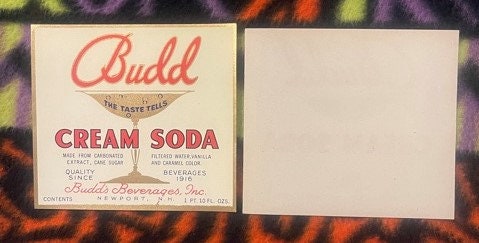
Budd's Beverages developed a meaningful roster of both house-label sodas and distributed brands. Among the company's own named labels were Dartmouth Dry, Fruit Bowl, and Old Sol — a suite of products that gave the brand real variety across the soda category. Beyond its own production, Budd's served as a regional distributor for several nationally recognized names: Moxie (the iconic New England tonic soda with its own fierce regional following), Coca-Cola, and Ted's Root Beer, the root beer associated with Ted Williams of the Boston Red Sox. The combination of house labels and major distribution partnerships was a standard business model for mid-century regional bottlers, and it speaks to the scale of Budd's operation that it held distribution relationships with brands of that stature.

What should I know about preserving and framing this label?

Paper lithograph labels from the mid-twentieth century reward thoughtful care. If you are framing this piece for display, archival-quality mounting — meaning acid-free mat board and backing materials — is the standard recommendation among paper ephemera collectors, as it prevents chemical interaction between the paper and its housing over time. UV-protective glazing (UV-filtering glass or acrylic) is worth considering if the piece will be displayed in a room with meaningful natural light exposure, as lithographic inks respond to light over long periods. For storage rather than display, archival polyester sleeves or envelopes are the preferred format. None of this is complicated or expensive — it is simply the standard practice that allows pieces like this to remain in excellent collectible condition across generations. This label is a piece of American lithographic printing history and New Hampshire commercial culture; it deserves a home that honors what it is.

Shipping

🚚 Shipping & Handling

  • Shipping costs and timing are calculated at checkout.
  • Items curated and shipped directly by me include U.S. shipping at no additional cost, professionally packed to ensure safe arrival of your artifact.

Items from Vetted Pro Collectors
Shipping for items offered by vetted Pro Collectors is determined at checkout. All Pro Collector listings are reviewed to ensure fair, reasonable shipping practices.

For full details, please refer to our Shipping Policy.

Returns & Exchange

Take your time — you've got a full six months. If a piece isn't right for you, send it back the way it reached you and we're good.

In the first 30 days your money goes straight back the way you paid. After that it's store credit, so you can put it toward something you'd rather have.

Return shipping we sort out between us, case by case. I don't make this difficult.

If something arrives damaged, or it isn't what I said it was, send me a photo within 48 hours and I'll make it right.

Email info@vintageantiquesgifts.com or call 802-356-9872 — that's me answering, not a call center.

The only things I can't take back are custom or special-order pieces and gift cards.

View full details

Preserving History: Authentic Objects Across Eras

— Curated by Travis Weigel