Skip to product information
1 of 5

Vintage and Antique Gifts

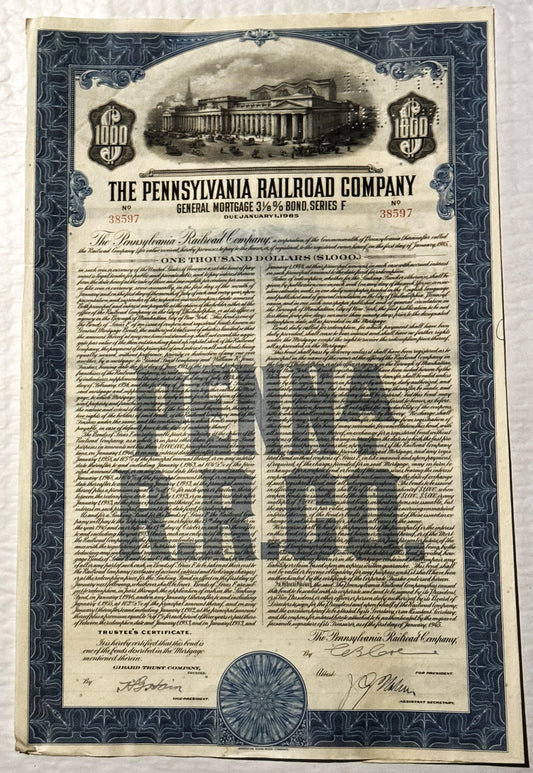
Antique Pennsylvania Railroad Stock Certificate ๐Ÿš‚ 1927 Nannie Cunningham Philadelphia

Regular price 8.00 USD
Regular price Sale price 8.00 USD
Sale Sold out
Shipping calculated at checkout.

Description

What did it feel like to hold a piece of the mightiest railroad on Earth? ๐Ÿš‚

There was a time when owning even a handful of shares in the Pennsylvania Railroad meant something. It meant you had a stake โ€” however small โ€” in the very corporation that was moving America's coal, steel, wheat, and people from one coast of ambition to another. Long before "blue chip" was a common phrase, the Pennsylvania Railroad was the blue chip, the stock that grandfathers bought for grandchildren, that trust officers recommended without blinking, that widows and orphans held onto because everyone knew the Pennsy simply didn't fail. Holding one of these certificates today is holding a small, engraved echo of that confidence.

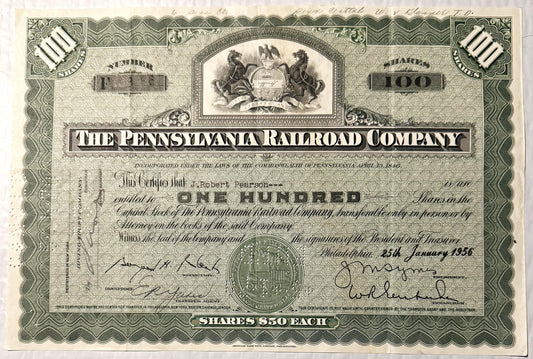
This is an original stock certificate issued by The Pennsylvania Railroad Company, headquartered in Philadelphia, Pennsylvania, engraved and printed by the American Bank Note Company at its Philadelphia office. The certificate is a piece of genuine early-20th-century financial engraving โ€” intaglio printing with dense guillochรฉ lathe-work borders (the fine, wave-like security patterns designed to defeat counterfeiters) and a central vignette rendered in the same painstaking, hand-engraved style used on U.S. currency of the day. The design places this issue in the late 1920s, and each share carried a $50 par value under the terms printed on its face. This is new old stock (NOS) โ€” a genuine, unused-in-commerce survivor of the railroad's original stock issue, never reprinted or reproduced, offered here as an authentic period document rather than a modern facsimile.


๐Ÿš‚ The Pennsylvania Railroad: From Charter Fight to "Standard Railroad of the World"

The date engraved into this certificate's letterhead โ€” April 13, 1846 โ€” is the company's real birthdate, granted by the Commonwealth of Pennsylvania. The railroad was born out of civic anxiety: Philadelphia's merchants watched Maryland's Baltimore & Ohio Railroad push westward toward the Ohio Valley and feared their own city would be left behind in the race for the lucrative Great Lakes and frontier trade. Pennsylvania answered by chartering its own line to run from Harrisburg to Pittsburgh, and letters patent were formally issued in early 1847.

What followed over the next several decades was one of the great corporate growth stories in American history. Engineers drove the line up and over the Allegheny Mountains โ€” the famous Horseshoe Curve near Altoona became one of railroading's signature feats of construction โ€” and from that mountain crossing the Pennsylvania Railroad expanded outward in every direction, absorbing, leasing, or partnering with hundreds of smaller lines. By the 1880s it had grown into the largest railroad, the largest transportation enterprise, and by some measures the largest corporation of any kind, anywhere in the world. It became known simply as "the Pennsy," and its own advertising called it the "Standard Railroad of the World" โ€” a boast that, for a long stretch of American history, was hard to argue with. At its height the company was the largest private employer in the United States, its payroll running into the hundreds of thousands, its rails threading through the industrial heart of the nation from New York to Chicago and St. Louis.

By the time this certificate was issued in the late 1920s, the Pennsylvania Railroad was riding the crest of that reputation โ€” a company so large and so trusted that its stock certificates were treated almost like currency in their own right, traded on exchanges in both New York and Philadelphia, as this very certificate's transfer clause states.


๐Ÿ–จ๏ธ Engraved by the Best: American Bank Note Company, Philadelphia

A railroad this important didn't hand its stock certificates to just any printer. It went to the American Bank Note Company, whose Philadelphia office is named directly on this document's lower border. The firm's lineage runs remarkably deep for an American company โ€” back to 1795, when Robert Scot, the very first chief engraver of the United States Mint, joined with partners to found an engraving house in Philadelphia. That original Philadelphia shop is a direct ancestor of the modern American Bank Note Company, which took its familiar corporate name in 1858 when several competing security-printing firms merged into one. By the 1840s, the company's Philadelphia branch was already advertising itself for exactly the kind of work seen on this certificate: bank notes, bonds, drafts, insurance policies, and "certificates of stock... in the finest and most artistic style, with all the requisites to prevent counterfeiting." That is precisely the craftsmanship on display here โ€” the fine-line guillochรฉ borders, the shaded intaglio lettering, the hand-engraved central vignette โ€” techniques borrowed directly from currency printing, because in an era before easy photographic reproduction, that level of engraving detail was the only real defense against forgery. American Bank Note Company would go on to print postage stamps, currency, and securities for governments and corporations around the world, and this certificate stands as a small but genuine sample of that output at its Philadelphia origin point.


๐Ÿ•ต๏ธ A Hidden Fingerprint: The Registrar's Clue

Old financial documents sometimes carry their own quiet dating evidence, buried in the fine print, and this certificate is a wonderful example. Along its left edge, the registrar is named as the "American Exchange Irving Trust Company." That specific name is a historical needle in a haystack: New York's Irving Trust Company only carried that exact compound name for a brief window, after it merged with the American Exchange-Pacific Bank and before it simplified its name back to Irving Trust Company a few years later. A certificate registered under that precise name could only have left the transfer agent's office during that narrow late-1920s window โ€” a small detail, easy to overlook, but the kind of thing that lets a collector confirm an issue's true era through the paper trail alone rather than guesswork. It's the sort of fingerprint that old-paper collectors love: proof hiding in plain sight, in a signature line most people skip right past.


๐Ÿฆ… Reading the Seal: Horses, Eagle, Ship, and Plow

The engraved vignette at the top of the certificate isn't generic decoration โ€” it's the full Commonwealth of Pennsylvania coat of arms, reproduced in exacting engraved detail, and the railroad's choice to feature it front and center says a great deal about how the Pennsylvania Railroad saw itself: not merely as a company, but as an extension of the state whose name it carried. Two rearing black horses flank a shield that tells the story of Pennsylvania's economy in three simple pictures โ€” a full-rigged ship for trade and commerce, a plow for the soil that fed the young republic, and sheaves of wheat for the harvest itself. Above it all stands an eagle perched on a stump, wings spread, and beneath it a ribbon carries the state's motto: "Virtue, Liberty and Independence." Collectors and Pennsylvania history buffs will recognize this seal from courthouses, state buildings, and official documents across the Commonwealth โ€” seeing it reproduced with such fine engraved detail on a corporate stock certificate is a reminder of just how tightly the Pennsylvania Railroad's identity was bound up with the state that chartered it. Old-timers in railroad circles have long pointed out that the Pennsy's later keystone-shaped company herald echoed this same civic pride โ€” a nod to Pennsylvania's nickname, the "Keystone State," carried forward from this earlier coat-of-arms imagery into the railroad's own branding.


๐Ÿ™๏ธ Philadelphia: Cradle of the Railroad and the Republic

Everything about this certificate runs through Philadelphia. It was the city where the Pennsylvania Railroad was chartered and headquartered, the city where its grand Broad Street Station once anchored downtown rail traffic before giving way to later terminals, and it was also the city where American Bank Note Company's own printing tradition began generations earlier. Philadelphia in the early 20th century was a city that understood both railroads and engraving intimately โ€” it had been the seat of the U.S. Mint's earliest engravers, a center of American banking and finance in its own right, and the corporate home of one of the largest employers the country had ever seen. A document like this one didn't just come from Philadelphia; it was, in a very real sense, Philadelphia twice over โ€” issued by a Philadelphia company and engraved by a Philadelphia printer, in a city that helped invent both American railroading and American security printing.


๐ŸŽฒ From Boardroom to Board Game: The Monopoly Connection

Ask almost anyone what they know about the Pennsylvania Railroad, and there's a good chance the first thing that comes to mind isn't Horseshoe Curve or Broad Street Station โ€” it's a small dark-blue square on a Monopoly board. Monopoly's classic layout was drawn from real streets and real landmarks around Atlantic City, and the four railroads on the board โ€” Reading, Pennsylvania, B&O, and Short Line โ€” were the four lines that genuinely carried travelers to that seaside resort town. Generations of players have passed "Pennsylvania Railroad" between their fingers as a game token without ever knowing that the real company behind that little card was, for decades, the single largest corporation on the planet. It's a piece of pop-culture trivia that collectors love to share, and it means this certificate connects a genuine boardroom document to one of the most recognizable board games in American life.


๐Ÿ“‰ The Long Decline and What Remains

The Pennsylvania Railroad's fortunes, so solid in the era this certificate was issued, would not last forever. The company posted its first-ever loss only in the mid-1940s, and by 1968 competitive pressure from trucking and airlines pushed the Pennsylvania Railroad into a merger with its old rival, the New York Central, forming the Penn Central Transportation Company. That merger proved disastrous โ€” Penn Central collapsed into bankruptcy within two years, at the time the largest corporate bankruptcy in American history โ€” and by 1976 the Pennsylvania Railroad's remaining assets were folded into the government-backed Conrail system. The company whose stock once anchored so many family portfolios simply ceased to exist as an independent corporation. That collapse is precisely why certificates like this one survive today at all: shares in a defunct railroad have no remaining monetary value as stock, but as artifacts of one of the largest and most storied corporations in American industrial history, they've become treasured collectibles โ€” small engraved windows into an era when the Pennsylvania Railroad really was, by every measure, standard.


๐Ÿ–ผ๏ธ Display Ideas

  • ๐Ÿ–ผ๏ธ Framed alone in a slim black or gold frame as a striking piece of Americana wall art in an office or den
  • ๐Ÿš‚ Paired with a vintage railroad photograph, timetable, or route map for a themed transportation gallery wall
  • ๐Ÿ“š Matted alongside other early American financial ephemera โ€” bonds, checks, or banknotes โ€” for a "history of capital" display
  • ๐Ÿ›๏ธ Displayed near Pennsylvania memorabilia or state history pieces, playing off the engraved coat of arms
  • ๐ŸŽ Given as a milestone or retirement gift for anyone with a career in finance, engineering, or railroading
  • ๐Ÿ’ผ Kept as a conversation piece on a desk or bookshelf, a quiet reminder of how large American industry once grew

๐ŸŽ Who Collects These

Scripophily โ€” the collecting of antique stock and bond certificates โ€” draws a wide and enthusiastic crowd, and Pennsylvania Railroad certificates sit near the top of many want-lists because of how much history the company packs into a single sheet of engraved paper. Railroad historians and model railroaders love them for the authentic period artwork and PRR imagery. Pennsylvania natives and Philadelphia history buffs appreciate the direct tie to the Commonwealth's own state seal. Finance and business history collectors value it as a document from what was, for decades, the largest corporation in the world. And fans of classic Americana simply appreciate the sheer craftsmanship of old-style engraved security printing โ€” the kind of fine, hand-cut detail that modern printing rarely attempts to replicate. It's a piece that appeals equally to the serious collector building a scripophily archive and the casual buyer who just wants a beautiful, genuinely old piece of American industrial history on the wall.


โ“ FAQ

What company issued this certificate?
The Pennsylvania Railroad Company, chartered in 1846 and headquartered in Philadelphia, Pennsylvania โ€” for much of its history the largest railroad and one of the largest corporations in the world.

How old is this certificate?
The design and registrar naming on this issue place it in the late 1920s, specifically the narrow window when the certificate's registrar carried the compound name "American Exchange Irving Trust Company" โ€” a name only used from roughly 1926 to 1929.

Who engraved and printed it?
The American Bank Note Company, at its Philadelphia office โ€” a security-printing firm with roots tracing back to 1795 Philadelphia and a corporate history intertwined with the earliest engravers of the U.S. Mint.

Is this an original certificate or a reprint?
It is an original, genuine period certificate โ€” new old stock (NOS), never reproduced or reprinted, preserved from the railroad's original stock issue.

Does this certificate have any remaining monetary/stock value?
No. The Pennsylvania Railroad ceased to exist as an independent company after its 1968 merger and subsequent 1976 folding into Conrail, so shares carry no active stock value โ€” their worth today is entirely historical and collectible.

Who was the original shareholder named on the certificate?
Certificates like this were issued to individual named shareholders of the era, whose personal stories are, in most cases, no longer traceable through public records โ€” a reminder that thousands of ordinary Americans once held a piece of this company.

What does the imagery on the certificate represent?
It's the full Pennsylvania state coat of arms โ€” two horses, an eagle, and a shield bearing a ship, plow, and sheaves of wheat, beneath the motto "Virtue, Liberty and Independence" โ€” reflecting the railroad's close identity with the Commonwealth that chartered it.

Shipping

๐Ÿšš Shipping & Handling

  • Shipping costs and timing are calculated at checkout.
  • Items curated and shipped directly by me include U.S. shipping at no additional cost, professionally packed to ensure safe arrival of your artifact.

Items from Vetted Pro Collectors
Shipping for items offered by vetted Pro Collectors is determined at checkout. All Pro Collector listings are reviewed to ensure fair, reasonable shipping practices.

For full details, please refer to our Shipping Policy.

Returns & Exchange

Product Page Return Policy

  • 60-Day Returns โ€“ Items must be in original condition.
  • Refunds โ€“ Issued after inspection (excluding shipping costs).
  • Return Shipping โ€“ Customer is responsible unless item is damaged or incorrect.
  • Damaged/Incorrect Items โ€“ Contact us within 48 hours for a replacement or refund.
  • Easy Returns โ€“ Email [email protected] or call 802-356-9872 to initiate a return.

For full details, visit our Refund Policy.

View full details