Skip to product information
1 of 4

Vintage and Antique Gifts

Vintage Valley King Brand Vegetables Crate Label 🦌 — 1940s San Francisco, Elk Stag & Ripe Tomato Graphics

Vintage Valley King Brand Vegetables Crate Label 🦌 — 1940s San Francisco, Elk Stag & Ripe Tomato Graphics

Regular price $5.50 USD
Regular price Sale price $5.50 USD
Sale Sold out
Shipping calculated at checkout.

Size: 13" x 5 1/2"

🚚 Free US Shipping — ships within one business day. International shipping calculated at checkout.

Quantity

Who Shipped Valley King Vegetables? 🎬 The San Francisco Shipper Whose Storefront Played the Villain in a 1949 Film Noir

Size: 13" x 5 1/2"

In October 1949, 20th Century Fox released Thieves' Highway, Jules Dassin's hard-edged picture about a war veteran who hauls a load of apples into the San Francisco produce market and runs up against an unscrupulous dealer named Mike Figlia. The film was shot partly on location in the market itself, and for Figlia's place of business the production used a real storefront on the southeast corner of Washington and Davis Streets, hanging a sign made for the movie, "Mike Figlia Fruit & Produce Co.," over the real name. The business behind that sign was the Half Moon Fruit & Produce Company of 364 Davis Street, the same shipper whose name runs along the bottom of this Valley King label.

This is a 1940s Valley King Brand vegetables crate label, unused and never pasted to a box: a proud elk stag in a circle at the center, clusters of ripe tomatoes on either side, and VALLEY KING across the top.


🦌 What Is Printed on It

  • PRODUCE OF U.S.A.
  • VALLEY KING BRAND
  • VEGETABLES
  • SHIPPERS AND DISTRIBUTORS
  • HALF MOON FRUIT & PRODUCE COMPANY
  • MAIN OFFICE SAN FRANCISCO, CAL.

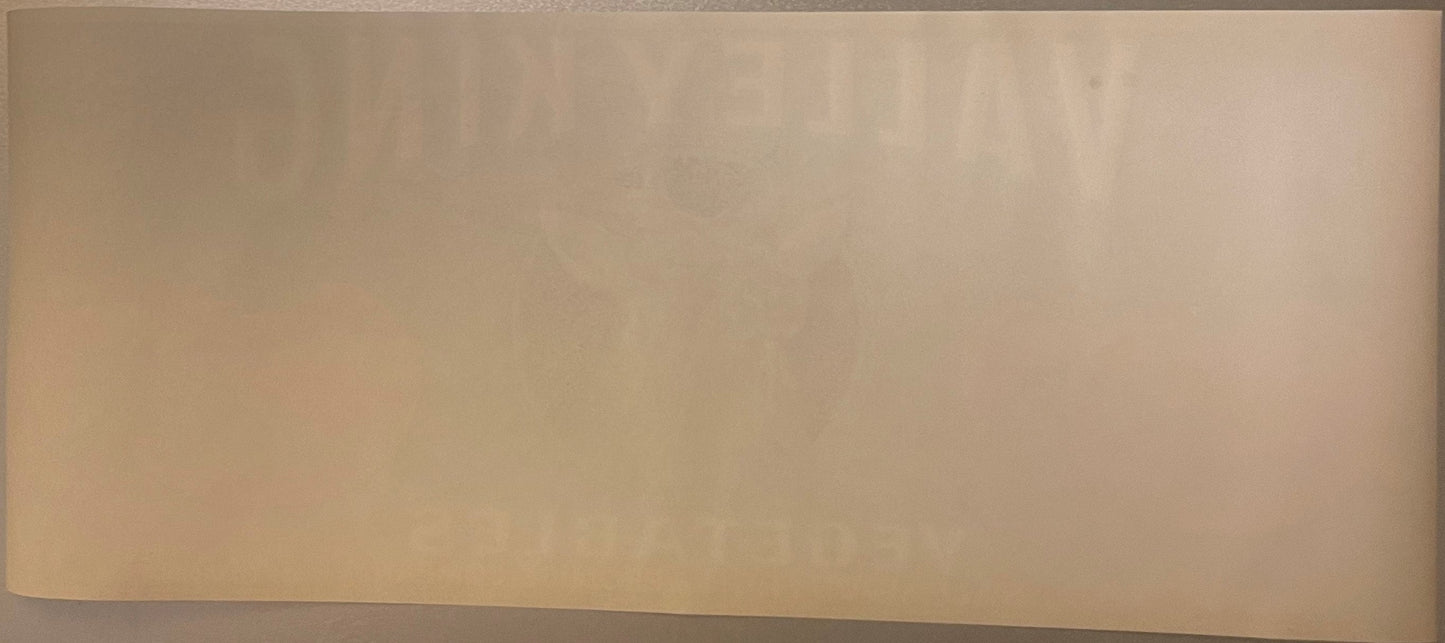
A single color-printed paper label in the long horizontal shape cut for the side of a vegetable crate. The elk is drawn with real care: the grain of the coat, the light caught in the eye, antlers sweeping out past the ring. The tomatoes are laid in broad glowing reds with finely drawn leaves, and the shipper's credit sits in orange and pale blue along the base. The reverse is unprinted paper, with only a soft mirror image of the front showing through.


🏢 Half Moon and the Valley King Name

Valley King was no one-season brand; the name is more than a century old. Federal trademark records show Half Moon Fruit & Produce Co. filing for the words VALLEY KING on February 27, 1922, for "fresh cantaloupes, cassaba, and fresh vegetables," and claiming first use in May 1921. The mark was registered on November 27, 1923. Half Moon kept it on the register for more than ninety years, renewing it in 1983 and again in 2003, before the registration was cancelled in 2016.

It was one name in a stable of them. In 1981 Half Moon registered MORNING CHEER for honeydew, Persian, casaba, Santa Claus and Juan Canary melons, stating that the brand had been in use since August 1938, and it registered Morning Cheer again in 2001. In 1991 it filed MELO-GLOW for peaches, prunes, cantaloupes and melons. A fruit shipper under the Half Moon Fruit & Produce name operates today in Woodland, California.


🌉 Main Office San Francisco: The Old Produce Market

"Main Office San Francisco, Cal." places this label on a very particular few blocks. San Francisco's wholesale produce market was centered at the junction of Washington and Davis Streets, packed into the area bounded by Jackson Street, Clay Street, Battery Street and the Embarcadero, a short walk north of the Ferry Building. The neighborhood had been a raucous mix of bars, dance halls and thievery until it was cleaned up in 1911, and by the early 1920s it had become the Produce Market, the same years the Valley King name first went into use.

It was a district of dozens of one- and two-storey warehouses, and it was the heart of Italian San Francisco, dominated by immigrant families from Genoa and from Ticino, the Italian-speaking canton of Switzerland. Half Moon's neighbors included Levy & Zentner Co. on the northwest corner of Davis and Washington, the John DeMartini Company and the Scatena-Galli Fruit Company. The streets grew so clogged with trucks that the fresh produce wasted in the jams became one of the main arguments for moving the whole market.


🎞️ Thieves' Highway: The Market on Film

The film grew out of A. I. Bezzerides' novel Thieves' Market, and Bezzerides wrote the screenplay himself. Born in Samsun in 1908, he came to America with his family before he was two; his father worked in farm fields before becoming a trucker hauling produce. Richard Conte, Valentina Cortese and Lee J. Cobb starred. The camera went into the real market, and the storefronts on screen include Half Moon Fruit & Produce under its movie sign, the John DeMartini Co. in two places, Levy & Zentner Co., Scatena Galli Fruit Co., the Oregon Restaurant, the Colchester Hotel and Wellman Peck & Co.

Bosley Crowther of The New York Times called it "a first-class melodrama" and praised how it caught the atmosphere of California's produce world. It is remembered today as a classic of the "film gris" strand of noir, and the Criterion Collection released it in 2005. For anyone holding this label, the film is a moving picture of the very corner where Half Moon did business.


🏙️ What Became of the Corner

The old market did not survive the city's plans for it. A group of produce market owners fought the redevelopment, but in 1963 the market was moved to Islais Creek, where the Redevelopment Agency helped most of the firms re-establish in a modern produce terminal. The blocks around Washington and Davis were demolished for the Golden Gateway Redevelopment Project, which transformed the area into an extension of the Financial District: the Embarcadero Center, the Golden Gateway apartments and their plazas now stand where the warehouses were. Photographs from November 1963 show the Washington and Davis intersection mid-demolition.

The whole block that held Half Moon's building is now a park. One relic of the old trade still stands nearby: the arch of the Colombo Market, which once spanned Front Street between Jackson and Pacific, survives as an entry gate beside Sydney Walton Square. This label has outlasted both Half Moon's downtown building and the old market around it.


📦 Why a Label This Old Is Still Unused

Paper crate labels grew out of simple stencils. Growers first stencilled their names onto fruit crates in the 1880s before turning to printers, local newspapers among them, for paper labels. A picture on the end of a wooden box was how one shipper's crate stood out from the next on a crowded market floor.

Cardboard ended the tradition. The demise of the wooden crate label is tied to lumber supply problems and to cheaper cardboard boxes, which could carry a simple brand printed or stamped straight onto the carton. By the 1960s and 1970s the colorful labels had mostly disappeared. Stock that was printed and never needed is what survives, and it is why this Valley King label still has its full color and a clean back.


🖼️ Ways to Display It

  • 🦌 A long panel frame over a kitchen doorway, a bar or a mantel, where the 13 x 5.5 inch shape reads like a banner.
  • 🌉 A San Francisco history wall: the Embarcadero, the waterfront and the produce district that stood where the Embarcadero Center is now.
  • 🎞️ A film noir fan's shelf, as a piece of the shipper whose storefront is on screen in Thieves' Highway.
  • 🍅 A crate label collection of California vegetable brands and wildlife designs.
  • 🎁 A gift for anyone with Bay Area roots or Italian San Francisco family history.

❓ Questions People Ask

Who shipped under the Valley King brand?

Half Moon, the shippers and distributors named along the base of the label, with a main office in San Francisco, California. Trademark records show it filed for the Valley King name in 1922 and claimed use from May 1921.

Is this the company from Thieves' Highway?

Its storefront is. The 1949 film hung its fictional dealer's sign over Half Moon's real business at 364 Davis Street, in the heart of the old produce district.

How old is it?

A 1940s label, from the years Half Moon kept its main office in San Francisco's downtown produce market.

Is that an elk or a deer?

An antlered elk stag, set in a green ring at the center of the design. The label itself names no animal.

Has it been used?

No. It was never pasted to a crate; the back is clean unprinted paper.

How big is it?

13 x 5.5 inches.

Shipping

🚚 Shipping & Handling

  • Shipping costs and timing are calculated at checkout.
  • Items curated and shipped directly by me include U.S. shipping at no additional cost, professionally packed to ensure safe arrival of your artifact.

Items from Vetted Pro Collectors
Shipping for items offered by vetted Pro Collectors is determined at checkout. All Pro Collector listings are reviewed to ensure fair, reasonable shipping practices.

For full details, please refer to our Shipping Policy.

Returns & Exchange

Take your time — you've got a full six months. If a piece isn't right for you, send it back the way it reached you and we're good.

In the first 30 days your money goes straight back the way you paid. After that it's store credit, so you can put it toward something you'd rather have.

Return shipping we sort out between us, case by case. I don't make this difficult.

If something arrives damaged, or it isn't what I said it was, send me a photo within 48 hours and I'll make it right.

Email info@vintageantiquesgifts.com or call 802-356-9872 — that's me answering, not a call center.

The only things I can't take back are custom or special-order pieces and gift cards.

View full details
  • 5 stars: 1 (100%)
  • 4 stars: 0 (0%)
  • 3 stars: 0 (0%)
  • 2 stars: 0 (0%)
  • 1 star: 0 (0%)
e
e***b (2510)

Perfect!!! Thank you!!!!

Preserving History: Authentic Objects Across Eras

— Curated by Travis Weigel