Skip to product information
1 of 7

Vintage and Antique Gifts

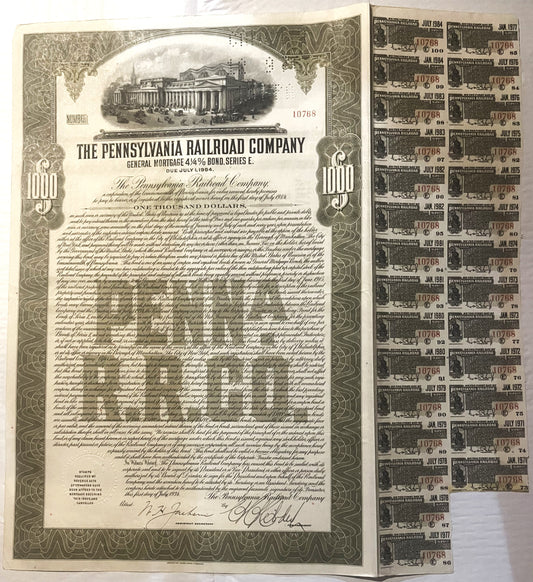
Vintage 1945 Pennsylvania Railroad Bond 🚂 "Pennsy" $1000 Gold Bond Certificate w/ Coupons, Penn Station Vignette

Regular price 16.00 USD
Regular price Sale price 16.00 USD
Sale Sold out
Shipping calculated at checkout.

Description

Ever held a piece of the "Standard Railroad of the World" in your own two hands? 🚂

There's a particular kind of quiet magic in an old railroad bond — thick, engraved paper that once represented real capital, real trust, real steel rails laid across a continent. Long before interstate highways and airport terminals, The Pennsylvania Railroad Company was the artery of American industry, and everyone from Wall Street bankers to shop-floor machinists simply called it "the Pennsy." Holding one of its bond certificates is a little like holding a folded-up piece of that empire — the deep blue scrollwork, the solemn engraved vignette of a great train station, the dense legal language promising payment "in gold coin" back when that phrase still carried real weight. This is that piece, preserved rather than spent, and it still has stories to tell.

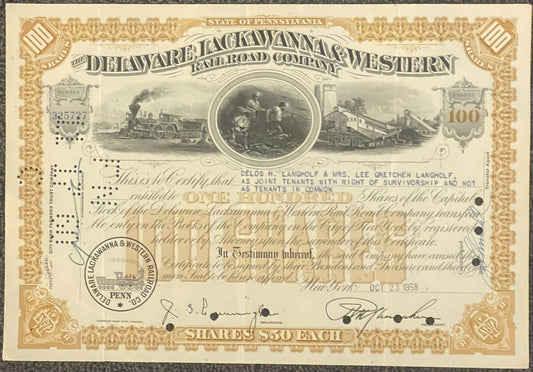
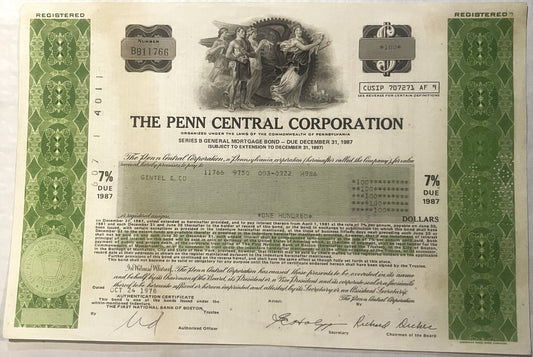
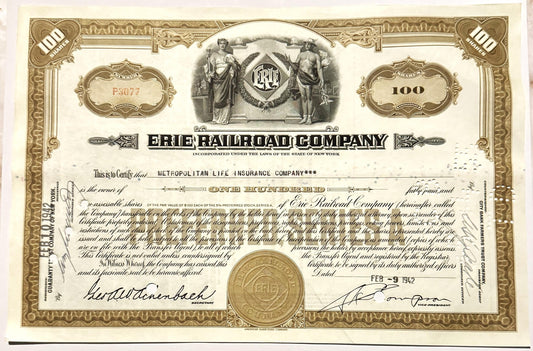
This is an original General Mortgage 3⅛% Bond, Series F, issued by The Pennsylvania Railroad Company and engraved in 1945, a genuine $1,000 corporate security running a full forty-year term to its January 1, 1985 maturity. Printed by the American Bank Note Company — the country's foremost security engraving house — the certificate measures a substantial 15 x 10 inches (about 38 x 25 cm) and carries the full formal weight of mid-century financial engraving. Ornate blue borders frame a black-and-white engraved vignette of Pennsylvania Station in New York City, its colonnaded facade crowded with period automobiles, streetcars, and pedestrians going about their day. Bold lettering spells out THE PENNSYLVANIA RAILROAD COMPANY beneath the image, flanked by ornamental "$1000" medallions, while dense two-column engraved legal text fills the body of the certificate below, anchored by the Trustee's Certificate of Girard Trust Company and a diagonal SPECIMEN overprint marking this as an archival printer's example rather than a bond ever placed into circulation. Alongside it runs a full, uncut sheet of dated semi-annual interest coupons stretching from the 1940s through the 1985 maturity, each one carrying its own small engraved portrait. Offered here as New Old Stock, this is an authentic and complete piece of American railroad and financial history, ready to be matted and framed.


🚂 The Pennsylvania Railroad — Once the Largest Corporation on Earth

The Pennsylvania Railroad Company was chartered by the Pennsylvania state legislature on April 13, 1846, and it was born out of pure civic anxiety. Philadelphia's merchants watched the Baltimore & Ohio Railroad creeping west toward Pittsburgh and feared that Baltimore was about to steal their port trade right out from under them. The legislature rushed the charter through, Samuel Vaughan Merrick took the reins as the company's first president in 1847, and construction pushed west into the Alleghenies almost immediately. By 1854, the line from Harrisburg to Pittsburgh was complete; three years later the PRR bought up the old state-owned Main Line of Public Works east to Philadelphia and, on paper at least, had itself a through line from the Atlantic to the Great Lakes.

What followed was one of the great growth stories of American capitalism. Under engineer-turned-president J. Edgar Thomson, the Pennsy expanded aggressively — leasing, absorbing, and building its way outward until its rails reached Chicago, St. Louis, and Washington, D.C. By the turn of the twentieth century the company controlled more than 10,000 route miles and had grown so large, so profitable, and so essential to American commerce that it was, for a time, the single largest publicly traded corporation in the world — a fact the company itself leaned into with its enduring motto, "The Standard Railroad of the World." Its keystone-shaped herald, echoing the shape of the Pennsylvania state seal, became one of the most recognized corporate emblems in the country, stamped on everything from locomotives to stock certificates like this one.

🏛️ The Lost Temple: Pennsylvania Station's Vignette

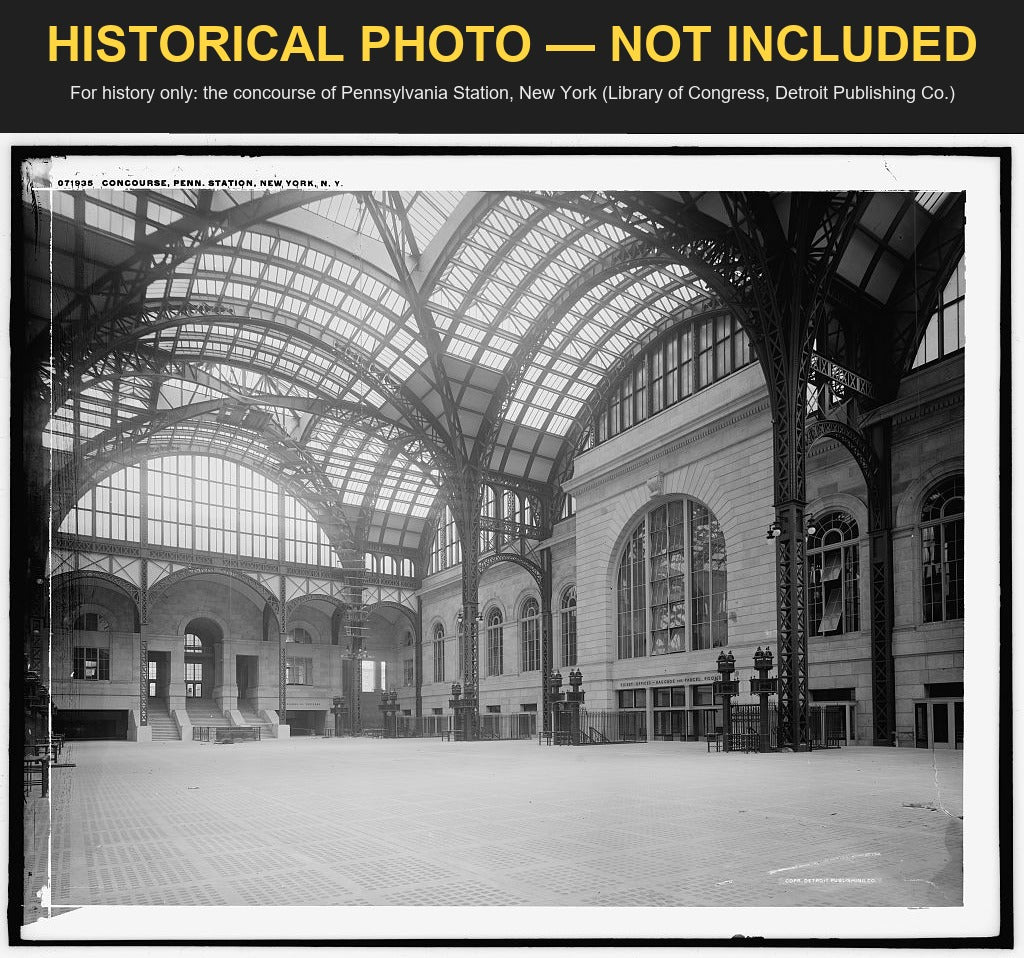
The building engraved at the top of this certificate is Pennsylvania Station in New York City, and its story is one of the great architectural sagas of American history. Opened in 1910 under the presidency of Alexander Cassatt — brother of the painter Mary Cassatt — the original Penn Station was the crowning achievement of an audacious engineering campaign: tunneling under both the Hudson and East Rivers to finally bring PRR trains directly into the heart of Manhattan, rather than stopping short across the water in New Jersey. Designed by the celebrated firm of McKim, Mead & White and modeled after the grand Roman Baths of Caracalla, the station's pink granite colonnades and soaring, glass-vaulted concourse made it one of the most magnificent public spaces ever built in America — precisely the scene captured in the engraving on this bond, with period automobiles and pedestrians crowding the plaza in front of its great columned entrance.

What makes the vignette especially poignant to collectors today is what happened next. In 1963, despite public outcry, the original above-ground station was demolished to make way for Madison Square Garden — a decision so widely mourned that architectural historians still cite it as one of the great cultural losses of twentieth-century New York, and the moment that is often credited with sparking the modern American historic preservation movement. Critics of the era famously lamented that where one had once entered the city "like a god," passengers were now made to scuttle in through a low-ceilinged basement. The public reaction was strong enough that it directly led to the creation of New York City's Landmarks Preservation Law in 1965 — the same law credited with saving Grand Central Terminal from a nearly identical fate a decade later. Engraved bonds like this one, produced while the original station still stood in its full grandeur, remain among the only detailed period images of a building that now survives only below street level.

✒️ The Engraver's Art — American Bank Note Company & the Gold Bond Tradition

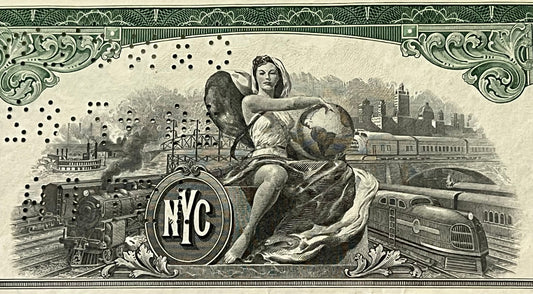
The craftsmanship on this certificate comes from the American Bank Note Company, a security-engraving firm whose lineage traces back to the earliest days of American currency and stock printing, and whose engravers produced everything from paper money to postage stamps to the ornate corporate bonds and stock certificates that financed the nation's railroads, utilities, and industrial giants. The vignette-and-scrollwork style seen here — hand-engraved intaglio lines, raised ink, elaborate lettering meant to deter counterfeiting — was as much a fine art as it was a security measure, and firms like American Bank Note Company employed dedicated engravers whose sole job was rendering buildings, allegorical figures, and portraits in painstaking detail.

The "Gold Bond" language woven through the certificate's text is its own small piece of financial history. Well into the early twentieth century, American corporate bonds routinely promised repayment specifically in gold coin, a pledge meant to reassure investors against currency devaluation. Congress effectively ended that practice for domestic contracts with a 1933 joint resolution, so by the time this Series F bond was engraved in 1945, the "gold bond" name survived mostly as a legacy of prestige — the certificate itself specifies payment "in such coin or currency of the United States of America as at the time of payment is legal tender." As a General Mortgage Bond, it was secured directly by a mortgage on the railroad's own property and franchises, held in trust on bondholders' behalf, with interest paid out every January and July via the physical clipping of a dated coupon — a bearer-bond system where whoever held the paper in hand, no registration required, could walk in and collect. It's a financial mechanism almost entirely phased out of American markets today, which is part of what makes surviving examples like this one so compelling to hold.

🏦 Girard Trust Company & Philadelphia's Financial Grandeur

Serving as Trustee on this bond issue was Girard Trust Company, one of Philadelphia's oldest and most storied financial institutions, named for the philanthropist and financier Stephen Girard. Girard Trust's role was to hold the mortgage on the Pennsylvania Railroad's property in trust for the benefit of every bondholder, certifying — as its signature on this very certificate attests — that each bond was legitimately issued under the terms of the underlying mortgage indenture. The company's landmark Philadelphia headquarters, a grand Beaux-Arts rotunda building at Broad and Chestnut Streets, stood as one of the city's great temples of finance for decades, a fitting architectural companion to the Pennsy's own soaring ambitions. Unlike Penn Station, that building still stands today, repurposed but preserved — a rare happy ending among the era's grand financial and transportation landmarks.

🚉 The People Who Built and Rode the Pennsy

At its peak, the Pennsylvania Railroad employed hundreds of thousands of Americans — engineers, conductors, telegraph operators, station agents, and shop workers — and entire communities grew up around its operations. Altoona, Pennsylvania, home to the PRR's massive locomotive shops and the legendary engineering marvel of Horseshoe Curve, became a company town in the truest sense, its identity and economy built almost entirely around keeping the Pennsy's fleet running. Old-timers in rail

Shipping

🚚 Shipping & Handling

  • Shipping costs and timing are calculated at checkout.
  • Items curated and shipped directly by me include U.S. shipping at no additional cost, professionally packed to ensure safe arrival of your artifact.

Items from Vetted Pro Collectors
Shipping for items offered by vetted Pro Collectors is determined at checkout. All Pro Collector listings are reviewed to ensure fair, reasonable shipping practices.

For full details, please refer to our Shipping Policy.

Returns & Exchange

Product Page Return Policy

  • 60-Day Returns – Items must be in original condition.
  • Refunds – Issued after inspection (excluding shipping costs).
  • Return Shipping – Customer is responsible unless item is damaged or incorrect.
  • Damaged/Incorrect Items – Contact us within 48 hours for a replacement or refund.
  • Easy Returns – Email [email protected] or call 802-356-9872 to initiate a return.

For full details, visit our Refund Policy.

View full details