Skip to product information
1 of 6

Vintage and Antique Gifts

Vintage 1950s-60s Baltimore Transit Company $1,000 Bond 🚋 Streetcar & Bus History, 6 2/3% Income Debenture

Vintage 1950s-60s Baltimore Transit Company $1,000 Bond 🚋 Streetcar & Bus History, 6 2/3% Income Debenture

Regular price 17.00 USD
Regular price Sale price 17.00 USD
Sale Sold out
Shipping calculated at checkout.
Quantity

Size: 15 x 10 inches ~ Issued and canceled. They vary a little one to the next.

🚛 The Baltimore Transit Company, 6⅔% Cumulative Income Subordinated Debenture

These are $1,000 registered debentures issued by The Baltimore Transit Company of Baltimore, Maryland, due January 1, 1977, engraved and printed by the Security Banknote Company. It's a big piece of paper — 15 x 10 inches — with the eagle vignette reading almost like a small poster. Because this is a registered issue, each sheet was re-dated every time it changed hands; sheets from this run turn up stamped anywhere from 1957 through the mid-1960s.

The design runs in orange and brown steel-plate engraving on cream stock, with black typeset text and a dense border of interlocking geometric lines running the full perimeter — the same kind of patternwork that makes old currency and railroad bonds hard to counterfeit. Centered at the top is the certificate's vignette: a spread-wing eagle gripping a branch in an oval medallion, an electric streetcar full of riders on the left, an early motor bus just as full of riders on the right, trees and period rooflines behind both.


🦅 Reading the Vignette: Two Systems, Running at Once

The eagle is standard iconography on American financial paper of this kind — meant to signal trust and a legally binding promise. The choice to flank it with a streetcar and a bus isn't generic decoration, though. This indenture is dated as of January 1, 1957, and Baltimore's streetcars kept running for six more years after that, until the last routes made their final trips on November 3, 1963. So the vignette doesn't show a company looking back at a system it had already lost — it shows both systems running side by side, right as the company was in the middle of trading one for the other.


🚆 From United Railways to Baltimore Transit

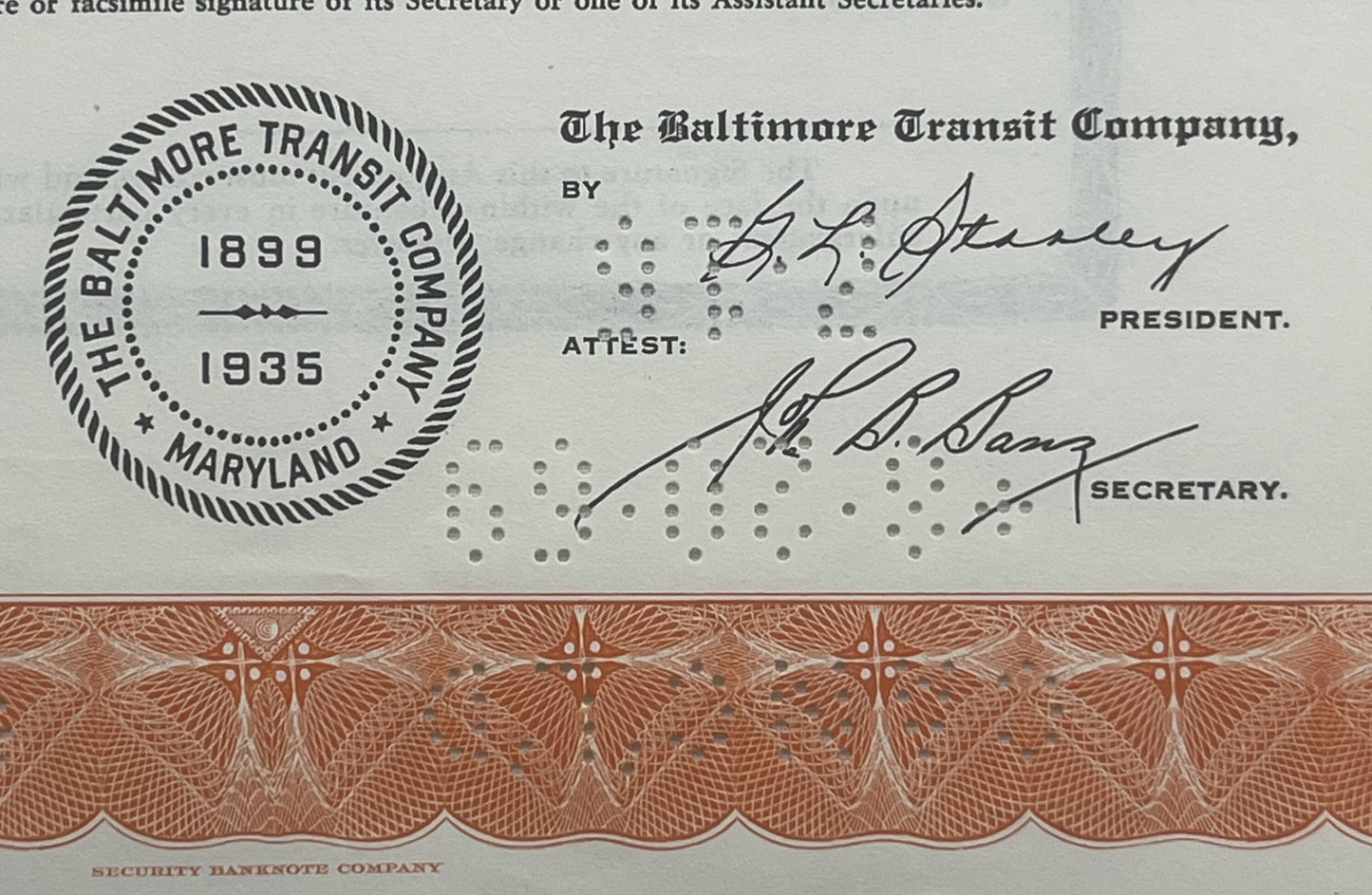
The company's own corporate seal, printed at the base of the document, carries two dates: 1899 and 1935. The United Railways and Electric Company formed in 1899 to consolidate Baltimore's streetcar lines, and it operated them for decades before reorganizing in 1935 under the name printed across this certificate, The Baltimore Transit Company. Baltimore's own transit history reaches back further still — the city is credited with the first commercially operated electric streetcar line in the United States, when Leo Daft ran his third-rail electric cars on the Baltimore-Hampden line on August 10, 1885, and with the country's first elevated electric line, on Guilford Avenue, in 1893. Those firsts belong to the city and its earlier lines, ahead of United Railways and well ahead of Baltimore Transit itself.

National City Lines — the holding company later convicted, in 1949, of conspiring with General Motors, Firestone, Standard Oil of California, Phillips and Mack Truck to monopolize bus and parts sales to the transit systems it controlled, a case remembered today as the Great American Streetcar Scandal — held a controlling interest in Baltimore Transit through this period. Baltimore's own streetcars went the way so many others did nationally: by November 3, 1963, the last routes had made their final runs, and the company converted the rest of its fleet to buses. In 1970, Baltimore Transit was absorbed into what became the Maryland Transit Administration, folding a privately run transit lineage into public ownership.


💰 What This Debenture Actually Paid For

This wasn't a company borrowing new money. In May 1957, Baltimore Transit filed with the SEC to qualify the indenture behind this exact debenture series, and the filing explains what it was for: the company had voted to convert a new class of $30-par preferred stock directly into these debentures, giving each preferred shareholder $30 of debenture plus one share of common stock for every preferred share they held, $3,345,200 in debentures altogether. It's a recapitalization, not a rescue — the company restructuring how its preferred stockholders were paid, right as it was finishing the shift from rail to rubber.

The terms themselves are on the certificate: interest at 6⅔% per year, payable each January 15 and July 15; a sinking fund committing $125,000 every July 1 from 1958 through 1964 and $200,000 every July 1 after that, earmarked to retire debentures over time; and a redemption premium that started as high as 10% for an early call and stepped down to par after July 1, 1976. "Debenture" means the debt is backed by the company's general credit rather than specific property. "Subordinated" means it sits behind the company's senior Series "A" First 4% and Series "A" First 5% debentures, named right on the certificate. "Cumulative income" means unpaid interest didn't vanish — it accumulated and stayed owed until the company could pay it.


🏦 The Trustee, the Seal, and the Fine Print

The indenture behind these debentures is dated as of January 1, 1957. The trustee name printed on the certificate varies across the run: sheets from earlier in the series name Fidelity-Baltimore National Bank as trustee, and later sheets name Maryland National Bank. The corporate seal at the bottom of every certificate is printed in black ink, not wax or an embossed stamp — "The Baltimore Transit Company, 1899, 1935, Maryland," with the facsimile signatures of the company's president and secretary alongside it.

Security Banknote Company, credited along the bottom border, was a Philadelphia security printer that had absorbed the Hamilton Bank Note Company in 1951; the same year as this indenture, 1957, Security Banknote itself merged with Columbian Bank Note Company to become Security-Columbian Banknote Co.


Shipping

🚚 Shipping & Handling

  • Shipping costs and timing are calculated at checkout.
  • Items curated and shipped directly by me include U.S. shipping at no additional cost, professionally packed to ensure safe arrival of your artifact.

Items from Vetted Pro Collectors
Shipping for items offered by vetted Pro Collectors is determined at checkout. All Pro Collector listings are reviewed to ensure fair, reasonable shipping practices.

For full details, please refer to our Shipping Policy.

Returns & Exchange

Take your time — you've got a full six months. If a piece isn't right for you, send it back the way it reached you and we're good.

In the first 30 days your money goes straight back the way you paid. After that it's store credit, so you can put it toward something you'd rather have.

Return shipping we sort out between us, case by case. I don't make this difficult.

If something arrives damaged, or it isn't what I said it was, send me a photo within 48 hours and I'll make it right.

Email info@vintageantiquesgifts.com or call 802-356-9872 — that's me answering, not a call center.

The only things I can't take back are custom or special-order pieces and gift cards.

View full details