Skip to product information
1 of 5

Vintage and Antique Gifts

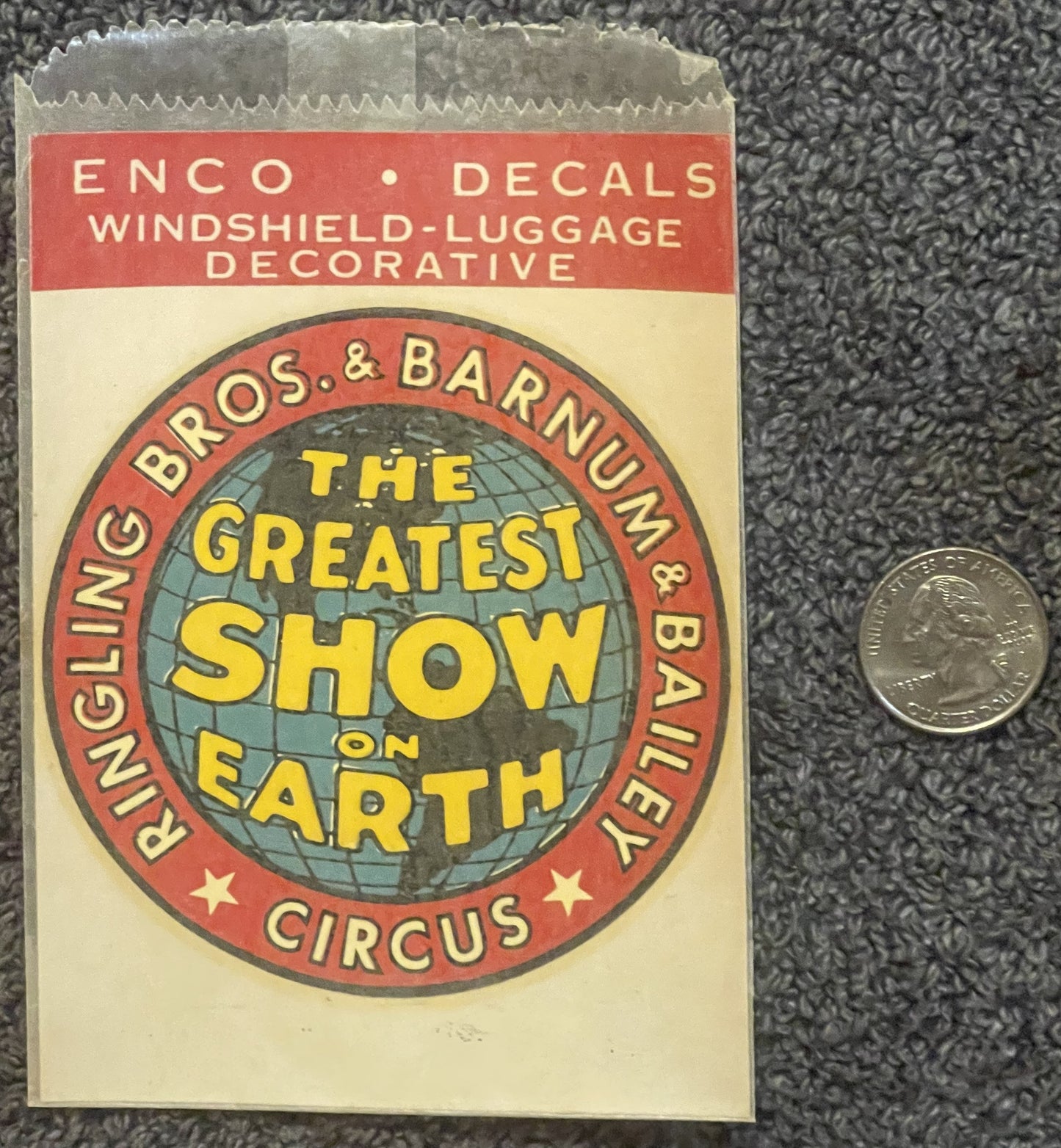
Enco Ringling Bros Barnum & Bailey Circus Waterslide Decal 🎪 Greatest Show on Earth, NOS 1950s Windshield-Luggage Transfer

Regular price 13.00 USD
Regular price Sale price 13.00 USD
Sale Sold out
Shipping calculated at checkout.

Description

🎪 Remember Circus Day, Before the Circus Rolled in on Trucks?

There was a time when the circus announced itself weeks before it ever arrived. Advance men pasted posters up the sides of barns and feed stores across the county, layer over layer, until the whole town had circus fever with not a single tent pole yet in the ground. Then, on the appointed morning, the sound everyone had been waiting for: a train whistle rolling into the rail yard just before dawn. Whole towns turned out for it. Schools let out early, or simply never opened at all. The elephants walked from the rail siding to the show lot while the streets lined up to watch them pass, and by the time the big top rose against the sky, "Circus Day" had become its own small-town holiday, as anticipated as the Fourth of July and gone again just as quickly. This little decal is a bright, unused survivor of exactly that world: a keepsake made for the car window or the suitcase lid, so a family could carry the thrill of "The Greatest Show on Earth" home with them long after the tent came down and the train pulled out for the next town down the line.

It has survived in a way almost nothing from Circus Day did. Not a scrap torn from a program, not a stub that spent decades in a shoebox, but a complete little packet that left the maker's hands and was simply set aside, still whole, still sealed, waiting. Everything written below describes only what the piece honestly is and what its own printing plainly says, told the way it deserves to be told.


🌍 What You Are Actually Holding

This is a genuine Ringling Bros. and Barnum & Bailey Circus waterslide (water-transfer) decal, made by Enco Inc. of 242 Fourth Avenue, New York, and sold as a windshield, luggage, and decorative transfer, exactly as the top of its own glassine envelope announces in bold red: "Enco • Decals — Windshield-Luggage Decorative." The artwork centers a globe rendered in bold blue and charcoal-gray, its continents mapped in a fine grid of drawn lines, and the whole thing is wrapped in a heavy red ring bearing the words "Ringling Bros. and Barnum & Bailey Circus" in cream block lettering outlined in black. Across the face of that globe, in cheerful sunshine-yellow letters with thick black outlines, runs the line every American of a certain generation could finish without looking: "The Greatest Show on Earth." Two small stars flank the word "Circus" along the bottom curve. The whole image measures a satisfying 5 inches by 3½ inches, sized to sit proudly on a windshield corner, a steamer trunk, or a scrapbook page without ever overwhelming it.

Turn the packet over and the story deepens. The back is printed with Enco's own step-by-step application instructions and the maker's full New York address. It is offered here as genuine new old stock (NOS): still resting in its original glassine envelope, never soaked, never slid into place, never pressed to glass or canvas. It is a piece that left the factory and simply never got stuck to anything, which is precisely why it is still here for us to hold.


🏆 Complete, Sealed, and Never Wetted

Here is what makes this one worth slowing down for. A waterslide decal was, by its very design, a thing built to be destroyed by being used. You wet it, you slid the film off its backing, you smoothed it onto a car window, and from that moment on it belonged to the weather and the years. The paper backing was thrown away. The glassine envelope went in the bin. The little printed instruction sheet was glanced at once and lost. That was the whole point of the object: it was meant to be spent.

This example is complete in a way that a used decal never can be. You get the decal itself, unwetted and unapplied. You get the original glassine envelope it was sold in. You get the full printed application instructions still with it. And you get the maker's own imprint, "Enco Inc., 242 Fourth Avenue, New York, N.Y.," naming exactly who made it and where. That is the entire period packet, intact, exactly as it crossed a five-and-dime counter or a souvenir stand at the show. When you collect mid-century paper, completeness is the whole game, because completeness is the thing that almost never survives. This one survived it all.


📜 The Greatest Show on Earth: A Boast Older Than the Show Itself

The phrase splashed across this little globe is older than the circus name wrapped around it. P.T. Barnum first billed his traveling show as "The Greatest Show on Earth" back in 1872, and the name stuck for good, bold and boastful and exactly the sort of thing a nineteenth-century showman would put his name behind. Barnum's operation later joined forces with James A. Bailey to become Barnum & Bailey, and when Bailey died in 1906, the Ringling brothers, already running a formidable circus empire of their own, bought the Barnum & Bailey show outright in 1907. For more than a decade afterward the two great circuses toured separately under common ownership, two famous names sharing one owner but never one ring, until 1919, when they were finally merged into a single spectacle: Ringling Bros. and Barnum & Bailey Circus, carrying Barnum's own 1872 slogan forward as its permanent banner. Every decal, poster, and ticket stub bearing that globe and that phrase, this one included, is really telling the story of two rival circus dynasties folding into one unstoppable show, and of a boast that outlived the man who first made it.


🚂 Baraboo Beginnings: Seven Brothers and an Empire on Rails

Long before any merger, five of the seven Ringling brothers, sons of a German immigrant harness maker named August Frederick Rüngeling who Americanized the family name to Ringling once he settled in the States, built a circus out of little more than ambition and a wagon. In 1882 they formed a small song-and-dance troupe, gradually working in acrobats, animal acts, and sideshow attractions until, in 1884, they staged their first true circus in Baraboo, Wisconsin. It was a modest start against what would come, but Baraboo stayed the circus's winter home and spiritual headquarters for decades, so thoroughly bound up with the Ringling name that the town is still remembered by old-timers and circus historians alike as a genuine "Circus City," home today to the Circus World Museum on the very grounds where the brothers once wintered their show. By 1890 they had begun moving the whole operation by railway car instead of horse-drawn wagon, a change that let them leap between towns overnight and grow from a regional act into a national institution. By 1900 Ringling Bros. was going toe to toe with Barnum & Bailey itself for the title of America's biggest circus, a rivalry they would end, within a decade, simply by buying their competitor.


🌴 Sarasota, the Last Big Top, and the Move Indoors

Charles E. Ringling, one of the founding brothers, died in 1926, but the circus he helped build kept flourishing straight through the Roaring Twenties. The following year, in 1927, John Ringling moved the circus's headquarters south to Sarasota, Florida, a relocation that turned a sleepy Gulf Coast town into a genuine circus capital, complete with winter quarters, performer housing, and eventually John Ringling's own lavish mansion and art museum. Sarasota still trades on that legacy today, its circus-town identity woven as deeply into local memory as Baraboo's. By the 1950s the show had grown to a staggering scale: a single tour required three separate trainloads just to move the spectacle from city to city, a rolling small city of performers, animals, riggers, and canvas. Then, in 1957, an era ended. The circus raised its own portable big top for the last time, after which it moved permanently indoors, into the sports arenas and stadiums built for basketball and hockey rather than sawdust rings. The tented circus, the one that rolled into town on rails and vanished by morning, was after that year a thing of memory rather than practice, which places this decal squarely at the tail end of the golden age it celebrates.


🎬 The 1952 Film That Made the Slogan a Household Phrase

That same decade handed the phrase on this decal its biggest lift yet, and it came from Hollywood rather than the tent. In 1952, Cecil B. DeMille released his sprawling Technicolor drama The Greatest Show on Earth, starring Charlton Heston, built around the grandeur and danger of exactly this circus. The film was a genuine sensation and went on to win the Academy Award for Best Picture, cementing "The Greatest Show on Earth" as one of the most recognized phrases in mid-century American culture whether you had ever set foot under a big top or not. A decal like this one, made for the family car's windshield or the corner of a suitcase, rode a wave of exactly that kind of nationwide enthusiasm: a slogan every household already knew by heart, ready to be pressed onto glass and canvas as a small badge of having been part of it.


🖨️ Enco Inc. of Fourth Avenue, and a Clue Hidden in the Address

The maker of this piece was Enco Inc., working out of 242 Fourth Avenue in New York City, a novelty and decal house turning out precisely this kind of transfer for the mid-century souvenir trade. And the address itself carries a small, satisfying clue to when this packet was printed. The stretch of Manhattan's Fourth Avenue that included this block was officially renamed Park Avenue South in 1959. A maker still printing "242 Fourth Avenue, New York" on its packaging is therefore most at home in the years before that change, which lands this piece comfortably in the 1950s. It is supporting evidence rather than a dated postmark, an old business address can linger on printed stock for a while, but it lines up neatly with everything else the object tells us: the circus's own final big-top years, the wave of enthusiasm from the 1952 film, and the golden age of the car-window decal. Taken together, they all point to the same decade.


🛣️ The Golden Age of the Car-Window Decal

Enco was working in a booming little corner of American commercial art. In the middle decades of the twentieth century the family road trip had become a national pastime, and the car itself had become a canvas for showing the world where you had been. Windshield decals, luggage decals, and souvenir transfers from state parks, tourist traps, world's fairs, and, as here, the circus, were sold at newsstands, five-and-dimes, and right at the show itself. The instructions printed on this very packet spell out the ritual in plain, practical language: wet the surface and leave it good and wet, soak the decal until the transfer loosens from its backing, position it paint-side down, then smooth from the center outward to chase out every bubble, let it dry a full day, and never apply it in freezing weather. It is a small window onto just how routine this once was, a whole generation of families who knew, without being told twice, exactly how to make a paper decal a permanent part of the family car. To hold an unused one now is to catch that entire vanished industry in mid-stride, frozen at the moment before the water touched it.


🕯️ Why So Few Survive, and Why This One Still Can

Think about what had to happen for this decal to reach you. It had to be printed, packaged, and sold, and then it had to be the one that got away, the one a family bought and carried home and, for whatever reason, never quite got around to sticking anywhere. Then it had to survive the decades that followed without being found by a child with a bowl of water, without being tossed in a drawer clear-out, without dampness or sun or simple bad luck. Nearly every decal like it was used exactly as intended and is long gone, worn off a windshield or a trunk lid generations ago. The maker is gone. The five-and-dimes are gone. Nobody is printing these Enco packets again, and the sealed ones that once turned up have all but stopped surfacing. What exists in the world now is, for all practical purposes, all there will ever be.

That is the quiet weight behind a piece like this. The bright globe and the famous boast are the easy part; the real rarity is the condition, the completeness, the sheer improbability of an untouched survivor from a world built to be temporary. And here is the honest heart of it: the only copies of this that are guaranteed to outlast us are the ones that collectors take home and care for. Every example that stays loved and protected is a genuine piece of Circus Day carried forward into the future. Buy this one and you are not just owning a decal. You are keeping a small, bright fragment of "The Greatest Show on Earth" alive.


🖼️ Ways to Live With It

A decal like this no longer has to be wetted and applied to earn its place. Its second life is as a small, vivid piece of Americana with real history in it, and it settles into a room in more ways than one:

  • 🎪 Frame it as-is in a small shadow box beside a vintage circus ticket stub or a program page for an instant conversation piece.
  • 🚗 Tuck it into a display of vintage automobilia, among old license plates, road maps, and travel decals from the same golden age of the family road trip.
  • 🧳 Set it beside an old steamer trunk or a vintage suitcase, a nod to the exact kind of luggage decoration it was born to be.
  • 📖 Slip it into a circus-themed scrapbook or memory album, still sealed in its own envelope, as a genuine period artifact.
  • 🎁 Pair it with other Ringling paper, posters, bags, and sideshow banners, for a themed gift a lifelong circus fan will not already own.
  • 🏠 Hang it in a home bar, den, or game room as a punchy, colorful bit of Americana that needs no explanation.

🎫 Who This Belongs With

This piece sits at a genuine crossroads of collecting. Circus memorabilia collectors chase Ringling Bros. and Barnum & Bailey material specifically because so little of it survived unused, and an untouched, sealed example is the exception rather than the rule. Vintage advertising and automobilia collectors are drawn to it as a genuine artifact of the mid-century decal industry, the same corner of commercial art that produced tourist-attraction stickers, world's fair souvenirs, and national-park transfers. Sarasota and Baraboo collectors seek it out for the hometown tie. And then there are the sentimental buyers: anyone with a personal or family thread to the circus, a relative who worked the show, a grandparent who never missed Circus Day, or simply a lifelong love of the big top, who wants a small, genuine piece of that world to hold onto. If you are building a Ringling collection, this decal has two natural companions in the shop, the Trimmit clown-and-tiger decal sheet and the Ringling popcorn-and-peanut bag set, both linked below.


❓ Questions Worth Answering

Is this an original vintage decal, or a modern reprint?

It is a genuine period piece: an actual Enco Inc. product still in its own original glassine packaging, printed in the mid-century golden age of the car-window decal. The completeness is the proof, an unwetted decal, its original envelope, the printed instructions, and the maker's own New York imprint, all together as they left the counter.

What does "NOS" mean, and can it still be used?

NOS stands for "new old stock," meaning this decal was made decades ago but never applied, wetted, or used, and has simply sat sealed since it left the factory. Because it is a genuine water-transfer decal, it can still be applied by following Enco's own printed instructions, or kept sealed and displayed exactly as it is.

How big is it?

The image measures 5 inches by 3½ inches, large enough to read clearly from a few feet away and to matt and frame on its own, small enough to fit neatly on a windshield corner, a trunk lid, or a scrapbook page.

Who was Enco Inc.?

Enco Inc. was a New York novelty and decal house at 242 Fourth Avenue, which made windshield, luggage, and decorative transfers for the mid-century souvenir trade. Its name is printed right on the back of this packet along with the full application instructions.

What era does it belong to?

Everything about it points to the 1950s: the circus's own final big-top years, the wave of fame from the 1952 DeMille film, the golden age of car-window decals, and the maker's "Fourth Avenue" address, a Manhattan street stretch that was renamed Park Avenue South in 1959.

Is this a good gift for a circus fan or Ringling collector?

Very much so. It is an unused, complete, original piece of the show's own mid-century world, small enough to display anywhere, meaningful to anyone who loves the circus, and genuinely uncommon in this untouched, sealed condition.


✨ Why It Matters

Some objects are collected because they are pretty; this one is worth having because it is real, whole, and improbable. It is a genuine artifact of "The Greatest Show on Earth," the bright globe and Barnum's own 1872 boast, made by a New York decal house at the tail end of the circus's golden age, and it survived when almost nothing like it did, still sealed in its glassine, its instructions intact, its maker named on the back, never once touched by the water that was meant to end it. Bring it home and you are keeping a small, vivid piece of Circus Day, the train whistle before dawn, the elephants walking up from the siding, the whole town turning out, alive and cared for, for the next generation to marvel at.

Shipping

🚚 Shipping & Handling

  • Shipping costs and timing are calculated at checkout.
  • Items curated and shipped directly by me include U.S. shipping at no additional cost, professionally packed to ensure safe arrival of your artifact.

Items from Vetted Pro Collectors
Shipping for items offered by vetted Pro Collectors is determined at checkout. All Pro Collector listings are reviewed to ensure fair, reasonable shipping practices.

For full details, please refer to our Shipping Policy.

Returns & Exchange

Product Page Return Policy

  • 60-Day Returns – Items must be in original condition.
  • Refunds – Issued after inspection (excluding shipping costs).
  • Return Shipping – Customer is responsible unless item is damaged or incorrect.
  • Damaged/Incorrect Items – Contact us within 48 hours for a replacement or refund.
  • Easy Returns – Email [email protected] or call 802-356-9872 to initiate a return.

For full details, visit our Refund Policy.

View full details