Skip to product information
1 of 2

Vintage and Antique Gifts

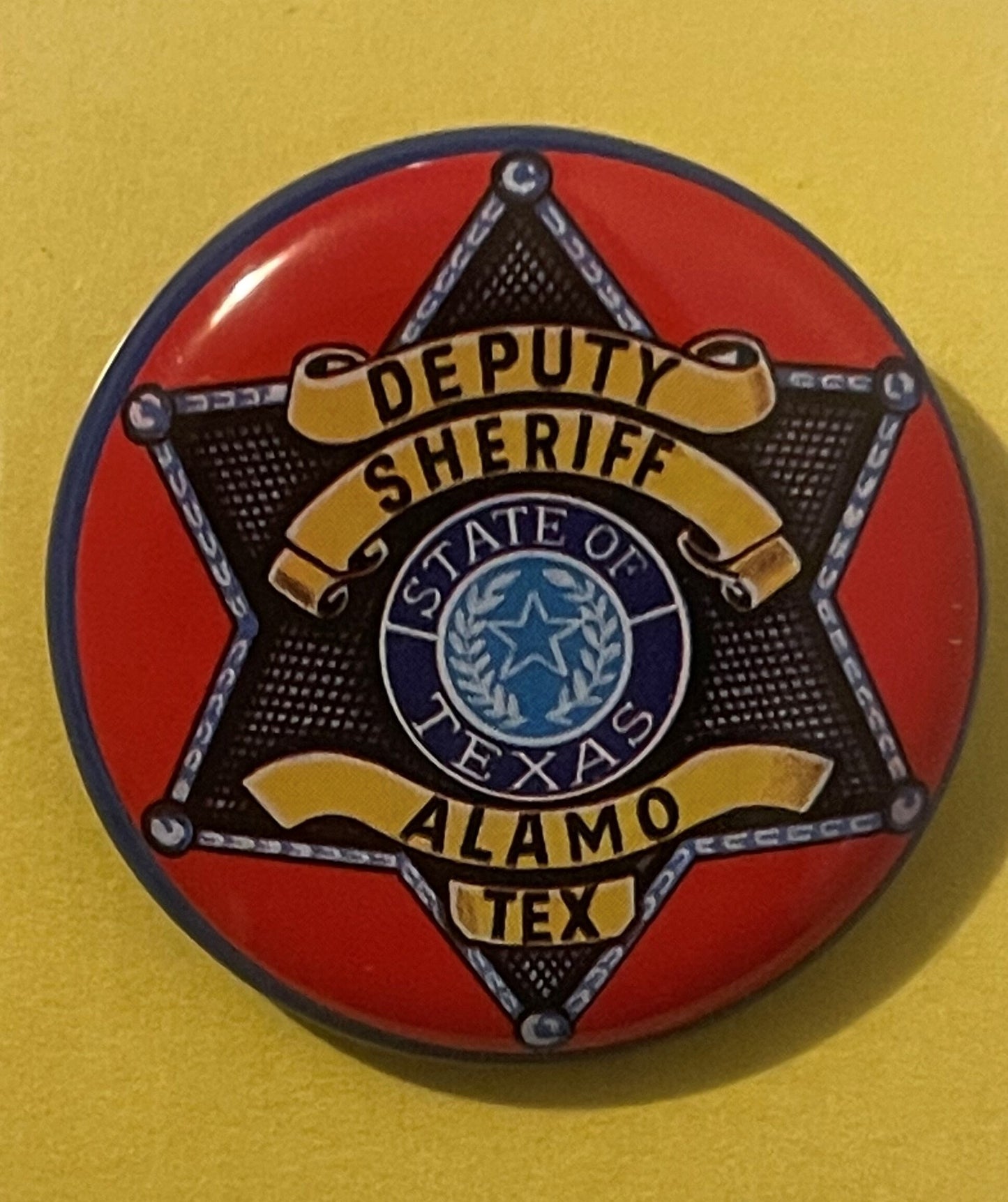
Vintage Tin Litho Deputy Sheriff Badge 🌟 Special Police Toy Pin Alamo Texas Made in Japan 1950s

Regular price 29.00 USD
Regular price Sale price 29.00 USD
Sale Sold out
Shipping calculated at checkout.

Description

Do You Remember the Moment a Tin Badge Made You Feel Like the Law? 🌟

There is a particular magic that lives inside a piece like this — a magic that has nothing to do with monetary value and everything to do with memory. You pick it up and something shifts. Suddenly you are back in the five-and-dime, the kind of store that smelled like popcorn and rubber erasers and possibility, where a spinning wire rack near the front door held a galaxy of small wonders at eye level for a child. Cap guns. Decoder rings. And these badges — these beautifully printed tin badges that could transform an ordinary kid on an ordinary Saturday into the sworn protector of everything he surveyed. This is one of those badges. And it came home to you still riding its original card, still sealed in its original plastic sleeve, still carrying every bit of that original charge.

What you have here is a New Old Stock mid-century Special Police Badge — a tin lithograph Deputy Sheriff pin produced in Japan during the postwar era and sold through the American five-and-dime and variety store trade. The badge itself is a six-pointed star approximately two inches in diameter, domed and glossy, printed in the richly saturated palette of the era: deep charcoal and black for the star body, bold red for the circular field behind it, gold ribbon banners carrying the words DEPUTY and SHERIFF, and at the very center, a crisp circular seal in blue and white bearing the lone star and wreath of the State of Texas, ringed with the inscription STATE OF TEXAS above and ALAMO TEX below. Silver chain-link detailing traces every arm of the star. The whole composition is confident, layered, and genuinely handsome — the kind of graphic work that holds up across generations. The badge rides on its original illustrated display card, 4 by 2.25 inches, printed on a warm yellow ground with a bold red header block reading SPECIAL POLICE BADGE in white capital letters. Below that header, a motorcycle officer in dark uniform leans hard into his machine — white cap, dark glasses masking his eyes, strong jaw squared forward, one gloved hand gripping the handlebar. He is the very image of mid-century authority and cool. The word JAPAN is printed on the card face. The entire assembly rides inside its original clear plastic sleeve, exactly as it would have sat behind a glass counter or on a spinner rack at your local Woolworth's or Ben Franklin sometime in the years when television Westerns ruled Saturday morning and every kid on the block needed a badge.


🏭 The Industry Behind the Badge — Tin Lithography and the Postwar Japanese Export Boom

To understand what this badge is and why it matters to collectors, you have to understand the world that made it. In the years immediately following the Second World War, Japan's manufacturing economy rebuilt itself with remarkable speed, and one of the industries that led the charge was the production of lithographed tinplate toys and novelties for export to the American market. Small workshops — many of them in the Kanto and Chubu regions — produced an extraordinary volume of brightly printed tin goods: toy cars, wind-up figures, cap guns, space toys, and badges. These items flowed by the crate into American import warehouses and from there to the five-and-dime chains, the variety stores, the carnival prize booths, the gumball machine distributors, and the counter display racks that were the retail infrastructure of mid-century American childhood.

The tin lithography process these craftsmen used was not a cheap or careless art. Lithographic printing on tinplate required skilled press operators, finely engraved printing plates, and careful registration of multiple color passes. The result — when it was done well, as it clearly was here — was a depth and richness of color that flat paper printing could not match. The glossy domed surface of a finished tin badge caught light and held it in a way that made the piece feel genuinely precious in a child's hand. Look at the chain-link detailing on the arms of this star. Look at the way the gold ribbon banners carry their letterforms. Look at the blue and white seal at the center with its fine wreath and lone star. These are not the marks of a careless production line. These are the marks of craftsmen who understood that even an item selling for a nickel or a dime deserved to be made well.

The specific factory behind this badge cannot be named with certainty — these pieces were almost never marked beyond their country of origin, and the anonymous workshop structure of the postwar Japanese novelty trade means that attribution is genuinely difficult even for advanced collectors. What can be said is that this badge belongs to a well-documented family of Special Police and Deputy Sheriff tin toy badges that collectors have tracked for decades, a category that turns up in original store stock and in estate collections with enough consistency to confirm the scale and reach of the original production run. Lore passed down among collectors of this category holds that the best examples — the ones with the deepest color saturation and the most detailed lithography — came from a relatively small number of workshops that specialized in the American novelty export trade and competed intensely on print quality. Whether this particular badge came from one of those premium shops or from a more general production run, the lithography speaks for itself.

The era of the Japanese tinplate toy export boom had a natural arc. It crested through the later years of the mid-century period and began to wind down as plastic manufacturing became dominant, as American toy safety regulation evolved, and as the economics of global manufacturing shifted. The badges that survived that arc in New Old Stock condition — never opened, never played with, still on their original display cards — are the ones that give collectors today the clearest possible window into what these pieces actually looked like the day they left the factory. This one is that kind of survivor.


🤠 The Name on the Badge — Alamo, Texas, and the Weight of a Legend

The words ALAMO TEX printed on this badge are not throwaway design choices. They are a deliberate invocation of one of the most powerful place-names in American mythology, and understanding why they appear on a Japanese-made toy badge tells you a great deal about the cultural moment in which this badge was produced.

The Alamo — the old Spanish mission in San Antonio, Texas — needs almost no introduction. Founded in the eighteenth century as a Franciscan mission and later converted to a military fortification, it became in March of 1836 the site of one of the most storied last stands in American history. A small garrison of Texian defenders, among them James Bowie and David Crockett, held the mission for thirteen days against a vastly larger Mexican force under General Santa Anna before being overwhelmed. The battle became the emotional engine of the Texas Revolution. "Remember the Alamo" became a rallying cry, a piece of American cultural shorthand for courage, sacrifice, and the defense of principle against impossible odds. The Alamo entered the national mythology so completely that by the mid-twentieth century its name was everywhere — in films, in television programs, in the Davy Crockett craze that swept American childhood in the mid-1950s with a completeness that is hard to overstate today. Coonskin caps. Frontier rifles. And badges — badges that said Texas, that said lawman, that said Western, that said something about the romance of the frontier and the authority of a man with a star on his chest. A badge marked STATE OF TEXAS / ALAMO TEX was speaking that language fluently, trading on exactly the cultural electricity that the name carried in the living rooms and schoolyards of mid-century America.

There is also a real Alamo, Texas — a city in Hidalgo County in the Rio Grande Valley of south Texas, near McAllen and not far from the Mexican border. The real Alamo is a place with its own genuine history. It grew from a townsite laid out in the first decade of the twentieth century on land assembled by entrepreneurs who saw the agricultural potential of the Valley. The Alamo Land and Sugar Company moved the early settlement to better-drained ground and established the infrastructure — railroad access, irrigation, community institutions — that allowed the town to grow. It was incorporated and built out through the 1920s and 1930s, becoming a significant shipping point for the citrus and vegetable crops that defined the mid-century Rio Grande Valley economy. By the time this badge was being produced, the real Alamo, Texas, was a community of several thousand people, deeply rooted in the Tejano and Spanish-speaking culture of the Valley, part of the agricultural heartland that was feeding a significant portion of the country. The Hidalgo County Sheriff's Department, of which any genuine Deputy Sheriff of Alamo would have been a part, had jurisdiction over one of the most culturally distinct and geographically remote corners of Texas — border country, ranch country, the kind of landscape that had its own relationship to law, authority, and the long history of the Texas-Mexico frontier.

Whether the toy's designers had the real Alamo, Texas, specifically in mind or were simply reaching for the most resonant Texas place-name available is a question that cannot be answered with certainty. Local legend among Rio Grande Valley collectors holds that these badges — and others in the same series marked with various Texas town names — were sold through the five-and-dime trade across the entire state, and that a child in the real Alamo, Texas, might well have purchased one from a local variety store counter, pressing a badge with his own hometown's name to his chest and feeling the particular thrill of a designation that felt both official and personal. That is a genuinely lovely piece of social history, even if it cannot be documented. It is the kind of thing that gives an object like this its resonance beyond the merely collectible.


🏛️ Mid-Century Western Mania — The Cultural Moment That Made This Badge Necessary

You cannot fully appreciate this badge without appreciating the cultural tidal wave that made it commercially necessary. The mid-century American obsession with the Western — with cowboys, lawmen, frontier justice, and the mythology of the American West — was not a niche enthusiasm. It was a dominant force in popular culture, shaping what children played, what families watched, what manufacturers produced, and what stores stocked on their shelves and spinner racks.

Television Westerns were a defining feature of mid-century American evenings. Programs built around lawmen, sheriffs, rangers, and deputies gave children a weekly tutorial in the mythology of frontier authority. The sheriff with the star on his chest was one of the most powerful archetypes in the culture — incorruptible, brave, alone against the lawless, the thin line between order and chaos in a landscape where civilization was always provisional. A child watching those programs on the family's new television set wanted to inhabit that archetype. He wanted the hat, the holster, and most of all the badge. Manufacturers — Japanese novelty exporters among them — were ready to supply that want at five-and-dime prices.

The Davy Crockett phenomenon of the mid-1950s intensified all of this to a degree that is difficult to convey to anyone who did not live through it. The television miniseries and the subsequent film sent coonskin caps into shortage and created a market for anything marked with the name or imagery of the Texas frontier. A badge marked STATE OF TEXAS / ALAMO TEX was perfectly positioned in that moment — it carried the Alamo's freight of legend, it spoke the language of the Western lawman, and it did so in a form small enough to fit in a pocket and affordable enough to sell from a counter display at the front of a variety store. This was cultural product design of a high order, even if no one involved would have used that language.


🖼️ Display Ideas

  • 🪵 Pin the badge to a reclaimed wood display panel alongside other mid-century tin litho law badges for a striking study in postwar graphic design and Western iconography.
  • 🖼️ Frame the complete card-mounted badge in a shadow box with period ephemera — a vintage TV Guide opened to a Western program listing, a period postcard from Texas — for a layered mid-century vignette.
  • 🤠 Display alongside other Western-themed mid-century toys and novelties — cap guns, tin sheriff stars, Roy Rogers or Hopalong Cassidy premium items — as part of a curated Western childhood collection.
  • 📚 Use the card as a teaching piece in a collection focused on the postwar Japanese-American novelty trade, paired with documented examples of the five-and-dime retail culture that distributed these items.
  • 🗺️ Display in a collection organized around Texas history and iconography, where the Alamo name and the State of Texas seal connect this piece to a broader story of Texas identity in American popular culture.
  • 🏠 Mount in a vintage-style mudroom, den, or bar area as a piece of authentic mid-century Americana — the kind of décor that invites questions and tells a story every time a guest notices it.

🎁 Who Collects These

The collector community for mid-century tin litho toy badges is genuinely broad, and that breadth is one of the things that makes pieces like this one so appealing to bring to market. At one end of the spectrum are the dedicated tin toy specialists — collectors who have spent years building comprehensive collections of postwar Japanese-made tinplate, who understand the printing technology, who can speak knowledgeably about color registration and the relative rarity of NOS examples, and who are always looking for strong examples in original packaging. These collectors know exactly what this badge is and why the original card matters enormously to its integrity as a collectible.

Then there are the Western and cowboy collectors — people whose primary interest is in the material culture of mid-century Western fandom, who collect everything from Roy Rogers lunch boxes to Lone Ranger premium items to sheriff's star badges of every description. For them, this badge is a piece of the world they are trying to reconstruct: the Saturday morning Western, the five-and-dime spinner rack, the particular way an American childhood in the 1950s was saturated with frontier mythology.

Texas collectors and Texas history enthusiasts form another natural audience. The State of Texas seal on this badge, the Alamo name, the whole complex of associations that comes with Texas iconography in American popular culture — these things have their own collector community, people who are building collections that tell the story of Texas identity as expressed through material culture across the decades.

And then there are the pure nostalgia collectors — people who are not specialists in any of these subcategories but who respond to the object itself, to the warmth of its colors and the confidence of its design and the feeling it carries of a specific, irretrievable American moment. These are often the collectors who come to a piece like this without knowing exactly why they want it and leave with a very clear sense of why they needed it. The badge speaks to something that does not require expertise to recognize. It just requires having been a child who once pressed a tin star to a chest and felt, for a moment, genuinely responsible for the peace of the world.


❓ Frequently Asked Questions

Is this a real law enforcement badge or a toy?

This is a mid-century novelty toy badge, produced in Japan for the American five-and-dime and variety store market. The words DEPUTY SHERIFF, STATE OF TEXAS, and ALAMO TEX appear as printed design elements — part of the Western and frontier mythology branding that made these badges irresistible to children of the era. It was never issued by a law enforcement agency and carries no official authority of any kind. That is a feature, not a limitation: it makes this an authentic piece of mid-century American popular culture and childhood material history, which is precisely what collectors are seeking when they add a piece like this to a collection.

What does "New Old Stock" mean for a piece like this?

New Old Stock — NOS — means that this badge has come to you as a survivor of the original retail supply chain. It was never sold through to a child, never played with, never removed from its display card and plastic sleeve for use. It has traveled from the factory to a store (or a warehouse, or a distributor's stock room) to the present day without passing through the play cycle that consumed the vast majority of pieces like it. For collectors, NOS status is significant because it means the piece represents its original production state — the colors, the card, the packaging — rather than the well-loved condition of a played-with example. The specific character of this particular piece is something you will assess when you hold it, and that assessment is part of the pleasure of acquiring NOS material.

Why does the card say "JAPAN" rather than "Made in Occupied Japan"?

This is an important dating question that serious collectors understand well. Goods exported from Japan during the period of American occupation — roughly from the late 1940s through April 1952 — were required by occupation authorities to be marked "Made in Occupied Japan." After the occupation ended and Japan regained sovereignty, the marking reverted to simply "Made in Japan" or "Japan." A badge card marked JAPAN, as this one is, is therefore most consistent with production after 1952 — placing it in the mid-century years that followed the occupation period. This is consistent with the broader mid-century dating of this badge's style, its graphic vocabulary, and the Western-craze cultural moment it was designed to serve.

Is Alamo, Texas, a real place?

It is absolutely a real place — a city in Hidalgo County in the Rio Grande Valley of south Texas, with a genuine history rooted in the agricultural development of the Valley in the early twentieth century. The town grew as a citrus and vegetable shipping center, incorporated in the mid-1920s, and by the era when this badge was produced had become a community of several thousand people with deep roots in the Tejano culture of the Texas-Mexico border region. The badge's use of the Alamo name, however, is almost certainly drawing on the cultural power of the famous 1836 battle site in San Antonio rather than making specific reference to the Hidalgo County municipality. The two Alamos coexist in Texas history, and this badge sits at their interesting intersection.

What makes the lithography on this badge worth noticing?

Tin lithography at this level of detail — the chain-link arm detailing on the six-pointed star, the layered gold ribbon banners with their clean letterforms, the circular state seal with its wreath and lone star rendered in blue and white against the black star body, the bold red circular field behind the whole composition — represents a genuine craft tradition. The process required skilled press operators, carefully prepared printing plates, and precise multi-pass color registration on tinplate. When it worked, as it did here, the result was a depth and vibrancy of color that paper printing could not achieve, and a durability that allowed pieces to survive decades in ways that paper ephemera often did not. The lithography on this badge is the primary reason it remains visually arresting today, and it is one of the central reasons mid-century tin litho pieces attract serious collector attention.

What is the significance of the motorcycle officer illustration on the display card?

The motorcycle officer on the card — dark uniform, white cap, masked eyes, strong jaw, leaning forward over the handlebars — is a piece of mid-century graphic illustration that deserves attention in its own right. The masked eyes are a particularly interesting detail: they evoke the masked lawman archetype of Western fiction and serial cinema, suggesting a connection to characters like the Lone Ranger who were at the peak of their cultural presence in exactly this era. The illustration does double duty as point-of-sale marketing — making the badge seem more dramatic and desirable to the child standing at the counter — and as a period document of how mid-century popular culture visualized law enforcement authority. Together, the card illustration and the badge itself form a complete artifact of their moment, which is why collectors who specialize in this material always prefer examples that retain their original cards.

How does this fit into a broader collection of mid-century Americana?

A badge like this functions beautifully as a connector piece in a broader Americana collection. It links the history of postwar Japanese manufacturing and the American import trade, the mid-century five-and-dime retail culture, the Western and cowboy enthusiasm that dominated American popular culture across the mid-century years, the Davy Crockett and Alamo mythology that was at peak intensity in exactly this era, and the specific material culture of American childhood in the years when television was transforming what children wanted and what manufacturers produced to meet that want. It is a small object with a large context, which is the quality that separates a genuinely interesting collectible from a mere souvenir.

⭐ When Kids Really Did Get Badges from the Law

The mid-century American childhood this badge comes from was full of real badges given by real officers. Junior deputy programs let sheriffs swear in schoolkids as honorary deputies; school safety patrol programs, organized since the 1920s, put badges and belts on millions of children; police departments handed out badges at parades, fairs, and classroom visits as a matter of civic routine. An Alamo, Texas deputy sheriff star was the dime-store cousin of all that — the badge a kid could buy with pocket change. That documented world of junior programs is the backdrop this little survivor belongs to.

Shipping

🚚 Shipping & Handling

  • Shipping costs and timing are calculated at checkout.
  • Items curated and shipped directly by me include U.S. shipping at no additional cost, professionally packed to ensure safe arrival of your artifact.

Items from Vetted Pro Collectors
Shipping for items offered by vetted Pro Collectors is determined at checkout. All Pro Collector listings are reviewed to ensure fair, reasonable shipping practices.

For full details, please refer to our Shipping Policy.

Returns & Exchange

Product Page Return Policy

  • 60-Day Returns – Items must be in original condition.
  • Refunds – Issued after inspection (excluding shipping costs).
  • Return Shipping – Customer is responsible unless item is damaged or incorrect.
  • Damaged/Incorrect Items – Contact us within 48 hours for a replacement or refund.
  • Easy Returns – Email [email protected] or call 802-356-9872 to initiate a return.

For full details, visit our Refund Policy.

View full details