Skip to product information
1 of 7

Vintage and Antique Gifts

Vintage 1952 Etched Brass Goblet Chalice, Indian Bright-Cut Engraving 🏺

Vintage 1952 Etched Brass Goblet Chalice, Indian Bright-Cut Engraving 🏺

Regular price 17.50 USD
Regular price Sale price 17.50 USD
Sale Sold out
Shipping calculated at checkout.
Quantity

🏺 A Brass Goblet With Its Passport Scratched on the Bottom

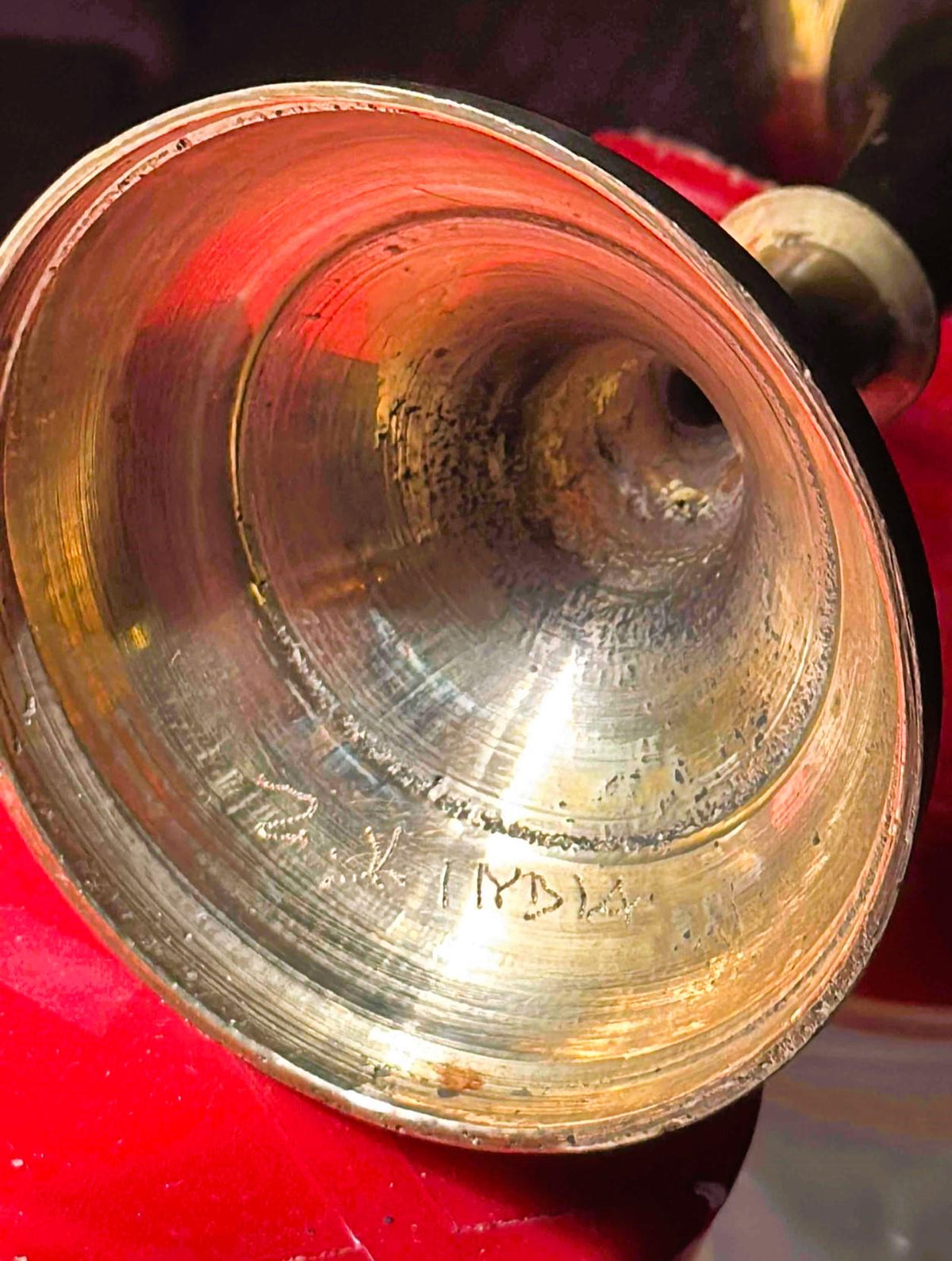
This is a vintage etched brass goblet out of India, a 1952 piece. It's a proper chalice shape -- a flared cup up top, a slim waisted stem with a little ring collar partway down, and a wide, steady domed foot to keep it standing. Every square inch of that cup is covered in hand-cut engraving, and turn it over and there's a second story waiting on the underside of the foot: two scratched initials and the word INDIA, put there by hand before this thing ever left the country it was made in. I'll get to both.


🔍 What You're Looking At

The cup is the star here. It's worked edge to edge in overlapping fan and shell shapes, each one built from tight little radiating lines cut straight into the brass, so the whole surface catches light differently depending on how you turn it in your hand. The foot picks up the same fan motif in a band around its dome, so the piece reads as one continuous idea from rim to base rather than a plain body with decoration slapped on top. Inside, the bowl is plain, warm brass.


🎨 Bright-Cut, and Why It Shimmers

The engraving technique has a name -- bright-cut -- and it's worth knowing what it actually is. A bright-cut graver doesn't scratch a flat line, it bevels a little faceted furrow into the metal, angled so each cut throws light back at its own angle. Do enough of those cuts packed close together, the way they're packed here, and the surface starts to shimmer and shift as you turn it. It's an old technique -- it first shows up around 1775 and had its heyday in British and Irish silver from the 1770s into the 1830s. India's brass trade borrowed the name for its own version of the same flashing, faceted cut, and that's exactly the family this goblet belongs to: not silver, but brass dressed in the same idea, done by hand, stroke by stroke.


📝 The Mark Under the Foot

Tip the goblet over and look inside the hollow foot, and you'll find two scratched initials that look like B.K., followed by the word INDIA, scratched in that same crude hand. That mark has a job: Section 304 of the U.S. Tariff Act of 1930 required every import to be marked "as legibly, indelibly, and permanently as the nature of the article permits" with its country of origin, in English, before it could enter the country. A small workshop piece like this one didn't come stamped from the factory -- somebody scratched INDIA into it by hand, right there in the hollow foot where it wouldn't show on the outside, to clear customs. That mark isn't a later note. It's the export mark, put on when it left India, and it's the one piece of direct writing this goblet carries about where it came from.


📅 About the 1952

1952 lands right at the tail end of India's first general election as an independent republic, which ran from October 1951 into February 1952 -- the country's first real trip to the polls, two years after the Republic itself was declared. I like that bit of history sitting behind a goblet from the same year.


🌍 Moradabad, India's Brass City

A lot of India's engraved export brass came out of Moradabad, and it's worth knowing where that tradition comes from. Moradabad, in Uttar Pradesh, was founded in 1625 by Rustam Khan, a governor under the emperor Shah Jahan, and named for one of Shah Jahan's sons, Prince Murad Baksh. Locally it's called Pital Nagri -- "Brass City" -- and it's earned the name: brass workshops there have been turning out engraved, embossed and cast brassware for export since the East India Company days, and Moradabad is still India's biggest metal-handicraft export center today. Bright-cut engraving like the pattern on this goblet is exactly the kind of decorative work that tradition is known for.


🔍 Condition, Honestly

This is the one goblet you're getting -- the one in the photos, not a stand-in from a shelf of them. It wears an honest, unpolished patina, darker down in the recesses of the engraving, with a few small dings at the rim and around the edge of the foot, and some dark oxidation spots underneath. None of that bothers me; it's what 70-odd years does to handled brass, and the engraving itself is still crisp and easy to read across the whole cup and foot. You'll see a US quarter sitting beside it in a couple of the photos for scale.


A genuine vintage Indian brass goblet, hand-engraved top to bottom, carrying its own country-of-origin mark scratched into the foot.

Shipping

🚚 Shipping & Handling

  • Shipping costs and timing are calculated at checkout.
  • Items curated and shipped directly by me include U.S. shipping at no additional cost, professionally packed to ensure safe arrival of your artifact.

Items from Vetted Pro Collectors
Shipping for items offered by vetted Pro Collectors is determined at checkout. All Pro Collector listings are reviewed to ensure fair, reasonable shipping practices.

For full details, please refer to our Shipping Policy.

Returns & Exchange

Take your time — you've got a full six months. If a piece isn't right for you, send it back the way it reached you and we're good.

In the first 30 days your money goes straight back the way you paid. After that it's store credit, so you can put it toward something you'd rather have.

Return shipping we sort out between us, case by case. I don't make this difficult.

If something arrives damaged, or it isn't what I said it was, send me a photo within 48 hours and I'll make it right.

Email info@vintageantiquesgifts.com or call 802-356-9872 — that's me answering, not a call center.

The only things I can't take back are custom or special-order pieces and gift cards.

View full details