
Skip to product information
1 of 2

Vintage and Antique Gifts

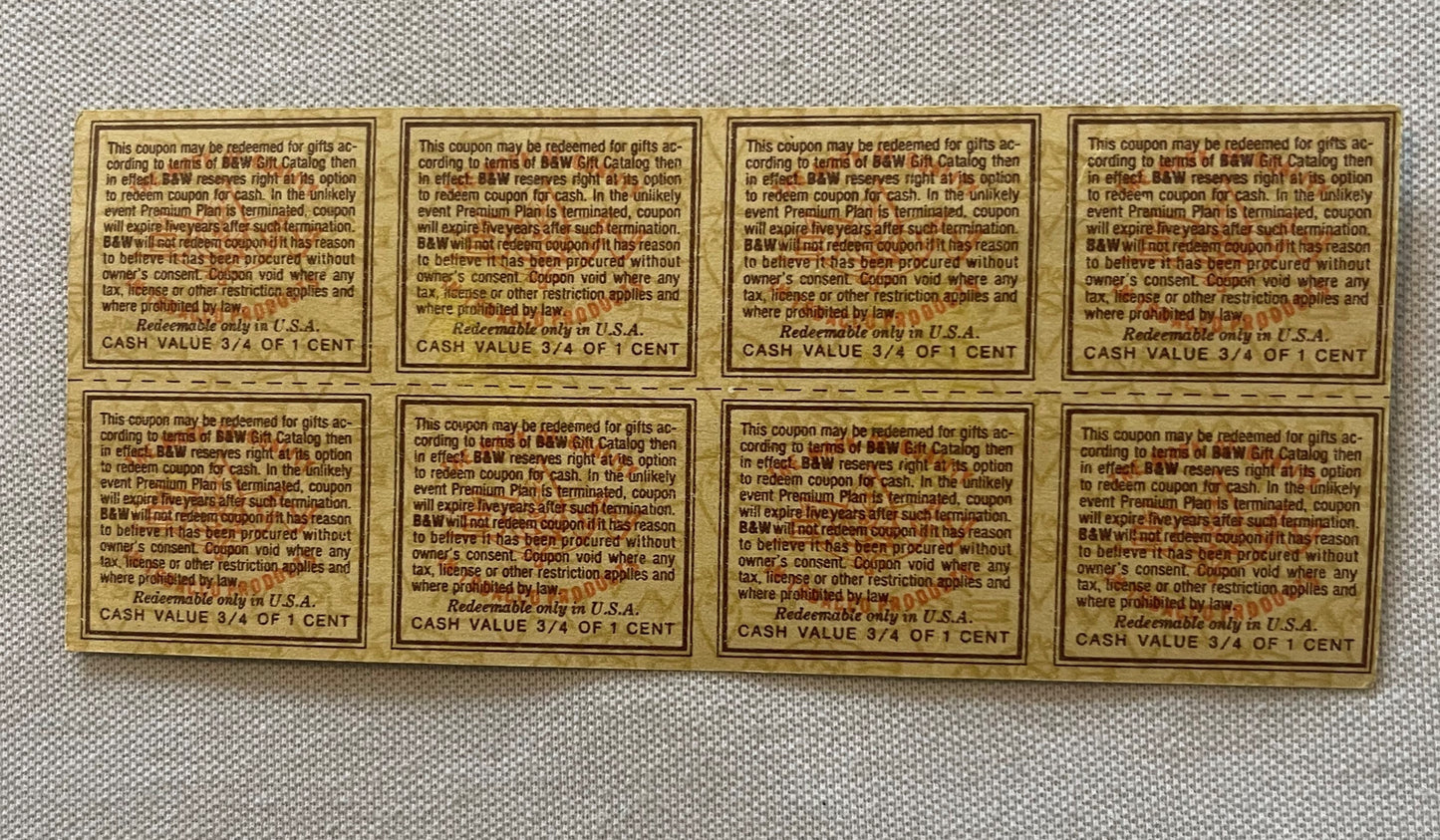
Vintage Raleigh Tobacco 🚬 Uncut Sheet 8 B&W Coupons NOS Brown & Williamson Premium Plan 1960s American Made

Regular price 5.50 USD
Regular price Sale price 5.50 USD
Sale Sold out
Shipping calculated at checkout.

Description

What Did Eight Little Coupons Know About Outlasting an Empire? 🚬

There is something quietly remarkable about an object that was never meant to survive. The Raleigh cigarette coupon was designed to be used — tucked into a pack, pulled out by a smoker's fingers, stacked in a kitchen drawer alongside dozens of others, and eventually bundled up and mailed off to a post office box in Louisville, Kentucky in exchange for a percolator or a set of mixing bowls. The coupon's entire purpose was consumption and disappearance. It was a temporary contract between a tobacco company and its loyal customers, printed on inexpensive paper, never intended to see another decade, let alone another century.

And yet here they are.

Eight of them, still joined at the press — an uncut sheet, New Old Stock, never redeemed, never separated, never mailed. Someone saved these, either out of forgetfulness, or sentiment, or one of those quiet domestic instincts that turns out, decades later, to have been a small act of accidental preservation. Whatever the reason, these eight coupons missed the trip to Box 903, Louisville, Kentucky 40201, and in missing that trip they became something far more interesting than a discount instrument. They became a document.


🎴 What You Are Looking At — The Object Itself

This is a genuine vintage uncut sheet of eight Raleigh tobacco coupons, issued as part of the Brown & Williamson Premium Plan, dating to the 1960s. The sheet measures 6½ x 2¾ inches — a modest footprint that belies the cultural weight it carries. The printing is black and white, clean and utilitarian in the way that commercial print of that era so often was: no flourishes, no apologies, just the confident typography of a program that fully expected to be taken seriously, because millions of people did take it seriously. The color palette runs warm, amber and brown tones in the paper stock itself giving the sheet a sepia-world feeling that no graphic designer could fake today without effort.

The eight coupons remain uncut, exactly as they left the press — perforated for separation but never separated. This NOS (New Old Stock) condition means the sheet has never passed through the redemption system. It carries all of its original printed text: the instructions, the program name, the Louisville mailing address, the accumulated small print of a reward economy that once touched virtually every household in America that kept cigarettes in the house. It is, in the most literal sense, a piece of printed industrial Americana that time simply forgot to destroy.


🏛️ Brown & Williamson — From Winston-Salem Red Clay to Louisville Limestone

The company whose name runs across these coupons did not begin in Kentucky. It began in North Carolina, in the red-clay tobacco country of the Piedmont, where the air in late summer still carries the faintly sweet, grassy scent of curing leaf drifting out of the ventilated barns that dot the countryside. In 1893, George T. Brown and his brother-in-law Robert F. Williamson — both of them men with tobacco running in their bloodlines as surely as it ran through the local economy — formed a partnership and set about building something in Winston-Salem. The city was already becoming the center of gravity for American tobacco manufacturing; R.J. Reynolds was there, Camel cigarettes were there, and the whole industrial machinery of the cigarette age was assembling itself in those streets.

Brown & Williamson grew steadily through the early twentieth century, and by 1927 the company had become a subsidiary of British American Tobacco — a transaction that connected the Winston-Salem operation to one of the largest tobacco enterprises in the world. With that backing came resources, and with resources came ambition, and the ambition eventually pointed north and west toward Louisville, Kentucky, where B&W would establish the manufacturing and corporate headquarters that would define the company for the next several decades. Louisville was a logical choice: centrally located, rail-connected in every direction, with a business culture comfortable with large-scale consumer goods manufacturing and a workforce that knew how to run a factory at volume.

By the postwar years — the 1950s and into the 1960s, when the coupons in this sheet were being printed — Brown & Williamson was one of the Big Six American tobacco companies, and Raleigh was one of its most strategically important brands. The Premium Plan coupon program was not an afterthought. It was a deliberate, sophisticated piece of brand loyalty architecture, designed at a moment when American households were beginning to have real discretionary choices about which cigarette brand they kept on the shelf. The coupon gave smokers a reason to stay loyal to Raleigh specifically — not just to cigarettes in general, but to this particular brand, this particular name, this particular box. Save enough, and you could furnish a room. Lore passed down among collectors holds that some particularly dedicated Raleigh households accumulated coupons for years, filling entire shoeboxes and paper bags, the whole family conscripted into coupon-saving duty, before making a single grand redemption order for something significant — a power tool, a set of luggage, a piece of furniture. Whether every story of that scale is exactly true hardly matters; what matters is that the program inspired that kind of loyalty, that kind of story, that kind of behavior.


🌿 Louisville, Kentucky — The City Behind the Box Number

Box 903, Louisville, Kentucky 40201. That address, printed on each of these eight coupons, points to a city with a complicated and fascinating relationship with American industry, American agriculture, and American consumer culture. Louisville sits at the confluence of two of the country's great geographic and commercial realities: the Ohio River, which made it a freight and transit hub from the earliest days of westward expansion, and the surrounding agricultural region, which produced not just tobacco but grains, livestock, and the raw materials for the bourbon distilling industry that made Louisville famous in ways that outlasted the tobacco era.

In the 1960s, Louisville was a manufacturing city in full stride. The Brown & Williamson operation there was one of the largest employers in the region, and the logistics of running a national coupon redemption program from that location made perfect sense — warehouses, freight connections, a postal infrastructure built for volume. When millions of American smokers dropped their Raleigh coupon bundles into mailboxes from Maine to California, those envelopes funneled toward Louisville the way tributaries funnel toward a river. The city was the hub of a quietly enormous consumer goods distribution network that most of the people participating in it never stopped to think about. They just saved the coupons.

Local legend in Louisville holds that the Brown & Williamson Premium Plan warehouse — wherever exactly it operated within the city's industrial geography — was one of those places where the holiday season created a visible surge, with coupon-redemption orders spiking in the weeks before Christmas as families cashed in their accumulated savings for gifts. Whether the warehouse staff braced for it the way retailers brace for December is one of those details lost to the ordinary passage of time, but it has the ring of truth. The Premium Plan ran on the same human instinct that drives every reward program: the pleasure of accumulation, and the even greater pleasure of the eventual exchange.


📋 The Premium Plan — How the Coupon Economy Actually Worked

Every pack of Raleigh cigarettes that left the Louisville factory carried a coupon inside. Every carton — ten packs — came with four additional bonus coupons, a small arithmetic incentive to buy by the carton rather than the pack. The accumulation was the whole game. A single coupon represented one pack of cigarettes smoked; a carton's worth of bonus coupons represented the extra step of planning ahead. And the catalog — that thick, tempting publication that B&W distributed to Raleigh smokers — laid out in full color what the accumulation was worth.

The catalog items were real, functional household goods. Not trinkets. Not novelties. Kitchenware, small appliances, tools, linens, toys, sporting goods — the kind of merchandise that appeared in the pages of a Sears catalog and sat in the back bedroom of a middle-class American home and got used for decades. Collectors who grew up in Raleigh-smoking households sometimes report finding, in estate sales and attic cleanouts, items with a particular provenance: "That's a B&W Premium item," someone will say, identifying a set of steak knives or a card table by the specific design language of mid-century promotional goods. The objects themselves became a quiet genre of American material culture, identifiable to those who know what to look for.

The system ran for decades. The program was, by any measure, a success — a loyalty mechanism that created genuine behavioral change among smokers who might otherwise have been indifferent to brand loyalty. That the coupons in this sheet never made the trip to Louisville is, in retrospect, a gift to the historical record. They preserve the full text of the program's instructions exactly as printed, undegraded by handling or the postal system, in a condition that no amount of redemption-era use could have produced.


🖨️ The Printing — Black, White, and Built to Last

There is a reason these coupons still look as sharp as they do. Mid-century commercial printing in America was a craft industry operating at industrial scale, and the standards applied to promotional materials for major national brands were not casual. The ink coverage on a sheet like this had to survive being tucked into a cigarette pack, handled by a smoker, stored in a drawer, and eventually mailed in an envelope — it had to hold up through all of that wear while remaining legible. The fact that this NOS sheet never underwent any of that handling means you are seeing the print quality at its absolute best: crisp letterforms, clean margins, the contrast of black ink on warm paper stock exactly as it came off the press.

The black and white palette was a deliberate choice, not a budget limitation. Color printing for small inserts added cost and complexity without adding redemption value — the smoker didn't need to be seduced by the coupon itself, only by the catalog. The coupon was a functional document, and its design language is purely functional: here is what this is, here is who issued it, here is where to send it, here is what it counts toward. That clarity, that confidence, is itself a period artifact. It speaks of a moment in American commercial design when instructions were written as if the reader was a capable adult, and the job of typography was communication, not decoration.


🖼️ Display Ideas

  • 🪟 Frame the uncut sheet behind UV-protective glass and hang it in a home bar, den, or study alongside other mid-century tobacco ephemera — match books, ashtrays, vintage tins — for a curated smoking-lounge aesthetic.
  • 📚 Lay it flat in an archival sleeve inside a scrapbook or ephemera album dedicated to 1960s American consumer culture, brand loyalty programs, or Brown & Williamson company history.
  • 🏬 Display it in a shadow box alongside a vintage Raleigh cigarette pack, a mid-century catalog page, and a period ashtray as a self-contained tableau of the Premium Plan ecosystem.
  • 🗂️ Include it in a tobacco-collectibles flat file or portfolio alongside other uncut coupon sheets, cigarette silks, or insert card collections — the uncut format makes it a natural centerpiece for a coupon-sheet subcollection.
  • 🎓 Use it as a teaching piece in discussions of American mid-century marketing history, brand loyalty mechanics, or the economics of the tobacco industry — it is a primary-source document in the most tactile sense.
  • 🖇️ Pair it with Louisville, Kentucky regional history materials — postcards, city directories, factory photography — as part of a geographically focused industrial heritage collection.

🎁 Who Collects These

The community of collectors drawn to pieces like this uncut Raleigh coupon sheet is broader and more varied than you might expect, and that breadth is part of what makes tobacco ephemera such a resilient corner of the vintage market. At the center of that community, naturally, are dedicated tobacco collectibles specialists — people who have spent years assembling comprehensive archives of cigarette packs, insert cards, silks, tins, lighters, ashtrays, advertising art, and promotional materials. For a collector like that, an NOS uncut coupon sheet in this condition is a significant find: it represents a format that rarely survives intact, and a program — the Brown & Williamson Premium Plan — that is well-documented in collector circles but not abundantly represented by surviving materials in this state.

Equally enthusiastic are collectors focused specifically on American mid-century consumer culture and brand loyalty programs. The 1950s and 1960s were the golden age of the trading stamp and the premium coupon — S&H Green Stamps, Gold Bond Stamps, Top Value Stamps, and the Raleigh program among them — and there is a growing collector community that approaches these objects as documentation of a specific and now-vanished economic behavior. For that collector, the Raleigh sheet is a primary source, a window into how American households were motivated and rewarded by consumer brands at a particular historical moment.

Paper ephemera and Americana collectors form another substantial audience. The uncut sheet format has a particular appeal for this group — it represents the piece in its pre-consumer state, before the industrial process gave way to individual use, and that pre-use integrity is intrinsically valuable in the ephemera world. Louisville and Kentucky regional history collectors add yet another dimension: anything connected to Brown & Williamson's Louisville operations carries local significance for that community. And then there are the personal-history collectors — people who grew up in homes where Raleigh coupons accumulated in a kitchen drawer, who remember the catalog, who perhaps remember a specific item that arrived from Box 903 and sat in the living room for years. For those collectors, a piece like this is less about market value and more about the irreplaceable weight of recognition — that feeling of encountering an object from the specific texture of your own past.


❓ Frequently Asked Questions

What exactly is an "uncut sheet" of coupons, and why does that matter for collectors?

An uncut sheet is the coupon exactly as it came off the printing press, before the individual coupons were separated. In normal use, a Raleigh coupon would be removed from the cigarette pack as a single unit — already cut and individual. An uncut sheet represents a stage in the production or distribution process before that separation happened, which means this sheet almost certainly never made it into retail circulation in the usual way. It may have been a printer's sample, a quality-control sheet, a record copy, or simply a sheet that was set aside before being processed further. Whatever its origin, the uncut format is significantly rarer than individual coupons and represents a complete record of how the coupons related to one another spatially on the printed page. For collectors, the uncut sheet is the more complete artifact — it tells a fuller story about the production of the program, not just the consumption of it.

What does NOS mean, and how confident can we be that this sheet is genuinely New Old Stock?

NOS stands for New Old Stock — a term used in collecting to describe items that are period-correct (genuinely from the era they represent) but were never used, opened, or put into service. In the case of these coupons, NOS means they were never redeemed, never mailed to Louisville, never handled as part of the Premium Plan exchange. The evidence for this is straightforward: the sheet is uncut (individual coupons that were redeemed would have been separated), the condition shows no postal markings, no fold lines from envelope insertion, and no handling wear consistent with the kind of accumulation and mailing that characterized normal coupon use. The paper and printing are consistent with 1960s commercial print production. NOS paper ephemera from this era occupies a premium position in the collector market precisely because so little of it survived — the objects were designed for use, not preservation, and most of them were used.

How does the size and format of this sheet relate to how Raleigh coupons were distributed?

Individual Raleigh coupons were sized to fit inside a standard cigarette pack — small enough to tuck between the foil and the interior of the box without affecting the fit of the cigarettes. The uncut sheet at 6½ x 2¾ inches represents eight of those coupons still joined, which gives a sense of the press format used to print them in volume. Cartons of Raleigh cigarettes included four bonus coupons in addition to the ten individual pack coupons, so the carton buyer was accumulating fourteen coupons per purchase. The arithmetic of accumulation was carefully calibrated: catalog items were priced in coupon quantities that required sustained brand loyalty to achieve, but not so many coupons that the goal felt unreachable. The sheet format you see here is the upstream origin point of all of that — the moment before the coupons entered the consumer economy.

Is the Brown & Williamson Premium Plan well-documented? Where does this coupon sheet fit in that history?

The Premium Plan is reasonably well-documented in tobacco industry histories, advertising scholarship, and collector literature, though surviving physical materials — particularly in NOS condition — are less common than the program's scale might suggest. The plan ran for decades, which means there are multiple generations of coupon design and catalog editions for collectors to track. This 1960s sheet represents the program at what many collectors consider its height — the postwar consumer boom years when the catalog was at its most expansive and participation was at its most widespread. Primary-source materials like this uncut sheet fill a specific gap that secondary sources cannot: they show exactly what the printed artifact looked like, at what scale, with what typography, in what paper stock. For a researcher or a serious collector, that specificity is the whole point.

How should this sheet be stored or displayed to preserve its condition?

Paper ephemera from the 1960s benefits from archival-quality storage that controls the two main enemies of vintage paper: light and humidity. For storage, an acid-free archival sleeve or envelope kept away from direct light and in a stable, relatively dry environment will preserve the paper's condition indefinitely. For display, UV-filtering glass or acrylic in a frame will allow you to show the piece without exposing it to the wavelengths of light that cause paper to yellow and ink to fade over time. The flat, uncut format of this sheet makes it particularly well-suited to framing — it lies flat naturally, it fills a small frame elegantly, and the black-and-white printing reads clearly at a distance. Avoid storing it folded, as fold lines in paper of this age can become permanent.

What makes a 1960s American tobacco coupon sheet appealing as a display piece versus a storage piece?

That's really a question about how you relate to the object's meaning. As a storage piece — held in an archival collection, brought out for research or comparison, consulted as a reference — this sheet functions as a primary source document, and its value is primarily informational and historical. As a display piece, it functions differently: it becomes a conversation object, something that prompts visitors to ask questions, that anchors a particular aesthetic vision of mid-century American commercial culture. The warm paper tones, the clean black typography, the modest scale — all of that reads beautifully on a wall in the right context. Collectors who display pieces like this often find that they become the most-discussed items in a room precisely because they are unfamiliar enough to provoke curiosity but legible enough to immediately communicate their era and purpose. Eight coupons that never went to Louisville, framed on a wall — that is a story that tells itself.

Is this piece specific to Louisville, Kentucky in a way that matters for regional collectors?

Yes, meaningfully so. The address printed on each coupon — Box 903, Louisville, Kentucky 40201 — ties this piece directly and specifically to Louisville's industrial and commercial history. Brown & Williamson's presence in Louisville was a significant chapter in the city's twentieth-century economic story, and anything connected to that operation carries local historical weight. For collectors focused on Louisville history, Kentucky business history, or the broader economic geography of the American tobacco industry, the Louisville address on these coupons is not incidental detail — it is the geographic anchor that connects this small piece of printed paper to a specific place, a specific factory, a specific postal box that received millions of envelopes over the decades the program ran. Regional collectors and local history institutions both have reason to value that specificity.

Shipping

🚚 Shipping & Handling

  • Shipping costs and timing are calculated at checkout.
  • Items curated and shipped directly by me include U.S. shipping at no additional cost, professionally packed to ensure safe arrival of your artifact.

Items from Vetted Pro Collectors
Shipping for items offered by vetted Pro Collectors is determined at checkout. All Pro Collector listings are reviewed to ensure fair, reasonable shipping practices.

For full details, please refer to our Shipping Policy.

Returns & Exchange

Product Page Return Policy

  • 60-Day Returns – Items must be in original condition.
  • Refunds – Issued after inspection (excluding shipping costs).
  • Return Shipping – Customer is responsible unless item is damaged or incorrect.
  • Damaged/Incorrect Items – Contact us within 48 hours for a replacement or refund.
  • Easy Returns – Email [email protected] or call 802-356-9872 to initiate a return.

For full details, visit our Refund Policy.

View full details