Skip to product information
1 of 5

Vintage and Antique Gifts

Vintage Alessi Magic Bunny 🐰 Toothpick Holder ASG16 Giovannoni 1998 NOS Omegna Italy Amber Yellow American Made

Regular price 11.00 USD
Regular price Sale price 11.00 USD
Sale Sold out
Shipping calculated at checkout.

Description

What Happens When a Magician's Best Joke Becomes a Design Classic? 🎩🐰

There is a moment in every magic show — you have seen it a hundred times, maybe a thousand — when the magician reaches into a perfectly ordinary top hat and produces something impossible. Ears first. Then that round, wide-eyed face. Then the whole rabbit, blinking under the stage lights as if it has just arrived from somewhere far more interesting. The crowd laughs. The trick is ancient. And somehow, impossibly, it never stops working. That is the joke Stefano Giovannoni decided to freeze in warm translucent amber-yellow plastic in 1998, and the result became one of the most recognized, most collected, most genuinely loved objects in the entire canon of Italian industrial design. This is the Alessi Magic Bunny Toothpick Holder, model ASG16 — and this particular example has never been displayed, never been used, and still wears its original cardboard box. It has been waiting, in exactly the right condition, for the right shelf.

The nostalgia this object carries is layered. There is the nostalgia for the magic trick itself — a piece of theatrical vocabulary so old it has practically become mythology. There is the nostalgia for the particular golden decade of Italian design optimism from which it emerged, when the studios and factories of northern Italy were producing objects that made people feel genuinely delighted to set a table or stock a kitchen. And there is the more personal nostalgia: the memory of seeing one of these on a cousin's counter, or spotting it behind glass in a design boutique and thinking, I'll come back for that. If you are reading this listing, that feeling is probably familiar. This is the one you come back for.


🐰 What This Object Is — Exactly

The Alessi Magic Bunny Toothpick Holder, model ASG16, was designed by Stefano Giovannoni and produced by Alessi S.p.A. of Omegna, Piedmont, Italy, beginning in 1998. It stands approximately six inches tall when fully assembled and separates cleanly into two functional components: a smooth cylindrical top hat with a wide, flat brim, and a rounded rabbit figure that nests inside the hat's open interior, resting at a depth that leaves only the ears and face visible above the brim line. The toothpicks load into the rabbit's hollow body. To retrieve one, you lift the rabbit out of the hat. You drop it back in. The trick resets. The show goes on.

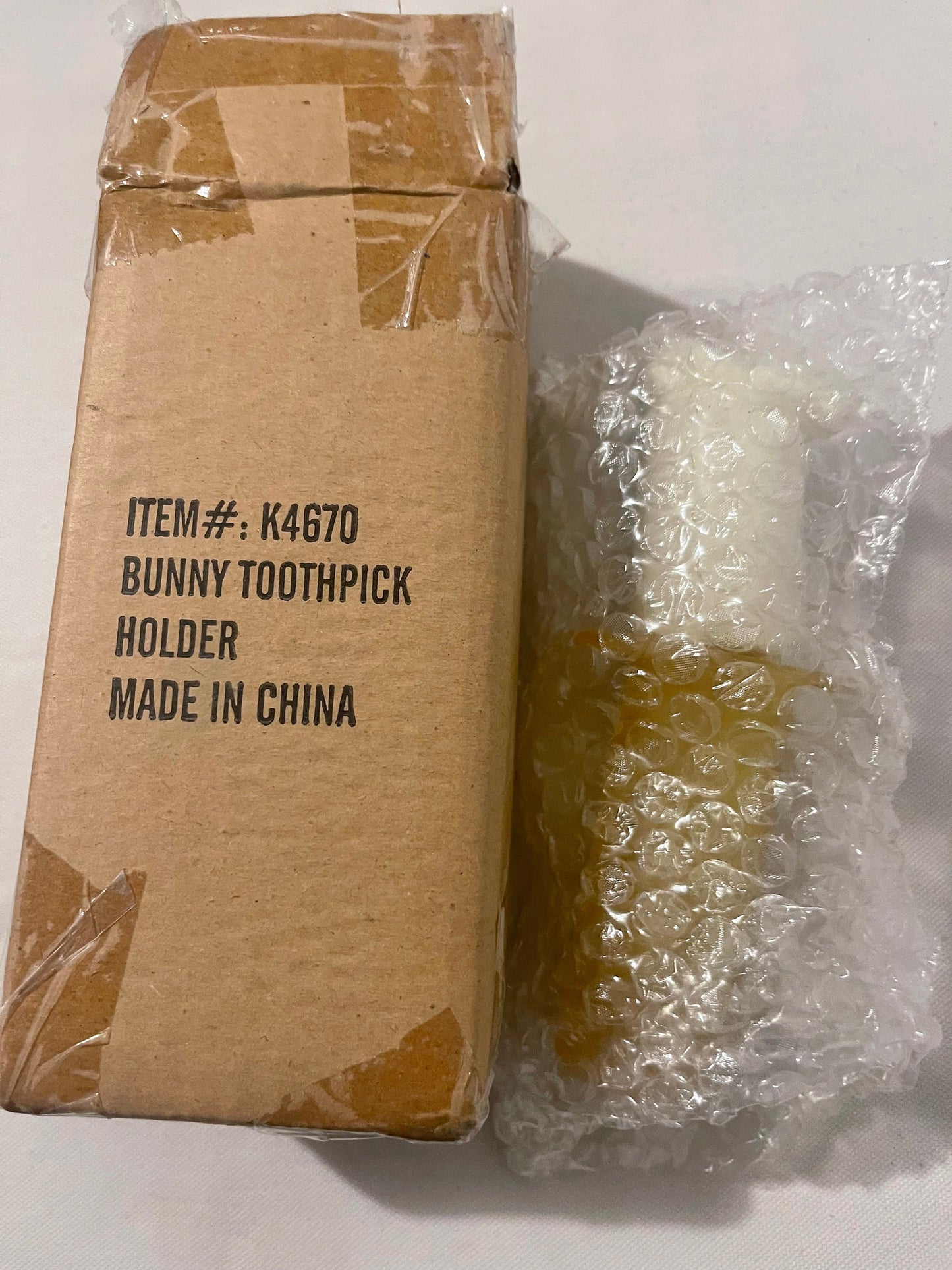
The material is molded thermoplastic resin in Alessi's signature warm translucent amber-yellow — a color that catches kitchen light beautifully, somewhere between honey and topaz, warm and slightly luminous without being aggressive. The brim of the hat carries a subtly recessed ring detail on its upper face, visible when you look straight down from above, a quiet piece of refinement that rewards attention. The whole form is molded with the clean precision that Alessi's manufacturing standards demanded at this period: no flash lines, no visible gates, no compromise in the surface quality. This example is New Old Stock (NOS) — dealer inventory that was never placed on display, never separated from its original cardboard box, and has spent the years since 1998 in storage rather than on a counter. The condition reflects that. It is, in every meaningful sense, as-made.


🏭 Alessi S.p.A. — The Factory on the Lake That Changed How the World Thinks About Kitchenware

To understand why this small amber rabbit matters so much to so many collectors, you have to understand where it came from — and Alessi's story is one of the genuinely great narratives in twentieth-century manufacturing. The company was founded in 1921 by Giovanni Alessi Anghini in Omegna, a small industrial town on the southern shore of Lake Orta in the Piedmont region of northwestern Italy. Giovanni began as a craftsman working in brass and nickel silver, producing trays, coffee services, and household objects with traditional metalworking techniques. The company's early decades were defined by extraordinary craft standards and a quiet, almost monastic commitment to getting the form exactly right.

The transformation into the Alessi the world knows came in the 1970s and 1980s under Alberto Alessi, Giovanni's grandson, who reframed the company's mission entirely. Alberto understood that an everyday object — a lemon squeezer, a kettle, a sugar bowl — could carry the same cultural weight as sculpture or architecture. He began commissioning some of the most significant designers and architects of the era: Richard Sapper, Ettore Sottsass, Michael Graves, Philippe Starck, Aldo Rossi. The resulting objects were not merely well-made; they were conversations about what design could mean when it took human delight seriously. The Graves 9093 Kettle with the singing bird spout became one of the best-selling design objects in history. The Starck Juicy Salif lemon squeezer sparked arguments about function versus form that design students still have today. Alessi had become something rare: a manufacturer whose name alone was a guarantee of cultural seriousness.

Stefano Giovannoni arrived in this context and understood it instinctively. Born in La Spezia in 1954 and trained at the Florence School of Architecture, Giovannoni brought a sensibility that was warmer and more openly playful than some of his predecessors — less interested in provocation, more interested in joy. His work for Alessi in the 1990s produced some of the decade's most iconic objects: the Merdolino toilet brush, the Girotondo family of tableware and accessories with their repeating paper-doll cutout figures, and the Magic Bunny itself. What united all of it was an understanding that humor and tenderness are not enemies of good design — that an object which makes you smile every single morning, every single time you reach for a toothpick, is doing something genuinely valuable. Lore passed down among collectors holds that Giovannoni sketched the Magic Bunny concept in a single session, that the magician's-trick idea arrived whole and essentially unchanged from sketch to production — a story that, whether literally true or collector mythology, captures something real about how completely resolved the concept feels.


🏘️ Omegna — The Town the Italians Call the Capital of Objects

Omegna is a small lakeside town of roughly fifteen thousand people, and it has no particular reason to be famous — except that it is, among designers and collectors worldwide, something close to sacred ground. Situated at the northern tip of Lake Orta, the westernmost of the Italian lake district's major bodies of water, Omegna sits in a valley that has been producing high-quality metalwork since the nineteenth century. The combination of abundant water power, skilled artisan labor inherited across generations, and proximity to the raw material trade routes of the alpine passes created what the Italians call a distretto industriale — an industrial district where an entire region's economy and culture organizes itself around a specific craft tradition.

The Cusio-Ossola district, of which Omegna is the center, became the heart of Italian household goods manufacturing. Alessi is there. Bialetti — makers of the Moka Express stovetop espresso maker, an object as iconic as anything Alessi ever produced — is there. Lagostina, the cookware manufacturer, is there. Local legend has it that on a busy production day in the mid-twentieth century, you could walk the length of Omegna's main street and hear, from open workshop windows, the sounds of metal being pressed, polished, and finished — a continuous percussion that the older residents called simply il rumore della città, the sound of the city. That acoustic landscape is quieter now, but the tradition it represented still shapes how the town understands itself. Omegna is not incidentally the place where these objects are made. It is constitutionally, historically, culturally the place where these objects are made. The Forum Museum in Omegna, dedicated to the history and design of the objects produced in the region, makes the case with the full weight of a civic institution.

For collectors of Italian industrial design, an object marked Alessi, Omegna, Italy carries something beyond brand recognition. It carries geography. It carries a lineage of making that stretches back generations before the famous designers arrived — all the way to craftsmen in small workshops who were solving, by hand, the same problems of form and function that Giovannoni would eventually solve in CAD.


✨ The 1990s Design Moment — Why These Objects Still Command Such Devotion

The Magic Bunny arrived in 1998 at the tail end of what might fairly be called the golden decade of Italian postmodern design for the home. The 1990s were a period when the ideas that had been incubating in the design studios of Milan and Florence through the 1980s reached full commercial and cultural expression. Design objects became gifts, became collectibles, became the things you bought for the person who already had everything. The Alessi catalog became a kind of curated shorthand for a certain type of aesthetic intelligence — if you had one of these on your counter, it communicated something about how you thought about the world.

What the Magic Bunny captured, specifically, was the decade's best impulse: the understanding that an object's job is not merely to hold toothpicks, but to make the act of holding toothpicks a small occasion worth noticing. The amber-yellow color was not accidental. Alessi's color choices in this period were deliberate, market-tested, and often derived from conversations between Alberto Alessi and his designers about what emotional register a piece should occupy. The translucent warmth of the ASG16's resin places it in the register of honey, of candlelight, of warm late-afternoon kitchen light — domestic, comforting, slightly sweet. It is a color that makes the object look like it belongs on a counter that gets cooked in and lived around, not behind glass.

Lore passed down among serious Alessi collectors holds that the Magic Bunny outsold nearly every other piece in the Giovannoni line for the first several years of its production — that it became a word-of-mouth phenomenon in gift shops and design boutiques before the internet gave such things a language. Whether the sales figures bear that out precisely is less important than what the story reveals: this was, from the beginning, an object that people wanted to give to people they loved.


🖼️ Display Ideas

  • 🍽️ On the dining table as a functional centerpiece — loaded with toothpicks or cocktail picks, the amber color catches candlelight and table lamps beautifully, earning its place at the center of a dinner party without trying too hard.
  • 🧺 On a curated kitchen windowsill — the translucent yellow plays warmly against natural daylight and sits naturally alongside other warm-toned objects: wooden boards, earthenware crocks, copper pots on hooks nearby.
  • 🖼️ In a dedicated Italian design shelf display — grouped with other Alessi or Giovannoni pieces from the same era, the ASG16 anchors a collection that tells the story of 1990s Italian design optimism in three dimensions.
  • 🎁 Displayed in its original box as a collector's piece — since this example is NOS with original packaging, the box itself is part of the artifact; a small display stand or open shadow box lets both the object and its packaging be appreciated simultaneously.
  • 🎩 As a desk or home-office accent — toothpick holders work beautifully as small stash boxes for paper clips, push pins, folded notes, or small keys; the Magic Bunny brings a flash of warmth and humor to a workspace without demanding attention.
  • 🏡 In a bar cart or cocktail station vignette — the wide, stable brim keeps the hat planted amid the activity of a well-used bar setup, and cocktail picks are among the object's most natural functional contents; the amber resin glows among bottles and glassware.

🎁 Who Collects These — and Why They Look So Hard to Find One in This Condition

The Magic Bunny ASG16 occupies an interesting position in the collector market because it is simultaneously a functional object, a design collectible, a pop-culture artifact, and a gift item with genuine sentimental histories attached to it. That breadth of appeal means it shows up in different collections for different reasons, and the people who want one in genuinely unplayed-with condition are working against the grain of what these objects were designed to do — be used, be touched, be loved to varying degrees of wear.

Italian design collectors — people building serious collections around Alessi, Kartell, Memphis, and their contemporaries — treat the ASG16 as an essential entry point and a piece whose modest scale belies its canonical status. It represents Giovannoni at his most purely joyful, and it represents the 1990s chapter of Alessi's story in a way that a single object rarely captures a whole decade. Mid-century and postmodern plastics collectors are drawn to the quality of the translucent amber resin and the precision of the molding. Kitchen and culinary antiques collectors find it a natural neighbor to other beloved counter objects from the same era. And then there are the gift-givers — people who need something for a design-minded friend or family member, something that arrives already carrying a story, already a known quantity in the world of beautiful objects. NOS condition speaks directly to all of these groups. The original box is itself a collectible document, and the undisplayed surface means the translucency reads as the manufacturer intended, without the minor hazing that light exposure accumulates over years.


❓ Frequently Asked Questions

Is this a genuine Alessi piece, and how can I confirm the authenticity?

Yes — this is an authentic Alessi production piece, model ASG16, designed by Stefano Giovannoni. Authentic examples from this production run carry Alessi's molded maker's marks and the designer attribution on the base or underside of the hat component. The original cardboard box, which accompanies this NOS example, carries the full Alessi branding, model number, and production information as issued by Alessi S.p.A. of Omegna, Italy. The amber-yellow translucent resin, the precise fit between the rabbit figure and the hat cylinder, and the quality of the molded surface finish are all consistent with Alessi's manufacturing standards for this era. The box itself is a useful authentication document; Alessi's original retail packaging from the late 1990s has a distinctive graphic language that is well-documented in collector reference materials.

What does "New Old Stock" mean for this specific piece, and does it affect the display condition?

New Old Stock — NOS — means this piece was part of a dealer or distributor's inventory that was never placed on display and never sold at retail during its original commercial life. It went from manufacturer to wholesale stock to storage without passing through a consumer's hands. For the Magic Bunny specifically, this matters for a few concrete reasons: the translucent amber resin has not been exposed to years of ambient light, which means the warm honey-yellow color reads at its full designed depth without any of the subtle hazing or color shift that display time can introduce. The surface retains its original molded finish without handling marks. And the original cardboard box, which is part of what makes a NOS example complete, is present and intact — something that rarely survives the object's normal consumer lifecycle, since most buyers discarded the box immediately upon first use.

What exactly does the Magic Bunny hold, and how does the mechanism work in practice?

The toothpick holder function works as follows: the rabbit figure is hollow through its body, open at the base, and this interior space is where toothpicks or cocktail picks are stored upright. The rabbit sits inside the top hat cylinder, which acts both as a stable base and as the concealment element of the magic trick metaphor. When the rabbit is nested in the hat, only its ears and face are visible above the brim line — the hat appears to be the primary object, the rabbit seemingly contained within it. To retrieve a toothpick, you grasp the rabbit figure and lift it free of the hat, accessing the stored picks from below. You drop the rabbit back into the hat, and the display resets. The two-piece construction means the hat can also function independently as a small open vessel — a stash box, as the seller's notes describe it — useful for paper clips, small trinkets, folded notes, or any small object that benefits from a dedicated and aesthetically satisfying home.

How does this piece fit into Stefano Giovannoni's broader design career?

Giovannoni's work for Alessi in the 1990s is considered the core of his commercial legacy, and the Magic Bunny is among the most widely recognized individual objects from that body of work. His approach during this period was consistently organized around what he described as the emotional and memory-laden aspects of objects — the ways in which familiar imagery, childhood references, and humor could be encoded into everyday items to make the act of living with them a continuously small pleasure. The Girotondo range, which preceded the Magic Bunny and featured the repeating paper-doll silhouette that became Alessi's visual signature through the decade, established his reputation for exactly this kind of warm, literate playfulness. The Magic Bunny took that sensibility and focused it entirely on a single cultural image — the magician's rabbit — that required no explanation in any language, in any country. It was, in that sense, one of Giovannoni's most universally legible designs, which explains much of its lasting commercial and collector appeal.

Is the amber-yellow color the only version, or were other colors produced?

The Magic Bunny ASG16 was produced in multiple colorways over the course of its production run, which has continued in various forms since the original 1998 release. The warm translucent amber-yellow of this example is among the most beloved and most associated with the piece's original identity — it is the color most frequently illustrated in Alessi's own catalog documentation from the late 1990s and the one most commonly encountered in collector discussions as the "original" or "classic" version. Other colorways have included white opaque versions, red, and additional translucent tints, produced at various points over the years. For collectors focused specifically on the 1990s production period and the design's original visual intention, the amber-yellow translucent version holds a particular significance.

What kind of collector already owns an Alessi Magic Bunny, and what else do they typically collect alongside it?

In our experience, Magic Bunny collectors are almost always people with a genuine and literate affection for Italian industrial design — people who understand that a toothpick holder can be as serious an object as a chair or a poster, and who build their living spaces around that understanding. They typically collect across the broader Alessi catalog, often focusing on the Giovannoni and Graves periods specifically. Many are drawn to related objects from the same Omegna-area manufacturing tradition: Bialetti Moka pots, Lagostina cookware, and the various small domestic objects that came out of the Cusio industrial district through the twentieth century. Others collect more broadly within Italian postmodern design, adding Memphis pieces, early Kartell plastics, and Sottsass ceramics to shelves that the Magic Bunny anchors with warmth and humor. It is consistently described by collectors as a piece that makes other things look better around it — the quality of its presence as a display object is greater than its modest size would suggest.

What should I know about the original box, and does the box add to the collectible value?

For NOS design collectibles from the 1990s Italian market, original retail packaging is increasingly significant to serious collectors and increasingly rare in the condition this example presents. Alessi's retail packaging from the late 1990s carried the full graphic standards of the company's design identity at that moment — a moment when Alberto Alessi was as attentive to the unboxing experience as to the object itself. The box for the ASG16 identifies the model number, the designer attribution, and the Omegna origin, making it a documentary artifact as well as a protective enclosure. For insurance documentation, estate valuation, and resale in the collector market, the presence of original packaging in intact condition consistently supports identification of authentic period production. For the collector who displays both the object and its box together — an increasingly popular approach with premium design pieces — the box completes the artifact and tells a story that the object alone, however beautiful, cannot fully tell on its own.

Shipping

🚚 Shipping & Handling

  • Shipping costs and timing are calculated at checkout.
  • Items curated and shipped directly by me include U.S. shipping at no additional cost, professionally packed to ensure safe arrival of your artifact.

Items from Vetted Pro Collectors
Shipping for items offered by vetted Pro Collectors is determined at checkout. All Pro Collector listings are reviewed to ensure fair, reasonable shipping practices.

For full details, please refer to our Shipping Policy.

Returns & Exchange

Product Page Return Policy

  • 60-Day Returns – Items must be in original condition.
  • Refunds – Issued after inspection (excluding shipping costs).
  • Return Shipping – Customer is responsible unless item is damaged or incorrect.
  • Damaged/Incorrect Items – Contact us within 48 hours for a replacement or refund.
  • Easy Returns – Email [email protected] or call 802-356-9872 to initiate a return.

For full details, visit our Refund Policy.

View full details