Skip to product information
1 of 7

Vintage and Antique Gifts

Vintage 1970s Mini Coors Beer Can, Gumball Vending Machine Prize, Never Opened Breweriana 🍺

Regular price 13.00 USD
Regular price Sale price 13.00 USD
Sale Sold out
Shipping calculated at checkout.

Description

🍺 A Quarter, a Crank, and a Tiny Can of Coors

There was a moment, sometime in the 1970s, that a lot of American kids remember without quite knowing why. You fed a coin into the machine by the drugstore door, turned the stiff chrome handle until it clunked, and a clear plastic bubble came tumbling down the chute into your hand. Inside — instead of the gumball you half expected — was something wonderful: a perfect, shrunken-down beer can, the grown-up world rendered in miniature and handed to you for pocket change. This is one of those exact little treasures: a vintage 1970s miniature Coors can, a real gumball and vending-machine prize, and it has never been opened. It is not a picture of that vanished corner-store moment; it is a survivor of it, capsule and all.

What you are looking at is a tiny replica of the most talked-about beer in 1970s America, made small enough to rattle out of a coin-operated machine and delight a child who had no business drinking the real thing. That is the whole charm of it, and the whole reason a grown collector wants it now. Everything described below comes straight from the photographs and from the words printed on the can itself — no invented history, no maker's name pulled from the air, no exact year or origin claimed beyond what the piece and its era honestly support.


🕹️ The Golden Age of the Vending-Machine Prize

To understand this little can you have to remember what vending machines meant to a 1970s kid. The bulk machines that stood in every supermarket lobby, bowling alley and five-and-dime were small engines of possibility. For a coin you got a fistful of candy — or, if you were lucky, a "prize" machine coughed up a clear capsule with a toy sealed inside: a sticky hand, a temporary tattoo, a superball, a charm, a ring. Somewhere in that world, someone had the inspired idea to shrink down the packaging of the adult world and sell it back to children as a novelty, and the miniature beer can was born. Tiny replicas of the big American brands became a genuine craze — the forbidden-fruit prize, a scale model of the thing a kid wasn't allowed to touch — collected, traded on the playground and dropped into pockets by the handful. Most were played with until the print wore off and then lost to the vacuum cleaner and the passage of time, which is precisely what makes an intact, never-opened survivor like this one worth slowing down for. It came out of a machine as a throwaway amusement, and has outlasted the machine, the store, and the decade that made it.


🔍 What You Are Actually Looking At

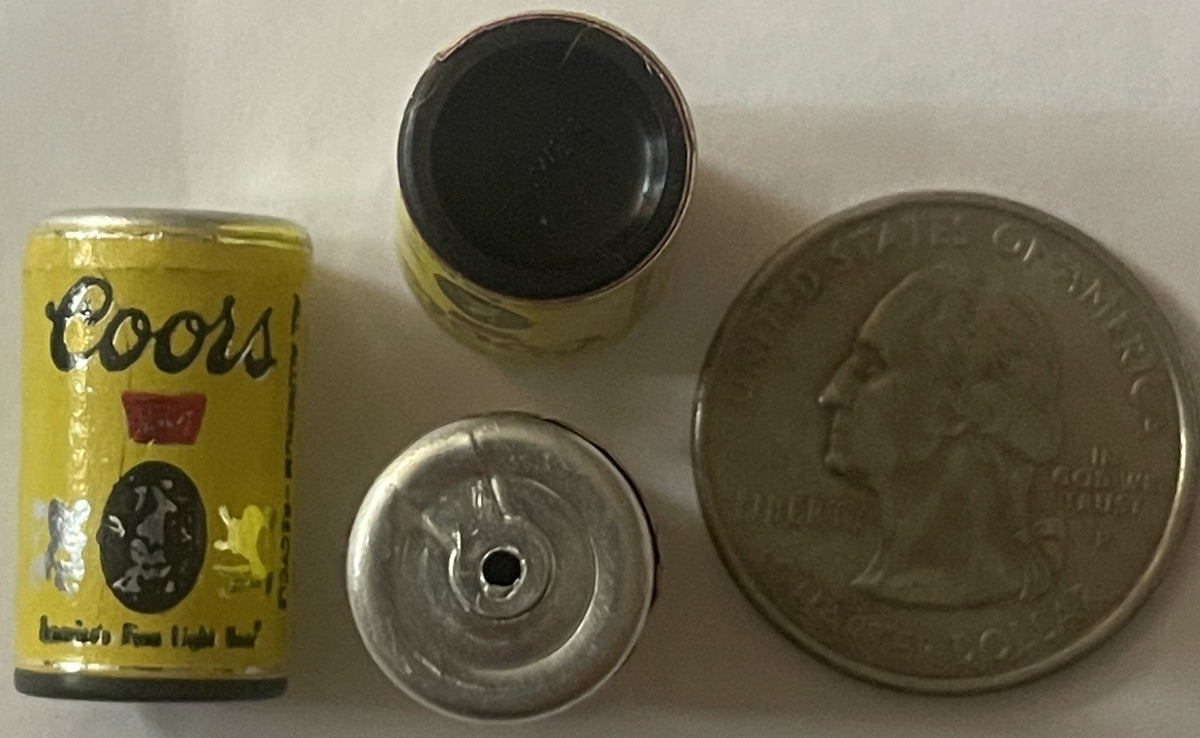
This is a miniature cylindrical can dressed in the unmistakable livery of vintage Coors. The wrap-around label is a warm mustard-yellow, and across the top runs the famous "Coors" name in flowing black script — the confident, hand-drawn signature that fronted the brand for generations. Beneath it sits a small red banner or box, and below that a central black oval medallion picked out with silvered detailing, flanked by silvered scrollwork flourishes. Along the bottom, printed in the period style, is the slogan the brand carried for years: "America's Fine Light Beer." Read up the side, in small vertical capitals, and you find another honest touch printed right into the design — "ALUMINUM · RECYCLE" — the miniature faithfully copying even the recycling note of a real full-size can.

Turn it end to end, as several photographs do, and the construction reveals itself. One end is a solid, dark, slightly recessed disc — the "top," styled to read as the shadowed lid of a can, but with no pull-tab and no opening of any kind. The opposite end is a spun, bright silver base with a shallow dome and a tiny dimple at its very center. It is a compact object: set beside the US quarter that appears in the photos for scale, the little can stands a touch taller than the quarter is wide and measures only about two-thirds of the quarter's diameter across — small enough to have tumbled out of a gumball machine and to sit, even now, inside its own clear capsule.


🫧 Still in Its Capsule — Never Opened

The phrase "never opened" means something specific here. This was sold as a vending prize sealed inside a two-part clear plastic capsule — the round, snap-together bubble that gumball and prize machines dispensed — and both halves of that capsule survive, shown in the photographs. The can itself is intact and whole: the solid dark top has never been pried, the body has never been crushed, and the piece remains exactly the sealed little novelty it was when it dropped down the chute — a genuinely uncommon state for an object designed to be a child's disposable trinket. Let us also be clear about what it is not, because honesty is the whole point: this is a novelty replica. It never held beer, it was never meant to, and it is not a beverage or anything consumable — it is a solid miniature model of a can, a toy and a collector's object.


🏔️ Why Coors, of All Beers?

A miniature of any brand would be a fun period piece. A miniature of Coors, from the 1970s, is something better — because in that decade Coors was the most romanticized beer in the country. Brewed in Golden, Colorado, at the foot of the Rockies, it built a reputation that ran far ahead of where you could actually buy it. And there was the catch: for much of the 1970s Coors was distributed across only a handful of western states and was not sold east of the Mississippi at all.

That scarcity did what scarcity always does — it turned an ordinary lager into a legend. People flying home from the West packed their suitcases with it; cross-country travelers loaded cases into their trunks like contraband. A can of Coors carried east of the Mississippi was a trophy, a favor repaid, a taste of something the folks back home simply could not get. The mystique was built as much on where you couldn't find it as on how it tasted. A little yellow Coors can rattling out of a vending machine, then, wasn't just any prize — it was a shrunk-down piece of the most wanted beer in America.


🚗 The Beer Worth Bootlegging

If the legend needs a single monument, it already has one, and it played in theaters in 1977. "Smokey and the Bandit" — the second-highest-grossing film of its year — is built entirely on the premise that Coors was contraband in the East. The Bandit's whole job is to run a truckload of Coors from Texas to Atlanta on a wild deadline, precisely because you could not legally buy it there. An entire blockbuster rested on the idea that this yellow-labeled beer was worth breaking the speed limit for. None of that is a claim about this specific little can — it never made any such journey, and we would never pretend it did. It is honest context: it explains why a 1970s kid clutching a plastic capsule with a tiny Coors inside was holding a scale model of something genuinely mythic. The object is small. The story it plugs into is not.


🥫 How the Little Can Is Made

For the collector who wants the plain mechanics: the body is a small metal cylinder wrapped in the printed yellow Coors label, and the maker went to real trouble to make it convincing — down to the "ALUMINUM · RECYCLE" note up the side and the spun, dimpled metal base that mimics the bottom of a full-size can. The top is a solid dark disc set into the rim, with no working tab; it reads as a can lid but does not open. We describe the make-up only as far as the piece declares it — printed as aluminum, with a clearly formed metal base — and leave the exact composition open rather than overstate it. Either way it is a proper little three-dimensional object, not a flat sticker, and it photographs beautifully next to a coin or a full-size can for scale.


✨ An Honest Look at Condition

We would always rather tell you exactly what you are getting than let a photograph flatter it. This is a roughly half-century-old novelty that was made to be handled, and it wears its age gently and honestly.

  • 💛 Label: The yellow wrapper is intact and the Coors branding — the black script, the red banner, the oval medallion, the "America's Fine Light Beer" line — is clearly legible.
  • 💛 Silvered accents: The silver scrollwork and highlights show some rubbing and light flaking here and there, exactly the honest wear you would expect on a small metallic-printed object that spent time in pockets and on shelves.
  • 💛 Print: A little softened and weathered in places under close-up macro light, but the design reads well and the character is all there.
  • 💛 Structure: The can is intact and unopened — solid dark top, formed silver base, no crush, no split. Never opened, never crushed.
  • 💛 Capsule: Its two-part clear plastic vending capsule survives with it.

It is offered exactly as pictured, with nothing altered, nothing added and nothing hidden. The small imperfections are not damage to apologize for — they are the fingerprints of an object that was genuinely a 1970s pocket-money toy and lived to tell about it.


🖼️ How to Enjoy It Now

A miniature like this asks almost nothing of you and gives back a surprising amount:

  • 🍺 Stand it on a bar shelf, back bar or man-cave display among full-size cans and breweriana, where its scale alone makes people lean in and smile.
  • 🕹️ Keep it in its capsule as the little time capsule it is — the clear bubble is part of the story and protects the print at the same time.
  • 📚 Add it to a breweriana or mini-can collection, where a clean, never-opened Coors example is exactly the kind of piece that anchors a shelf.
  • 🎁 Give it as a nostalgia gift — to a Coors fan, a child of the 1970s, or anyone who remembers the crank of a gumball machine.

🎁 Who This Is For

This little can will mean the most to a handful of very different people: the breweriana collector, who knows how quickly these disposable mini cans vanished and values an intact, never-opened one; the Coors devotee, who feels every ounce of the brand's 1970s mystique and wants a pocket-sized piece of it; the child of the seventies, who fed a hundred quarters into machines like this and would love the jolt of recognition; and the gift-giver hunting for something with genuine age, story and character rather than something merely new — for a beer lover, a nostalgia buff, a man-cave decorator, or a collector of the wonderfully small. There are a few available, so more than one of them can go home happy.


❓ Questions Worth Answering

Is it really from the 1970s?

It is described as a vintage 1970s miniature Coors can, in keeping with the era of the vending mini-can craze and the vintage Coors label it wears. We do not claim an exact year, a maker or a country of origin, because the object itself does not, and we will not invent what we cannot show you.

Does it contain beer? Can you drink from it?

No. This is a solid miniature novelty replica. It never held beer, it is not a beverage and it is not consumable in any way — it is a tiny model of a can, made to be a toy and a collectible.

How big is it?

Small. A US quarter appears in several photographs so you can judge the size directly: the can stands a little taller than a quarter is wide and about two-thirds as wide — gumball-capsule sized.

How many are available?

There are several of these little cans available. Each is a genuine 1970s survivor in the same honest, never-opened condition shown. The wrapper is printed "ALUMINUM · RECYCLE" and the base is a clearly formed, spun metal disc, so each presents as a metal-bodied miniature; we describe only what the piece shows and leave the exact composition open rather than overstate it.


💛 Why It Matters

Some things are collected because they are grand; this one is worth having because it is real, and small, and improbably still here. It is a genuine artifact of two overlapping American stories — the coin-operated vending craze that put tiny wonders into children's hands, and the 1970s mystique of a Rocky Mountain beer so wanted that a movie was made about smuggling it. It carries no invented pedigree and needs none. What it offers is the thing itself: a perfect little yellow Coors can, never opened, still cradled in the plastic bubble it dropped out of, waiting for someone who remembers what it felt like to turn that crank and hope.

Shipping

🚚 Shipping & Handling

  • Shipping costs and timing are calculated at checkout.
  • Items curated and shipped directly by me include U.S. shipping at no additional cost, professionally packed to ensure safe arrival of your artifact.

Items from Vetted Pro Collectors
Shipping for items offered by vetted Pro Collectors is determined at checkout. All Pro Collector listings are reviewed to ensure fair, reasonable shipping practices.

For full details, please refer to our Shipping Policy.

Returns & Exchange

Product Page Return Policy

  • 60-Day Returns – Items must be in original condition.
  • Refunds – Issued after inspection (excluding shipping costs).
  • Return Shipping – Customer is responsible unless item is damaged or incorrect.
  • Damaged/Incorrect Items – Contact us within 48 hours for a replacement or refund.
  • Easy Returns – Email [email protected] or call 802-356-9872 to initiate a return.

For full details, visit our Refund Policy.

View full details
  • 5 stars: 1 (100%)
  • 4 stars: 0 (0%)
  • 3 stars: 0 (0%)
  • 2 stars: 0 (0%)
  • 1 star: 0 (0%)
T
Thomas

Cool little buy and fast shipping too!👍