Skip to product information
1 of 6

Vintage and Antique Gifts

Vintage 1989 New Kids on the Block Pinback Button 🎤 "The Pose" NKOTB Button-Up Troy MI Metal Pin

Regular price 6.00 USD
Regular price Sale price 6.00 USD
Sale Sold out
Shipping calculated at checkout.

Description

Remember Taping This Exact Pose Inside Your Locker Door? 🎤

If you came of age anywhere near the late 1980s, you know this photo before you even finish looking at it. Five guys, five distinct outfits, one unmistakable attitude — the too-cool, off-duty pose that every teen magazine, cereal box insert, and mall poster of that era seemed to be built around. This little pinback button freezes that exact moment: New Kids on the Block, caught mid-swagger, ready to be pinned to a jean jacket lapel, a backpack strap, or a corkboard already crowded with concert ticket stubs and Polaroids. It's the kind of small, humble object that carried enormous teenage devotion on its back — and it still does.

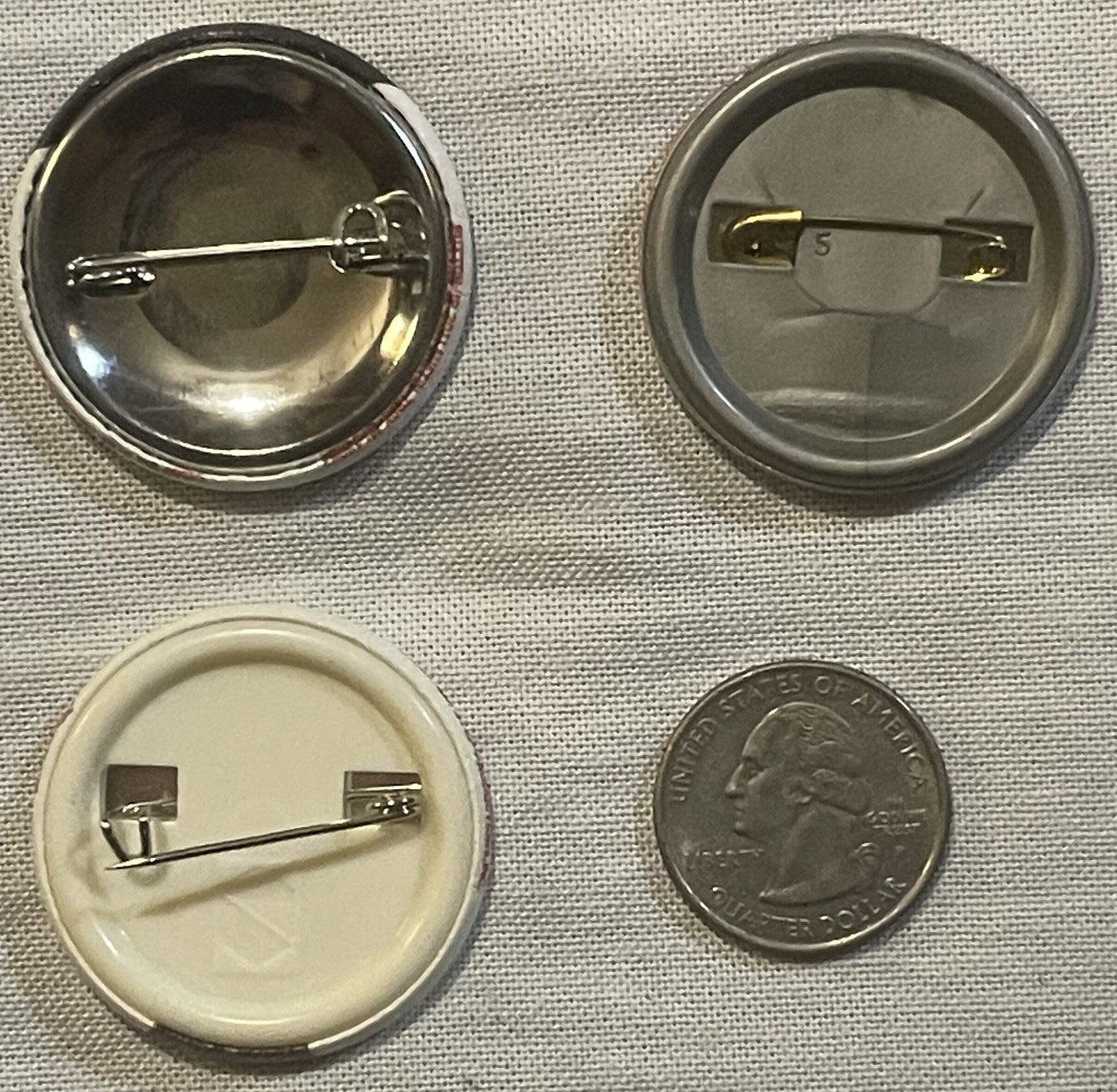
This is a New Kids on the Block pinback button, produced by Button-Up out of Troy, Michigan, measuring 1.5 inches across — a compact, classic lapel-pin size, exactly the scale collectors and fans of the era used to cover a jacket front or a backpack flap with a whole constellation of favorite bands, causes, and inside jokes. The button's rim carries two separate imprints. One is the maker's address — "BUTTON-UP 2011 AUSTIN TROY, MI 48083" — which reads 2011 Austin, Troy, Michigan 48083: a street number, a street name, a city, a state and a ZIP code, not a date. The other is the copyright notice "©1989 BIG STEP PRODUCTIONS, INC." That is the date mark, and 1989 is the year this button belongs to — the absolute peak of New Kids fever. That's not a contradiction; it's simply how a lot of band pinback buttons work. A beloved old photo gets licensed and reprinted years later, onto new metal, for a new wave of fans and collectors who want the image without needing a time machine to find it. This example is new old stock (NOS) — never worn, never pinned to anything, sitting exactly as it came off the manufacturing line, ready for a new home.

The artwork itself is a straightforward, vivid group shot rendered in offset lithograph printing directly onto the metal button face. All five members stand together against a black background, each dressed in the era's own particular flavor of cool: a purple dress shirt worn open over a crisp white turtleneck, a black button-front top, an open black shirt flashing a bit of jewelry and attitude, a boxy dark green tee, and an oversized white jersey numbered "71." Across the bottom, the band's name is lettered in bold red bubble type — NEW KIDS ON THE BLOCK — the exact kind of chunky, candy-colored lettering that decorated everything from concert tour programs to bedroom wall posters in that era. Every color in the design — the black, the purple, the green, the white, the red, the warm flesh tones of the group photo — comes through crisp and bright, the way collectors hope to find these decades-old promotional images still looking today.


🎸 From Dorchester Street Corners to the Top of the Charts

New Kids on the Block didn't spring out of a boardroom fully formed — they were built, deliberately and painstakingly, by a Boston producer named Maurice Starr. Starr had already found enormous success managing New Edition, the all-Black teen vocal group that gave the world Bobby Brown and a run of R&B hits earlier in the 1980s. As the story is told and re-told among fans of the era, Starr wanted to replicate that formula with a new group — this time drawing from Boston's white, working-class neighborhoods. He sent a talent scout named Mary Alford out to find the raw material: kids who could sing, rap, dance, and carry themselves with real conviction, not polish.

In Dorchester — one of Boston's oldest, most tightly-knit neighborhoods, a place of triple-decker houses and corner stores rather than glamour — Alford found a fourteen-year-old named Donnie Wahlberg. Around him, Starr and Alford assembled the rest of what would eventually become the classic lineup: Jordan Knight, Jonathan Knight, Joey McIntyre, and Danny Wood. There was some shuffling in those early days — the group briefly included Donnie's younger brother Mark Wahlberg, who left before the band's breakthrough to eventually build his own separate career in music and film. The self-titled debut album the group released in 1986 landed with barely a ripple: modest regional airplay around Boston, a trickle of sales, and little else to suggest what was coming.

Then, in 1988, everything changed. Hangin' Tough — the group's second album — didn't just sell, it detonated. The record shot all the way to number one on the Billboard 200 and threw off five top-ten singles, including two chart-topping hits. Songs like "Please Don't Go Girl," "You Got It (The Right Stuff)," and the driving title track "Hangin' Tough" became inescapable — blasting out of boomboxes, dominating MTV, filling roller rinks and school dances across the country. By 1989, New Kids on the Block weren't simply a successful pop group anymore. They were a full-blown cultural phenomenon, arguably the first modern boy band in the sense we'd come to recognize decades later — five relatable, non-threatening young men who could sing a ballad, throw down a rap verse, and still look like the boy down the street.


📼 Hangin' Tough and the Merchandising Machine

What followed the Hangin' Tough explosion was a merchandising blitz almost unmatched in its era. New Kids on the Block dolls lined toy store shelves. Lunchboxes carried their faces into cafeterias across the country. There was a Saturday morning animated cartoon built around the group, board games, comic books, bedsheets, sleeping bags, trading cards, and — inevitably — buttons like this one, sold at mall kiosks, concert merchandise tables, and drugstore checkout counters everywhere. The band toured relentlessly through 1989 and 1990, and 1990's follow-up album, Step by Step, kept the momentum rolling with another string of hits.

Like nearly every teen-pop phenomenon before or since, the wave eventually crested. 1994's Face the Music found a music landscape that had moved on to grunge and a new generation's tastes, and the group stepped away from the spotlight for over a decade. But the story didn't end there — in 2008, the original five-man lineup reunited and released The Block, introducing themselves to both the fans who'd grown up alongside them and a curious new audience discovering them for the first time. A second reunion-era album, 10, followed in 2013. That comeback stretch — roughly 2008 through 2012 — brought New Kids on the Block back onto arena stages and back into the merchandise business, and sent a whole generation of fans digging out the buttons, posters and pins they had bought the first time around.


🎤 NKOTBSB and the Package Tour That Brought Two Eras Together

Among the touring history tied to this reunion stretch is a run fans still talk about with real fondness: in 2011 and into 2012, New Kids on the Block joined forces with the Backstreet Boys for a co-headlining outing that fans nicknamed NKOTBSB — a genuine collision of two generations of boy-band devotion sharing one stage. It was, in its own way, a perfect full-circle moment: the group that essentially invented the modern boy-band template touring alongside the group that had carried the format into the following decade. A button like this one, made at the height of the first wave and never worn, is what those reunion-era crowds were reaching back toward — a small, wearable piece of the original moment rather than a souvenir of the second act.


🔵 The Golden Age of the Pinback Button

It's worth pausing on the pinback button itself as an object, because it was, for an entire generation, the single cheapest and most personal form of self-expression available. Long before profile pictures and playlists told the world what you loved, your jean jacket did the talking — covered edge to edge in an overlapping constellation of band buttons, cause buttons, cartoon buttons, and inside-joke buttons, each one a tiny public declaration of identity. Mall kiosks specialized in these things, spinning wire racks packed with hundreds of designs for a dollar or two apiece, and concert merchandise tables sold them right alongside t-shirts and tour programs. A backpack strap, a denim vest, a corkboard above a bed — these were the natural habitats of the pinback button, and a New Kids on the Block button would have been among the most sought-after designs a mall kiosk could stock at the height of the band's fame.

That culture of wearable fandom never entirely went away — it simply moved into different objects. But the pinback button retains a particular charm precisely because it asks so little and delivers so much: no batteries, no charging, no login. Just a small circle of printed metal and a sturdy pin, doing exactly what it did decades ago the moment you clip it on.


🏭 Reading the Button's Own History: An Address, a Copyright, and 1989

This particular button carries its own maker's record right on its rim: "BUTTON-UP 2011 AUSTIN TROY, MI 48083." Read it for what it is and it is an address — 2011 Austin, Troy, Michigan 48083 — the shop that made the button, in a city just north of Detroit that has long served as a business and light-manufacturing hub for southeast Michigan. The number in front of the street name is a street number, and Button-Up put that same address on its buttons for years, which is exactly why it cannot be read as the year any one of them was made. The photograph reproduced on its face, however, is a genuine period promotional image of the band from their original late-1980s run — the "signature casual look" era captured in magazines, tour programs, and merchandise of that time. Put those two facts together and you get exactly what collectors love to find: an authentic period photograph on an authentic period button, made for the merchandise tables of the tour it belongs to, and then never worn. It's a neat little artifact of how band nostalgia works in practice — an image from one era, physically manufactured in another, both eras equally real and both worth preserving.


💫 Why This Little Circle Still Matters

There's a reason New Kids on the Block buttons, posters, and ephemera keep surfacing at collector shows, in shoeboxes at estate sales, and in the backs of closets belonging to people who are now, themselves, parents. This band didn't just make hit records — they arrived at exactly the moment when a certain kind of teenage devotion was possible: the era of Tiger Beat pull-out posters, of debating with your friends over lunch about who was your favorite, of pinning your loyalty quite literally to your clothing. A button like this one is a small, tangible proof that all of that really happened — that the boombox really was blasting "Hangin' Tough" from someone's bedroom window, that the mall kiosk really did have a whole wall of these things, and that somebody, somewhere, really did clip one onto a denim jacket and wear their devotion proudly out into the world.


🖼️ Display Ideas

  • 📌 Pin it to a denim jacket lapel exactly the way it would have been worn during the band's original run
  • 🎒 Clip it onto a backpack strap or tote bag alongside other era-appropriate band pins
  • 🖼️ Frame it in a small shadow box alongside a ticket stub, cassette single, or magazine clipping for a mini NKOTB shrine
  • 📋 Add it to a corkboard display of vintage band and pop-culture pins as a rotating centerpiece
  • 🎁 Gift it to a lifelong fan who grew up on this exact photograph and lineup
  • 💍 💍 Wear it to a reunion-era concert or nostalgia-themed party as a genuine period accessory

🎁 Who Collects These

New Kids on the Block pinback buttons draw a wonderfully specific crowd: fans who grew up with this exact lineup and this exact photograph, and who want a small, wearable piece of that memory back in their hands. They appeal to boy-band and teen-pop historians tracing the lineage from New Edition through New Kids on the Block and on into the boy bands of the 1990s and 2000s. They appeal to pinback button collectors generally, who prize band buttons as a distinct sub-category of pop-culture ephemera. And they appeal to anyone building a personal collection of 1980s-and-90s music memorabilia — the lunchboxes, the cassette singles, the tour programs — who wants a button to complete the set. For many buyers, though, the appeal is simpler than any collecting category: it's the chance to hold, once again, the exact image that used to hang inside a locker door.


❓ FAQ

Is this an original 1980s New Kids on the Block button?

The photograph printed on the button's face is a genuine period promotional image of the band from their original late-1980s run. The button itself carries the maker's address imprint, "BUTTON-UP 2011 AUSTIN TROY, MI 48083," which names the shop in Troy, Michigan that assembled it, and separately the "©1989 BIG STEP PRODUCTIONS, INC." copyright that dates it.

What size is the button?

It measures 1.5 inches across, the classic compact pinback size made for a jacket lapel, backpack strap, or corkboard display.

Who are the five members shown in the photo?

The classic lineup pictured is Jordan Knight, Jonathan Knight, Joey McIntyre, Danny Wood, and Donnie Wahlberg — the group formed in Boston in 1984 under producer Maurice Starr.

What does "Button-Up, Troy, MI" refer to?

That's the manufacturer's address imprint stamped directly onto this button's rim, naming where this piece was made: Button-Up, at 2011 Austin in Troy, Michigan.

Is this button new old stock?

Yes — this is new old stock (NOS), meaning it has never been worn or pinned to anything and has remained in its original, unused manufactured state since it left the production line.

Doesn't the "2011" on the rim mean it was made in 2011?

No. That 2011 is the street number in Button-Up's address — "2011 AUSTIN TROY, MI 48083" reads 2011 Austin, Troy, Michigan 48083 — and the same address imprint turns up on Button-Up buttons made years apart. The date mark is the separate copyright line on the rim, "©1989 BIG STEP PRODUCTIONS, INC.," which puts this button in 1989, right in the middle of Hangin' Tough mania.

Is this an officially titled product called "The Pose"?

"The Pose" describes the button's artwork — the group's signature off-duty, too-cool stance captured in this particular promotional photograph — rather than a confirmed official product name printed anywhere on the piece itself.

Shipping

🚚 Shipping & Handling

  • Shipping costs and timing are calculated at checkout.
  • Items curated and shipped directly by me include U.S. shipping at no additional cost, professionally packed to ensure safe arrival of your artifact.

Items from Vetted Pro Collectors
Shipping for items offered by vetted Pro Collectors is determined at checkout. All Pro Collector listings are reviewed to ensure fair, reasonable shipping practices.

For full details, please refer to our Shipping Policy.

Returns & Exchange

Product Page Return Policy

  • 60-Day Returns – Items must be in original condition.
  • Refunds – Issued after inspection (excluding shipping costs).
  • Return Shipping – Customer is responsible unless item is damaged or incorrect.
  • Damaged/Incorrect Items – Contact us within 48 hours for a replacement or refund.
  • Easy Returns – Email [email protected] or call 802-356-9872 to initiate a return.

For full details, visit our Refund Policy.

View full details