Skip to product information
1 of 3

Vintage and Antique Gifts

Vintage 1960s-1970s Gainesville Police 🚔 Special Tin Lithography Badge NOS Original Card Japan Novelty Pin

Vintage 1960s-1970s Gainesville Police 🚔 Special Tin Lithography Badge NOS Original Card Japan Novelty Pin

Regular price 18.00 USD
Regular price Sale price 18.00 USD
Sale Sold out
Shipping calculated at checkout.
Quantity

Size: Badge 1 1/2" ~ Card 4" x 2 1/4" ~ New Old Stock, still on its card. They vary a little one to the next.

🌴 Hogtown's police, in tin, on a card printed in Japan

Gainesville, Florida started life as Hogtown, a Seminole village where hogs were raised. This little tin button puts GAINESVILLE POLICE on a navy shield around a red map of Florida, a green palm and a white star, and rides a yellow card with a cartoon motorcycle cop under the words SPECIAL POLICE BADGE. It is a dime-store toy made in Japan, and town-named tin litho badges like it rarely surface for sale anywhere. What it keeps is a whole chain of history that is easy to lose: a railroad town named for a Seminole War general, the police force that grew up with it, the university that invented Gatorade, and the last years of Japan's tin toy trade.

What is printed on the badge and the card

The badge is a round tin lithograph with a dark edge and a red field, carrying a navy police-style shield trimmed in gold. GAINESVILLE arches across the top of the shield in gold capitals and POLICE sits along the bottom. In a gold-ringed circle at the center, the state of Florida is printed in red with a white star in the north-central part of the peninsula, and a green palm tree leans over a curving strip of shore. A gold star stands on each side of the lower shield. The front is tin litho; the back is a thick plastic.

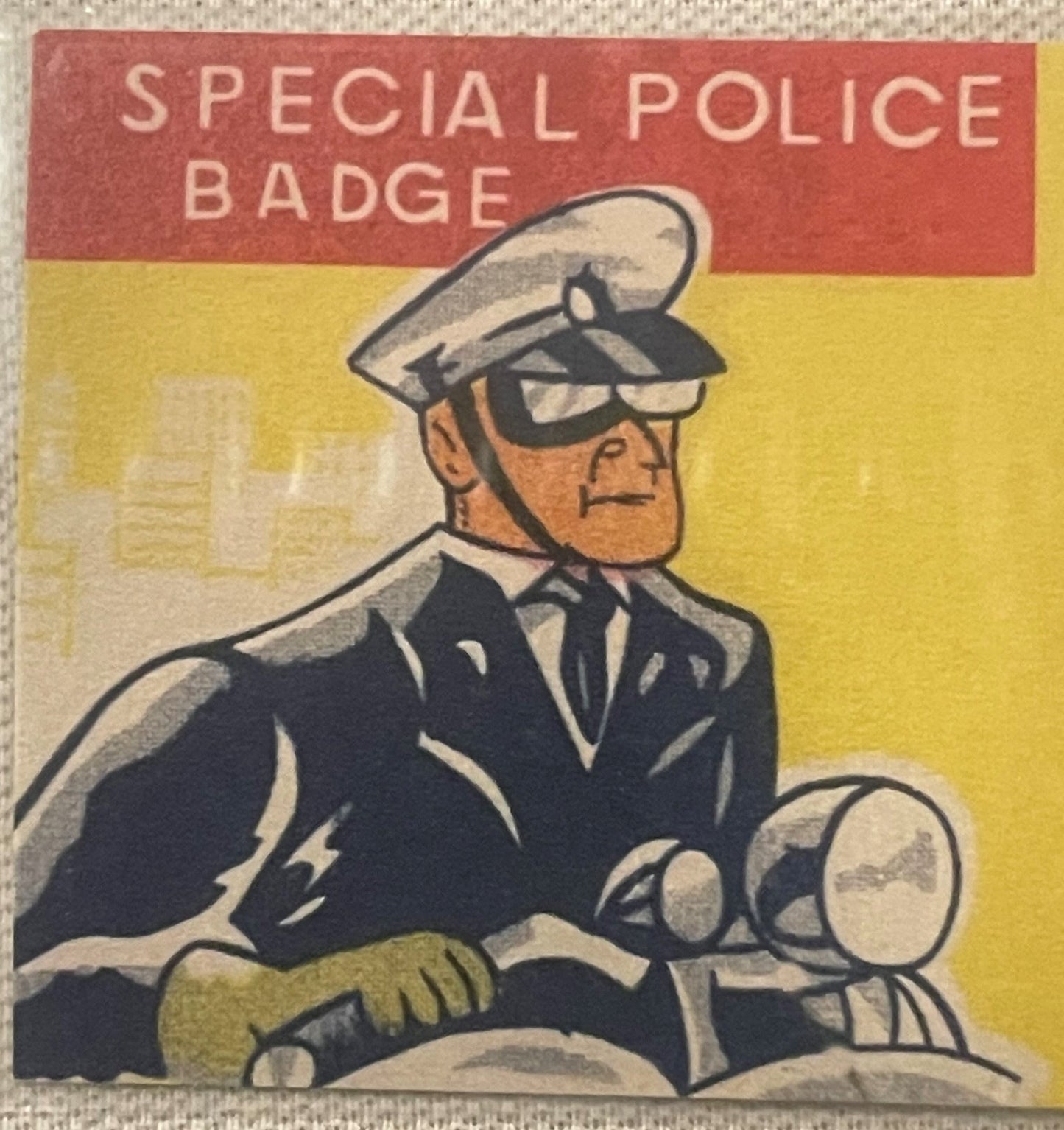
The card is yellow, with a red header lettered SPECIAL POLICE BADGE and a comic-style motorcycle officer in a white peaked cap and dark goggles, gloved hands on the handlebars, a pale skyline behind him. JAPAN is printed in the lower right corner. The card is still in its clear sleeve.

🗓️ Dating the card

The card does the dating. The identical SPECIAL POLICE BADGE card, the same motorcycle officer in the same place, was also printed for a New York City button that copies the NYPD shoulder patch — and New York did not adopt that patch until July 1, 1971. So this card series was still in production in the 1970s, which fits the badge's 1960s-1970s place in the long run of Japanese tin.

🐖 From Hogtown to a railroad county seat

People lived on this ground for a very long time before any town. Archaeologists have found traces of Paleo-Indians from about 12,000 years ago, a Deptford culture campsite from roughly 500 BCE to 100 CE, and when Europeans arrived the Potano people held the region. By 1824 a Seminole settlement called Hogtown, after the hogs its families raised, counted fourteen inhabitants. After the Treaty of Moultrie Creek removed the Seminoles, American settlers took Hogtown over in the late 1820s.

Gainesville itself was a railroad decision. David Levy Yulee's Florida Railroad, running from Fernandina to Cedar Key, was going to bypass the Alachua County seat at Newnansville, so in 1853 county residents decided to move the seat to the line. Meeting at Boulware Springs to choose a name, they settled on Edmund Pendleton Gaines, the general who had fought in the area during the Second Seminole War. The new town was founded in 1854 a few miles east of Hogtown, the rails reached it from Fernandina in 1859, six blocks south of the courthouse, and it was incorporated in 1869 and chartered as a city in 1907.

The year before that charter, in 1906, the University of the State of Florida moved to Gainesville from Lake City; it became simply the University of Florida in 1909. The campus gave the town its most famous invention. In 1965 Dr. Robert Cade and his team at the UF College of Medicine tested the Gator football players, found their electrolytes and blood sugar badly out of balance in the Florida heat, and mixed a drink of salts and sugars. It was first used in a Gator victory in October 1965, helped the team win the 1967 Orange Bowl, and took its name from the mascot: Gatorade, the drink that started the sports-drink industry.

🚓 The real Gainesville Police Department

The department's own history reads like a small-town force growing into a city one. Gainesville bought its first police car, a Ford Motor Company Model T, in 1908. In 1922 the entire department was three men, chief included, and a set salary for the chief and officers came only in 1926. In 1928 the Model T gave way to a Model A, and C.E. Strickland became the city's first motorcycle patrol officer. Chief W.B. Cahoon had the department's first radio transmitter built in 1935.

Under Chief William D. Joiner in 1946, Oscar Lewis became the department's first African-American police officer. In August 1953 the force, 40 officers strong, moved into a new building at 721 NW 6th Street, and a 1962 renovation doubled the station's size.

The years this card series was on the racks brought the biggest changes. Gainesville's population had more than doubled, from 29,701 in 1960 to 64,510 in 1970, and reached 81,371 by 1980. Elaine Garrett became the first sworn policewoman in 1970, working as a detective. In 1975 Fern Nix and Sylvia Sadlack (Hill) became the first women on uniform patrol. By 1976 the department had 101 sworn officers answering 45,394 calls for service, and in 1980 Atkins Warren became Gainesville's first African-American chief.

The city was a national story in those years too. The Gainesville Eight, eight men, seven of them members of Vietnam Veterans Against the War, were accused of planning violence at the 1972 Republican National Convention in Miami. Their trial ran alongside the Watergate revelations, brought to light government informants inside the veterans' group, and ended with a jury acquitting all eight on August 31, 1973, after a 14-month legal fight.

⭐ Prize badges and kid cops

Tin badges like this one were more than store toys. Sheriffs running youth programs handed them out as prizes, and a badge from a grown-up in uniform meant something to the kid who earned it. Putting children in police badges is an old American tradition: in 1914 John Sweeney, a New York police captain on the Lower East Side, founded the Junior Police, which at its peak had more than 4,000 uniformed boys drilling in 22 precincts and became the Police Athletic League in 1936.

🎌 The MacArthur story, and the end of the tin era

The story goes that these badges came out of General Douglas MacArthur's rebuilding of Japan. The rebuilding was real. Under the Allied Occupation, from 1945 to 1952, Japanese exports carried the mark "Occupied Japan," and the tin toy trade that grew out of those years reached its golden age from about 1952 to 1962, when Japan made nearly all of the world's battery-operated toys and American five-and-dimes — Woolworth, W.T. Grant, Ben Franklin, J.J. Newberry, G.C. Murphy and McCrory's — stocked them.

This badge is marked simply JAPAN, on a card still in use in the 1970s, so it comes from that trade's long afterlife rather than its first chapter. By then plastic was replacing tin, Japanese wages were rising and safety rules were tightening, and toy work was moving to Hong Kong and Taiwan. A Florida town's police name, lithographed on tin in Japan for an American toy rack, carries that whole arc in a button an inch and a half across.

Shipping

🚚 Shipping & Handling

  • Shipping costs and timing are calculated at checkout.
  • Items curated and shipped directly by me include U.S. shipping at no additional cost, professionally packed to ensure safe arrival of your artifact.

Items from Vetted Pro Collectors
Shipping for items offered by vetted Pro Collectors is determined at checkout. All Pro Collector listings are reviewed to ensure fair, reasonable shipping practices.

For full details, please refer to our Shipping Policy.

Returns & Exchange

Take your time — you've got a full six months. If a piece isn't right for you, send it back the way it reached you and we're good.

In the first 30 days your money goes straight back the way you paid. After that it's store credit, so you can put it toward something you'd rather have.

Return shipping we sort out between us, case by case. I don't make this difficult.

If something arrives damaged, or it isn't what I said it was, send me a photo within 48 hours and I'll make it right.

Email info@vintageantiquesgifts.com or call 802-356-9872 — that's me answering, not a call center.

The only things I can't take back are custom or special-order pieces and gift cards.

View full details