Skip to product information
1 of 18

Vintage and Antique Gifts

Vintage English Metal Mystery Object 🧩 Two-Piece Industrial Artifact, Stamped, Purpose Unknown

Vintage English Metal Mystery Object 🧩 Two-Piece Industrial Artifact, Stamped, Purpose Unknown

Regular price 24.00 USD
Regular price Sale price 24.00 USD
Sale Sold out
Shipping calculated at checkout.
Quantity

Size: 3 inches

⚜️ What Does a Goblet Remember When the Hand That Made It Is Gone?

There is a moment every serious collector knows. You are standing at a table, or crouching over a box, or turning something small over in your hands under a bare lightbulb, and the object sends a very specific signal up through your palms. It is not warmth, exactly. It is not recognition. It is something closer to attention — the feeling that whatever this thing is, it was not made carelessly. Every curve and flat, every fluted rib, every stamped numeral was put there by someone who understood precisely what the object needed to be, and made certain it would be exactly that, indefinitely, without complaint.

And then you realize you cannot name the hand that made it. Not because it looks rough or anonymous. Quite the opposite. You cannot name it because it looks too right. Too deliberate. Too confidently shaped for a world that has simply — quietly, without fanfare — moved on around it. The world moved. This goblet stayed. And it stayed beautifully.

We have been doing this long enough to know that mystery in the presence of precision is something entirely different from plain ignorance. Mystery in the presence of precision is history wearing a locked door. And locked doors, as every collector knows, are irresistible. Settle in. Pour something warm. This one deserves the long read.


🔍 What It Is — Described as Honestly as We Know How

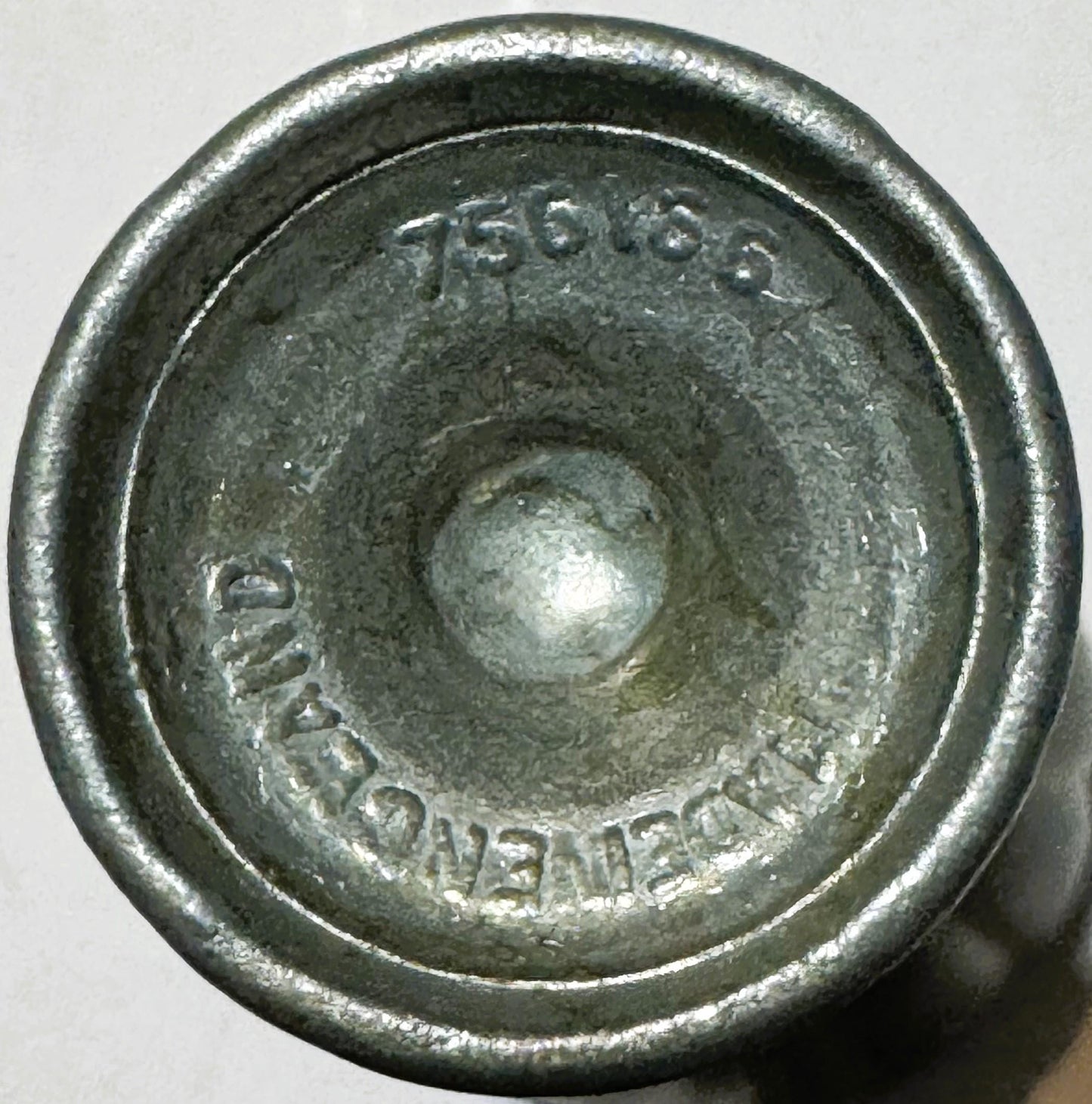
What we have here is a miniature pewter goblet — a chalice, really, in the most classical miniature form — stamped on its base with the words MADE IN ENGLAND and a number that reads 7561954. It arrived in our shop the way the best things always do: carrying itself with the quiet dignity of an object that was made to last and has, in fact, done exactly that. This is a New Old Stock piece — found rather than used, kept rather than displayed, preserved by circumstance as much as by intention.

The goblet is small — slightly taller than a US quarter coin stood upright on its edge, as the second photograph confirms plainly. In spite of that modest scale, there is nothing modest about its ambition. The bowl is fluted, its ribs running in clean, even channels from rim to neck the way a proper craftsman's work would come — not pressed flat into sheet metal but shaped into a fully three-dimensional form that catches light differently at every angle, each rib a small decision made and executed well. Below the bowl, a turned baluster stem rises and falls in the classic chalice profile: collared rings at the top where stem meets cup, a graceful double-baluster swell through the middle, a broad disc node at the lower stem, and a stepped, spreading foot that gives the piece its stable, grounded authority. The base is recessed on its underside — that classic turned well — and it is there that the maker left his only message: the country mark and a stamped number, pressed into soft metal with a confidence that suggests these marks were applied routinely, by habit, by a workshop or factory that had been doing this long enough to make it second nature.

The metal is pewter — that honest, silver-gray alloy that has served humanity's table and altar for more than a thousand years. It photographs beautifully in silver and deep gray, and it holds a turned profile with a crispness that speaks to a mold of real quality. The style of the piece — the ribbed cup, the multi-stage baluster, the stepped foot — places it squarely in the tradition of English ecclesiastical and ceremonial metalwork, translated here into a miniature scale that makes it no less serious for being small. We describe its era as vintage, mid-century in character, consistent with the "MADE IN ENGLAND" country-of-origin convention as it was used through the middle decades of the twentieth century. We offer that honestly, without pinning a year to it, because the piece has not yet told us its birth year — only its birthplace.


🏴󠁧󠁢󠁥󠁮󠁧󠁿 England and Its Pewter — A Tradition Longer Than Almost Anything Else in the Workshop

To hold a piece of English pewter is to hold the end of a very long thread. England's pewter tradition reaches back to the Roman occupation — fragments of Romano-British pewter vessels have been recovered from riverbeds and field ditches across the south and west of the country, and by the medieval period, pewter had become so central to English domestic and religious life that London's Pewterers' Company was granted its Royal Charter in 1348, making it one of the oldest continuously operating craft guilds in the world. That is not a decorative fact. That is context for understanding why an English pewter workshop of the mid-twentieth century was not improvising. It was inheriting.

The English pewter tradition has always had two streams running side by side. The first is the grand, ceremonial stream: the great ecclesiastical chalices, the guild flagons, the civic plate that still sits in English town halls behind glass. These pieces were made by named masters, hallmarked under guild supervision, and are documented with the precision of legal instruments. The second stream is quieter, more democratic, and in some ways more interesting to the working collector: the everyday and the commemorative — the beakers, the tot cups, the small souvenir goblets and cabinet pieces made by provincial workshops for the gift trade, the tourist trade, the household market. These pieces were made in their thousands, marked with a country stamp and a catalog number rather than a maker's full touchmark, and distributed through channels that left no archives and kept no ledgers that have survived to the internet age.

Our little goblet belongs to that second stream, and that membership is not a diminishment. It is a classification. The English gift and souvenir pewter trade that flourished through the mid-twentieth century produced work of genuine craft quality — the tooling of a good mold cost real money, the skill of a competent spinner or caster was real skill, and the market was competitive enough that a badly made piece simply did not sell and did not survive. What survived, survives because it was worth keeping. This piece was worth keeping.

The number stamped on its base — 7561954 — remains, in our honest assessment, unresolved. We looked carefully. We searched specifically. The number did not surface as a documented hallmark, a registered design number in the public record, or a known catalog entry from any identified English pewter maker. What we can say is this: numbers of this kind, in this position on this type of English miniature giftware, almost always represent a mold or pattern catalog number internal to the workshop — a reference that meant something very specific to the man pulling the casting off the sprue and checking it against his order book, but that was never intended to be a public record. The first three digits may be a pattern or mold designation. The last four — 1954 — may be a secondary code, a batch year, or simply the continuation of the pattern number. We are not willing to state that as fact, and we respect you too much to dress up a guess as a conclusion. What we can state as fact is that the number is sharply struck, cleanly legible, and present — and that the base also carries a central casting nub, that small raised dome at the center of the turned recess that is the direct physical signature of the lathe-turning process used to finish English pewter bases of this type and era.


🏛️ The Chalice Form — Why This Shape Has Never Gone Out of Style

The goblet or chalice is one of the oldest manufactured objects in the human record. Before the written word was standardized, before coinage was minted, before the wheel was put to the cart, someone was making a cup with a stem and a foot and placing it on a table or an altar as a signal: this moment matters enough to use the good vessel. The chalice form is not decorative in its origins. It is functional and ceremonial simultaneously — the stem lifts the bowl above the surface, keeps the warmth of a hand from chilling or warming the contents, and the foot gives it the gravity of an object that is meant to stand, to wait, to be reached for deliberately rather than grabbed.

The specific design language of this miniature — the ribbed bowl, the multi-stage baluster stem, the disc node, the stepped foot — is the design language of English ecclesiastical silversmithing from the sixteenth and seventeenth centuries, translated first into pewter for the parish churches and chapel tables that could not afford silver, and then carried forward across centuries into the commemorative and decorative metalwork tradition. A collector who knows their English church silver will look at this goblet and see the lineage immediately. The ribs on the bowl echo the lobed cups of the Elizabethan period. The double-baluster stem is a form that appears in English metalwork from the early Stuart era onward. The stepped foot is as old as the craft itself.

That this vocabulary appears on a miniature piece — a piece small enough that a quarter coin nearly matches it in height — is itself a statement about how seriously the maker took the commission. A miniature made carelessly shrinks the proportions and loses the form. A miniature made well compresses the form and intensifies it. Every rib on this bowl is still a rib. Every stage of the baluster is still a stage. Nothing was sacrificed to the reduction in scale. That takes either a very good mold or a very good craftsman finishing the mold's work — and in the best English small metalwork shops of the mid-twentieth century, it was often both.


🗝️ The Lore of the Unmarked English Miniature — What Collectors Pass Down

Lore passed down among collectors of English miniature pewter holds that the finest small-scale pieces from the mid-century gift trade were not made by the large, well-documented firms whose names appear in the reference books — they were made by the small provincial foundries and family workshops that served those larger firms as subcontractors, casting the molds and spinning the bases and passing the finished pieces up the chain without ever stamping their own name on the work. The result, the lore goes, is that some of the most technically accomplished English miniature pewter in circulation carries no maker's name at all — only a country mark and a number — because the name that mattered commercially was the name of the retailer or the brand that sold it, not the name of the craftsman who cast it.

Local legend in the English pewter trade — and here we are passing on what has circulated among dealers and collectors at fairs and in correspondence, rather than what any archive confirms — holds that certain numbers in the 700-series mold catalogs used by several Midlands and West Country workshops in the mid-twentieth century correspond to pieces made specifically for the ecclesiastical supply market: small chalices, patens, and altar pieces sold to parish churches, school chapels, and private collectors of religious objects who wanted the form and the gravity of a proper chalice without the cost of a full-scale silver or silver-plate piece. The miniature scale, on this reading, was not a concession to the tourist trade. It was a deliberate ecclesiastical format — a votive object, a study piece, a gift to a confirmand or ordinand that said something specific about the tradition being entered.

We cannot verify that legend against a ledger or a catalog. We pass it on because it fits the evidence of the object itself — the seriousness of the proportions, the quality of the baluster, the precision of the ribbing — and because this is exactly the kind of contextual knowledge that disappears when the people who carry it stop attending the fairs and the correspondence stops. We would rather record it here, in this listing, than let it vanish entirely. If you know more — if this number means something specific to you, if you have held another piece with this same mark — we would genuinely like to hear from you.


🖼️ Display Ideas

  • Ecclesiastical Vignette: Pair with a miniature pewter paten, a small cross, or a fragment of vintage lace on a shadow-box shelf — the goblet's chalice form anchors a devotional tableau beautifully.
  • 🪞 Collector's Curiosity Cabinet: Grouped with other English miniature pewter — thimbles, beakers, flagons — this goblet reads as the centerpiece of a serious small-scale collection, the piece that sets the register of the whole grouping.
  • 📚 Bookshelf Companion: Set beside a volume on English ecclesiastical silver, pewter history, or medieval metalwork — the goblet becomes both ornament and illustration, a three-dimensional footnote to whatever story the books are telling.
  • 🕯️ Candlelit Mantelpiece: In candlelight, the pewter's silver-gray surface comes fully alive, shifting between bright highlights on the rib peaks and deep shadows in the rib valleys — this is a piece that rewards low, warm light.
  • 🎁 Gift Presentation: Nestled in a small velvet or linen-lined box, this miniature chalice carries the weight of a genuinely considered gift — for a collector, a person of faith, a student of history, or anyone who understands that small things made with care are not small gifts.
  • 🗺️ Anglophile Shelf: Alongside other English-made objects — a Wedgwood cameo, a small piece of Staffordshire, a pressed-glass tot cup — this goblet contributes to a shelf that tells the story of English craft as a living, continuous tradition rather than a museum category.

🎁 Who Collects These — and Why They Keep Looking

The collector who reaches for this piece is not buying a brand. They are buying a form — and they know the difference. Miniature English pewter of this caliber attracts a specific and devoted community: people who understand that the chalice shape is one of the most historically loaded silhouettes in Western material culture, that pewter is one of the most honest metals ever put to the craftsman's hand, and that a well-made miniature is not a lesser version of the full-scale object but a concentrated one.

Collectors of ecclesiastical antiques and religious decorative arts have long recognized the miniature pewter chalice as a category worth pursuing seriously. The form connects directly to the history of Christian worship, parish life, and the craft traditions that served the church for centuries before industrial production made everything interchangeable. A piece like this sits comfortably in a collection of church silver, altar textiles, devotional prints, and liturgical objects — it carries the same gravity without requiring the same investment.

Anglophile collectors — people who have spent years assembling the material culture of English life, from the grand to the modest — find that miniature giftware and souvenir pewter from the mid-century English trade fills a gap that the great documented makers don't cover. The documented firms give you the official story. The unmarked pieces give you the lived story — the workshops, the provincial trade, the gift shops in cathedral towns, the commemorative pieces bought by ordinary people to mark ordinary occasions in their own quietly significant lives.

Dollhouse and miniature enthusiasts who work in a scale where a piece this size serves as a full-scale chalice will recognize immediately that this is not a toy. The quality of the casting, the crispness of the baluster stages, and the stability of the foot are the qualities of a piece made to stand and be looked at — which is exactly what a serious miniature room requires. And then there are the collectors who simply know what they know when they hold it — who feel that signal come up through the palms, who understand that something made this carefully deserves a home where it will be seen.


❓ Frequently Asked Questions

What does "MADE IN ENGLAND" tell us about when and where this was made?

The "MADE IN ENGLAND" mark is a genuine and well-established country-of-origin designation used on English-manufactured goods exported to markets — particularly the American market — where import-labeling requirements made country marking standard practice. This phrasing became widespread across the twentieth century and is entirely consistent with a vintage, mid-century production date, though we want to be precise: the mark tells us the piece was made in England, and it tells us it was made in an era when that marking convention was in routine use. It does not, by itself, name a town, a county, or a workshop. England's pewter industry in the mid-twentieth century was distributed across several regions, with notable concentrations in the Midlands, the West Country, and the Sheffield area — all of which produced giftware and ecclesiastical small metalwork of this general type. We describe this piece as vintage and mid-century in character, and we stand behind that characterization honestly.

What does the number 7561954 mean?

We looked carefully and we searched specifically, and we are going to tell you exactly what we found: we could not confirm the meaning of this number against any public record, hallmark database, or documented catalog. Numbers in this position on English pewter miniatures of this type almost certainly represent an internal mold or pattern catalog reference — a designation that was meaningful within the workshop's own ordering system. The sequence may represent two separate numbers run together in the stamping, which was not uncommon in smaller foundry operations. We will not speculate beyond that. What we can confirm is that the number is cleanly and confidently struck, which speaks to a standardized production process rather than a one-off piece. If you have access to a reference that resolves this number, we would be genuinely glad to hear from you — this is the kind of detail that advances the whole field's knowledge.

Is this piece actually intended as a miniature, or is it a full-size chalice that simply photographs large?

It is genuinely miniature. The second photograph shows the goblet alongside a standard US quarter dollar, and the comparison is unambiguous: the piece stands at roughly the height of two and a half quarters stacked. This is a collectible or display-scale miniature, not a functional liturgical chalice. That scale places it squarely in the tradition of English miniature giftware and souvenir metalwork — pieces made to be owned, displayed, given as gifts, and kept rather than used. The quality of the casting and the fidelity of the proportions to the full-scale chalice form confirm that this was made by someone who understood the original object deeply enough to compress it without distorting it.

How does the ribbed bowl connect to the broader history of chalice design?

The ribbed or fluted bowl is one of the oldest decorative and structural choices in English ecclesiastical metalwork. Fluting appears on medieval English silver chalices, on pewter communion cups made for parish churches in the post-Reformation period, and on the decorative giftware that carried those forms forward into the twentieth century. Structurally, the ribs strengthen the bowl wall against distortion — a practical consideration when working in a relatively soft metal like pewter. Visually, they create the play of light and shadow that makes a plain hemispherical bowl into a surface that rewards close looking. On this piece, the ribs run clean and even from rim to neck, which is the mark of a well-cut mold and careful finishing. It is a detail that serious collectors notice and value.

What is the baluster stem, and why does it matter?

The baluster is the turned profile of the stem between the bowl and the foot — the swelling, narrowing, swelling form that gives a chalice stem its characteristic sculptural quality. The term comes from architecture, where a baluster is the turned column supporting a stair rail, and the connection is exact: both the architectural baluster and the metalwork baluster are expressions of the lathe-turner's art, a discipline of creating complex three-dimensional profiles by rotating material against a cutting tool. A multi-stage baluster — like the one on this piece, with its collar rings, double swell, disc node, and stepped foot — is a more demanding form than a simple taper or cylinder, and its presence on a miniature piece of this scale speaks to the quality of both the mold and the finishing work. In English pewter, a well-executed baluster stem is one of the primary markers of a piece that was made to a standard rather than simply made to a price.

Is this a good piece for someone new to collecting English pewter?

It is an excellent entry point, and we say that as people who have handled a great deal of English pewter across a wide range of types, periods, and price points. The piece is self-contained — it does not require a set, a companion piece, or a specific display context to make sense. It is unambiguously English in its making and its design vocabulary. It carries an open research question — the number on the base — that gives a new collector a genuine and satisfying puzzle to pursue, a connection to the broader community of pewter scholars and enthusiasts, and the pleasure of potentially adding something to the collective knowledge of the field. And it is, in the simplest terms, a beautifully made small object that rewards the kind of close, patient attention that collecting is really about. This is New Old Stock — found in the condition it has carried through its life, offered here without artifice and without overclaiming. What it is, it is fully and without apology.

What should I look for if I want to research this piece further?

The most productive next step is a careful examination of the base under good magnification — a loupe or a macro lens — looking for any secondary marks that may be present but faint: a lion passant, a rose or portcullis stamp, a maker's initials in a cartouche, or any small symbol that did not photograph clearly. English pewter from this era and trade category sometimes carries a second, lighter touchmark alongside the primary country stamp, and that secondary mark, if present, would significantly narrow the field of possible makers. Beyond that, the Pewter Society in the United Kingdom maintains archives and a community of specialist knowledge that is genuinely accessible to collectors worldwide — a post with clear photographs of the base markings would likely generate informed responses. We have shared everything we know, and we mean that fully. The piece is offered with complete transparency about what is documented and what remains open — because that is how we would want to receive it, and it is the only way we know how to sell.

Shipping

🚚 Shipping & Handling

  • Shipping costs and timing are calculated at checkout.
  • Items curated and shipped directly by me include U.S. shipping at no additional cost, professionally packed to ensure safe arrival of your artifact.

Items from Vetted Pro Collectors
Shipping for items offered by vetted Pro Collectors is determined at checkout. All Pro Collector listings are reviewed to ensure fair, reasonable shipping practices.

For full details, please refer to our Shipping Policy.

Returns & Exchange

Take your time — you've got a full six months. If a piece isn't right for you, send it back the way it reached you and we're good.

In the first 30 days your money goes straight back the way you paid. After that it's store credit, so you can put it toward something you'd rather have.

Return shipping we sort out between us, case by case. I don't make this difficult.

If something arrives damaged, or it isn't what I said it was, send me a photo within 48 hours and I'll make it right.

Email info@vintageantiquesgifts.com or call 802-356-9872 — that's me answering, not a call center.

The only things I can't take back are custom or special-order pieces and gift cards.

View full details