
Skip to product information
1 of 8

Vintage and Antique Gifts

Vintage Art Deco Style Bulldog Inkwell Base 🐶 – Faceted Figural Desk Piece

Vintage Art Deco Style Bulldog Inkwell Base 🐶 – Faceted Figural Desk Piece

Regular price $83.00 USD
Regular price Sale price $83.00 USD
Sale Sold out
Shipping calculated at checkout.

Size: 6" x 4" base, 5 1/2" tall

🚚 Free US Shipping — ships within one business day. International shipping calculated at checkout.

Quantity

Remember Art Deco Bulldog Desk Sets? 🐶 A Vintage Faceted Bulldog Inkwell Base Still Guarding the Desk

Size: 6" x 4" base, 5 1/2" tall

Whatever used to sit beside him walked off a long time ago, but the dog stayed. He's a seated bulldog cut entirely from flat planes — no curves, just angle after angle catching the light — finished in black, with cream-ringed eyes watching you from under a jutting brow. He used to hold up somebody's ink. Now he just holds down a desk, and he's good at it.

📐 The Piece

He sits a little crooked on his base with his head tipped over, one ear pricked and the other lying flat, and that lopsided pose is what gives him his personality. Every surface is built from hard, flat facets: a squared muzzle, an angular skull, a raised collar band at the neck, and a chest and haunches faceted the same way, so the whole dog reads like he was carved from a block rather than modeled in the round. His eyes are cream-ringed with dark centers, set deep under the brow line.

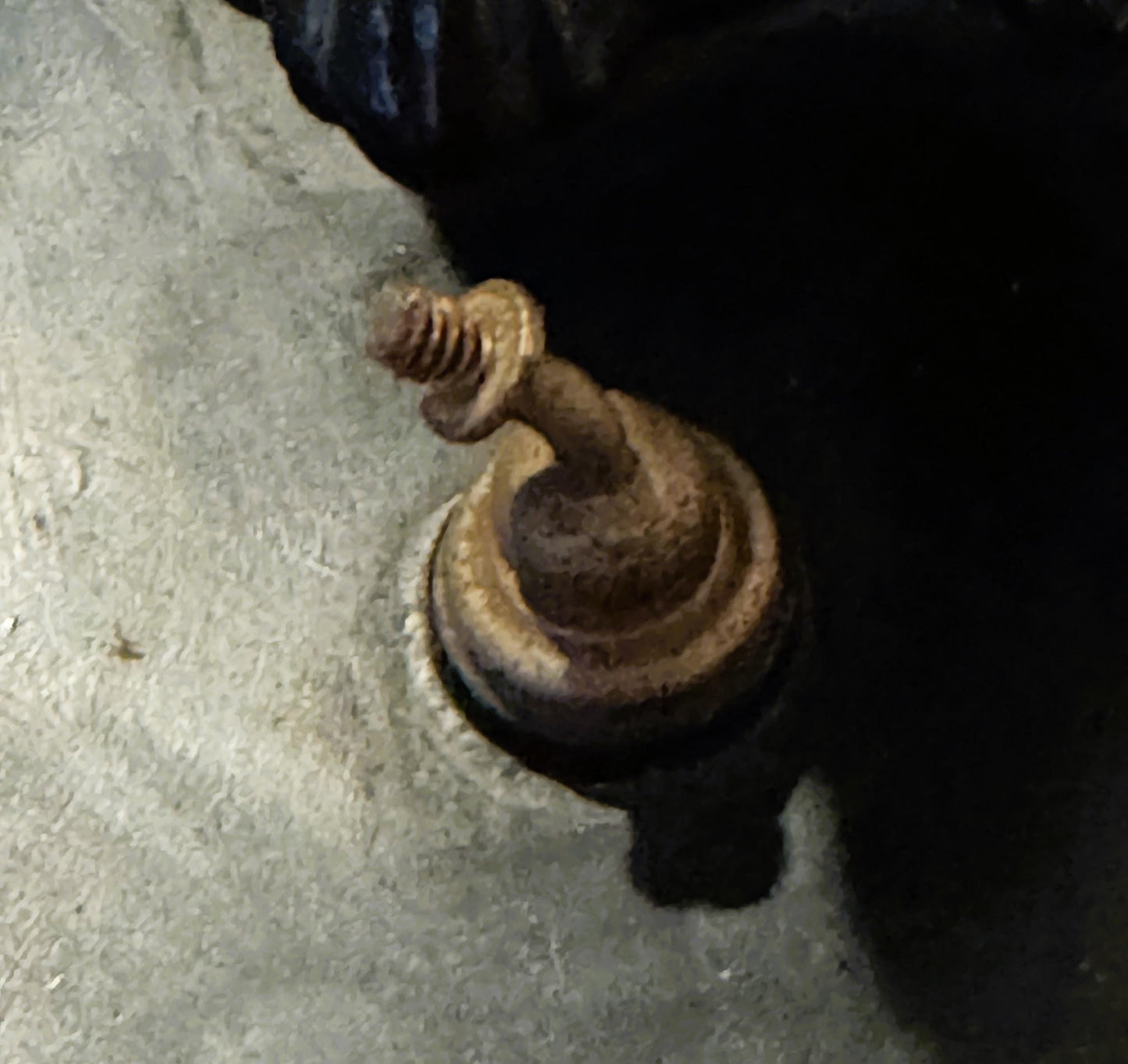
Under him is a black rectangular base with its four corners clipped off at an angle. Beside his front paws, a threaded brass post rises on a small tiered washer — that post is where a pen holder or a small well used to screw down. Whatever sat there is gone now; the post is what's left of it. Flip the base over and the underside is finished in green felt. There's wear along one edge of the base where the black finish has rubbed down over the years, about the only sign of the years he's put in. The bulldog himself carries no such wear — he's in amazing shape. No maker's mark anywhere on him, front, back or underneath, and nobody marked him with a date.

🏛️ Why He Looks Like This

It's the cut planes and sharp edges that make him a Deco dog. Faceted, geometric modeling like his was the Art Deco look of the twenties and thirties, and makers went on turning out pieces in that style for years afterward.

Nobody called it Art Deco while it was new, though. The style made its big entrance in Paris in 1925, at the Exposition Internationale des Arts Décoratifs et Industriels Modernes, the exhibition that put geometric modern design in front of the world. In France it went by names like the "1925 style." The name we use came four decades later. In 1966 the Musée des Arts Décoratifs in Paris staged a retrospective called "Les Années 25," curated by Yvonne Brunhammer, with "Art Déco" right in its title, and that show set the word going for the design of the years between the wars. Two years later, in 1968, the British historian Bevis Hillier fixed it in English with his book "Art Deco of the 20s and 30s."

Cast animals like this were a favorite desk novelty, the trick being to turn a plain pen stand or inkwell into something you would want to look at all day. Bulldogs turned up on plenty of them, since a squat, stubborn, slightly funny dog was a natural for a small casting.

Between the wars the bulldog was everybody's picture of grit, and the Marines had a lot to do with that. The story goes that German soldiers facing the Marines at Belleau Wood in 1918 called them Teufelshunde, devil dogs. Marine Corps historians have never found credible evidence that the Germans actually said it, but the name stuck to the Marines, and the bulldog came right along with it. Brigadier General Smedley Butler bought an English bulldog named King Bulwark as the mascot for the Quantico Marines football team. A "King" did not sit well with the Corps, so the dog became Jiggs, for his resemblance to Mr. Jiggs of the "Maggie and Jiggs" comic strip. On October 14, 1922, Butler signed Jiggs's enlistment papers, for a term of life (a few accounts give the date as October 7). Jiggs rose from private to sergeant major by 1924. When he died on January 9, 1927, his satin-lined casket lay in state in a hangar at Quantico, and he was buried with full military honors.

Trucks got the bulldog treatment too. British soldiers who drove the Mack AC in World War I said it had the tenacity of a bulldog, and "Bulldog Mack" became the nickname. In 1932 Alfred Fellows Masury, Mack's chief engineer, was in the hospital recovering from surgery and carved the first bulldog hood ornament out of a bar of soap; the patent was granted on October 11, 1932. Masury died in 1933 in the crash of the Navy airship Akron, the same year his bulldog began riding on Mack hoods.

Nothing on him names a maker, and figural desk pieces came out of a lot of foundries here and in Europe. One of the best-known American names shows how the trade worked: the Jennings Brothers Manufacturing Company of Bridgeport, Connecticut. Brothers Edward and Erwin Jennings started out in 1888 as the American Jewelry Company and were running as Jennings Brothers by about 1891. The Jennings family's own history also names their father, Austin Morehouse Jennings, as a founder, and Edward's son Henry Ashton Jennings led the company until his death in 1937. Jennings Brothers cast white metal, also called spelter, and finished it to look like bronze, turning out bookends, clocks, candelabra, jewelry boxes and animal figures, bulldogs among them. Its pieces were marked "J.B.", usually with a catalog number, and some carry the slogan "Trademark J.B. Signifies the Best." The firm's last Bridgeport directory listing came in 1953. In the 1960s its molds went to the Philadelphia Manufacturing Company, which kept making pieces from them.

Then the job went away. Self-filling fountain pens, and after them the ballpoint, pushed the old desk set aside, and a figure like this one carried on purely as decoration. The ballpoint itself came out of Hungary: journalist László Bíró, who knew how fast newspaper ink dried, patented his ball-tipped pen in 1938. In October 1945 Gimbels department store in New York put the Reynolds ballpoint on sale at $12.50, and its entire stock of 10,000 pens sold out the first day.

✅ Condition

The bulldog is in amazing shape — every facet crisp. The base shows wear along one edge. Whatever once fit onto that post isn't part of this listing; this is the base and figure only.

🎁 Good For

  • Art Deco collectors who want the geometric look without needing a full inkstand.
  • Bulldog people, obviously.
  • A repurposed desk piece: paperweight, pen-tray anchor, or just presence next to the lamp.
  • Anyone who likes their décor a little odd. He's not trying to be tasteful.

Shipping

🚚 Shipping & Handling

  • Shipping costs and timing are calculated at checkout.
  • Items curated and shipped directly by me include U.S. shipping at no additional cost, professionally packed to ensure safe arrival of your artifact.

Items from Vetted Pro Collectors
Shipping for items offered by vetted Pro Collectors is determined at checkout. All Pro Collector listings are reviewed to ensure fair, reasonable shipping practices.

For full details, please refer to our Shipping Policy.

Returns & Exchange

Take your time — you've got a full six months. If a piece isn't right for you, send it back the way it reached you and we're good.

In the first 30 days your money goes straight back the way you paid. After that it's store credit, so you can put it toward something you'd rather have.

Return shipping we sort out between us, case by case. I don't make this difficult.

If something arrives damaged, or it isn't what I said it was, send me a photo within 48 hours and I'll make it right.

Email info@vintageantiquesgifts.com or call 802-356-9872 — that's me answering, not a call center.

The only things I can't take back are custom or special-order pieces and gift cards.

View full details

Preserving History: Authentic Objects Across Eras

— Curated by Travis Weigel