





Skip to product information
1 of 6

Vintage and Antique Gifts

Vintage Blue Art Glass Candlesticks ✨ Murano-Style Twisted Blue Ribbon Stem Pair, Applied Flowers, Venetian Decor

Vintage Blue Art Glass Candlesticks ✨ Murano-Style Twisted Blue Ribbon Stem Pair, Applied Flowers, Venetian Decor

Regular price $42.00 USD
Regular price Sale price $42.00 USD
Sale Sold out
Shipping calculated at checkout.

🚚 Free US Shipping — ships within one business day. International shipping calculated at checkout.

Quantity

Are These Murano-Style Candlesticks? 🌸 Cobalt, Crystal and a Spiral of Blue — A Pair of Art-Glass Candlesticks in the Venetian Manner

Size: 3" x 9"

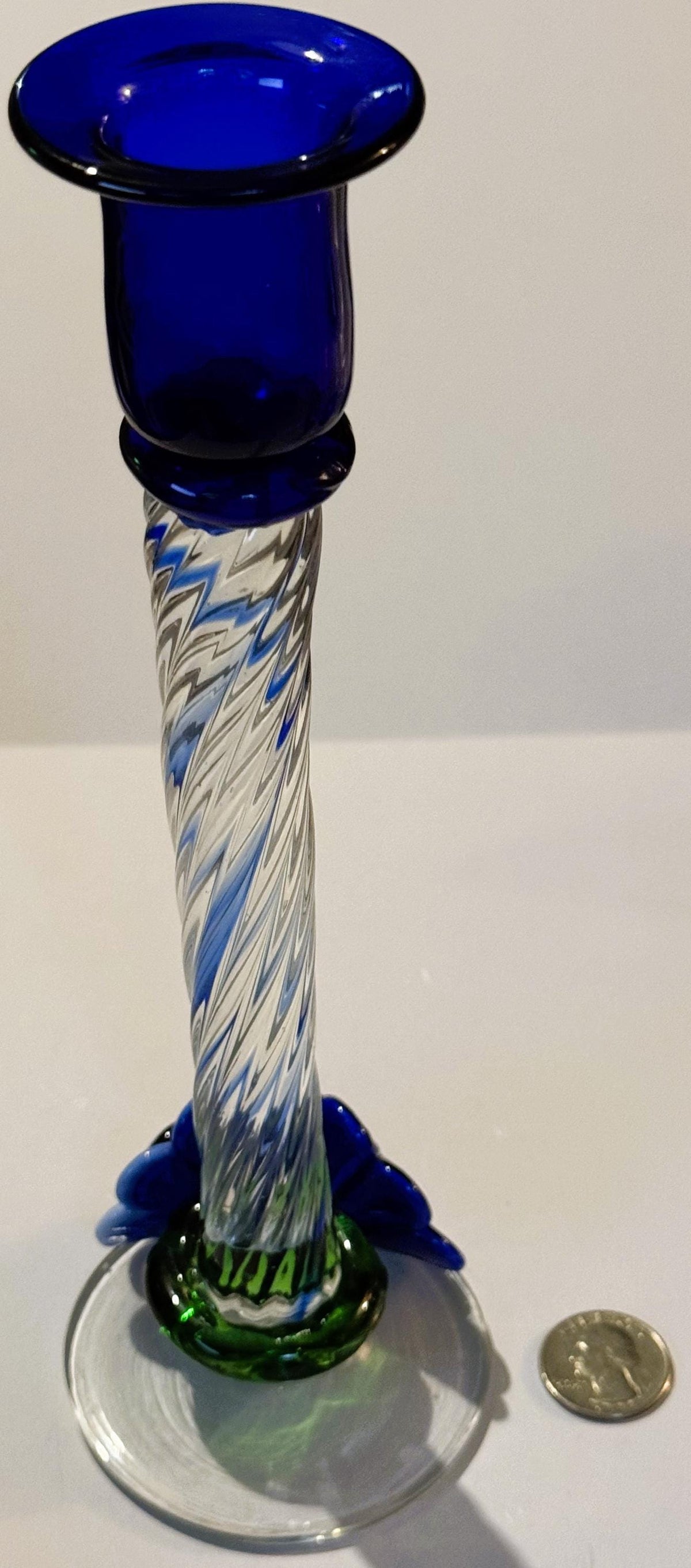
The twisted stem is the thing that stopped me. Inside a clear glass column, ribbons of blue wind upward in a tight spiral until they meet a deep cobalt cup, and at the foot a pair of applied glass flowers sits on a clear disc beside a ring of bright green. Turn it in the light and the whole spiral seems to move. It's the vocabulary of Venetian glass, the decorative language Murano made famous: colored threads twisted inside clear glass, applied ornament, color set against crystal. This listing is a set of two candlesticks — only one is pictured here, since its twin came packed so well I left it wrapped rather than disturb it. There's no maker's mark, label or signature on them. Each cobalt cup is sized to hold a standard taper.


What Each Candlestick Looks Like

The cup. A cobalt-blue tulip-shaped candle cup with a wide, flared rim, deep enough to seat a taper. Under it sits a thick cobalt collar that separates cup from stem.

The stem. A long, gently curving column of clear glass, twisted along its length, with ribbons of blue — paler at the edges, deeper at the core — spiraling through it. Seen straight on, the twist breaks into a zigzag of chevrons; turned in the light, it reads as one continuous spiral.

The foot. Where the stem meets the base, a ring of green glass wraps its lower end. The base itself is a round clear disc, and on it sit two applied glass flowers with layered petals — one deep cobalt, one a lighter periwinkle blue — each with a dark center. Both flowers were formed separately and fused onto the foot while hot, so they stand up proud of the surface rather than lying flat in it.


🏝️ Murano: The Island Venice Built for Its Glassmakers

In 1291 the Republic of Venice ordered its glass furnaces out of the city and onto the island of Murano. The official reason was fire — Venice was built largely of wood, and a glass furnace was a constant danger. Many historians think the deeper reason was secrecy: keeping the craftsmen and their methods in one place where they could be watched.

The masters of Murano lived under a strange bargain. They enjoyed privileges few craftsmen anywhere could claim, including the right to carry swords and to marry into noble families, but they were forbidden to leave the Republic without permission, and taking glassmaking secrets abroad was treated as treason. Local legend has it that Venice sent assassins after masters who fled — whether or not the daggers were real, the story survives because it captures just how much the Republic believed its glass was worth.


🌀 1527: Two Brothers and the Twisted Thread

The spiraling colored threads in stems like this one descend from a single Venetian invention. In 1527 the brothers Filippo and Bernardo Catani, who ran the Serena glass furnace on Murano, petitioned the Council of Ten for a patent on an entirely new technique of glass "a retortoli," decorated with twisted threads. They asked for twenty-five years of protection and were granted ten.

Their method set canes of lattimo, milk-white glass, in regular arrangement inside clear crystal, then reheated, stretched and twisted the whole cane so the threads spiraled through the finished piece. It became known as filigrana, and it was an immediate success — by the second half of the 16th century, glass made à la façon de Venise, in the Venetian manner, was being produced far outside Venice, filigree included. The technique changed European glass for good, and nearly five centuries later glassmakers everywhere still twist colored threads through clear stems in that same tradition.

This pair carries the idea in blue rather than the original milk-white: the ribbons in the stem are colored glass canes sealed inside clear glass and twisted while hot, the same forming trick the Catani brothers patented, worked in a different color. Strictly speaking, latticino is the name for the white-thread version; this is the same twisted-cane family, several centuries on, done in blue.


📖 The Golden Book and the Revival

Murano turned its glassmakers into a kind of nobility. From 1602 the island's governor, Gabriele Barbarigo, began inscribing its leading glass families in a Libro d'Oro, a Golden Book, and in 1605 the Council of Ten declared all of them official citizens of Murano. Those families held the monopoly on the craft at a time when glassmaking employed some 3,000 workers on an island of about 7,000 people, and they were even allowed to strike their own commemorative coins, the oselle, bearing their own names and crests.

The glory did not last forever. By the nineteenth century the industry needed rescuing, and the man most credited with it was Antonio Salviati, a lawyer who got pulled into restoring the mosaics of St. Mark's in Venice and never really left glass again. He opened his first glass business in 1859 with Lorenzo Radi, supplied the mosaic glass for the altar screen of Westminster Abbey, and in 1866 — backed by Henry Layard and two associates — founded Salviati & Company, known in English as The Venice and Murano Glass and Mosaic Company, one side making mosaic and the other making blown glass. Salviati was the first modern Italian factory owner to employ many skilled glassworkers producing for export, and his revival sparked a new European appetite for brightly colored, ornate Italian glass. Cobalt cups, twisted colored stems and applied flowers are exactly that taste, and it's a taste that never really went away.


💙 Cobalt Glass and Applied Flowers

The deep blue of the cups comes from the glass itself, not a surface coating, which is why it darkens where the glass runs thick and glows when light passes through it. The flowers at the foot are applied ornament — worked as separate small pieces and fused on while still hot — the same basic idea behind the prunts, trails and applied decoration that Venetian-style glass has used for centuries. Set a pair of lit tapers in the cups and the stems catch the light from above, spiral and all. That's really the whole appeal of this kind of glass: it's meant to be looked through, not just at.

Nobody signed these. What they do have is cobalt against clear, a twisted stem worked in the Venetian tradition, and two flowers that clearly took a steady hand to fuse on straight.

Shipping

🚚 Shipping & Handling

  • Shipping costs and timing are calculated at checkout.
  • Items curated and shipped directly by me include U.S. shipping at no additional cost, professionally packed to ensure safe arrival of your artifact.

Items from Vetted Pro Collectors
Shipping for items offered by vetted Pro Collectors is determined at checkout. All Pro Collector listings are reviewed to ensure fair, reasonable shipping practices.

For full details, please refer to our Shipping Policy.

Returns & Exchange

Take your time — you've got a full six months. If a piece isn't right for you, send it back the way it reached you and we're good.

In the first 30 days your money goes straight back the way you paid. After that it's store credit, so you can put it toward something you'd rather have.

Return shipping we sort out between us, case by case. I don't make this difficult.

If something arrives damaged, or it isn't what I said it was, send me a photo within 48 hours and I'll make it right.

Email info@vintageantiquesgifts.com or call 802-356-9872 — that's me answering, not a call center.

The only things I can't take back are custom or special-order pieces and gift cards.

View full details

Preserving History: Authentic Objects Across Eras

— Curated by Travis Weigel