Skip to product information
1 of 1

Vintage and Antique Gifts

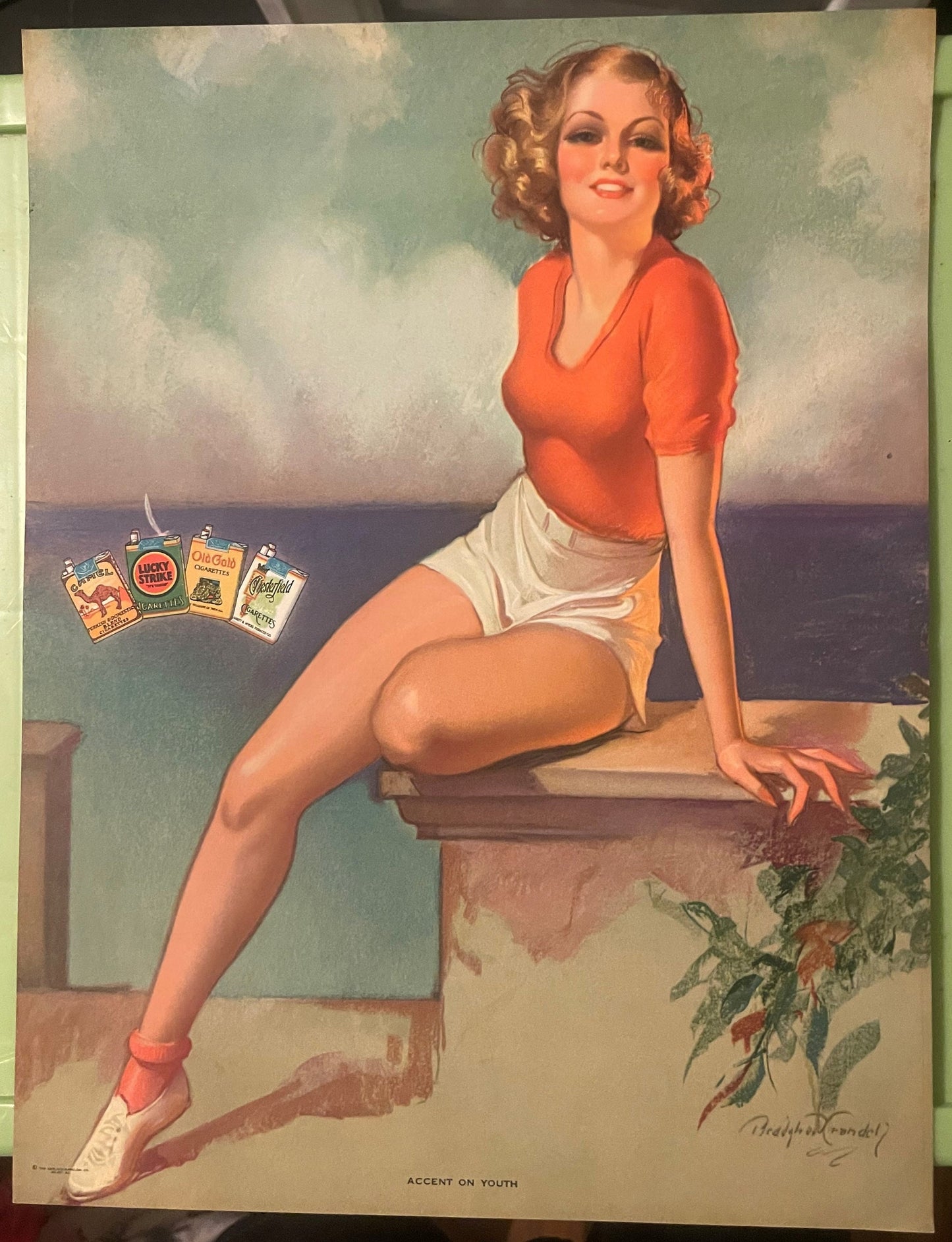
Vintage 1939 Bradshaw Crandell Pin-Up 🎨 "Accent on Youth" Cigarette Advertising Litho 🌊 10.75x14

Vintage 1939 Bradshaw Crandell Pin-Up 🎨 "Accent on Youth" Cigarette Advertising Litho 🌊 10.75x14

Regular price 20.00 USD
Regular price Sale price 20.00 USD
Sale Sold out
Shipping calculated at checkout.

Description

🎨 Bradshaw Crandell's "Accent on Youth" — A 1939 Cigarette Advertising Lithograph from the Golden Age of American Pin-Up Art

There is a particular kind of confidence that only the best illustrators of the 1930s could put into a figure, and Bradshaw Crandell had it in abundance. The young woman in this lithograph sits on a stone sea wall with the easy assurance of someone who has never once doubted she is exactly where she belongs. Her orange knit top, white shorts, and white canvas shoes with their little red cuff of a sock — she is summer, completely and unapologetically. The ocean opens behind her under a sky full of rolling cloud. She turns just slightly toward the viewer, and her expression says she noticed you a moment ago and decided you were worth looking at. That is Crandell's genius: not the pose, not the setting, but the expression. It is never vacant. It is never performing. It is present.

This is an original New Old Stock (NOS) lithographic advertising print produced by the Gerlach Barklow Co. of Joliet, Illinois, for use on calendar tops and point-of-purchase displays in the late 1930s. 🗓️ The piece is titled "Accent on Youth" — the title appears in the lower portion of the print — and it was issued in documented form with a January 1939 calendar pad advertising Lucky Strike, Camel, Chesterfield, and Old Gold cigarettes. The cigarette brand miniatures appear in the image itself, arranged to one side of the figure, and they serve as the sole commercial anchor for a composition that is otherwise entirely given over to beauty and light. The print measures 10.75 x 14 inches.


🖋️ The Man Behind the Image — John Bradshaw Crandell

John Bradshaw Crandell was born June 14, 1896, in Glens Falls, New York, and he came up through the working ranks of American commercial illustration the way most of the great ones did — through magazine covers, advertising accounts, and relentless draftsmanship. His career opened formally in 1921 with an advertisement for Lorraine hair nets sold through F. W. Woolworth, and his first cover illustration ran on the May 28, 1921 issue of Judge magazine. By 1925 he had opened John Bradshaw Crandell Studios, and by 1935 he had simplified his professional name to the one that appears on this print: Bradshaw Crandell.

His reputation was built on Cosmopolitan. For twelve years spanning the 1930s and 1940s, Crandell produced the cover girls for that magazine, succeeding the legendary Harrison Fisher in a lineage of American glamour illustration that reads like a hall of fame in itself. He also worked for Redbook, Judge, the Saturday Evening Post, and The Ladies Home Journal, and produced movie poster art for Twentieth Century Fox. In 2006 — forty years after his death on January 25, 1966, in Madison, Connecticut — he was inducted into the Society of Illustrators Hall of Fame. 🏛️ That is the measure of the man: not just beloved in his time, but formally recognized by the institution of American illustration as one of the people who defined what the craft could be.

What makes this lithograph particularly meaningful to serious collectors is the crossover it represents. Crandell's world was the mainstream — Cosmopolitan covers, studio portraits, film poster glamour. The story circulated widely in pin-up and tobacciana collector circles holds that Crandell was so selective about his glamour commissions that he rarely stepped into pure advertising work, and that when he did venture into the cigarette advertising space, the results stood apart from the usual promotional fare. Whether or not the lore has been sharpened in the telling over the decades, the observation it carries is real enough: had he chosen to compete directly with Petty and Vargas in the pin-up calendar market, the consensus among collectors and historians who have studied the period is that he would have been right at the top of the list. The "Accent on Youth" lithograph exists in that rare zone where Crandell's technical mastery met the commercial world of tobacco advertising — and that intersection is exactly what drives the serious collector interest this piece commands.


🏭 Gerlach Barklow — The Calendar Factory That Printed America's Walls

The Gerlach Barklow Co. was not a small operation. Founded in Joliet, Illinois, in 1907 by Theodore R. Gerlach, Edward J. Barklow, and K. H. Gerlach, it grew into one of the largest calendar and advertising printing companies in the United States. Joliet — a city with deep roots in industrial manufacturing along the Des Plaines River — was home to printing infrastructure that could handle the kind of volume the American calendar trade required, and Gerlach Barklow took full advantage of it.

The company's roster of artists was a who's who of 1920s and 1930s commercial illustration: Bradshaw Crandell, Arthur H. Hider, Fletcher C. Ransom, Adelaide Hiebel, Zula Kenyon. These were not anonymous house illustrators grinding out anonymous work. These were known names, names with followings, names whose presence on a calendar pad was itself a selling point. Gerlach Barklow also operated a Volland Books division and a Rust Craft Greeting Card division, which tells you something about the scale and ambition of the enterprise — this was a company that understood American visual culture and positioned itself at the center of it. 🖼️

The lore that circulates in collector circles around Gerlach Barklow's model practice is one of those stories that has grown comfortable with repetition: old-timers at Illinois ephemera shows have long held that the company used local Joliet-area women as models for a number of its advertising figures, rather than sourcing talent from Hollywood or the New York studio circuit. If that tradition is accurate — and it has never been firmly documented, which is part of what keeps it alive — then the woman sitting on this sea wall in her orange top and white shorts may be a local Illinois girl preserved in lithographic ink, not a film star or a professional model, but someone who walked into a Joliet commercial photography studio one afternoon in the late 1930s and became, without quite meaning to, an emblem of American summer. It is the kind of story that can't be verified and won't be forgotten.


🚬 The Cigarettes in the Frame — Lucky Strike, Camel, Chesterfield, Old Gold

The four cigarette brand miniatures arranged to the left of the figure — Camel, Lucky Strike, Old Gold, Chesterfield — are not incidental. They are the commercial engine that put this lithograph into existence, and they are also a precise historical document of American tobacco in 1939. These were the four dominant American cigarette brands of that era, the giants who had divided the market between them and were in the process of attaching themselves to every available advertising surface in the country. Calendar tops and point-of-purchase displays were prime real estate, and Gerlach Barklow knew exactly how to make them sing.

Lucky Strike alone was a phenomenon in 1939. The "Reach for a Lucky instead of a sweet" campaigns of the late 1920s had already embedded the brand into American domestic life with an audacity that still startles — a cigarette brand openly marketing itself as a weight management tool, running testimonials from opera singers about throat protection, and placing its product in the hands of stylish women in every medium available. By 1939, Lucky Strike's green packaging was as recognizable as any commercial color in America. Camel was operating from its "more doctors smoke Camels" positioning, the campaign that would become one of the most analyzed pieces of American advertising history. Chesterfield was the "milder" alternative, and Old Gold was running its "not a cough in a carload" line. 🎴 All four of these advertising personalities, compressed into small illustrated pack miniatures, sit in this lithograph alongside Crandell's golden-haired figure — and together they create a document of exactly where American commercial culture stood in the last months before the world changed.


📅 The "Accent on Youth" Print — What the Auction Record Shows

The documented auction history of this specific composition is clear. A paper lithograph version with a calendar pad dated January 1939 and advertising Lucky Strike, Camel, Chesterfield, and Old Gold cigarettes is on record. A separate auction entry records an "Accent on Youth" lithographic print by Gerlach Barklow Co. dated 1937. The two dates — 1937 and 1939 — are not in conflict. Gerlach Barklow produced calendar tops that circulated for multiple years, and a composition could appear with different calendar pad dates while the lithographic image itself remained the same. The most directly documented version of this print carries the 1939 date, placing it at the end of that golden decade of American commercial illustration and just before the wartime economy reshaped every corner of the printing and advertising industry.

That signature is not a reproduction detail or a printed facsimile; it is part of the original lithographic composition as Crandell approved it for the Gerlach Barklow production run, the same way a Cosmopolitan cover girl carried his name into newsstands across the country.


🌊 "Accent on Youth" — The Image Itself

The composition is a masterpiece of the deceptively relaxed pose. The figure sits on a stone ledge or low wall, the ocean visible behind her in a sweep of deep blue under a sky of soft cloud. She wears an orange short-sleeved knit top and white shorts, her legs extended and crossed at the ankle, her white canvas shoes with their small red sock cuffs pointing toward the lower edge of the image. Her auburn curls catch implied light. Her expression — and this is always where Crandell earned his reputation — is the expression of someone who is genuinely pleased to be sitting where she is sitting. Not a pose, not a performance. A moment.

This was aspirational imagery of the most effective kind: not wealth explicitly, not luxury explicitly, but freedom and summer and the particular grace of a young woman who is comfortable in her own skin by the sea. The cigarette brands float to her left, almost deferential, as if they know the figure is the thing drawing the eye and they are simply grateful to be in the same frame.


✨ Display, Collection, and Decor

A lithograph at this scale — 10.75 x 14 inches — fits comfortably into a wide range of display contexts, and the image itself is versatile enough to work in several different collecting categories simultaneously.

  • 🖼️ Framed behind UV-protective glass and mounted in a study, den, home bar, or game room — the warm palette of orange, ivory, and sea blue reads beautifully against dark wood or painted walls
  • 🚬 Centered in a tobacciana display alongside vintage cigarette tins, matchbook sets, or advertising cards from the four brands depicted — Lucky Strike, Camel, Chesterfield, Old Gold
  • 📅 Grouped with other Gerlach Barklow calendar prints as a study in what the great Joliet calendar factory was capable of at the height of its powers
  • 🎨 Displayed alongside other Bradshaw Crandell works — Cosmopolitan covers, magazine tear-sheets, advertising reproductions — as a focused collection built around one of the Society of Illustrators Hall of Fame's inductees
  • 🏖️ Used as a statement piece in a beach house, sunroom, or any space where the sea wall and ocean imagery speak directly to the mood of the room
  • 🎁 Given as a gift to the pin-up art collector, the tobacciana enthusiast, the American illustration history devotee, or anyone with a serious appreciation for the commercial art of the late 1930s
  • 📚 Sleeved in an archival collector's portfolio alongside other documented Crandell advertising work as a primary artifact of his crossover into tobacco advertising
  • 🪟 Shadow-boxed with a period cigarette pack from one of the four featured brands — the combination of flat lithograph and three-dimensional packaging creates a layered display that stops people in a room

👤 Who Collects "Accent on Youth"

This print sits at the intersection of several serious and active collector communities, and the documented sell-through on competing listings confirms the demand is real.

  • 🎨 American illustration collectors who build around named artists from the Society of Illustrators Hall of Fame — Crandell's induction in 2006 gives this piece institutional credibility that generic pin-up prints cannot match
  • 🚬 Tobacciana collectors who chase cigarette advertising from the pre-war era — a lithograph featuring all four of the major 1939 American cigarette brands in a single composition is a genuinely comprehensive artifact
  • 📅 Calendar art and ephemera collectors who focus on Gerlach Barklow productions specifically, one of the most documented and studied of the great American calendar printing houses
  • 🖼️ Vintage advertising art collectors who are building toward display-quality framed pieces with provenance — a documented artist, a documented printer, a documented year, and a documented title
  • 🌊 Mid-century Americana collectors for whom the beach-and-summer imagery speaks directly to a golden period of American leisure culture
  • 🏛️ American commercial art historians who want primary examples of how mainstream illustrators — not the dedicated pin-up circuit, but the Cosmopolitan cover artists — occasionally crossed into tobacco advertising

📐 Condition and Specifications

This is a New Old Stock (NOS) example of the "Accent on Youth" lithograph. The print is a Gerlach Barklow Co. production, Joliet, Illinois. Dimensions: 10.75 x 14 inches. Documented era: 1937–1939, with the 1939 calendar pad date the most directly sourced version on auction record. Subject: a young woman seated on a stone sea wall, ocean background, orange top, white shorts, red-trimmed white canvas shoes, four cigarette brand miniatures — Camel, Lucky Strike, Old Gold, Chesterfield — appearing to the left of the figure. Title "Accent on Youth" printed on the lower portion of the image.


🌟 Why This Print Belongs in a Serious Collection

There are advertising lithographs, and then there are advertising lithographs with a documented artist, a documented printer, a documented title, a documented year, and a story that places the image at the center of American commercial art history in the last gilded moment before the 1940s arrived and changed everything. "Accent on Youth" is all of those things at once. 🌺

Bradshaw Crandell spent twelve years defining the look of American glamour on the cover of Cosmopolitan. He worked for the Saturday Evening Post, Redbook, The Ladies Home Journal, and Twentieth Century Fox. He was inducted into the Society of Illustrators Hall of Fame in 2006, forty years after his death, because the institution of American illustration recognized that his contribution to the craft was not a matter of nostalgia but of lasting importance. And then there is this print — the moment where all of that mastery turned toward a cigarette advertisement, and produced something that is still being actively collected, displayed, framed, and sought after more than eighty years later.

The Gerlach Barklow Co. knew what it was doing when it brought Crandell into the tobacco advertising fold. The company had built one of the largest calendar printing operations in America precisely because it understood that the image on a calendar top was not decoration — it was the reason a business's customer kept the calendar on the wall for an entire year, looking at it every day, absorbing the brand association quietly and completely. A Crandell figure did that work more effectively than almost anything else in the Gerlach Barklow catalog, which is why the "Accent on Youth" composition has survived in collector hands while most of its contemporaries have not. 🏆

The young woman on the sea wall is still there, still turning toward you with that unhurried confidence, still wearing her orange top and white shorts in the summer sun. She has been there since 1939. She is going to be there for a long time yet.

Shipping

🚚 Shipping & Handling

  • Shipping costs and timing are calculated at checkout.
  • Items curated and shipped directly by me include U.S. shipping at no additional cost, professionally packed to ensure safe arrival of your artifact.

Items from Vetted Pro Collectors
Shipping for items offered by vetted Pro Collectors is determined at checkout. All Pro Collector listings are reviewed to ensure fair, reasonable shipping practices.

For full details, please refer to our Shipping Policy.

Returns & Exchange

Product Page Return Policy

  • 60-Day Returns – Items must be in original condition.
  • Refunds – Issued after inspection (excluding shipping costs).
  • Return Shipping – Customer is responsible unless item is damaged or incorrect.
  • Damaged/Incorrect Items – Contact us within 48 hours for a replacement or refund.
  • Easy Returns – Email info@vintageantiquesgifts.com or call 802-356-9872 to initiate a return.

For full details, visit our Refund Policy.

View full details