Skip to product information
1 of 4

Rugistan

Antique Shahsavan Caucasian Hand-Knotted Wool Mafrash Cradlebag Panel

Regular price 450.00 USD
Regular price 650.00 USD Sale price 450.00 USD
Sale Sold out
Shipping calculated at checkout.

Description

🌙 The Cradlebag Tradition: An Antique Shahsavan Mafrash Panel from the Early 1900s

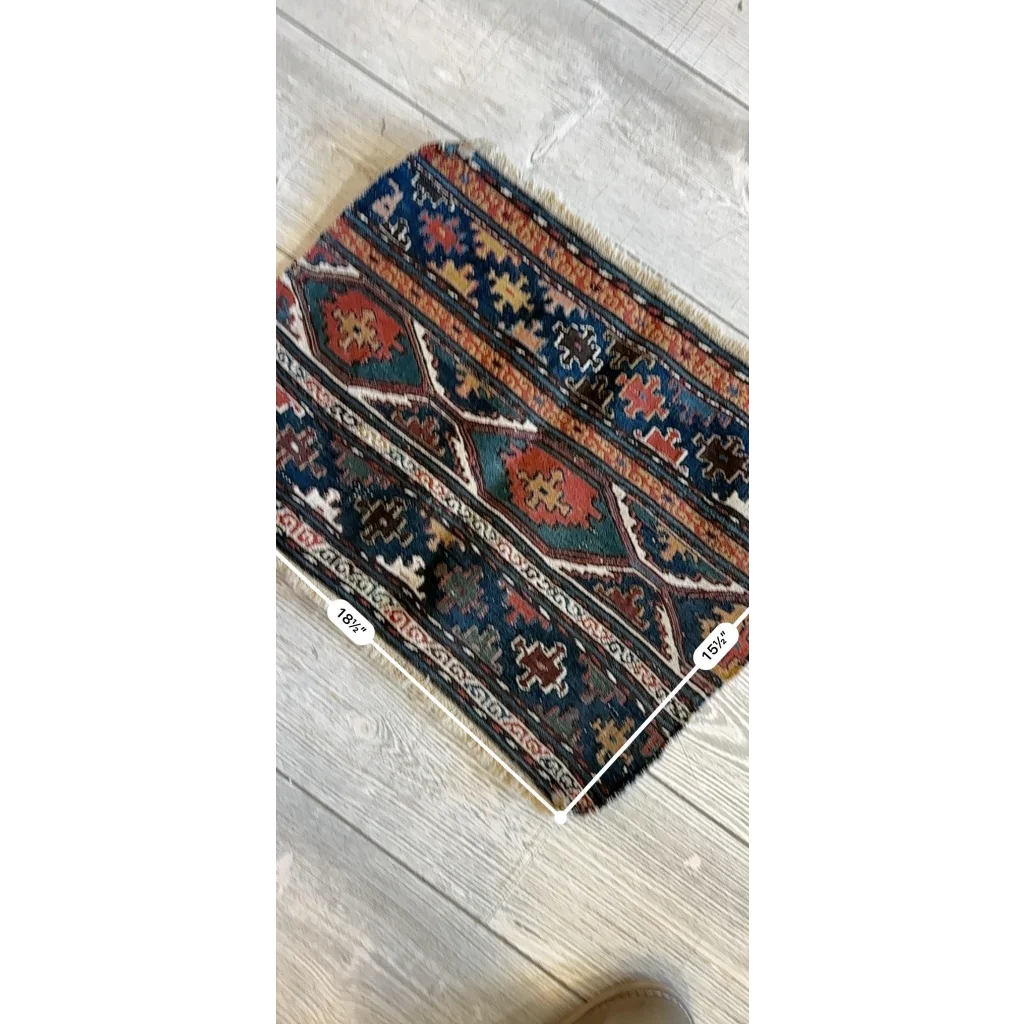
Among the textiles woven by the Shahsavan nomads of the Caucasus, few carry the same intimate weight as the mafrash — the large, woven storage bag that traveled with the family on every seasonal migration. 🏔️ And within the mafrash tradition, no panel carries more meaning than the cradlebag fragment: the woven case designed specifically to carry and protect an infant during the long journeys between pastures. This antique Shahsavan Caucasian mafrash cradlebag panel, hand-knotted in natural wool pile with a wool foundation, dating from the 1900s and measuring 18 in by 16 in, is one of those pieces — compressed tribal history in perfect condition for its age.

🏔️ The Shahsavan: Nomads Who Loved the Shah

The Shahsavan — literally those who love the Shah — were a confederation of nomadic and semi-nomadic Turkic tribes whose territory ranged across the Moghan Steppe and the Caucasian highlands, moving seasonally between winter lowland pastures and summer mountain grazing grounds. 🐑 Their weaving tradition developed in direct relationship to this nomadic lifestyle: everything they made had to be portable, durable, and functional, yet simultaneously beautiful, because beauty in the nomadic world was not a luxury — it was a language.

The Shahsavan produced textiles that are among the most recognizable and most prized in the antique tribal market. 🎨 Their characteristic visual vocabulary — bold geometric forms in saturated natural dyes, often incorporating abstracted figures within geometric lattices — is unmistakable. The quality of their workmanship, even in everyday functional objects, was exceptional: the knotting was tight, the wool selection careful, the dye preparation sophisticated. These were not crude folk objects — they were sophisticated textiles made by people who had refined their craft across generations within a demanding, aesthetically attentive community.

👶 The Cradlebag: Textile as Protection

The cradlebag fragment holds a specific place in Shahsavan material culture. 🌿 The cradlebag was woven to hold infants during the long migrations between seasonal pastures, when the tribe was moving through mountain passes that could take days or weeks to traverse on pack animals. The bag needed to be strong enough to bear the weight and motion of travel while remaining comfortable for the infant inside.

But the cradlebag was also one of the most symbolically charged objects in the domestic material world. 🛡️ The patterns incorporated protective motifs, amulet symbols, and clan identifiers that were believed to shield the infant from harm during the vulnerable period of the journey. To weave a cradlebag was to participate in an act that combined practical craft with ceremonial significance — a textile that was simultaneously a carrier, a protector, and a declaration of identity.

Finding a cradlebag panel in this condition — intact pile, clear patterning, sound foundation, described as in perfect condition for its age — is uncommon. 💎 These pieces were used intensively, passed from child to child within families, stored through decades of environmental change, and often survive only in fragmentary form. A cradlebag panel at this integrity level is a collector's piece of real consequence.

🧶 Construction: Natural Wool Pile, Hand-Knotted Throughout

The construction of this panel — hand-knotted natural wool pile on a natural wool foundation — defines the highest tier of Shahsavan weaving. ✋ The Shahsavan maintained the all-wool approach that gave their textiles their particular hand and weight, resisting the cotton-foundation shortcuts that later commercial production often adopted.

The natural dyes that color this panel have proven their stability across more than a century. 🌿 Madder root, indigo derivatives, and locally sourced mineral and plant pigments — these were the materials that Shahsavan weavers used to achieve their characteristic palette of deep reds, rich blues, warm ivory, with occasional ochre or green accents. The aging of natural dyes on antique wool is one of the great pleasures of the antique textile world — the colors warm rather than fade, gaining depth and specificity as the decades accumulate.

At 18 in by 16 in, this fragment is compact enough to display in multiple formats. 📐 The near-square proportions are characteristic of mafrash and cradlebag construction, reflecting the structural requirements of a three-dimensional bag whose face panels needed to be roughly equal in dimension. The geometry of the format is itself a record of function — the shape tells you something about how the object was used before it became a collector's piece.

🖼️ Display and Living With This Panel

Framed behind conservation glass, this piece becomes a museum-quality textile work — the bold geometry and warmth of natural dyes rendering it striking at any scale. 🎨 In collector display on a deep shelf or atop a cabinet, it creates an immediate focal point that rewards closer inspection: the subtle variations in dye tone from knot to knot become visible, the irregularities of hand production come into focus as evidence of the human hands that made this.

Interior designers have found that antique Shahsavan textiles carry a specific authority in modern interiors. 🏡 Against a white wall, the bold geometric patterning reads as graphic art with historical weight. Against warm-toned walls or wood-paneled rooms, it reads as archaeological treasure. The piece is large enough to anchor a display but small enough to be handled, examined, and repositioned without the logistical challenges of full-scale antique rugs.

For the serious collector, this panel sits at the intersection of multiple desirable qualities: Shahsavan attribution, documented cradlebag function, 1900s production dating from the final era of genuine nomadic weaving, natural materials and dyes throughout, and condition that speaks to careful provenance across the decades since its creation. 🏆

🎁 A Piece That Has Already Outlasted Its World

This mafrash cradlebag panel has already survived the world that made it. 🕰️ The Shahsavan nomadic lifestyle, the seasonal migrations, the high mountain pastures, the community of weavers who understood exactly what they were making and what it meant — all of that is now history. What remains are the textiles: dense, durable, pigmented with earth and plant, tied knot by knot onto foundations that have proven their strength across more than a century.

This panel is that survival. 💎 Ready to become part of a collection that recognizes it for what it is.

Item ID: K1606 🏷️

Shipping

🚚 Shipping & Handling

  • Shipping costs and timing are calculated at checkout.
  • Items curated and shipped directly by me include U.S. shipping at no additional cost, professionally packed to ensure safe arrival of your artifact.

Items from Vetted Pro Collectors
Shipping for items offered by vetted Pro Collectors is determined at checkout. All Pro Collector listings are reviewed to ensure fair, reasonable shipping practices.

For full details, please refer to our Shipping Policy.

Returns & Exchange

Take your time — you've got a full six months. If a piece isn't right for you, send it back the way it reached you and we're good.

In the first 30 days your money goes straight back the way you paid. After that it's store credit, so you can put it toward something you'd rather have.

Return shipping we sort out between us, case by case. I don't make this difficult.

If something arrives damaged, or it isn't what I said it was, send me a photo within 48 hours and I'll make it right.

Email [email protected] or call 802-356-9872 — that's me answering, not a call center.

The only things I can't take back are custom or special-order pieces and gift cards.

View full details