Skip to product information
1 of 4

Vintage and Antique Gifts

Antique 1920s Pioneer Grape Nip Label from Davenport WA 🍇 Ox Drawn Covered Wagon, Pioneer Soda Bottling Works

Antique 1920s Pioneer Grape Nip Label from Davenport WA 🍇 Ox Drawn Covered Wagon, Pioneer Soda Bottling Works

Regular price $9.00 USD
Regular price Sale price $9.00 USD
Sale Sold out
Shipping calculated at checkout.

🚚 Free US Shipping — ships within one business day. International shipping calculated at checkout.

Quantity

Who Made Pioneer Grape Nip in Davenport? 🐂 Look Again at the Wagon — Those Are Oxen, Not Horses

Size: 4" x 2 1/4"

Almost every listing for a label like this calls the little scene in the middle a stagecoach. It is not. Put your eye close to the engraving and you will count four oxen in pairs, yoked at the neck, heads down, with a driver sitting up on the seat of a canvas-topped freight wagon. No horses, no coach, no mail run. That is an emigrant covered wagon — the kind that carried families and their furniture across the plains at two miles an hour, the exact image a soda company in eastern Washington would reach for when it wanted to say the word pioneer without spelling it out twice.

It is a small distinction and it changes the whole picture. A stagecoach is speed, mail, and the tail end of the frontier. An ox team is the frontier itself, arriving slowly, with everything a family owned in the back.


🍇 What the Label Is

This is an original, unused paper bottle label from the Pioneer Soda Bottling Works of Davenport, Washington, printed for their GRAPE NIP flavor. It is a color lithograph: an orange outer border, a range of indigo mountains with snow on the peaks against a streaked orange sky, and a large cream diamond laid across the middle. PIONEER runs across the top of the diamond in heavy orange block capitals outlined in indigo; the ox-team vignette sits beneath it in fine engraved line work; and GRAPE NIP is set below in tall indigo capitals.

Under the flavor name is the ingredient declaration, in the flat, plain-spoken language of its day: "MADE FROM PURE CANE SUGAR, TARTARIC ACID, CARBONATED WATER, HARMLESS COLOR AND FLAVOR." That word harmless is doing real work. After the Pure Food and Drug Act of 1906, American bottlers had to stand behind what went into the bottle, and a line like that one was how a small-town works told a customer it had nothing to hide. The Act itself, approved on June 30, 1906 and in force from January 1, 1907, uses almost the same words as this label: it speaks of "harmless coloring or flavoring ingredients." Across the two bottom corners of the label, in indigo on cream: PIONEER SODA BOTTLING WORKS at the left, DAVENPORT, WASHINGTON. at the right.

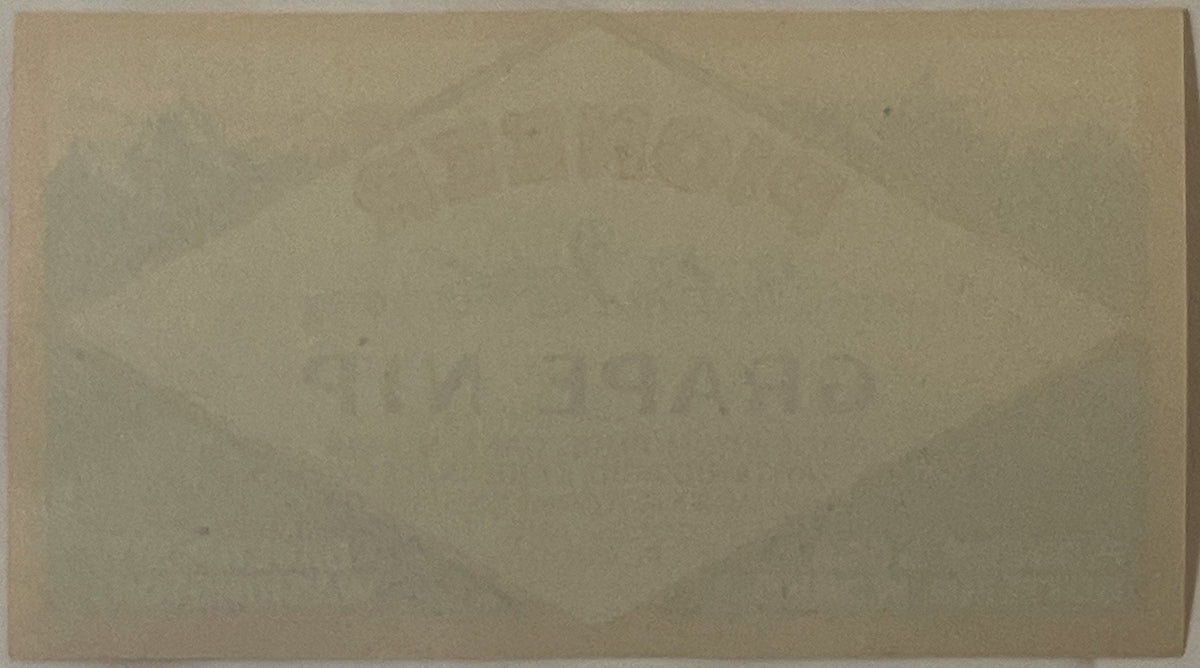
The label is unused — it was never pasted to a bottle, never soaked off one. The back is plain paper with the front showing faintly through it, which is exactly what an unapplied label looks like.


🏭 The Einbecks: One Family, Seventy-Eight Years, Twenty-Six Flavors

The Pioneer Bottling Works was started in 1904 by Arthur Einbeck (1872–1916) and his wife Emma (1881–1968). They began with carbonated soda pop in flavors that read today like a dare: peach, rhubarb, sarsaparilla, celery and banana. Celery. Banana. And they kept going — the works eventually offered twenty-six different flavors, of which Grape Nip was one.

Arthur came from soda people. His Washington death record names his parents as Edward Einbeck and Kathinka, and that is the Edward Einbeck, born in Frankfurt, Germany, in 1837, who married Kathinka Zinndorf in 1863, settled in Monroe, Wisconsin, in 1871 and by 1876 was getting set up to make bottled soda water there. His Monroe Bottling Works went to his sons Charles and Hugo when he died in December 1898. Emma was born Emma Amelia Pfeil in Minnesota in 1881, and the family came out to Davenport from Minnesota in 1904. When Art died, the Davenport Times summed it up: three generations of Einbecks had worked as pop makers.

Arthur died in 1916, only twelve years in, and Emma carried the business. She ran it for more than half a century. When Emma died in 1968 their children took it on — Art Einbeck (1902–1982) and Gertrude (1906–1989) — and the plant kept filling bottles until Art's death in 1982, at which point it closed. Around Davenport, Art was known as "Pioneer Pops," and Gertrude's obituary in the Davenport Times called the works the last privately operated bottling works in Washington State. That is a seventy-eight-year run in a town that has never had two thousand people in it, held by one family from beginning to end.

The delivery story is the part that explains the wagon on the label. Pioneer started out delivering by wagon, the ordinary way a small bottling works reached the farms and the section houses around it, and later loaded its cases onto the trains and ran them out to the towns along the Northern Pacific and Great Northern lines. Wagons first, then rails: the same arc the label's engraving is quietly bragging about.


🌾 Davenport: Wheat, Fire, and a County Seat Won Twice

Davenport is the seat of Lincoln County, out in the Big Bend country of northeast Washington — dryland wheat and cattle, with the Columbia to the north and the Palouse rolling away to the south. The first permanent non-Native settler at Cottonwood Springs was Aloysius Harry Harker, who came in 1880, with John and Emma Eads Nicholls close behind him. In 1883 John C. Davenport (1830–1919) started a town of his own on the bluff above Cottonwood Creek and put up a house, a blacksmith shop, a store, a saloon and a warehouse in quick order. Fire wiped that little town out in 1884. The burned-out businesses moved down the hill into Cottonwood Springs, and Cottonwood Springs took the name Davenport, so the town carries the name of the settlement that burned, not the one it grew from.

Then the town burned again. And again. Major fires hit Davenport on September 8, 1898 and June 20, 1903, and both times the town was quickly rebuilt. Pioneer Bottling Works opened the year after the second fire.

The county seat was its own long fight. The territorial legislature made Davenport the temporary seat in 1883; Sprague took it away in 1884 and held it for twelve years; and Davenport took it back in 1896 after a fire gutted Sprague on August 3, 1895. The two-story buff-brick courthouse that followed was designed by the Spokane architect John K. Dow and built in 1896–97 by Frederick K. W. Baske, a Davenport contractor. Two towns, four fires, one courthouse. The railroads arrived in between — the Northern Pacific's Washington Central branch on February 14, 1889, and the Seattle, Lake Shore & Eastern on October 11, 1889, which the Northern Pacific later bought. Those are the rails a case of Grape Nip would have ridden out on.


📜 Why a Soda Called Itself "Pioneer" in Lincoln County

The name was not decoration. The people buying this soda were one generation removed from the wagons in the vignette, and some of them had come in one. Lincoln County filled up with wheat farmers in the 1880s and 1890s, and a bottling works that opened in 1904 was selling to the sons and daughters of the people who had made that crossing. Putting an ox team on the label was not nostalgia for a distant past — it was a picture of the family album.

"Nip" was the other half of the thinking. A nip is an old word for a small drink, short for nipperkin and related to the Dutch and Low German nippen, to sip, so the name promised a short, sharp, cold drink you finished in one go. Grape Nip is a soda-fountain name for a farm-town product.


🎨 What Makes the Printing Good

Look at how the label is built: a flat orange field, a flat indigo field, cream paper showing through as the third color, and a single engraved line block for the wagon. That is a cheap job done well. The lithographer got a snow-capped mountain range, a streaked sunrise sky, an ox team, five lines of ingredient type and two corner imprints out of essentially two inks plus the paper — and made it read at arm's length from a cooler. Small-town label printing at its best was a masterclass in doing a great deal with very little, and this is one of the good ones.


🖼️ Display Ideas

  • 🖼️ Float-mounted in a simple frame, where the cream paper and the orange border can breathe
  • 🍇 Grouped with other soda and fruit-crate labels for a wall of American commercial color
  • 🐂 Paired with Western and overland-trail material — the ox team earns its place there
  • 🌾 Hung in a kitchen or bar in Washington, Idaho or eastern Oregon as regional history
  • 🎁 Given to someone with Lincoln County or Big Bend roots, or an Einbeck in the family tree
  • 📚 Kept flat in an archival sleeve alongside other unused labels from vanished bottlers

🎁 Who Collects These

Soda and advertising-label collectors chase unused small-town labels because labels were consumables, printed by the thousand and destroyed by the bottle. Western and Pacific Northwest collectors want anything Washington-bottled. Graphic-design people buy them for the lithography. And there is always someone from Davenport, or descended from someone in Davenport, for whom this is not a design object at all but a piece of the family's town.


❓ Questions People Ask

Is the vehicle on the label a stagecoach?
No. It is a canvas-topped covered wagon pulled by a team of four oxen, with a driver on the seat. You can make out the horns and the yokes in the engraving.

Is this label original, or a reproduction?
It is an original unused paper label from the bottling works, never applied to a bottle.

Who was Pioneer Soda Bottling Works?
A family bottling plant in Davenport, Washington, founded in 1904 by Arthur and Emma Einbeck and run by the Einbeck family until it closed in 1982.

What was Grape Nip?
One of the flavors Pioneer bottled. The works offered twenty-six flavors over its life, including peach, rhubarb, sarsaparilla, celery and banana.

What does "harmless color and flavor" mean?
It is period ingredient labeling, and it borrows the law's own word: the 1906 Pure Food and Drug Act speaks of "harmless coloring or flavoring ingredients," and "harmless" was the standard reassurance of the era for coloring and flavoring.

Does the label have anything printed on the back?
No. The reverse is plain paper; you can see the front faintly showing through it.

Will I get the exact label photographed?
These came out of the same unused bundle, so you will receive one of the same printing. Small differences in edge trim and paper tone are normal from sheet to sheet.

Shipping

🚚 Shipping & Handling

  • Shipping costs and timing are calculated at checkout.
  • Items curated and shipped directly by me include U.S. shipping at no additional cost, professionally packed to ensure safe arrival of your artifact.

Items from Vetted Pro Collectors
Shipping for items offered by vetted Pro Collectors is determined at checkout. All Pro Collector listings are reviewed to ensure fair, reasonable shipping practices.

For full details, please refer to our Shipping Policy.

Returns & Exchange

Take your time — you've got a full six months. If a piece isn't right for you, send it back the way it reached you and we're good.

In the first 30 days your money goes straight back the way you paid. After that it's store credit, so you can put it toward something you'd rather have.

Return shipping we sort out between us, case by case. I don't make this difficult.

If something arrives damaged, or it isn't what I said it was, send me a photo within 48 hours and I'll make it right.

Email info@vintageantiquesgifts.com or call 802-356-9872 — that's me answering, not a call center.

The only things I can't take back are custom or special-order pieces and gift cards.

View full details
  • 5 stars: 1 (100%)
  • 4 stars: 0 (0%)
  • 3 stars: 0 (0%)
  • 2 stars: 0 (0%)
  • 1 star: 0 (0%)
a
a***m (195)

Just as advertised.

Preserving History: Authentic Objects Across Eras

— Curated by Travis Weigel