Skip to product information
1 of 5

Vintage and Antique Gifts

Vintage 1940s Sunkist Crate Label 🍊 Pala Brave Native American Chief

Vintage 1940s Sunkist Crate Label 🍊 Pala Brave Native American Chief

Regular price $10.00 USD
Regular price Sale price $10.00 USD
Sale Sold out
Shipping calculated at checkout.

Size: 10 3/4" x 9 3/4"

🚚 Free US Shipping — ships within one business day. International shipping calculated at checkout.

Quantity

Who Packed Pala Brave Valencias? 🍊 PALA BRAVE Brand Valencias, Bradford Bros., Inc., Placentia, California

Size: 10 3/4" x 9 3/4" ~ Little to no wear.

This is one of the most striking portraits on any crate label I carry. A Native American man in a full feathered war bonnet looks straight out at you, calm and serious, and honestly they don't paint advertising like this anymore. It's a vintage 1940s Sunkist label for Valencias, the Pala Brave brand, grown in the U.S.A. and packed by Bradford Bros., Inc. of Placentia, California, with a Sunkist-wrapped orange in the corner.

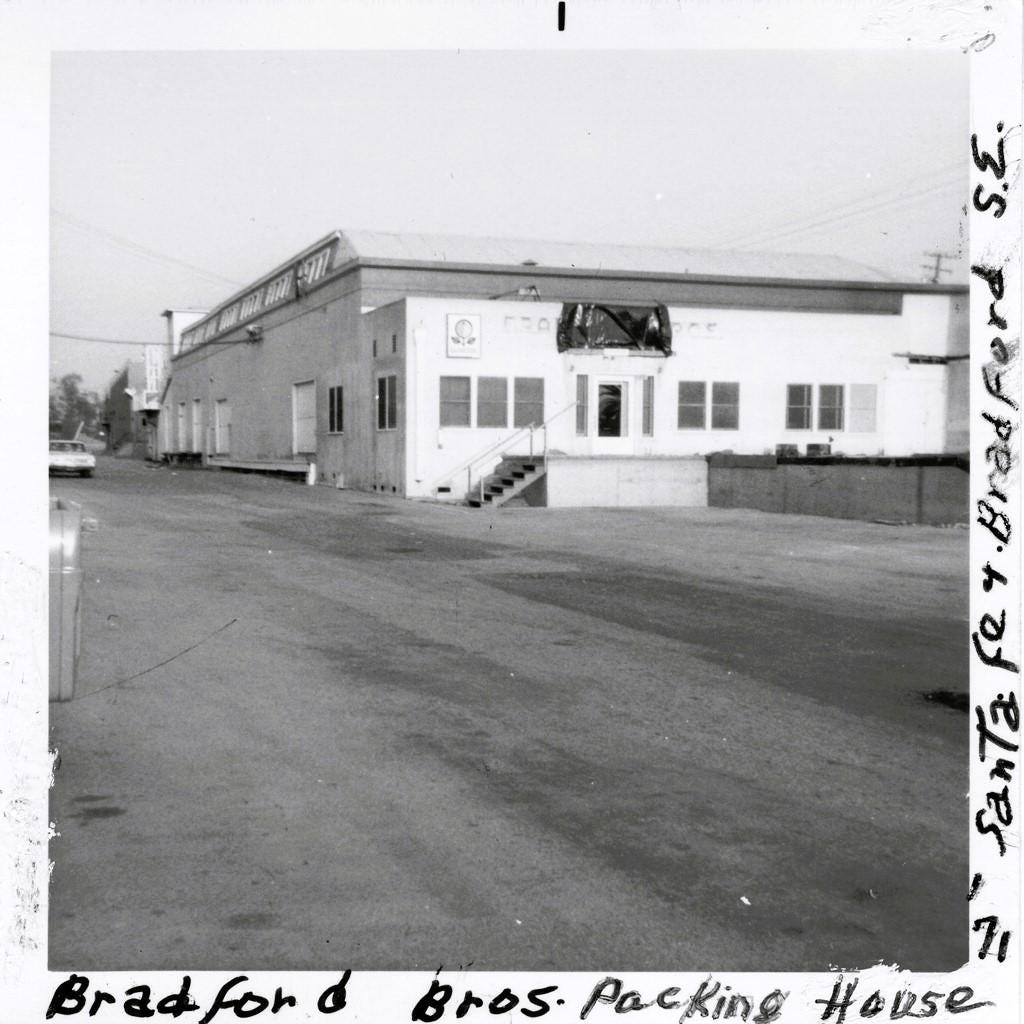
The last photo in the listing is an old black-and-white snapshot of the Bradford Bros. packing house itself, captioned by hand "Bradford Bros. Packing House" and "Santa Fe & Bradford S.E.," and marked '71.

🪶 The Name and the Picture

Pala is a real place in Southern California. The Pala Indian Reservation lies in the San Luis Rey River Valley of northern San Diego County, east of Fallbrook, home of the Pala Band of Mission Indians, whose people are Cupeño and Luiseño. The little mission there, San Antonio de Pala, was founded on June 13, 1816 as an outpost of Mission San Luis Rey, and it still stands on the reservation. Beginning in 1901 the Cupeño faced forced removal from their ancestral homeland, Kupa, at what is now Warner's Ranch, and in May 1903 they were moved to Pala, beside the Luiseño. The tribe remembers it as the Cupeño Trail of Tears, and the two peoples have shared Pala ever since.

The man on this label wears the feathered war bonnet of the Plains nations, not the traditional dress of the Luiseño or Cupeño people of Pala. Labels like this are part of the record of how American advertising pictured Native people, and I think they're worth keeping and understanding for exactly that reason.

🌳 Bradford Bros. and Placentia

The Bradford on this label is the family of Albert Sumner Bradford, the man Placentia calls its father. He was born in Shapleigh, Maine on August 18, 1860, and at twelve he left home for Boston to work as a market gardener. He came to California in 1887, and in 1890 he bought 20 acres in what is now Placentia, his Tesoro Ranch, planted oranges and started a citrus nursery. Once refrigerated rail cars came in, his young orange trees jumped from 13 or 15 cents apiece to a dollar. He helped organize the early Fullerton-Placentia Farmers Union and the Southern California Fruit Exchange, the growers' co-op that became Sunkist, and in 1902 he built his big Queen Anne house on the Tesoro Ranch.

When the Santa Fe came through, Bradford led the push to get it the right of way, bought 60 acres by the new depot from Richard Melrose of Anaheim, and on September 19, 1910 filed the plat for the townsite of Placentia. The next year he organized the Placentia National Bank, and he was president of the Chamber of Commerce from its start until he died in 1933. His house went on the National Register of Historic Places in 1978, and Bradford Avenue still carries his name.

The Bradford Brothers packing house opened in 1922 by the depot at Santa Fe and Bradford, the very corner written on that old snapshot, and it stayed in use into the 1970s before it was torn down in the early 2000s. In 1977 it was still running under the Bradford Brothers name, owned by his namesake grandson, and in 1978 Bradford Bros. joined the Villa Park Orchards Association. And here's a twist I love: that grandson, Albert Sumner "Bud" Bradford, born in 1933, started out working with his family at Bradford Brothers, and later he moved his own family south to Pala and threw in with Villa Park for its Sunkist standards and its family ownership.

📅 How Old Is It?

Bradford Bros., Inc. was already putting its name and "Grown in U.S.A." on its labels by 1928: the Boston Public Library keeps the firm's Miracle Brand label, printed by Western Litho with a 1928 copyright on its face. The Pala Brave name came later to the Patent Office. Bradford Bros. filed it as a trademark for fresh citrus fruits on July 12, 1951, and it was registered on June 17, 1952. When Bradford joined Villa Park in 1978 the mark went along, and the Villa Park Orchards Association still owns it. The dealers who handle this label date this printing to the 1940s, and that's where I put it too. The Tustin Area Historical Society and Azusa Pacific University's citrus label collection each keep a Pala Brave label of their own.

Placentia has a long story of its own. The Tongva lived here for thousands of years, and the large village of Hutuknga stood close to the present town. In 1837 the Mexican government granted the land to Juan Pacifico Ontiveros as part of Rancho San Juan Cajón de Santa Ana. In 1878 Sarah Jane McFadden suggested renaming the local school district Placentia, from a Latin word for "pleasant place to live," and the town took its name from the school. The first commercial orange grove went in in 1880, worked mostly by Mexican and English laborers, the town center grew up around 1910 at the Santa Fe stop where the oranges were shipped, oil was struck in 1919, and Placentia incorporated on December 2, 1926.

It's a powerful label to frame, and a meaningful one for anybody with roots in Placentia, the old Orange County groves, or the Pala country down in San Diego County.

Shipping

🚚 Shipping & Handling

  • Shipping costs and timing are calculated at checkout.
  • Items curated and shipped directly by me include U.S. shipping at no additional cost, professionally packed to ensure safe arrival of your artifact.

Items from Vetted Pro Collectors
Shipping for items offered by vetted Pro Collectors is determined at checkout. All Pro Collector listings are reviewed to ensure fair, reasonable shipping practices.

For full details, please refer to our Shipping Policy.

Returns & Exchange

Take your time — you've got a full six months. If a piece isn't right for you, send it back the way it reached you and we're good.

In the first 30 days your money goes straight back the way you paid. After that it's store credit, so you can put it toward something you'd rather have.

Return shipping we sort out between us, case by case. I don't make this difficult.

If something arrives damaged, or it isn't what I said it was, send me a photo within 48 hours and I'll make it right.

Email info@vintageantiquesgifts.com or call 802-356-9872 — that's me answering, not a call center.

The only things I can't take back are custom or special-order pieces and gift cards.

View full details

Preserving History: Authentic Objects Across Eras

— Curated by Travis Weigel