Skip to product information
1 of 6

Vintage and Antique Gifts

Antique Harveys Nat Leaf Tobacco Tin Tag 1870s 1910s Figural Leaf Shape Pin Back Advertising Collectible Tobacciana 🚬

Regular price 8.00 USD
Regular price Sale price 8.00 USD
Sale Sold out
Shipping calculated at checkout.

Description

What Does a Tiny Tin Leaf Tell You About American Commerce? 🍂

It tells you everything. It tells you that somewhere around the 1870s, 1880s, or perhaps right at the turn of the twentieth century, a manufacturer named Harvey looked at a plug of chewing tobacco and decided that his brand was worth marking — worth stamping, worth pressing into metal, worth spending money on so that every man who bit into that plug knew exactly whose product he was holding. It tells you that pride in craft and competition in the marketplace were alive and fierce long before neon signs, broadcast radio, or a single pixel of digital advertising existed. And it tells you that the object you're looking at right now — this leaf-shaped, amber-gold lithographed tin tag with a portrait medallion pressed into its center — is not a reproduction, not a souvenir recreation, and not a later tribute. It is the original article, and it has survived the better part of a century and a half looking, by all accounts, like it never left the factory floor.

That's the kind of object that stops a collector cold.


🍃 What This Piece Actually Is

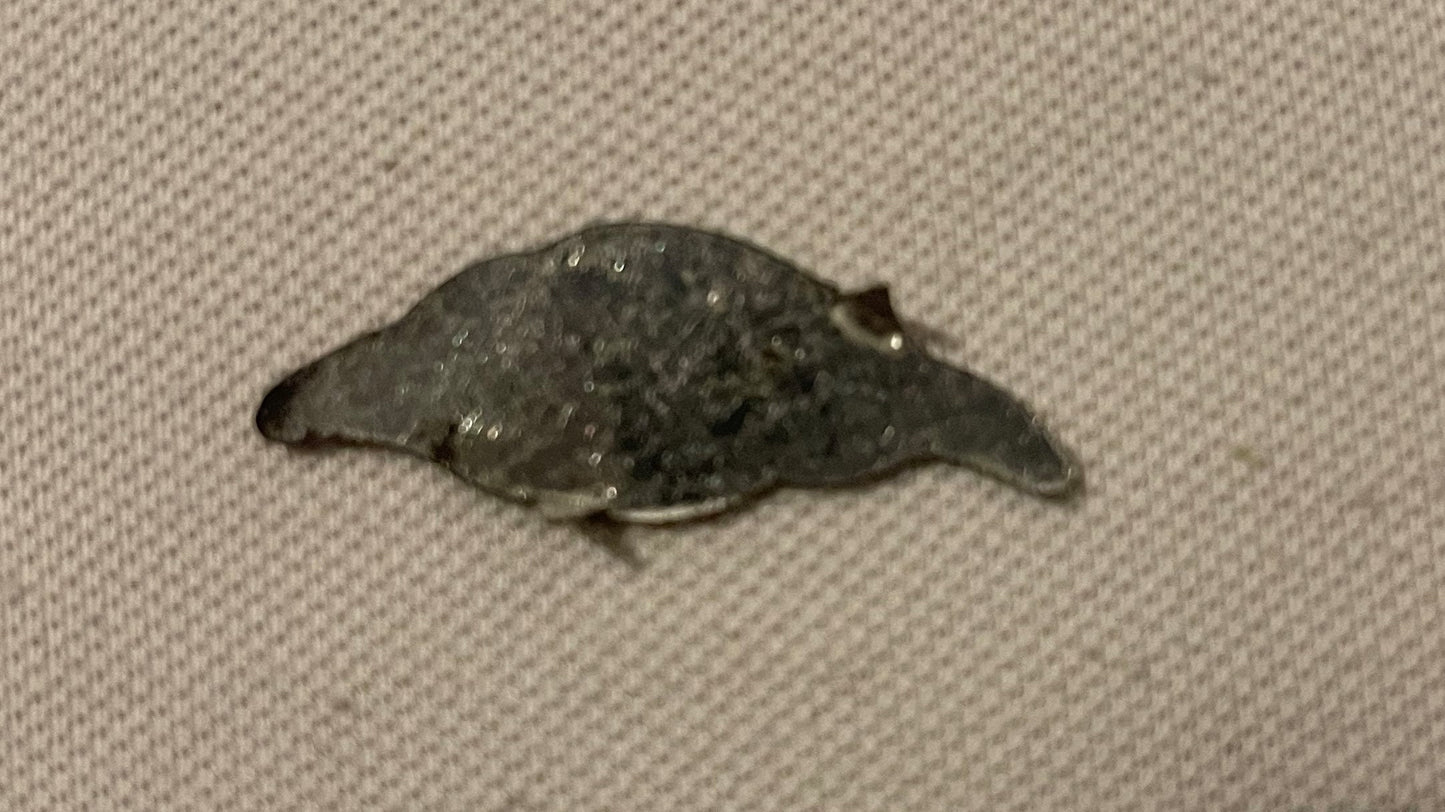
This is a Harvey's Nat Leaf tobacco tin tag, dating to the golden era of American plug tobacco production — roughly 1870s through 1910s. It is a small, figural, pin-back advertising tag stamped in the form of a tobacco leaf with outstretched wings, measuring approximately one and a half inches across by half an inch tall. The surface is lithographed in warm amber gold and deep brown tones, with a portrait medallion pressed directly into the center face of the leaf — a level of decorative investment that speaks volumes about the competitive branding wars of its era. On the back sits a pin mechanism, meaning this tag was designed not only to be pressed through a plug of chewing tobacco at the point of sale, but also to be worn — carried home, kept, traded, or pinned to a lapel by a loyal customer who wanted the world to know his brand.

Critically, this example is New Old Stock — NOS in collector's parlance — meaning it was never used, never pressed through a plug, never bent or punched or stained with tobacco resin. It came through the intervening century in essentially unissued condition, which places it in the top tier of survivability for objects of this type and this age. Tin tags, by nature, were consumable. They were made to be used and discarded, which is precisely why finding one in this state of preservation is the kind of discovery that makes a collector's hands go a little unsteady.


🏭 The Birth of the Tobacco Tin Tag — An American Invention

The tobacco tag was born in the 1870s, and the credit for its invention belongs, by most accounts, to the P. Lorillard Tobacco Company of New Jersey — the oldest American tobacco manufacturer still operating at the time — who first recognized that a small stamped tin tag, pressed through a plug of chewing tobacco, could serve simultaneously as a brand mark, a proof of authenticity, and a kind of receipt nailed directly to the product itself. Before the tag era, a man walking into a general store and asking for his weekly plug of chewing tobacco had to rely entirely on the shopkeeper's word about which brand was which. After tags, the brand was inextricable from the tobacco. You could see it, feel it, and carry it home.

The timing was not accidental. In the years immediately following the Civil War, the American appetite for Southern-grown tobacco — particularly the bright leaf varieties of Virginia, North Carolina, and Kentucky — had exploded in ways that manufacturers were still scrambling to meet. The problem was that success bred imitation. Lesser plugs were being passed off under popular names. Shopkeepers with no particular loyalty to any brand would sell whatever came off the nearest freight wagon. In this environment, the tin tag was a masterstroke: small enough to cost nearly nothing per unit, visible enough to be unmistakable at point of sale, and sturdy enough to survive the journey from factory to freight car to general store counter. Within two decades, hundreds of manufacturers across the tobacco belt and beyond were issuing their own figural tags in every conceivable shape — fish, horseshoes, bells, axes, stars, animals, and, most commonly of all, tobacco leaves.

Harvey's Nat Leaf enters this story as a participant in that competitive golden age — a brand that thought its name and its leaf were worth investing in at the level of a portrait medallion and careful lithography. That's not a throwaway decision. That's a manufacturer saying: our customer will recognize us, and we will give him something worth keeping.


🌿 The Tobacco Leaf Shape — Why It Matters to Collectors

Among figural tin tags, the leaf shape carries a particular weight of meaning. It is, in a sense, the most honest shape a tobacco manufacturer could choose — the raw material itself, stylized and pressed into metal, placed right at the heart of the transaction. The outstretched wings on this Harvey's example give it a slightly heraldic quality, as though the leaf is mid-flight, which was a common design flourish of the period. Manufacturers understood that a tag would sometimes leave the tobacco plug entirely — pulled off by a curious customer, kept by a child, saved in a tobacco tin at home — and so the visual interest of the tag had to stand on its own terms. This one does.

The amber gold and deep brown colorway is also worth pausing on. Lithography on tin at this scale and in this period was not a trivial process. The coloring had to survive factory conditions, freight handling, and the humid interior of a general store's tobacco drawer. Manufacturers who invested in quality lithography were signaling something about the quality of the product behind the tag. The warm, autumnal palette chosen for Harvey's Nat Leaf — naturalistic, leaf-like, seasonally resonant — was a deliberate choice in an era when color itself was still a luxury in everyday commercial objects.

Lore passed down among tobacco tag collectors holds that the leaf-and-wings figural form was sometimes called a "flying leaf" in trade parlance, and that certain regional distributors kept them in cigar boxes behind the counter specifically because customers would ask for the brand by describing the tag shape rather than the name — "give me the flying one," or "I'll take the gold leaf with the face on it." Whether that story is verifiable in any record book is another matter, but it has the ring of something true about how ordinary commerce actually worked in small-town America.


📜 Portrait Medallions and the Language of Authority

The portrait medallion pressed into the center of this tag deserves its own moment of consideration. In the Victorian and Edwardian commercial vocabulary, a portrait on a product — especially a small, finely rendered one — conveyed authority, authenticity, and personal guarantee. It was the visual equivalent of a signature. The manufacturer, or a trusted figure associated with the brand, was literally putting a face to the product. This convention was widespread across patent medicines, baking products, tobacco, and whiskey in this period, and it carried genuine weight with consumers who had grown up in an era when a man's word and his face were his bond.

Who the portrait figure on the Harvey's Nat Leaf tag represents is an intriguing open question. Local legend among Virginia and Carolina tobacco collecting circles has it that some of the smaller plug manufacturers used founder portraits, while others used generic "quality gentleman" engravings purchased from commercial die-makers — the nineteenth-century equivalent of a stock photograph. Either way, the presence of that medallion on an object this small is a mark of ambition, and it elevates this tag from a simple brand marker into something that participates in the broader visual language of American commercial pride.


🕰️ New Old Stock — What That Means for a Piece This Age

New Old Stock is a term that gets used loosely in some collecting circles, but for an object dating to the 1870s–1910s, it carries a very specific and almost improbable meaning. These tags were made to be consumed by the manufacturing process — pressed through plugs, handled by storekeepers, carried home in pockets, lost in the lining of a coat. The survival rate of used tags in good condition is already surprisingly low given their age. The survival rate of unused tags, still in factory-fresh condition, is genuinely rare.

NOS examples of tobacco tin tags typically turn up in one of a handful of ways: a general store inventory that was never fully sold through and was sealed in a back room for decades; a manufacturer's sample run that never made it to distribution; or, occasionally, a salesman's sample kit that was put away in a trunk and forgotten. Each of these pathways tells a small story about the economics of the trade — what happened when a brand was discontinued, when a salesman retired, when a general store closed its doors and left its stock to accumulate dust. This Harvey's Nat Leaf example carries that kind of backstory embedded in its condition, even if the specific path it took to arrive here is now lost to time.


🖼️ Display Ideas

  • 🪵 Shadow box with period ephemera: Mount the tag in a small shadow box alongside a period tobacco trade card, a plug tobacco wrapper fragment, or a general store invoice from the same era — the combination creates an instant narrative vignette that reads beautifully on a study or library wall.
  • 🧲 Magnetic display on an antique tin surface: The pin-back allows freestanding display options, but a small rare-earth magnet behind a period tin surface (an old coffee tin lid, a biscuit tin panel) lets the tag float visually without damage to the piece itself.
  • 📚 Framed alongside tobacciana reference pages: A matted frame pairing the tag with a reproduced page from an 1890s tobacco trade catalog or a relevant passage from a tobacciana reference guide gives collectors and guests immediate historical context.
  • 🏪 General store or apothecary vignette: Displayed with other period general store artifacts — an antique scale weight, a glass candy jar, a trade token — this tag anchors a tabletop or vitrine vignette that tells the story of nineteenth-century American retail commerce.
  • 🔬 Collector's reference display: Pin-mounted in a specimen-style display case alongside other figural tin tags of the period, this Harvey's example stands as both an aesthetic anchor and a comparative reference point for the leaf-figural form.
  • 🎨 Working artist's or writer's desk accent: Small, beautiful, historically charged — a single well-chosen antique object on a creative desk has a grounding quality that larger decorative pieces rarely achieve. This tag earns its place.

🎁 Who Collects These

Tobacco tin tag collectors are among the most focused and knowledgeable specialists in American advertising collectibles, and they are also among the most welcoming to newcomers who arrive with a single piece and a genuine question. The field has been active since at least the 1960s, when the first dedicated tobacciana collector clubs began organizing, and it has produced some of the most thorough reference literature in the advertising collectible space — illustrated guides to figural forms, regional brand histories, and condition grading standards that rivals any category in antique advertising.

Beyond the specialists, these tags draw in collectors from adjacent fields: American advertising collectibles broadly, Victorian and Edwardian ephemera, folk art and figural metalwork, general store antiques, and Southern Americana. A Harvey's Nat Leaf tag in NOS condition is the kind of crossover piece that shows up on a serious tobacciana collector's want list, in a decorative arts enthusiast's shadow box, and in a folk art scholar's research archive with equal plausibility.

Gift-givers also find these tags endlessly useful. For the history teacher who loves tactile primary sources, the grandparent who grew up watching a grandfather chew plug tobacco on the back porch, the designer who wants something genuinely old and visually distinctive for a study or office — a piece like this one hits all of those marks without requiring any specialized knowledge to appreciate. You don't have to know what a tin tag is to understand, the moment you hold this one, that it is old, that it is beautiful, and that someone once cared enough to make it very well.


❓ Frequently Asked Questions

Is this tag actually from the 1870s–1910s, or is that a wide estimate?

That range reflects an honest acknowledgment of how tobacco tin tag dating actually works. The tin tag as a commercial form was introduced in the early 1870s and remained in widespread use through approximately the 1910s, when shifts in tobacco consumption habits — a movement toward cigarettes and away from plug chewing tobacco — began to reduce the commercial relevance of the plug format and, with it, the tin tag. Within that window, attributing a specific decade to an unsigned, undated tag requires reference to lithographic technique, die-cutting style, and brand registration records that are not always fully preserved. The 1870s–1910s attribution is grounded, not speculative, and it places this piece squarely within the golden age of the form. For most collectors and display purposes, this is exactly the right level of specificity.

What does "NOS" mean, and how can I tell?

New Old Stock means the item was produced in its original era but was never put into use — in this case, never pressed through a plug of chewing tobacco, never handled extensively at point of sale, and never subjected to the wear that most surviving tags show. On a tin tag, NOS condition typically presents as sharp lithographic color without fading, crisp die-cut edges without bending or rolling, no tobacco resin staining on the surface or pin mechanism, and overall surface integrity consistent with an item that has been stored rather than used. This Harvey's Nat Leaf example presents all of those characteristics. Its survival in this state over a period of roughly one hundred to one hundred and fifty years is the thing that makes it genuinely unusual among tags of its type.

What is the pin-back mechanism for, and is it still functional?

The pin-back on tobacco tin tags served a dual purpose. Functionally, it was used to press or pin the tag through the plug of tobacco at point of manufacture or sale, securing the brand identification to the product. But manufacturers also understood — and in some cases explicitly encouraged — the secondary life of these tags as wearable items. Loyal brand customers would pin tags to their lapels, hat bands, or work jackets as a badge of preference, which was free advertising of a remarkably effective kind. The pin-back mechanism on antique tags of this age should be handled with care, as the metal is period-original and not intended for heavy repeated use; display mounting is recommended over daily wearing for a piece in this condition.

How do I store or care for a tin tag in this condition?

For NOS tin tags in fine condition, the primary enemies are humidity, direct light, and contact with acidic materials. Archival storage options include acid-free tissue wrapping in a stable-temperature environment, or display in a UV-filtering frame or case that limits light exposure. Avoid storing loose metal pieces in contact with paper that is not acid-free, as off-gassing from degrading paper can contribute to surface oxidation over time. For display, keeping the piece away from exterior walls (which can cycle through humidity and temperature more dramatically) and out of direct sunlight preserves both the lithographic color and the surface integrity of the tin. These are low-maintenance objects — they have already proven their durability across a century and a half — but they reward thoughtful placement.

Is this a common tag, or is the Harvey's Nat Leaf form considered scarce?

Among the hundreds of brands that issued tin tags during the plug tobacco era, Harvey's Nat Leaf occupies an interesting position. It is not among the most commonly encountered tags in circulation — the largest brands, by virtue of production volume, produced tags in quantities that still turn up with some regularity. Harvey's, as a smaller regional or specialty brand, produced in lower quantities, which means surviving examples appear less frequently in dealer inventories and at auction. NOS examples of any Harvey's tag are rarer still. Experienced tobacciana collectors and advanced advertising collectible specialists can assess authenticity through hands-on examination of lithographic technique, metal gauge, surface aging patterns, and hardware style, all of which are consistent with period production on this piece. For collectors who want formal documentation, tobacciana reference guides and specialist club resources provide detailed comparison points. For the majority of collectors and gift purchasers, the physical evidence of age and the NOS presentation speak clearly and honestly on their own terms.

What makes this a particularly good entry point into tobacco tin tag collecting?

Several things converge in this piece that make it an ideal introduction to the category. It is figural — the leaf shape is immediately legible and visually interesting — which means it reads beautifully even to someone who has never thought about tobacco tin tags before. It is in NOS condition, which means it represents the form at its best rather than in its most commonly encountered worn state. It is small enough to display or store without dedicated infrastructure. And it carries a specific brand name — Harvey's Nat Leaf — that gives a new collector an immediate research thread to pull on. The tobacco tin tag category rewards exactly that kind of engagement: one piece leads to a question, the question leads to a reference book, the reference book leads to another piece, and before long you have a collection that tells a coherent, richly documented story about American commerce, material culture, and the ingenuity of nineteenth-century brand marketing.

Shipping

🚚 Shipping & Handling

  • Shipping costs and timing are calculated at checkout.
  • Items curated and shipped directly by me include U.S. shipping at no additional cost, professionally packed to ensure safe arrival of your artifact.

Items from Vetted Pro Collectors
Shipping for items offered by vetted Pro Collectors is determined at checkout. All Pro Collector listings are reviewed to ensure fair, reasonable shipping practices.

For full details, please refer to our Shipping Policy.

Returns & Exchange

Product Page Return Policy

  • 60-Day Returns – Items must be in original condition.
  • Refunds – Issued after inspection (excluding shipping costs).
  • Return Shipping – Customer is responsible unless item is damaged or incorrect.
  • Damaged/Incorrect Items – Contact us within 48 hours for a replacement or refund.
  • Easy Returns – Email [email protected] or call 802-356-9872 to initiate a return.

For full details, visit our Refund Policy.

View full details