Skip to product information
1 of 4

Vintage and Antique Gifts

Antique Black Maria Tin Tobacco Tag 🏷️ 1870s–1910s Taylor Bros Winston NC Rare Prongs Intact Collectible

Antique Black Maria Tin Tobacco Tag 🏷️ 1870s–1910s Taylor Bros Winston NC Rare Prongs Intact Collectible

Regular price 12.00 USD
Regular price Sale price 12.00 USD
Sale Sold out
Shipping calculated at checkout.
Quantity

Can You Hold a Piece of the Post-Civil War Tobacco Boom in the Palm of Your Hand? 🏷️

There is something almost magical about holding an object this small that carries this much history. A single inch of stamped tin, shaped and prong-fitted by hands long since gone, marked with a name that once meant everything in the bright-leaf tobacco world of the American South. This little tag — no bigger than a stick of gum — was clipped onto a plug of chewing tobacco somewhere between 1870 and 1910, in a warehouse district that smelled of cured leaf and ambition, in a city that would become the tobacco capital of the American interior. It survived. All the plugs it ever touched crumbled to dust generations ago. The tag remains. That is what antiques do. They outlast everything else and arrive, eventually, in the hands of someone who knows enough to stop and listen.

Welcome to one of the most quietly compelling corners of American folk collecting: the tobacco tin tag. And this one — the Black Maria — is a genuine rarity in the condition you see here.


🏷️ What Exactly Is This Piece?

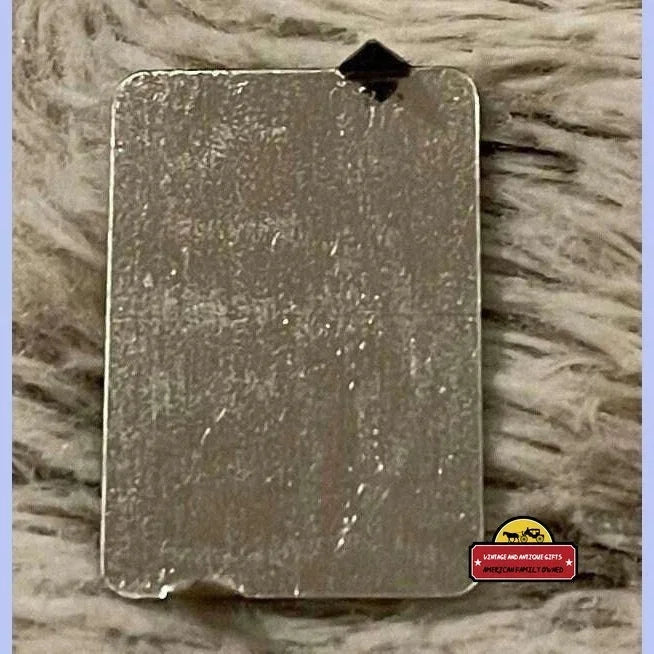
This is an original antique tin tobacco tag, style name Black Maria, produced by Taylor Brothers of Winston, North Carolina, and dating to the era spanning roughly 1870 through 1910. It measures approximately 1 inch by one-third of an inch — a tiny, precisely made slip of tin that was die-cut, finished, and fitted with prongs designed to pierce and grip a plug of chewing tobacco, identifying the manufacturer right there at the point of sale and use. The construction is characteristic of the American tin tag trade of the period: thin-gauge stamped tin, with the brand name or design embossed or printed into the surface, and those signature prongs formed as part of the same piece — meant to be bent through the plug and crimped to hold fast.

What makes this particular example exceptional — and the reason it deserves every word written here — is condition. The prongs are intact and fully upright. They have not been flattened, bent, or pressed down for storage in a collector's book or display binder, which is precisely what happened to the overwhelming majority of surviving tags. Most tags you encounter in the market today were flattened at some point in their lives. Finding one with prongs still proud and original is genuinely uncommon. For the serious collector, this is the difference between a tag that has been interfered with and one that is, as closely as possible, exactly as it left the Taylor Brothers factory more than a century ago.


🏭 Taylor Brothers, Winston, and the Bright-Leaf Revolution

To understand why this tag exists — why anyone bothered to make something so tiny so carefully — you have to understand what happened to tobacco in the American South after the Civil War ended in 1865.

The war itself had done something unexpected. Union soldiers, moving through North Carolina and Virginia, encountered bright-leaf flue-cured tobacco for the first time — and they loved it. When they went home to Ohio, Pennsylvania, New York, and beyond, they took that craving with them. Demand for Southern-cured tobacco exploded virtually overnight. The men who owned curing houses, factories, and warehouses in the Piedmont region of North Carolina suddenly found themselves at the center of a gold rush measured not in ore but in leaf.

Winston, North Carolina — incorporated as a town in 1849, sharing its identity with neighboring Salem until the two merged formally in 1913 as Winston-Salem — became one of the beating hearts of this expansion. By the 1870s and 1880s, the town's Main Street district was thick with tobacco manufacturers, leaf dealers, auction warehouses, and the supporting trades that follow any boom: coopers, tinsmiths, printers, and merchants of every stripe. The railroad connections that ran through the Piedmont made Winston a natural shipping hub, moving processed tobacco north to manufacturers and east to export ports.

Taylor Brothers was among the manufacturers who rose during this era, producing plug tobacco — the pressed, sweetened, firm-cut chewing tobacco that was the dominant form of tobacco consumption in working America at the time. Plug tobacco was a product of labor: field hands, warehousemen, factory workers, railroad men, farmers. It required no pipe, no papers, no fire. You cut a chew with a pocketknife, and you worked. The plug was everywhere.

And because the plug was everywhere, and because competition among manufacturers became ferocious as the market filled with new entrants through the 1870s, 1880s, and 1890s, the tobacco tin tag was born as a commercial and protective tool of genius.


📌 The Tin Tag System — Why It Mattered More Than You Might Think

Here is the problem the tag solved: once a plug of tobacco was cut from a larger pressed block and sold across a general store counter, it was essentially anonymous. A dishonest storekeeper — or a competitor's agent — could purchase a popular brand's product, resell it out of the wrapper, and substitute an inferior or cheaper plug while still charging the premium price. The consumer had no way to know the difference until it was too late. Brand reputation was everything, and it was vulnerable.

The tin tag changed that calculus. Pressed directly through the plug and crimped in place at the factory, the tag could not be removed and reattached without obvious damage. It was the 19th-century equivalent of a tamper-evident seal. If the tag said Black Maria — Taylor Brothers, Winston, NC, then the plug in your hand came from Taylor Brothers. Full stop.

Beyond anti-adulteration protection, the tags served a second and brilliantly clever commercial purpose: they were collectible from the very beginning. Manufacturers encouraged customers to save their tags and redeem them — sometimes for cash, sometimes for premiums like pocket knives, bandanas, tin boxes, or other small goods. Children collected them obsessively. Adults traded them. The tag became a tiny piece of brand loyalty hardware more than a century before any modern loyalty program was invented.

Collectors today estimate that hundreds — possibly over a thousand — distinct tag designs were produced across the major tobacco-manufacturing states during the tag era, which ran roughly 1870 to 1920. Some were simple rectangles. Others were shaped as animals, anchors, horseshoes, hatchets, stars, and figures. The Black Maria name itself is evocative: Black Maria was 19th-century American slang for the paddy wagon — the police wagon used to haul arrestees — and the name carries with it exactly the kind of knowing, humorous, working-class cultural shorthand that tobacco brand names of the era trafficked in heavily.


🌿 Winston, North Carolina — The Town That Tobacco Built

It is worth sitting with the geography for a moment, because it matters to the character of this piece. Winston, North Carolina, in the 1870s and 1880s, was a town in the full flush of transformation. The Moravian community of Salem to its immediate south was a place of careful, orderly craftsmanship and religious community. Winston, by contrast, was a boom town — rough-edged, commercially ambitious, full of men and women making fortunes and losing them with equal speed. The two communities coexisted in productive tension, their cultures different enough to notice but their economies intertwined.

The tobacco warehouses and factories of Winston drew workers from across the Piedmont — white and Black workers, many of them formerly enslaved people seeking wages and autonomy in the post-Reconstruction economy. The labor culture of the tobacco factories was its own world, with its own hierarchies, its own rhythms, its own folklore. Women worked the stemming rooms. Men worked the pressing floors. Children ran errands and swept. And the finished plugs, tagged and wrapped, moved out on wagons and rail cars to a country that could not get enough of them.

Local collectors who have spent decades hunting the Winston-Salem antique circuit will tell you that Taylor Brothers tags turn up most often in estate sales from Forsyth County and the surrounding Piedmont counties — exactly where you would expect them, concentrated in the geography of manufacture and immediate distribution. They occasionally surface further afield, carried by travelers, salesmen, or the ordinary drift of goods across a country knitted together by rail.

Local legend has it that Taylor Brothers maintained a particularly fierce pride about their product quality, and that employees who were found taking shortcuts in the pressing or tagging process were let go without negotiation — a standard that apparently became a point of informal company lore among workers in the district. Whether entirely factual or burnished by the passage of time, this kind of reputation speaks to what a brand like Black Maria represented: a guarantee, pressed into tin and driven through tobacco, that the product inside was what it claimed to be.

Whether those origin stories are provable or not, they reflect the genuine affection that communities of working people developed for the small beautiful objects that their labor produced.


🖼️ Display Ideas

  • 🪵 Shadow box with period ephemera: Mount the tag alongside a period tobacco trade card, a snippet of vintage tobacco wrapper paper, and a small reproduction carte-de-visite portrait for a complete 1880s tobacciana vignette.
  • 📚 Collector's reference display: Frame alongside a printed identification guide page for tobacco tin tags and a hand-lettered label noting the Taylor Brothers provenance — perfect for a library wall or study.
  • 🛠️ Americana working-trades collection: Group with other 19th-century tradesmen's hardware — a cobbler's tack, a cooper's stamp, a printer's block — to create a display honoring American artisan manufacture.
  • 🗺️ North Carolina / Piedmont regional heritage display: Pair with a vintage map of Winston or Forsyth County, a period photograph of a tobacco warehouse, and other Winston-Salem antiques for a deeply local historical installation.
  • 🔍 Magnified display under a dome: Given the tiny, intricate scale of the piece — 1 inch by one-third of an inch — a small glass cloche or dome display with a magnifying lens card lets viewers appreciate the prongs and surface detail up close without handling.
  • 🎨 Tobacciana theme shelf: A dedicated shelf or case with plug tobacco tins, trade cards, cutter blades, and tag collections grouped by manufacturer makes a display that tells the full story of the American plug tobacco trade.

🎁 Who Collects These — and Why They Search Them Out

Tobacco tin tag collecting is one of those deep, absorbing American folk-collecting categories that rewards patience, knowledge, and a genuine love of history. The community of serious tag collectors is not large, but it is devoted — and knowledgeable. These are people who study the manufacturers, the brand names, the die shapes, the prong configurations, and the redemption premium systems with the same attention that coin collectors bring to mint marks and die varieties.

Within that community, tags with intact prongs are a consistently discussed and valued subset. The vast majority of tags in collector hands were flattened for storage at some point — pressed into albums or sandwiched between boards. A tag like this one, where the prongs remain in their as-manufactured position, represents the piece in its working state: as close to factory-original as the intervening century permits.

Beyond dedicated tobacciana collectors, this tag is a natural fit for: North Carolina and Winston-Salem regional history collectors, who prize anything that connects to the pre-merger Winston manufacturing district; Americana and folk-art collectors who assemble displays of 19th-century commercial objects; advertising and trade ephemera collectors who value early brand-identification objects; and gift buyers searching for a genuinely meaningful, one-of-a-kind piece for someone with roots in the North Carolina Piedmont or a love of Southern history. At one inch long, it is also the rare antique that travels easily and stores without drama — a remarkable amount of history in a remarkably compact form.


❓ Frequently Asked Questions

What does "Black Maria" mean as a brand name?

In 19th-century American slang, "Black Maria" was the common name for the paddy wagon — the police van used to transport those under arrest. The term was widely used from the mid-1800s onward and was recognizable to virtually any working adult of the era. Tobacco manufacturers of the period were famous for colorful, humorous, or provocative brand names — names that would stick in the memory and prompt a smile at the counter. Black Maria fits squarely in that tradition: it is unexpected, slightly irreverent, and instantly memorable. It also suggests a certain toughness and dark humor that would have appealed to the working-class men who were the primary plug tobacco consumers of the time.

Why are intact prongs so significant to collectors?

The prongs on a tobacco tin tag were its functional element — the mechanical means by which the tag was attached to the plug. In their original state, they stood upright, ready to be pressed through the tobacco and crimped flat on the reverse side. The overwhelming majority of tags in collections today had their prongs flattened at some point, either during use, during removal from the plug, or deliberately by collectors storing tags in flat albums or binders. A tag with prongs still in their original raised position has simply not been subjected to that alteration. It is, structurally, closer to its manufactured state — and that rarity is recognized and specifically sought by advanced collectors who want the piece as it was made, not as it was stored.

How do I know this is genuinely from the 1870–1910 era?

The dating of tobacco tin tags is established through a combination of manufacturer history, tag design characteristics, and material analysis. Taylor Brothers of Winston, North Carolina, operated during the active tobacco tag era, which is historically documented as running from approximately 1870 to 1920, when changes in tobacco consumption habits, packaging, and federal regulation effectively ended the tag system. The construction characteristics of this tag — the gauge of the tin, the prong formation style, the surface treatment — are consistent with period production. These markers, taken together, confirm authentic period origin.

Was the Black Maria tag part of a premium redemption program?

Many — though not all — tobacco tin tags of the period participated in manufacturer redemption programs, where consumers saved tags and exchanged accumulations for premiums ranging from small household goods to pocket knives, bandanas, and other practical items. Whether Taylor Brothers operated a specific Black Maria redemption program is not definitively documented in surviving records that are widely available to collectors. What is certain is that the broader redemption culture of the tag era made tags actively collectible by consumers during their own time — which means that some percentage of surviving tags were deliberately saved rather than simply discarded, which accounts in part for the range of condition you find in surviving examples today.

Is this appropriate for a child or beginner collector?

This is unambiguously a piece for an informed collector or someone receiving it as a carefully chosen gift. Because of the prongs, the tiny scale, and the fragility that comes with any intact 19th-century tin object, it is best handled by adults and stored or displayed in a thoughtful setting. For a beginning collector interested in tobacciana, American advertising history, or North Carolina history, this would make an exceptional starting piece — precise, documented, and remarkable in condition. For an advanced collector, it is the kind of tag that fills a specific gap in a serious collection.

How should this be stored or displayed to protect it?

The most important thing to preserve about this tag is exactly what makes it special: those intact, upright prongs. Any storage method that applies pressure to the face of the tag risks bending them. Ideal storage is in a small rigid container — a coin capsule of appropriate diameter, a small archival box with a foam recess, or a shadow-box display where the tag is mounted with minimal contact and no compression. If displaying, a small mount that holds the tag by its edges rather than its face is ideal. Avoid environments with high humidity or direct sunlight, both of which accelerate oxidation on antique tin. Handled with reasonable care, a tag in this condition can remain stable for another century.

How rare are Taylor Brothers tags compared to the broader tobacco tag market?

The tobacco tin tag market encompasses hundreds of manufacturers across Virginia, North Carolina, Kentucky, Tennessee, and other states. Major national producers like Lorillard, Liggett & Myers, and R.J. Reynolds generated enormous quantities of tags and are therefore more frequently encountered today. Regional and mid-sized manufacturers like Taylor Brothers produced smaller total quantities, and their tags appear less frequently in the general market — particularly in excellent, unaltered condition. Within the Taylor Brothers output, specific brand names like Black Maria represent a further subset. Rarity in this category is genuine: you are not competing with mass-market quantities. Pieces like this appear, are recognized by collectors who know what they are looking at, and move quickly.

Shipping

🚚 Shipping & Handling

  • Shipping costs and timing are calculated at checkout.
  • Items curated and shipped directly by me include U.S. shipping at no additional cost, professionally packed to ensure safe arrival of your artifact.

Items from Vetted Pro Collectors
Shipping for items offered by vetted Pro Collectors is determined at checkout. All Pro Collector listings are reviewed to ensure fair, reasonable shipping practices.

For full details, please refer to our Shipping Policy.

Returns & Exchange

Take your time — you've got a full six months. If a piece isn't right for you, send it back the way it reached you and we're good.

In the first 30 days your money goes straight back the way you paid. After that it's store credit, so you can put it toward something you'd rather have.

Return shipping we sort out between us, case by case. I don't make this difficult.

If something arrives damaged, or it isn't what I said it was, send me a photo within 48 hours and I'll make it right.

Email info@vintageantiquesgifts.com or call 802-356-9872 — that's me answering, not a call center.

The only things I can't take back are custom or special-order pieces and gift cards.

View full details
  • 5 stars: 2 (100%)
  • 4 stars: 0 (0%)
  • 3 stars: 0 (0%)
  • 2 stars: 0 (0%)
  • 1 star: 0 (0%)
c
cbch60

Accurate description as well as fast and safe arrival of item; great seller.

Thank you so much!

r
reluctantsaint

Very happy with my item, no issues! Thank you! Love it! ++++++++. Love the extra gift too!

We are so glad you love it and appreciate your kind words!