Skip to product information
1 of 4

Vintage and Antique Gifts

Antique 1882 Oregon and Transcontinental Railroad 1000 Dollar Gold Bond Henry Villard Northern Pacific History 📜

Antique 1882 Oregon and Transcontinental Railroad 1000 Dollar Gold Bond Henry Villard Northern Pacific History 📜

Regular price 26.00 USD
Regular price Sale price 26.00 USD
Sale Sold out
Shipping calculated at checkout.
Quantity

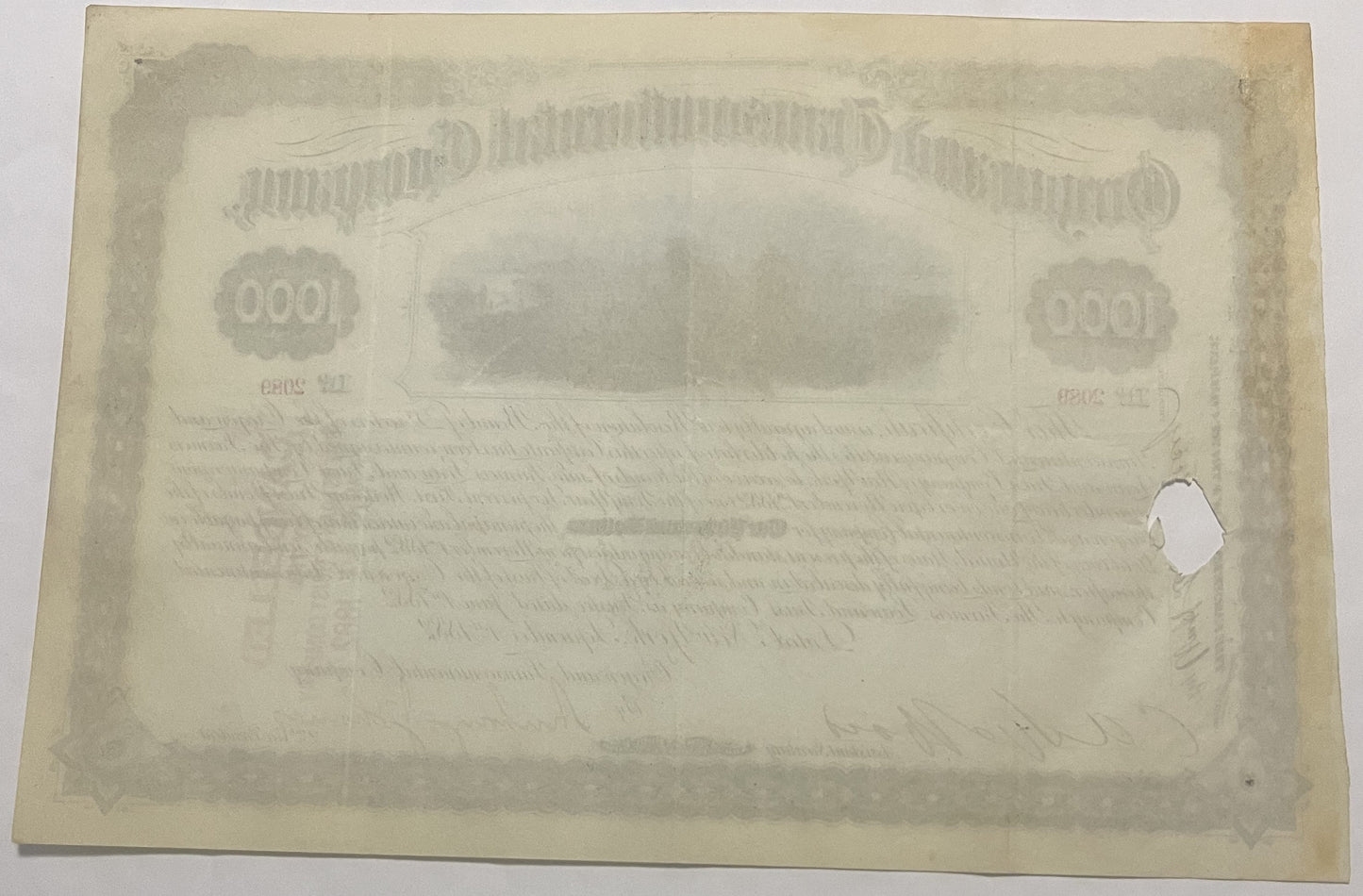
Size: 11.5 x 7.75 inches ~ Cancelled, the way surviving ones are, and they vary a little one to the next.

🏔️ Two Figures on a Bluff, Watching the Valley Below

I've spent a good part of my collecting life going through boxes of old railroad paper, and every so often a piece stops me cold — not because of the numbers printed on it, but because of the picture. This one does exactly that. Two figures kneel on a rocky bluff, a quiver and a bow beside them, one with an arm reached out over a valley that's busy with everything the railroad brought with it: a covered wagon down by a creek, a town strung along the shore, a farm with a team working it, a little 4-4-0 locomotive hauling a boxcar and a car behind, men cutting timber right by the track, a suspension bridge with a paddle steamer and a couple of sailboats passing under it, and snow on the mountains past all of that. It's engraved small, tucked into the top of a big financial document, but it's doing real storytelling — the old world and the new one sharing the same hillside.

Here's what the document itself actually says, in plain terms. This sheet entitles the holder, once it's been countersigned by The Farmers' Loan and Trust Company of New York, to receive — on or before November 1, 1882 — one of the Oregon and Transcontinental Company's Forty Year Six Percent First Mortgage Trust Bonds for one thousand dollars, principal and interest paid in United States gold coin, secured by a Deed of Trust dated June 1, 1882. So this isn't the bond itself. It's the interim certificate that stood in for the bond until that exchange was made — dated New York, September 1, 1882, and engraved by the American Bank Note Company of New York.

🚂 Henry Villard's Blind Pool

The company behind this certificate was built by one of the more remarkable characters in American railroading. Henry Villard organized the Oregon and Transcontinental Company in Oregon in 1881, with fifty million dollars in authorized capital stock, as a holding company to bring the Northern Pacific Railroad and the Oregon Railway & Navigation Company under one roof. He'd raised the money for it through what's still called his "blind pool" — a circular sent that February to roughly fifty investors, asking them to commit their capital to an unnamed venture on nothing but his word. They did, and the pool grew from an initial eight million dollars to twenty million. Villard became president of the Northern Pacific on September 15, 1881, and pushed the line toward the Pacific with that money behind him.

📰 The Reporter Who Became a Railroad Man

Villard wasn't born to finance. He was born Ferdinand Heinrich Gustav Hilgard on April 10, 1835, in Speyer, Bavaria, and took the name Villard from a French classmate after he emigrated. He made his name as a journalist first — he covered the Lincoln-Douglas debates for a German-language New York paper and reported the Civil War for the New York Tribune. In 1866 he married Fanny Garrison, daughter of the great abolitionist William Lloyd Garrison.

🏆 The Last Spike, and the Fall That Followed

The Northern Pacific's line to the Pacific Northwest was finished in 1883. The last spike went in out in western Montana in September 1883, and former President Ulysses S. Grant was among the guests Villard brought out to see it. It was the high point of the whole venture, and it didn't last. Then the money ran out, and on January 4, 1884, only months after that ceremony, Villard resigned. He didn't disappear from public life. He'd bought the New York Evening Post and The Nation back in 1881, and he went on to run Edison General Electric until the 1892 merger that created General Electric as we know it today.

The Oregon and Transcontinental Company carried on in another form: in 1890 it was re-incorporated in New Jersey as the North American Company.

✍️ The Men Whose Names Are On It

The signature over "2nd Vice President" on these certificates belongs to Anthony J. Thomas. He was an officer of the Oregon and Transcontinental Company, and Villard thought enough of him to make him the Northern Pacific's second vice-president as well — but it's in his Oregon and Transcontinental capacity that he signed this sheet. Up the left margin runs the countersigning panel of The Farmers' Loan and Trust Company of New York, the trustee named right in the certificate's own text. That company had been chartered back in 1822 as the first trust company organized in New York, and its line runs on: it merged into National City Bank in 1929, part of the lineage that leads to today's Citibank. Down at the foot of the sheet sits the imprint of the American Bank Note Company of New York, whose engravers cut the scene that opens this listing.

🎨 Reading the Vignette

Worth a longer look. The two figures on the bluff kneel with a quiver and a bow between them, one reaching an arm out over the valley as if pointing something out to the other. Below them, at the left, a covered wagon sits near a creek where people are working. Further along, a town spreads along the water, a farm has a team out working its fields, and a 4-4-0 locomotive pulls a boxcar and a passenger car past a crew of men cutting timber right beside the rails. A suspension bridge crosses the river with a paddle steamer passing beneath it and a couple of sailboats further out, and snow-capped mountains close the scene off in the distance. It's a lot of story packed into one small engraving, and it's exactly the kind of picture that made bank note engravers worth what they were paid.

📜 The Life This Certificate Had

They carry the red CANCELLED stamp, the countersignature panel, and the punch that mark a completed exchange — details that differ a little from sheet to sheet, and the photographs here show you the type. The cancellation is the end of its working life on paper: the obligation was met, the certificate retired, and instead of being destroyed it made its way into a collection instead. Nearly a century and a half later, it's still legible, still carrying that engraving, and still telling the story of the men who bet on a railroad reaching the Pacific.

Shipping

🚚 Shipping & Handling

  • Shipping costs and timing are calculated at checkout.
  • Items curated and shipped directly by me include U.S. shipping at no additional cost, professionally packed to ensure safe arrival of your artifact.

Items from Vetted Pro Collectors
Shipping for items offered by vetted Pro Collectors is determined at checkout. All Pro Collector listings are reviewed to ensure fair, reasonable shipping practices.

For full details, please refer to our Shipping Policy.

Returns & Exchange

Take your time — you've got a full six months. If a piece isn't right for you, send it back the way it reached you and we're good.

In the first 30 days your money goes straight back the way you paid. After that it's store credit, so you can put it toward something you'd rather have.

Return shipping we sort out between us, case by case. I don't make this difficult.

If something arrives damaged, or it isn't what I said it was, send me a photo within 48 hours and I'll make it right.

Email info@vintageantiquesgifts.com or call 802-356-9872 — that's me answering, not a call center.

The only things I can't take back are custom or special-order pieces and gift cards.

View full details