Skip to product information
1 of 8

Vintage and Antique Gifts

Antique 1897 Lake Shore and Michigan Southern Gold Bond 📜 NYC Route with Coupon Sheet Scripophily, Brings History to Life

Antique 1897 Lake Shore and Michigan Southern Gold Bond 📜 NYC Route with Coupon Sheet Scripophily, Brings History to Life

Regular price $17.00 USD
Regular price Sale price $17.00 USD
Sale Sold out
Shipping calculated at checkout.

Size: 15" x 10"

🚚 Free US Shipping — ships within one business day. International shipping calculated at checkout.

Style
Quantity

What Did the Lake Shore and Michigan Southern Promise? 🚂 A Thousand Dollars, Promised in Gold

Size: 15" x 10" ~ Folds and toning vary a little one to the next.

I love handing someone one of these, because you feel the weight of it before you've read a single word: heavy green engraved paper, a portrait looking back at you, two locomotives blowing smoke in opposite directions off the same page. This is an 1897 gold bond from The Lake Shore and Michigan Southern Railway Company — a thousand dollars at three and one-half percent interest, payable, in the bond's own printed words, "in gold coin of the United States... of the standard of weight and fineness as it existed June 1, 1897." That's not sales copy. That's what's engraved on the paper, from a year when what a dollar was actually worth was a live national argument.

Read the two dates printed on the face and you get something I still find remarkable every time I handle one: issued June 1, 1897, principal due June 1, 1997. A hundred years, to the day. Whoever signed off on this series was making a promise they'd never live to see paid.

🚂 What Did It Feel Like to Hold a Piece of the Vanderbilt Railroad Empire in Your Hand?

Long before stock certificates lived in a brokerage app, they lived in a safe deposit box — thick, engraved, and proud of it. This 1897 Lake Shore & Michigan Southern Railway Company gold bond is one of those documents, a survivor from the age when the railroad and Wall Street were, quite literally, printed on the same green banknote paper. Somewhere out there, an investor tucked one of these into a strongbox, trusting a great American railroad to make good on its promise twice a year, every year, for a hundred years. Printed in deep engraved green under an arched UNITED STATES OF AMERICA banner, with $1000 in the corners and lathework guilloche borders - the bank-note engraver's defense against forgers - it measures about 15 x 10 inches (about 38 x 25 cm) for the bond itself, the overall sheet running larger once the coupon strip is included.

🌾 A Gold Bond Born in the Shadow of the "Cross of Gold"

Just one year earlier, the nation had been consumed by the fiercest currency debate of the century: William Jennings Bryan electrified the 1896 Democratic Convention with his "Cross of Gold" speech, and the 1896 contest between William McKinley and Bryan turned almost entirely on gold versus silver. Gold won. A railroad that could promise to pay "in gold coin of the United States" - and be believed - was making a real statement about its financial strength to conservative investors on both sides of the Atlantic, in the decade the Panic of 1893 had sent the big trunk lines scrambling to steady their balance sheets. That is the 1890s, engraved right into this bond's promise.

🏛️ Buffalo to Chicago, and the Vanderbilt Years

The railway itself was formed on April 6, 1869, when the Michigan Southern and Northern Indiana Railroad merged with the Lake Shore to make one line running the length of Lake Erie's south shore, from Buffalo to Chicago. Call it about 540 miles of railroad: out of Buffalo through Erie, Pennsylvania, on to Ashtabula, Cleveland and Toledo in Ohio, then across northern Indiana by way of Elkhart and South Bend and into Chicago, Illinois. The whole road ran just about flat, hugging the lake shore and the plain beyond it, and that run along the water became the western half of what the New York Central sold for generations as the Water Level Route. The big rival, the Pennsylvania Railroad, had to haul its trains up and over the Alleghenies, and the Central's advertising never let anybody forget it: "The Water Level Route — You Can Sleep." You could say the Lake Shore just glided along the water. Out west, the Lake Shore kept its shop town at Elkhart, where the repair shops on Mason Street went back to 1851 and grew to around 1,500 workers. It stayed its own corporation on paper, but by around 1877 the New York Central and Hudson River Railroad had picked up a controlling interest in it — the Vanderbilt years, when this was the New York Central's own road west from Buffalo to Chicago. The two companies stayed linked but separate until December 22, 1914, when the Lake Shore and Michigan Southern was formally folded into the New York Central Railroad and the name came off the letterhead for good. Commodore Cornelius Vanderbilt took control of the Lake Shore in 1869, the year it was formed; he already ran the New York Central & Hudson River from New York City up to Buffalo, and the Lake Shore was the missing link that carried his trains the rest of the way to Chicago. Once it was folded into the Vanderbilt system, the New York Central's road between the Atlantic seaboard and Chicago followed rivers, lake shores and valley floors nearly the entire way - no mountain grades meant faster schedules, lower fuel costs and heavier trains, a competitive edge the Vanderbilts never let the traveling public forget. That was the same Gilded Age Wall Street where the Commodore had battled Daniel Drew, Jay Gould and James Fisk for the Erie in 1868. Follow the route and you trace a chain of towns whose identities were shaped by the railroad: Buffalo at the eastern gateway, Erie hugging the Pennsylvania shoreline, Cleveland and Toledo anchoring Ohio's industrial north - the Sandusky Division along the bay eventually became the main line - and Elkhart, which grew for generations around the railroad's yards and shops. By 1897 the Lake Shore was no speculative upstart - it was one of the most solid names a conservative investor could put money behind.

🌉 The Night at Ashtabula

Every railroad this old carries at least one night it can't outrun. For the Lake Shore, that was December 29, 1876, when the Pacific Express went down with the collapsing iron bridge at Ashtabula, Ohio — 92 people killed, 64 more injured, in what's still remembered as one of the deadliest rail disasters of the century. This bond was printed two decades later, under the same company name that carried that night. The Pacific Express went down in a blizzard that had been raking northern Ohio for two days, at 16 degrees, into the icy river below. The bridge had been personally designed by Amasa Stone, and the Lake Shore's chief engineer, Charles Collins, was found dead in his bedroom of a gunshot wound soon after - believed at the time to have taken his own life out of grief and a sense of responsibility, though two autopsies in 1878 concluded he had been murdered. Engineers banned cast iron from load-carrying structures soon after the accident, and in 1887 a federal system was set up to investigate fatal railroad accidents - a somber but real thread in the story of the railroad whose name is engraved across this bond.

🖋️ The Trustee, the Printer, and the Engraving

Every bond in this series was secured by a mortgage and deed of trust dated June 1, 1897, with the United States Trust Company of New York and a John T. Dye named as trustees, and part of the fifty-million-dollar ceiling set on the whole issue was reserved specifically to retire older debt already secured by earlier mortgages — so this was as much a refinancing as a fresh loan. U.S. Trust has a pedigree worth knowing on its own: founded in 1853 as the first trust company in the United States, with a million dollars from a founding group that included Peter Cooper and Erastus Corning — the Albany man who'd just finished stitching the New York Central itself together that same year. The trustee's certificate on the back, signed in ink by one of its officers, is what the bond's own text says makes it valid at all. In the bond's own words the series ran to "Fifty Million Dollars at any one time outstanding," of which $33,192,000 of bonds were reserved to take up bonds secured by prior mortgages. The witness clause says exactly how each one was executed: signed by the President or a Vice-President, the corporate seal affixed, attested by the Secretary or an Assistant Secretary - the "Attest" line at the foot - with "coupons for said interest with the engraved signature of its Treasurer to be attached hereto this first day of June, 1897."

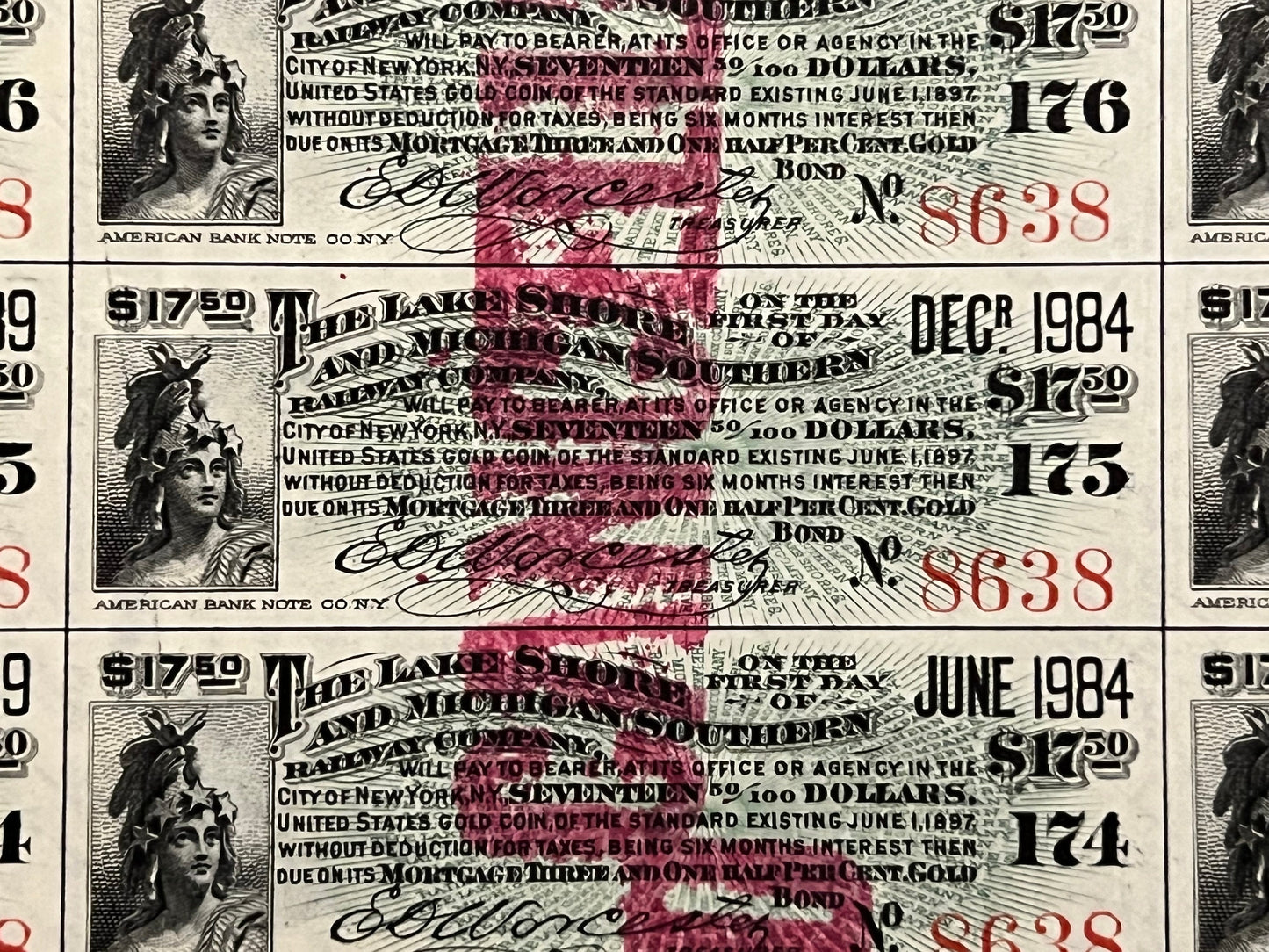
It's a bearer bond, payable "to the bearer, or, if registered, to the registered holder" — the registry columns on the back are printed for whoever chose to convert it to registered form. The coupons running down the sheet were engraved and printed by the American Bank Note Company of New York, whose name runs across every one of them; the firm had been in that business since 1858 and had printed the Union's own demand notes during the Civil War. Each coupon on this bond promised $17.50, due every June and December, for as long as the bond ran.

👤 The Man in the Oval

Nobody's name is printed under that portrait — the engraving just gives you the face. Dealers call him William K. Vanderbilt, though they've never agreed whether it's the father or the son. He sits between two steam locomotives that face outward, away from each other, smoke pouring off both stacks. The left engine carries the number 590 on the front of its smokebox; the right one's number is hard to make out.

📜 Issued, Held, and Finally Cancelled

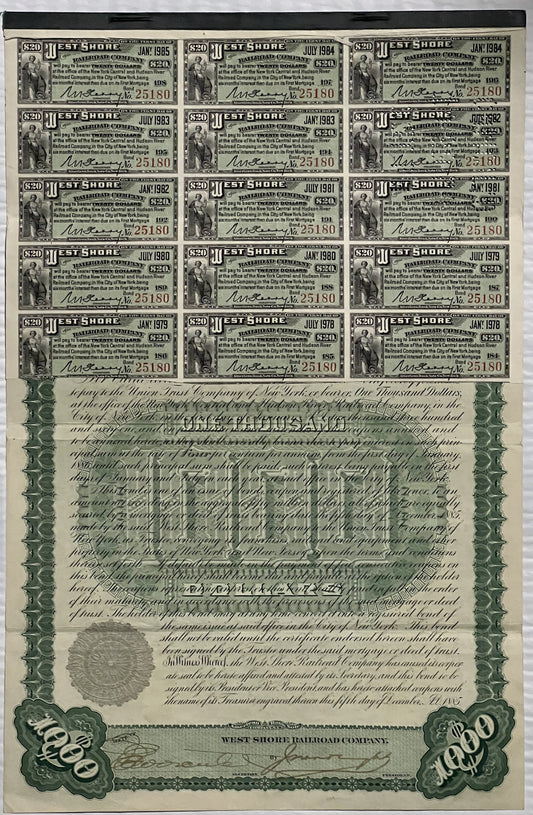
Paper like this carries the record of its own working life right on its face: ink signatures, an embossed corporate seal, a stamp affixed on the back, a hand-signed trustee's certificate, and cancellation cut straight through the engraving as perforated lettering. None of that is damage. It's what a bond looks like after it did its job — issued, paid out twice a year, and finally retired. Stock and bond certificates can carry financial writings, markings, stamps, hole punches and staples as part of the life of the instrument. Bondholders of this era would literally clip each small dated coupon from the sheet as it came due and carry it to a bank counter to be redeemed - twice a year, for as long as they held the bond - and that simple, genteel ritual is where the old phrase "clipping coupons" comes from, and the "coupon clipper" who lived comfortably off interest rather than labor. A bond that still has its coupon sheet is the complete instrument, not just the pretty half of it. Most surviving railroad bonds were stripped of their coupons decade by decade, one clipping at a time, until only the certificate was left. When a road went under, holders often taped the last coupon back on and kept the bond in a drawer, still hoping to collect what they were owed; families depended on those payments, and that small act is about as human as financial paper gets.

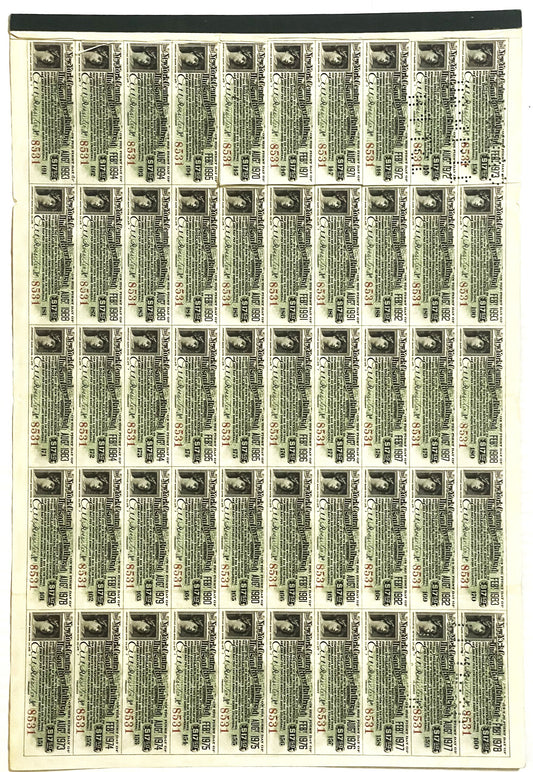
This listing covers three versions of that same bond, and each one catches it at a different point in that story. Bond Only is the face alone, cancelled, with no coupon sheet attached. Bond With Coupons keeps its sheet of $17.50 gold coupons, each one carrying the American Bank Note Co. imprint — uncancelled. Bond W/ Cancelled Cpns pairs the bond with a coupon sheet where CANCELLED has been struck across the coupons themselves in red ink, right over the printed text — a clerk's stamp marking them retired. Expect folds and toning, too — ordinary handling for paper that's spent well over a century in a file. Coupon counts run a few more or a few fewer than pictured. These are held as a group, and no two are alike: the run of coupon dates, the placement of punch cancellations and stamps, a clerk's pencil marks, the folds and toning of decades in a bank file all change from one example to the next, so treat the photographs as an example of the type rather than a portrait of one specific sheet. It isn't a live investment any more - the issue matured or was superseded long ago, and what it holds now is history.

🛤️ A Route Still Very Much Alive

What makes Lake Shore paper so satisfying to collect is that its corridor never became a ghost line. The old main line is still a major rail corridor for freight, and Amtrak's New York City-Chicago Lake Shore Limited runs along the full route from Buffalo west. For decades the New York Central's most famous train, the Twentieth Century Limited - first run in 1902 - used these same rails; its passengers boarded on a crimson carpet, the origin of the "red-carpet treatment," and from 1938 it ran as a streamlined Art Deco train. This bond came a few years before the Century, but it helped pay for the track the Century ran on.

🖼️ Where It Looks Great, and Who Collects These

Hung whole, the coupon column reads like a timeline of payments; cropped in a mat to the banner, the portrait and the engines, it becomes a compact piece for over a desk. Next to a map of the Buffalo-to-Chicago Water Level Route or a stack of old New York Central timetables, the paper and the geography tell one story - and for a lifelong railfan's retirement, it's hard to beat. The people who collect these come at them from different directions: New York Central and Vanderbilt-system railfans, scripophily collectors chasing gold-standard bonds, history buffs from Michigan, Ohio and the Great Lakes towns along the line, and bank-and-Wall-Street collectors who couldn't care less about trains but love the engraving and the money story.

Shipping

🚚 Shipping & Handling

  • Shipping costs and timing are calculated at checkout.
  • Items curated and shipped directly by me include U.S. shipping at no additional cost, professionally packed to ensure safe arrival of your artifact.

Items from Vetted Pro Collectors
Shipping for items offered by vetted Pro Collectors is determined at checkout. All Pro Collector listings are reviewed to ensure fair, reasonable shipping practices.

For full details, please refer to our Shipping Policy.

Returns & Exchange

Take your time — you've got a full six months. If a piece isn't right for you, send it back the way it reached you and we're good.

In the first 30 days your money goes straight back the way you paid. After that it's store credit, so you can put it toward something you'd rather have.

Return shipping we sort out between us, case by case. I don't make this difficult.

If something arrives damaged, or it isn't what I said it was, send me a photo within 48 hours and I'll make it right.

Email info@vintageantiquesgifts.com or call 802-356-9872 — that's me answering, not a call center.

The only things I can't take back are custom or special-order pieces and gift cards.

View full details
  • 5 stars: 6 (100%)
  • 4 stars: 0 (0%)
  • 3 stars: 0 (0%)
  • 2 stars: 0 (0%)
  • 1 star: 0 (0%)
k
k***k (539)

Beautiful. The seller had great communication and the items were just as described

7
7***3 (150)

Good quality and the condition was just as described the value is just excellent the appearance was good

9
9***b (123)

Received bond certificate in great condition it looks fantastic. Packaged well and delivered promptly. Price was fair. I will purchase from seller again

D
Douglas

Excellent Item for my Michigan Railroad Collection !

M
Monte Swain (Santa Ana, US)
Great!

Wonderful family business. Great transactions. Great products and prices.

Y
Yancy

Fast shipping! Nice piece of history.

Preserving History: Authentic Objects Across Eras

— Curated by Travis Weigel