Skip to product information
1 of 4

Vintage and Antique Gifts

1893 Tennessee Supreme Court Writ of Fieri Facias ✨ Executed Alias Writ, Goodpasture Clerk, Prichard v Mann No 16892, Nashville Doc

1893 Tennessee Supreme Court Writ of Fieri Facias ✨ Executed Alias Writ, Goodpasture Clerk, Prichard v Mann No 16892, Nashville Doc

Regular price 35.00 USD
Regular price Sale price 35.00 USD
Sale Sold out
Shipping calculated at checkout.
Quantity

Size: 14 x 8.5 inches

📜 The Writ That Finished Its Work — and Kept the Receipt

Most legal paper never got to finish its job. A writ would issue, a return would come back partly done or not at all, and the whole errand would trail off into the county files unresolved. This one is different, and that difference is the reason it is worth writing about at length. This is an 1893 writ of the Supreme Court of Tennessee that went out into the world, did exactly what it was ordered to do, and then came back bearing the physical proof that it had succeeded. On the front, the command. On the back, in a sheriff's own hand, the answer: the money was collected. What you are looking at is not a form, a reproduction, or a photograph of “the sort of thing.” It is the exact document pictured — the one that traveled, the one the officers handled, the one the clerks signed by hand — and it is a complete, closed loop of nineteenth-century justice caught on a single folded sheet.

Everything described here is read straight from the document itself: the printed form it was struck on, the case it names, the judgment it enforces, the county it was sent to, the officers listed on it, the signatures at its foot, and the return endorsed across its back. Where the historical record stops, this description stops too, honestly, rather than guessing. First, what this writ actually is — because the words on it are wonderful once you know how to read them.

⚖️ What a “Writ of Fieri Facias” Actually Is

The phrase is Latin. Fieri facias means, roughly, “that you cause to be made” — cause it to be done. Lawyers wore it down centuries ago to two friendly syllables, a fi. fa., and it is one of the oldest working instruments in the common law. Its function is beautifully concrete. A court reaches a judgment; someone owes money under it. The judgment by itself is only words on a page. The writ of fieri facias is the muscle behind the words: a command addressed to the sheriff to go and make that sum out of the debtor's goods and chattels, lands and tenements — to levy on property, and if need be seize and sell it, until the debt and its costs are satisfied.

A writ like this belongs to the very end of a case — the enforcement phase, after the arguing is over and the decision is made, when the abstract authority of a court becomes a real officer walking up a real road with a paper in his hand. There was no wire transfer in 1894, no electronic lien, no automated garnishment. There was a printed order, a handwritten name, and a man who had to physically go and collect. That is why these sheets are such vivid artifacts of how justice actually functioned. This one directed the machinery of a Tennessee county to collect a Supreme Court judgment down to the last itemized cost — and, crucially, to answer for having done it.

🔁 “Alias” — Why This Is a Second Writ

Here is the first thing that sets this piece apart, and it is printed right on the face of the docket panel: this is not a plain fieri facias but an alias fieri facias. That small Latin word alias — “at another time” — carries real meaning in court practice. When a first writ of execution was issued and, for whatever reason, did not complete its work — the officer could not find enough property, or the writ ran out its life before the money was made — the court did not simply give up. It issued a second writ in the same cause, and that follow-up writ was marked alias: another one, sent again, to finish the job the first had left undone.

So this document is, by its own printed label, the court's renewed effort — the second swing at collecting a judgment it was determined to enforce. That detail alone makes it a richer object than an ordinary first execution. It tells you the matter was contested or difficult enough that one writ was not sufficient, that the clerk's office had to draw up and issue the command a second time, and that the State of Tennessee kept coming until the debt was satisfied. An alias writ is a small monument to institutional persistence. And this particular alias writ, as the back of it proves, is the one that finally worked.

🧾 The Full Life of One Judgment: 1893 to 1895

What makes this sheet extraordinary is that you can trace the entire life of a legal debt across it, in order, in period ink. It is rare to hold a document that carries its own complete chronology, and this one does:

  • 🗓️ December 1893 — the writ is attested (its teste) in the name of the Clerk of the Supreme Court, dated to the first Monday of December, 1893, the point from which the writ speaks.
  • ⚖️ 19 March 1894 — the underlying judgment is entered, recorded on the sheet as “Judgment 19 day of Mch 1894.”
  • 📤 25 September 1894 — this alias writ is issued out of the Supreme Court at Nashville, sent down to the county to be executed.
  • 💰 12 February 1895 — the sheriff makes his return: the money is collected, the execution satisfied, the loop closed.

Judgment, to writ, to collection, to proof of collection — the whole arc of an enforcement, from the court's decision to the officer's receipt, survives on one piece of paper. I want to be plain about the dating: the 1893 in the title rests on the handwritten digit in that December teste line, the date the writ is witnessed in. The document's active working life then runs forward through 1894 and closes in 1895. Rather than flatten all of that into a single year, the honest and far more interesting truth is the arc itself — a Tennessee judgment followed from its attestation to the day a sheriff wrote “collected” on the back.

💵 The Crown of It: A Return That Says “Collected”

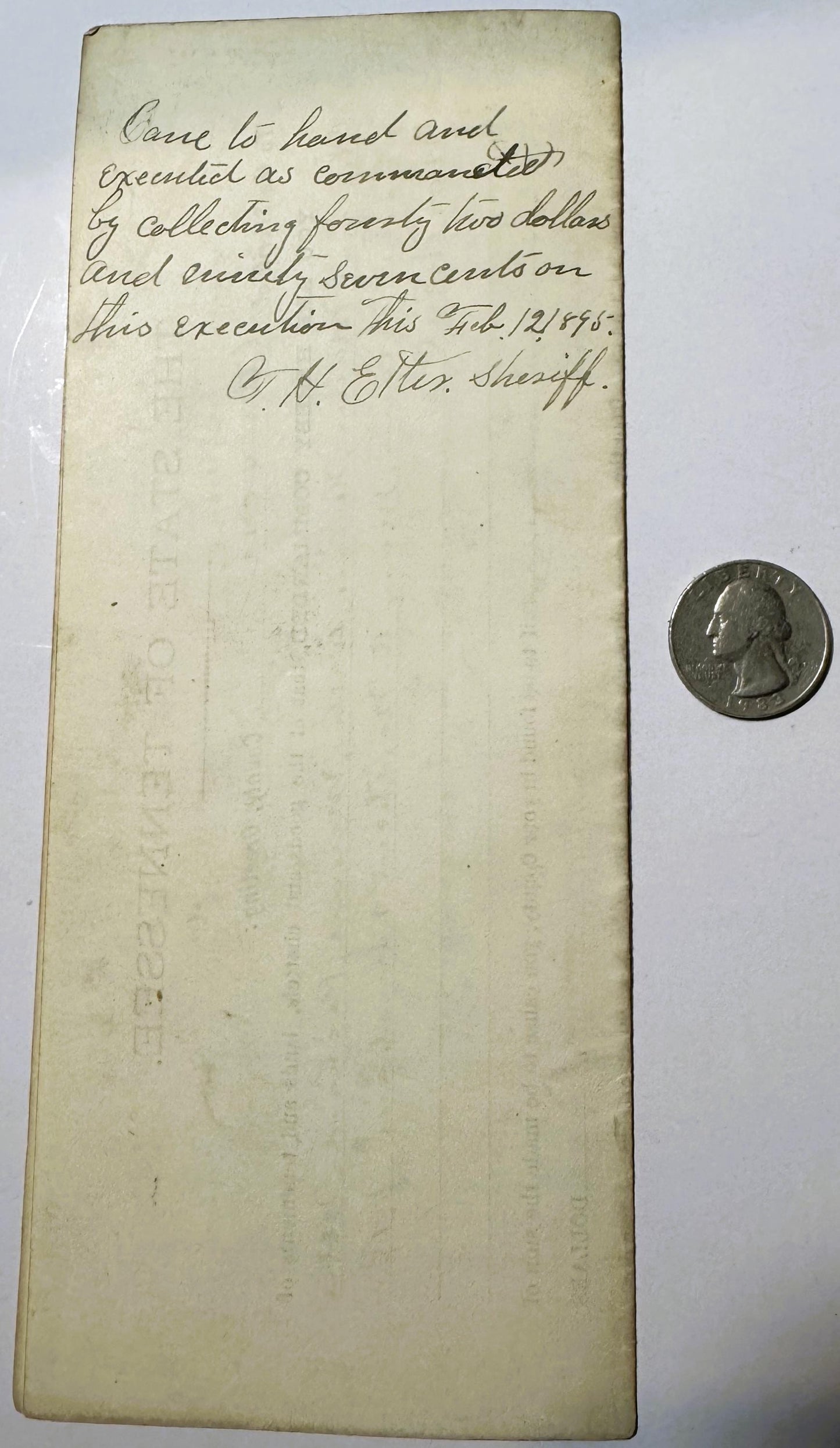
Turn the sheet over and you find the single most remarkable thing about it — the feature that lifts it out of the ordinary run of court paper. On the back, in a confident nineteenth-century hand, is the sheriff's return, fully written out and executed:

“Came to hand and executed as commanded by collecting forty two dollars and ninety seven cents on this execution this Feb. 12, 1895.”

It is signed at its foot by the county sheriff. Read that again and let it land. This is not a blank form, and it is not an execution that failed and was filed away half-finished. This is a writ that did its job — the officer took it in hand, went out, and made the whole sum out of the debtors, and then wrote across the back of the very same sheet that he had done so, to the exact penny. The command on the front and the receipt on the back are two halves of one completed act of the law, and both halves survive here together.

That is genuinely uncommon. A great many surviving writs are unserved blanks, or carry only a brief docket note that the paper was sent somewhere. To have the executed return itself — the officer's own certification that the money was collected on that date — turns this from a document that merely ordered a collection into a document that records one. It is a self-contained story with a beginning, a middle, and an end, and you are holding the ending.

✍️ Two Goodpasture Brothers on One Sheet

Now the provenance, and it is a good one. The writ issues and is attested in the name of the Clerk of the Supreme Court of Tennessee — and in this era that clerk was Albert Virgil Goodpasture, whose name is set into the printed witness line at the foot of the command, the teste dated the first Monday of December, 1893. A. V. Goodpasture (1855–1942) is not a forgotten courthouse functionary. He is one of the canonical historians of the State of Tennessee. He held the clerkship of the Supreme Court through the 1890s — the exact window this writ falls in — and around that public office he built a scholarly life that shaped how generations of Tennesseans learned their own past. He co-authored the standard school text History of Tennessee, edited the American Historical Magazine (the direct forerunner of today's Tennessee Historical Quarterly), and wrote county histories and biographies that scholars still cite. The man whose office authenticated this small piece of everyday enforcement was the very man who would go on to write the history of Tennessee itself.

And the Goodpasture name appears on this sheet twice more in living ink. The writ carries the handwritten signature of W. H. Goodpasture, D.C. — Deputy Clerk, Albert's brother William — and it is signed by his pen in two separate places: once at the close of the command on the front, and again on the docket panel. This is an important distinction to keep straight: A. V. Goodpasture's name is the printed clerk's name in whose authority the writ speaks, while it is W. H. Goodpasture who actually put ink to this paper, twice, as the deputy who processed it. The two brothers worked the clerk's office together, and in 1897 they opened the Goodpasture Book Company in downtown Nashville, a bookshop-and-gathering-place they ran together for years. So this one sheet holds both brothers — the elder as the certifying Clerk-historian in whose name it issues, the younger as the living hand that signed it — a quiet Goodpasture family document folded inside a routine act of the court.

🗂️ The Case It Names: Prichard v. Mann, No. 16892

The writ arises from a specific, named cause: O. Prichard and others v. Thomas Mann and others, entered on the docket as No. 16892, and sent to be executed in Warren County. The defendants are named out in full across the command — Thomas Mann together with Horace, Minnie, Richard, and other members of the Mann family, and Mary O. Northcut and her husband J. R. Northcut — the whole roll of parties the judgment ran against, each set down in the clerk's hand. The underlying dispute had come up through the Chancery Court of DeKalb County, whose bill of costs is itemized further down the same sheet, before reaching the Supreme Court and being sent back out as an executable order.

I will be scrupulous about the limits of what the paper tells us. The substance of the quarrel — what Prichard and the Manns were actually fighting over — is not something the writ spells out, and it is the kind of detail that lives in specialized legal archives rather than on the face of an execution. I will not invent it or dress a guess up as fact. What the document establishes beyond any doubt is the machinery: a named cause, a docket number, an originating chancery court in DeKalb, an enforcement in Warren County, a bill of costs, and a completed collection. That is a great deal of true, specific, checkable history for one folded sheet to carry.

💰 A $42.97 Bill of Costs, Line by Line

Turn to the costs and the writ opens like a little window onto the working machinery of an 1890s courthouse. The sum this alias writ went out to collect in costs was $42.97 — and it is not a round abstraction but an itemized bill, broken out fee by fee. The clerk's own charges are entered under the Goodpasture office; below them, under the heading of the Chancery Court of DeKalb County, runs a column of county costs — clerk's fees, sheriff's fees, witness costs, and the small charges of the various officers who had a hand in the case — each on its own line, adding up in period ink to the total the sheriff would ultimately collect. It is social history disguised as accounting: a payroll and a roster of a vanished county office, all on one page, and the whole apparatus was set in motion to make forty-two dollars and ninety-seven cents. The figure that appears in the costs column on the front is the same figure the sheriff certifies collecting on the back — the paper agreeing with itself, front to reverse.

🖋️ Printed in Nashville, Finished by Hand

The physical object rewards a close look. It was struck as a printed legal blank carrying the imprint of a Nashville printing house — the “Brandon Print” mark sits at the foot of the docket panel — and then completed in manuscript by the court's own hands. That combination is the signature of authentic nineteenth-century officialdom: the impersonal printed scaffold of the state, filled in by individual human hands. The imprint ties the paper firmly to Nashville and to the specific ecosystem of court blanks the Supreme Court clerk's office actually used, and it is a quiet authenticity marker in its own right. The result is a handsome piece of period officialdom — the formal printed language of the writ, the elegant penmanship of the entries, the names and figures set down in iron-gall-era ink — a document made to be authoritative and permanent, reading exactly as what it is: a formal order of the highest court in the state, carried out and answered for.

🔎 An Honest Condition Report

I would always rather you know precisely what is coming than be charmed by adjectives, so here is the plain state of the sheet, read from the same photographs you can see. The writ is complete and fully legible. The printed text and the handwritten entries alike read clearly — the case, the names, the dates, the costs, the signatures, and the whole of the sheriff's return are all present and readable. It carries its original folds, the creases from having been folded for filing and carrying, exactly as a served writ of this age should be and part of its honest character rather than a fault. There is light, even toning to the paper, the gentle mellowing that rag stock of this age earns with time, along with the small handling marks and faint spots you would expect on a working document more than a century and a quarter old. None of it compromises the sheet: it displays beautifully and reads throughout. One of the photographs sets a coin beside the folded panel so you can judge the scale honestly for yourself. What you see in the images is the whole and honest state of it.

💠 One Document on Earth

Now the plainest fact of all, and the one that frames everything else: this is a true one-of-a-kind. A served, executed alias writ of fieri facias is, by its nature, unique. It was issued once, in one cause, on one docket number, filled out by hand for that single case, signed by that particular deputy clerk, sent to that one county, and endorsed with the sheriff's own certification of collection on that one date. There was never an edition of it. There is no second copy in a drawer, no reprint, no reissue. This exact sheet is the only one of itself in the world — the sole surviving physical record of this particular act of the Tennessee Supreme Court in this particular case, carried all the way through to a receipt. I state that as a simple fact, not as a sales tactic. What makes it rare is not that few were made and many sold; it is that only one ever existed at all, and here it is. And so there is no ambiguity about what you are buying: you receive the exact document photographed, folds and toning and return and all. Not one like it. This one.

🖼️ Living With It, and Who It Is For

A document like this deserves to be seen, and it settles into a room in several handsome ways.

  • 🖼️ Float-frame it between glass so both the printed command on the front and the sheriff's return on the back can be read, and hang it where the ink and the folds catch a raking light — it becomes genuine wall history, not decoration.
  • ⚖️ Stand it in a law office, a judge's or attorney's study, or a library as a real artifact of how judgments were once enforced — a conversation piece that runs from a Latin command to a sheriff's plain “collected.”
  • 🏛️ Place it in a Tennessee history collection or a Nashville-themed room, where the Goodpasture connection gives it a depth few pieces of local ephemera can match.
  • 🎁 Or give it to the historian, the lawyer, the genealogist, or the collector of Americana in your life who would rather have one real, singular, complete thing than a shelf of ordinary ones.

Some people will read this far and already know it is theirs: the collector of Tennessee history who understands what the Goodpasture name means; the collector of legal Americana who prizes a genuine served writ with a fully executed return; the lawyer or judge who wants the real ancestor of every writ of execution filed today; the genealogist chasing Mann, Northcut, Prichard, or DeKalb and Warren County names; and the person who simply loves a singular object with a true, deep, documented story.

❓ Questions Worth Answering

Is this the actual document, or a reproduction?

It is the actual, original document — the one and only physical writ from this case. You receive the exact sheet shown in the photographs, folds, toning, signatures, and sheriff's return and all. There is no reproduction involved, and because it is a served one-of-a-kind writ, no other copy exists.

What is a writ of fieri facias, and what does “alias” mean?

A writ of fieri facias is a court's order of execution — Latin for “that you cause to be made” — commanding the sheriff to collect a money judgment out of the debtor's goods and property. “Alias” marks it as a second writ issued in the same case, sent again to finish a collection the first writ had not completed. This one carries that alias label on its face — and, on its back, the proof that it succeeded.

Who are the Goodpastures, and why do they matter?

Albert Virgil Goodpasture was Clerk of the Tennessee Supreme Court in this period and one of the state's most important historians — co-author of the standard school textbook History of Tennessee and editor of the American Historical Magazine. His name is on the printed teste line in whose authority the writ issues. The living ink signature on the sheet, in two places, is that of his brother and deputy, W. H. Goodpasture, with whom he later ran the Goodpasture Book Company in Nashville. Both brothers are present on this one sheet.

What was the case about?

The writ names Prichard and others v. Mann and others, docket No. 16892, a matter that came up through the Chancery Court of DeKalb County and was enforced in Warren County. The document does not state the substance of the dispute, and I will not guess at it; what it establishes is the judgment, the alias execution, and the collection.

What condition is it in?

Complete and fully legible, with its original filing folds, light overall toning, and the minor handling marks of a genuine working document of its age. Everything discussed above — names, dates, costs, signatures, and the full sheriff's return — is present and readable. Offered exactly as pictured.

✨ Why It Matters

Some objects are worth having because they are decorative; this one is worth having because it is real, singular, and complete. It is a genuine 1893 alias writ of fieri facias from the Supreme Court of Tennessee — the ancient enforcement order that made a judgment real — struck on a Nashville printer's form and finished by hand. It issues in the name of A. V. Goodpasture, the clerk who would write the state's history, and it is signed twice in the ink of his brother and deputy, W. H. Goodpasture. It names a real cause, No. 16892, out of DeKalb County chancery and into Warren County; it itemizes a $42.97 bill of costs; and, most rare of all, it carries on its back the sheriff's own return certifying that the money was collected on the 12th of February, 1895. Judgment, writ, collection, receipt — the entire life of an enforcement, closed and preserved on one folded sheet, of which exactly one exists. Bring it home and you are not buying a picture of Tennessee legal history. You are keeping a completed piece of it — the only piece of this piece there is.

Shipping

🚚 Shipping & Handling

  • Shipping costs and timing are calculated at checkout.
  • Items curated and shipped directly by me include U.S. shipping at no additional cost, professionally packed to ensure safe arrival of your artifact.

Items from Vetted Pro Collectors
Shipping for items offered by vetted Pro Collectors is determined at checkout. All Pro Collector listings are reviewed to ensure fair, reasonable shipping practices.

For full details, please refer to our Shipping Policy.

Returns & Exchange

Take your time — you've got a full six months. If a piece isn't right for you, send it back the way it reached you and we're good.

In the first 30 days your money goes straight back the way you paid. After that it's store credit, so you can put it toward something you'd rather have.

Return shipping we sort out between us, case by case. I don't make this difficult.

If something arrives damaged, or it isn't what I said it was, send me a photo within 48 hours and I'll make it right.

Email info@vintageantiquesgifts.com or call 802-356-9872 — that's me answering, not a call center.

The only things I can't take back are custom or special-order pieces and gift cards.

View full details