Skip to product information
1 of 4

Vintage and Antique Gifts

Vintage Hancock County Sheriffs Dept 🦅 Special Police Badge Tin Litho Button Pin Home of the Melungeons Tennessee American Made

Regular price 29.00 USD
Regular price Sale price 29.00 USD
Sale Sold out
Shipping calculated at checkout.

Description

Have You Ever Held a Piece of a Mystery? 🦅 The Hancock County Sheriff's Department Badge That Carried One of Appalachia's Greatest Secrets Into Every Five-and-Dime in America

There is a county tucked up into the far northeastern corner of Tennessee, wedged against the Virginia line in the ancient ridge-and-valley country of the southern Appalachians, that most of America had never heard of — until suddenly, in a burst of curiosity and wonder, everyone seemed to want to know its name. Hancock County. Population thin, mountains steep, roads winding, and stories deep beyond reckoning. And somewhere in the middle of all of it, a mystery that was old before the Republic was born — a people of uncertain origin, proud and fierce and beautiful, living in the hollows of Newman's Ridge while the rest of the world argued about who they were and where they came from. That mystery, and the sheriff's department bold enough to claim it as a badge of honor, is what you are holding right now.

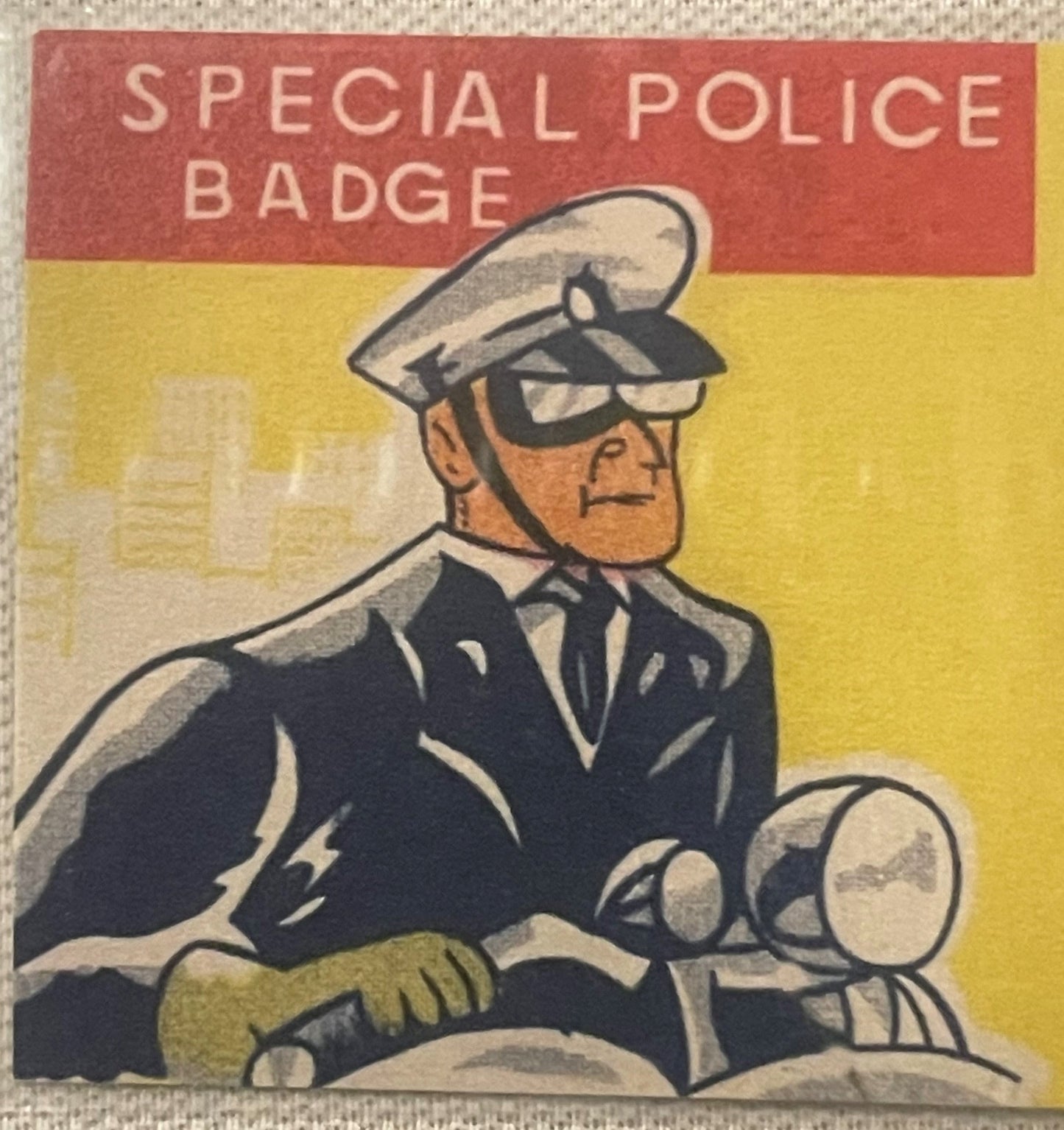
This is one of those pieces that arrives quietly and then refuses to leave your thoughts. A round tin litho pinback button bearing the full official insignia of the Hancock County Sheriff's Department in Sneedville, Tennessee — eagle spread wide, crossed flags, the Bicentennial dates 1776 and 1976 locked in a central medallion, and running along the bottom arc of the shield in letters that pull no punches: HOME OF THE MELUNGEONS. It rides on its original illustrated display card, a cheerful yellow-and-red affair printed with a square-jawed masked lawman at the wheel of a motorcycle, the kind of hero who looked equally at home on a Saturday morning radio dial and in the imagination of every kid who ever pressed their nose against a five-and-dime glass counter. New Old Stock — NOS — meaning this piece has come to you directly from the era that made it, untouched by the retail cycle, exactly as it left the store shelf.


🎖️ What This Piece Is — The Button, the Card, and the Craft Behind Them

Let's talk about what you are actually looking at, because there are two distinct objects here and each tells its own story. The button itself is a round tin lithograph pinback, bright yellow at its outer rim, enclosing a bold shield-shaped design. At the top arc: HANCOCK COUNTY. At the center: a magnificent eagle rendered in olive green with a red-crested head, wings spread in the full heraldic posture that American law enforcement has always loved. Behind the eagle, crossed flags — the American flag to the left, the Tennessee state flag to the right — frame a circular medallion at the bird's breast. That medallion carries the phrase TOWARD THE SUNSET WALK curving around the rim, and at its heart, the paired dates 1776 · 1976. Below the eagle, in strong block letters: SHERIFFS DEPT. And then, sweeping across the entire lower arc of the shield in a bold banner that announces itself like a declaration: HOME OF THE MELUNGEONS.

The color work is exactly what you want from a piece like this — red, white, olive green, yellow, and navy, printed with the tight registration and saturated ink that the best tin litho production of its era achieved. The shield design is crisp and purposeful, the kind of heraldic composition that a real law enforcement department would stand behind with pride, and did. This was not generic souvenir artwork. This was the actual Hancock County Sheriff's Department insignia, the same imagery worn on shoulder patches by real deputies, reproduced here in the pinback format for the tourism and commemorative market that the county's brief, remarkable moment in the national spotlight had created.

The card it rides on is a separate artifact altogether — the classic postwar Japanese "Special Police Badge" display card, yellow with a red header bar reading SPECIAL POLICE BADGE in bold white letters. The illustrated figure is a masked lawman at the motorcycle wheel, dark uniform, white cap, that confident square-jawed profile that mid-century illustration did so well. At the lower right corner of the card, in plain letters: JAPAN. This card style was produced in Japan during the postwar decades and distributed through American five-and-dime stores as a standard badge presentation format — a cheerful, graphic piece of retail packaging that became a vehicle for all kinds of regional and novelty pinback buttons. Together, the button and the card form a composite that is part regional law enforcement souvenir, part Americana retail artifact, and entirely its own thing.


🏭 The Art of Postwar Japanese Tin Litho — How This Card Came to Exist

The story of postwar Japanese tin lithograph production is one of the more quietly remarkable chapters in American consumer history, and it is worth understanding if you collect in this space. After 1945, Japan's manufacturing sector lay in ruins. Under the American occupation, a deliberate effort was made to rebuild Japanese industry, and one of the first sectors allowed to resume exports was the tin plate toy and novelty industry. Japanese manufacturers had deep prewar expertise in tin lithography — the process of printing directly onto thin sheet metal using offset lithographic presses, then cutting, forming, and finishing the pieces — and they rebuilt that capacity with remarkable speed.

By the early postwar years, Japanese tin litho goods were flowing into American retail channels in enormous quantities, carried by the same distribution networks that served the five-and-dime trade. Woolworth's, Kresge's, Ben Franklin — these stores were the arteries of American popular culture, and Japanese tin toys, badges, novelties, and display cards moved through them by the millions. The "Special Police Badge" card format was among the most common of these formats: a simple, colorful display card with a bold illustration designed to catch a child's eye from three feet away, mounting a pinback button that could represent anything from a fictional space ranger to — as here — a real Tennessee county sheriff's department.

What makes this particular pairing special is the button it carries. The Hancock County Sheriff's Department insignia is not generic. It is specific, historically grounded, and tied to one of the most extraordinary moments in Appalachian cultural history. Whoever placed this button on this card understood that the "Home of the Melungeons" branding had real pull — real curiosity value — and that the five-and-dime format was exactly the right vehicle to carry it into American living rooms and junk drawers and eventually into the hands of collectors like us.


🏔️ Hancock County, Tennessee — The Place This Badge Calls Home

Hancock County sits at the extreme northeastern corner of Tennessee, bordered by Virginia to the north and east, Claiborne County to the south, and Hawkins County to the west. The terrain is classic Appalachian ridge-and-valley — long parallel ridges of sandstone and shale separated by narrow valleys and creek bottoms, the whole landscape running in a northeast-southwest grain that determined where people settled, where they farmed, where they built churches and courthouses and one-room schools. Newman's Ridge is the most famous of these ridges, running through the heart of the county, and it is on Newman's Ridge and in the valley community of Vardy below it that the history this badge commemorates was written.

The county itself was created by act of the Tennessee General Assembly, carved from parts of Hawkins and Claiborne Counties. The naming of the county in honor of John Hancock — the great Massachusetts patriot whose bold signature on the Declaration of Independence became a permanent piece of the American language — was an act of civic pride, a statement that this remote corner of the Appalachians understood itself to be part of the great American story. The county seat, Sneedville, took its name from W. H. Sneed, a Knoxville attorney who represented the county through a complicated early legal challenge to its charter. These are small facts, the kind that local historians cherish, but they matter because they establish the deep-rooted American identity of a place that would later be accused of harboring people who didn't belong.

By the mid-twentieth century, Hancock County was among the poorest counties in the United States — reports from the era placed it as eighth-poorest in the nation. Population had been declining for a generation as residents left for factory work in the industrial cities of the Midwest. The roads were still rough, the economy was still subsistence-level in many hollows, and the county was invisible to the national media. Then the Melungeons changed everything.


🔮 The Melungeons — Appalachia's Greatest Mystery and the Story Behind This Badge

The word "Melungeon" first appears in the written record in the minutes of the Stoney Creek Baptist Church in Scott County, Virginia, on September 26, 1813. From that moment, the paper trail begins — but the story itself is much older. The Melungeons are a mixed-race people of uncertain and deeply debated origin, documented in the ridge-and-valley country of what is now Hancock County, Tennessee, and the surrounding region since the late eighteenth century. It is believed they arrived in the area around 1790; by 1830 the census recorded some 330 individuals in 55 family units, concentrated on Newman's Ridge and in the Vardy Valley below it. Among the first and most prominent families were the Collinses — and the patriarch Vardy Collins gave his name to the community of Vardy, which still appears on maps today.

Because of their dark complexion — neither clearly European, nor clearly African, nor clearly Native American in the eyes of their white Appalachian neighbors — the Melungeons faced legal discrimination under Tennessee's antebellum racial codes and social discrimination that persisted long after Reconstruction. They were barred from public schools, denied the vote, and pushed to the margins of county life. And yet they persisted. They farmed the rocky hillsides of Newman's Ridge with extraordinary tenacity. They built their own churches. They maintained their own community, their own networks, their own identity.

The theories about Melungeon origins are themselves a kind of Appalachian legend — and local lore has always run well ahead of academic consensus on the question. Old stories passed through the hollows claimed descent from Portuguese sailors shipwrecked on the Carolina coast, from Moorish travelers, from the Lost Colony of Roanoke, from a tribe of Native Americans who had adopted European ways before European records began. Local legend holds that the name "Melungeon" itself may derive from the French mélange — mixture — though linguists and historians have never settled the etymology. What genetic research in more recent decades has confirmed is that Melungeon ancestry does indeed reflect a complex mixture of European, sub-Saharan African, and Native American lineages, which makes the old stories not wrong exactly, just incomplete.

The turning point in how Hancock County — and the Melungeons themselves — understood their own identity came in the late 1960s, when a coalition of local residents, educators, and VISTA workers conceived an outdoor historical drama as a vehicle for economic development and cultural reclamation. The playwright they enlisted was Kermit Hunter, one of the most prolific authors of outdoor drama in American history, whose other works included Unto These Hills in Cherokee, North Carolina; Horn in the West in Boone, North Carolina; Honey in the Rock in Beckley, West Virginia; and The Trail of Tears in Tahlequah, Oklahoma. Hunter gave them Walk Toward the Sunset — and with it, a stage on which Melungeon history could be told with dignity and pride for the first time.

The drama ran from 1969 through 1976 in an outdoor amphitheater outside Sneedville. The Hancock County Drama Association staged it with actors from Carson-Newman College filling the principal roles and local residents taking the ensemble. At its peak, tourists came from virtually every state east of the Mississippi River. The county's entire civic identity reorganized around the production — and the Hancock County Sheriff's Department, in one of the great quiet acts of institutional courage in Appalachian history, put HOME OF THE MELUNGEONS on their shoulder patches and wore it on duty. Local restaurants sold Melungeon cheeseburgers. The sheriff and his deputies greeted visitors warmly, wearing their badges and their motto with pride.

The drama faced real turbulence. A bomb threat — apparently from those who did not want the county's mixed-race history celebrated publicly — kept volunteers awake all night guarding the newly built amphitheater before the production's first performance. Financial difficulties suspended the run in 1972, revived it in 1973, and the energy crisis and gasoline shortages of 1974 killed attendance again. The final season ran in 1976 — the Bicentennial year, and the year commemorated on this very button's central medallion. The dates 1776 and 1976 pressed into that tin medallion mark not just the nation's two-hundredth anniversary but the close of a chapter in Hancock County's own long story.

Among the most beloved figures in Melungeon folklore — and she is absolutely local legend, not merely history — is Mahala "Big Haley" Mullins, the immortal matriarch of Newman's Ridge. Big Haley was famous across three counties for two things: her formidable size, recorded at well over 500 pounds, and her moonshining operation, which she ran openly and with considerable success. The story passed down through Hancock County lore holds that the law could never quite arrest Big Haley, not because she was faster than the deputies, but because she was too large to be removed from her cabin. She reportedly lived and died on Newman's Ridge, untouchable in the most literal sense. Whether you call that legend or history, it belongs to this badge.


🖼️ Display Ideas

  • 🗺️ Mounted in a shadow box alongside a vintage Tennessee state map open to the northeastern corner — Hancock County, Newman's Ridge, and Sneedville visible — as a geography-and-history display that tells the whole story at a glance.
  • 🦅 Grouped with other Appalachian law enforcement memorabilia — sheriff's patches, court documents, historical postcards — as a deep regional collection anchor piece.
  • 📚 Displayed alongside a copy of Wayne Winkler's Walking Toward the Sunset: The Melungeons of Appalachia, the definitive account of this history, for a reading-nook tribute to one of Appalachia's most remarkable stories.
  • 🏛️ Framed flat behind UV glass on its original card, displayed as a piece of mid-century graphic design — the illustrated motorcycle officer on one side, the heraldic eagle badge on the other, the full composition preserved exactly as it was sold.
  • 🎁 Presented as a gift to anyone with Tennessee roots, Appalachian heritage, or a fascination with American mystery — this is the kind of piece that opens a conversation and never quite closes it.
  • 🏔️ Incorporated into a Melungeon heritage display for a museum, heritage organization, or family history archive — a primary-source artifact from the exact years when Hancock County wore its identity proudly and publicly.

🎁 Who Collects These

This piece draws from several distinct collector communities, and that overlap is part of what makes it so interesting to own. Tin litho pinback collectors prize the postwar Japanese "Special Police Badge" card format as a distinct subcategory — the illustrated cards are graphic artifacts in their own right, and NOS examples on original cards are exactly what serious button collectors look for. Law enforcement memorabilia collectors — those who pursue sheriff's department patches, badges, and departmental insignia from specific counties and departments — will recognize immediately that the Hancock County Sheriff's Department "Home of the Melungeons" imagery is a documented, historically significant piece of departmental identity, not a generic design. Tennessee history collectors and Appalachian heritage enthusiasts will know the Melungeon story and understand precisely what the 1776–1976 Bicentennial framing means in the context of the outdoor drama era. And Melungeon descendants and researchers — a community that has grown substantially since the 1990s, when academic and genealogical interest in Melungeon history surged — actively seek primary-source objects from the drama years, the years when Hancock County first said publicly and proudly what it was. Any one of these communities would call this piece a find. Someone who lives at the intersection of two or three of them will not let it go.


❓ Frequently Asked Questions

Is this an authentic Hancock County Sheriff's Department item, or is it a novelty reproduction?

The pinback button bearing the Hancock County Sheriff's Department insignia is an authentic regional souvenir item tied to the documented history of the department and the Walk Toward the Sunset outdoor drama era. The "Home of the Melungeons" motto and the heraldic eagle-and-flags design are confirmed as the actual Hancock County Sheriff's Department insignia — the same imagery worn on deputies' shoulder patches during the period when the drama was running and tourism was at its peak. The display card it is mounted on is a separate item, a standard postwar Japanese "Special Police Badge" presentation card of the type used broadly in American five-and-dime retail. Together they form a composite that is historically coherent and genuinely from the era.

What do the dates 1776 and 1976 on the button refer to?

The paired dates 1776 and 1976 in the central medallion of the shield are a Bicentennial reference — 1776 marking the year of American independence and 1976 marking the two-hundredth anniversary of that founding. The U.S. Bicentennial was a major national observance, and communities across the country incorporated the 1776–1976 pairing into official seals, souvenirs, and commemorative items throughout the period. For Hancock County specifically, 1976 was also the final season of the Walk Toward the Sunset outdoor drama, making the date doubly significant in local history. These dates tell you when this imagery was current and meaningful — the Bicentennial moment and the drama's closing chapter happening simultaneously.

What does "TOWARD THE SUNSET WALK" mean, and why is it on a sheriff's badge?

Walk Toward the Sunset was an outdoor historical drama produced in Sneedville, Tennessee, telling the story of the Melungeon people. It ran from 1969 through 1976 and was the catalyst for Hancock County's brief but remarkable moment of national attention. The Hancock County Sheriff's Department embraced the drama and its cultural mission publicly — deputies wore patches reading "Home of the Melungeons," and the sheriff personally greeted tourists arriving from across the country. The phrase on the button's medallion reflects the drama's title and the department's proud association with it. It is an unusually poetic piece of law enforcement insignia, and that is part of what makes this button so distinctive.

What is "New Old Stock" and why does it matter for this piece?

New Old Stock — NOS — means this item was produced, entered the retail supply chain, and was never sold through to an end consumer. It came to us directly from old store or warehouse stock, still in its original retail configuration, button on card, exactly as it would have appeared behind the counter of a five-and-dime store. For collectors, NOS status matters because it means the piece arrives in its complete original form — card and button together, as a unit — rather than separated, as these pieces so often are after decades of individual handling. The combination of original card and period button intact is what elevates this from a loose pin to a full artifact.

Who were the Melungeons, and why did the Sheriff's Department choose to celebrate them?

The Melungeons are a mixed-race people documented in the ridge-and-valley country of Hancock County and surrounding areas since the late eighteenth century, with ancestry reflecting European, sub-Saharan African, and Native American lineages. For most of their documented history, they faced legal and social discrimination. The outdoor drama Walk Toward the Sunset, which opened in 1969, was created specifically to reframe that history — to tell the Melungeon story with dignity and pride, and to build a tourism economy around it. The Hancock County Sheriff's Department's decision to put "Home of the Melungeons" on their official patches and insignia was an act of institutional solidarity with that reframing. It was also savvy civic identity — the motto created a memorable, distinctive brand for the county that drew national curiosity. Today, Melungeon heritage organizations and genealogical researchers are active across the country, and Hancock County's role as the historical heartland of Melungeon community life is fully documented.

Is the card printed in Japan? Does that affect the collectibility of the piece?

The "JAPAN" mark on the card indicates that the display card and its format were produced in Japan, as was standard for the postwar five-and-dime novelty badge trade. This is not a diminishment — it is a historical fact about how American retail worked in the postwar decades, and the "Special Police Badge" card format is itself a collected genre among tin litho and paper ephemera enthusiasts. The regionally significant and historically grounded element is the Hancock County button, which is the reason this piece exists as a collectible at all. The card provides the original retail context; the button provides the historical substance. Both belong together.

Is this a good gift for someone with Tennessee or Appalachian roots?

It is an exceptional one. This is the kind of piece that carries real history in a small, holdable, displayable form — a piece of a specific place and a specific moment that most people have never encountered and will immediately want to know more about. The Melungeon story, the outdoor drama, the Bicentennial moment, the sheriff's deputies wearing their motto with pride — all of it is embedded in this small round button on its cheerful yellow card. For anyone with roots in East Tennessee, a passion for Appalachian history, or a collector's instinct for the genuinely rare and regionally specific, this is a find that holds its meaning every time you look at it.

Shipping

🚚 Shipping & Handling

  • Shipping costs and timing are calculated at checkout.
  • Items curated and shipped directly by me include U.S. shipping at no additional cost, professionally packed to ensure safe arrival of your artifact.

Items from Vetted Pro Collectors
Shipping for items offered by vetted Pro Collectors is determined at checkout. All Pro Collector listings are reviewed to ensure fair, reasonable shipping practices.

For full details, please refer to our Shipping Policy.

Returns & Exchange

Product Page Return Policy

  • 60-Day Returns – Items must be in original condition.
  • Refunds – Issued after inspection (excluding shipping costs).
  • Return Shipping – Customer is responsible unless item is damaged or incorrect.
  • Damaged/Incorrect Items – Contact us within 48 hours for a replacement or refund.
  • Easy Returns – Email [email protected] or call 802-356-9872 to initiate a return.

For full details, visit our Refund Policy.

View full details