Skip to product information
1 of 4

Vintage and Antique Gifts

Antique Blue Bell Broom Label Hamburg Broom Works Hamburg Pennsylvania NOS 1920s Chromolithograph Broom Corn Ephemera Paper Label 🧹

Antique Blue Bell Broom Label Hamburg Broom Works Hamburg Pennsylvania NOS 1920s Chromolithograph Broom Corn Ephemera Paper Label 🧹

Regular price 5.50 USD
Regular price Sale price 5.50 USD
Sale Sold out
Shipping calculated at checkout.
Quantity

What Did a Pennsylvania Broom Factory Put on Every Handle — and Why Does It Still Matter? 🌼

There is a particular pleasure that comes from holding something small and flat and printed that was made for a completely practical purpose — slapped onto the handle of a broom, meant to be used up, worn off, thrown away — and discovering that it survived anyway. Not because anyone decided it was art. Not because someone put it behind glass. But because a stack of them sat undisturbed in a drawer or a storeroom for a hundred years, and now here one is, still carrying every bit of the color and intention the lithographer put into it sometime in the 1920s. That is the specific magic of New Old Stock ephemera, and this Blue Bell broom label from the Hamburg Broom Works of Hamburg, Berks County, Pennsylvania is one of the finest small examples of it you are likely to find.

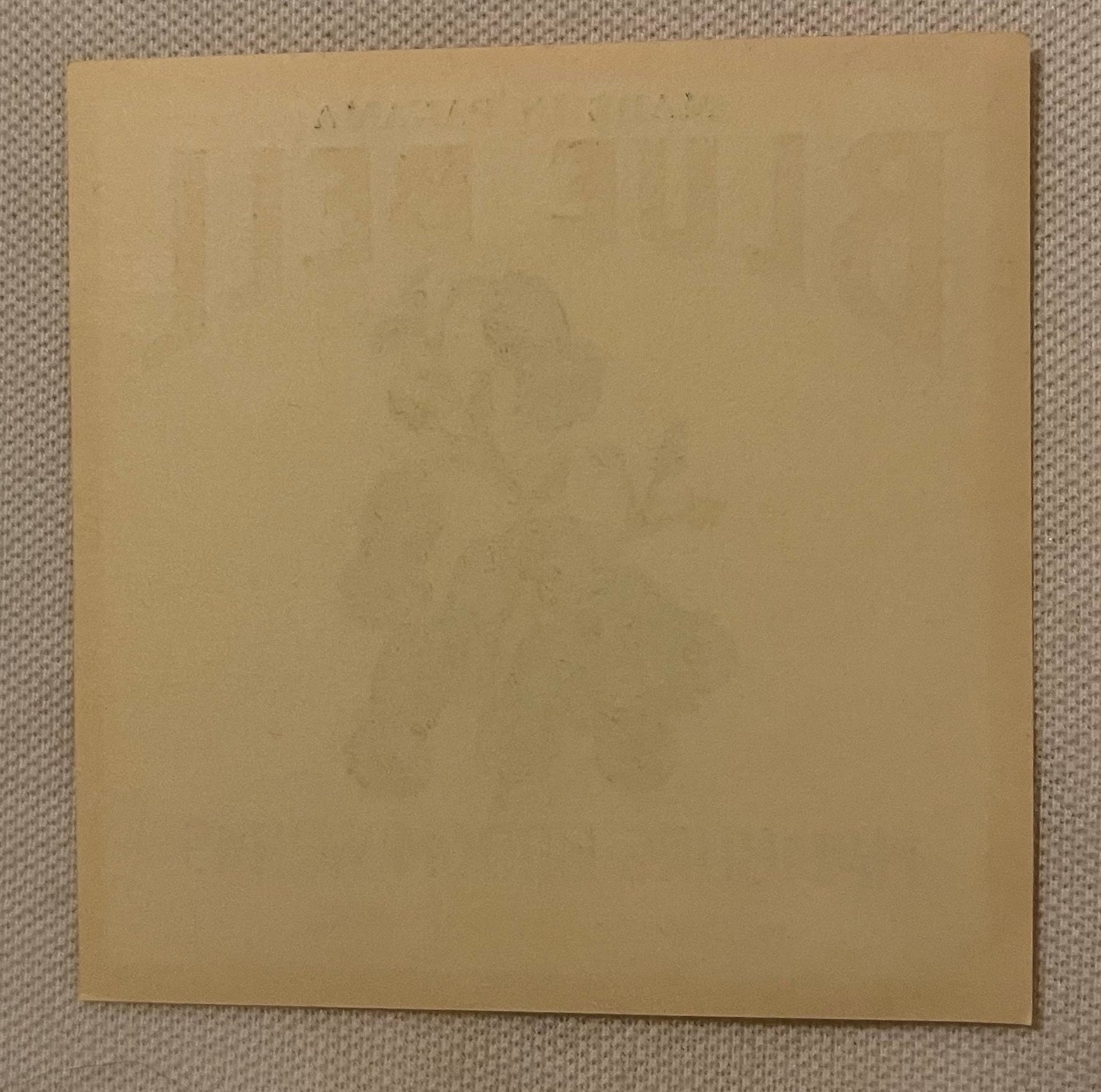
It is a modest object by dimension — just 3 inches by 3 and 1/8 inches — but it punches well above its weight in visual presence and historical meaning. The label was printed in rich chromolithograph color on paper stock, produced for the Hamburg Broom Works, a company founded in 1894 by Wilson Schmick in the small but industrially active borough of Hamburg, Pennsylvania. It was designed to be affixed to a broom handle, to tell a householder or a shopkeeper or a hotel supply buyer exactly whose broom they were holding. It never made it to a broom. It came out of old stock exactly as it was printed, unapplied and unsent, carrying the same saturated yellow ground and bold red border it wore when it left the press. That is what New Old Stock means in this context: it was manufactured, it was stored, and it was never used. A hundred years of doing nothing, which is precisely why it looks like this today.

The design commands your attention the moment you see it. Against a deep warm yellow background set inside a strong red border, a spray of bluebell flowers and berries occupies the center in a botanical rendering that is both confident and genuinely accomplished. Deep blue-green tones, leafy stems branching upward, clusters of berry-like pods hanging in elegant arcs — the illustrator knew what they were doing, and the chromolithograph process rewarded that knowledge by preserving every layer of color with a fidelity that a century has not dimmed. This is not a crude ink stamp or a one-color paper wrap. This is chromolithography: a multi-stone printing process that required a separate press run for each color, careful registration, and real skill at every stage of production. The people who made this label were craftspeople working in an industry that took commercial printing seriously, because the label on a product was the brand, full stop.


🏭 The Hamburg Broom Works: A Quietly Remarkable Pennsylvania Industry

Hamburg, Pennsylvania sits in Berks County along the Schuylkill River, tucked into the terrain that made eastern Pennsylvania one of the most productive manufacturing corridors in nineteenth and early twentieth century America. The borough was — and remains — the kind of place where the railroad defined the town's economic heartbeat, where a brick building along the tracks could receive raw broomcorn from the Midwest, process it into finished goods, and ship them east and west under a variety of brand names without most buyers ever knowing where the brooms actually came from. That was the model, and it worked extraordinarily well for decades.

Wilson Schmick founded the Hamburg Broom Works in 1894, and what he built there became one of the more quietly remarkable manufacturing operations in the region. Broom manufacturing at industrial scale in this era was not a simple business. It required reliable sourcing of broomcorn — the sorghum variety grown primarily in Illinois, Kansas, and Oklahoma whose stiff fiber made the functional broom head — consistent labor, strong relationships with regional distributors and hardware merchants, and a brand identity compelling enough to earn shelf space in a crowded market. The Blue Bell brand was one of the tools Hamburg Broom Works used to do exactly that. The name was botanically appropriate to the Pennsylvania landscape, the design was attractive and distinctive, and the chromolithograph label gave it a finished, premium presence on the retail floor.

Regional broom manufacturers of this period often operated under multiple brand names simultaneously, producing private-label goods for large retailers alongside their own named lines. This was not unusual — it was standard practice across the housewares and dry goods industries. A single factory might ship brooms under half a dozen labels in a single season, each label tailored to a regional buyer's preferences or a retailer's house brand requirements. The Hamburg Broom Works was no exception, and the Blue Bell label represents one thread in what was a genuinely complex commercial textile.

🌾 Broomcorn, Railroad Towns, and the Industrial Geography of Pennsylvania

To understand what the Hamburg Broom Works meant to its community, you have to understand the infrastructure that made it possible. Berks County in the early twentieth century was laced with rail lines connecting the agricultural and manufacturing zones of the interior to the port cities of the Atlantic coast. Raw broomcorn arrived by freight car. Finished brooms left the same way, bound for hardware stores, hotel supply houses, janitorial wholesalers, and dry goods merchants across the region. The label — this label — was part of that supply chain. It was printed in quantity, stored at the factory, applied to broom handles as brooms were finished, and then shipped out into commerce.

The fact that this label never made that last journey is what makes it remarkable today. New Old Stock of this kind survives because manufacturing operations maintained inventory — labels, wrappers, tags — and when a company closed or consolidated or simply moved on to a new design, that inventory sometimes stayed behind. It ended up in storerooms, in filing cabinets, in the back corners of old factory buildings. Occasionally, decades later, it surfaced in estate sales, in the hands of collectors who understood what they were looking at, or in the quiet archives of people who simply could not bring themselves to throw away something so beautifully printed.

🕯️ Local Legend and Collector Lore: What Gets Passed Down

Local legend in Hamburg has it that the Schmick operation was known in the borough not just for the brooms it produced but for the particular care its founders took with the appearance of their products at a time when many competitors were cutting corners on finishing. The story, as it gets told among collectors of Pennsylvania manufacturing ephemera, is that Wilson Schmick believed the label was the first and last impression a customer had of his product — and he invested in lithography accordingly. Whether or not that specific attribution is documented, the evidence is right there on the label: this is not a budget printing job. Someone approved the botanical illustration, chose the yellow ground, specified the red border, and signed off on a chromolithograph process that required real press time and real skill.

Lore passed down among collectors of antique broom labels and household trade ephemera holds that Pennsylvania broom manufacturers were, as a category, more attentive to label design than their counterparts in other regions — a function, the theory goes, of the competitive density of the eastern Pennsylvania market, where a hardware merchant might carry four or five brands and the label was doing real sales work every time a customer walked the aisle. That context gives the Blue Bell design additional meaning. It was not decorative indulgence. It was competitive strategy, expressed in chromolithograph ink on yellow paper.

Among the small community of broom label collectors — a niche within the broader world of advertising and trade ephemera that has grown quietly but steadily over the past three decades — Hamburg Broom Works labels are considered desirable finds. The combination of strong design, regional specificity, and genuine NOS condition places them in the upper tier of what this collecting category has to offer. Finding one with this level of color saturation and this degree of paper integrity is not an everyday occurrence.


🖼️ Display Ideas for Your Blue Bell Broom Label

  • 🪞 Frame it immediately. At 3 x 3 1/8 inches, this label drops beautifully into a small square or near-square frame — a 4x4 or 5x5 frame with a mat gives it the breathing room the design deserves. It looks exceptional on a sideboard, a shelf, or a kitchen wall grouping.
  • 🍃 Build a botanical vignette. The bluebell and berry illustration pairs naturally with other botanical prints, pressed botanicals, or vintage seed and garden catalog pages. Group it with similar pieces for a collected, curated wall display that feels like it was assembled over a lifetime.
  • 🏡 Anchor a Pennsylvania or regional Americana display. If you collect Berks County, Pennsylvania Dutch country, or broader mid-Atlantic Americana, this label is a genuine regional artifact. Display it alongside other Pennsylvania-made ephemera, maps, or trade pieces for geographic coherence.
  • 🗓️ Create a 1920s trade and industry vignette. Pair this with other 1920s advertising pieces — seed labels, hardware trade cards, country store ephemera — for a display that tells the story of American small-scale manufacturing in the decade between the wars.
  • 🧺 Style it in a working kitchen or pantry. Vintage homestead kitchens and farmhouse-style pantries are natural homes for a broom label. Framed and hung near a collection of vintage household tools, crocks, or enamelware, it reads as both decorative and historically grounded.
  • 🎨 Use it as the chromolithograph centerpiece in a printing history display. Collectors and designers fascinated by pre-digital commercial printing often build displays around the printing processes themselves. A chromolithograph of this quality, set alongside examples of letterpress trade cards or woodblock broadsheets, makes a compelling visual argument for the artistry of commercial printing at its peak.

🎁 Who Collects Antique Broom Labels — and Why This One Belongs in a Serious Collection

The world of antique advertising and trade ephemera is broader and more passionate than most people outside it realize, and broom labels occupy a particularly interesting corner of that world. They were produced in enormous quantities, applied to consumable household goods, and designed to disappear along with the product they identified. That they survived at all is a small miracle. That they survived in NOS condition — unapplied, unfaded, exactly as printed — elevates them into a different category entirely.

Collectors drawn to this Blue Bell label tend to fall into several overlapping groups. Pennsylvania history and regional Americana collectors are drawn to the Hamburg Broom Works connection specifically — this is a documented piece of Berks County industrial history, and that geographic anchor gives it meaning beyond its visual appeal. Chromolithography enthusiasts and printing history collectors prize it for the process itself: the multi-stone color printing, the botanical illustration quality, the sheer technical achievement of producing something this visually rich for a mass-market household product. Advertising and trade ephemera collectors — a community with deep roots and serious scholarship behind it — recognize the Blue Bell label as a strong example of brand identity work from an era when the label was doing everything a television commercial does today.

There is also a growing community of collectors who simply love beautiful small things with genuine age and documented provenance. People who frame their finds, who style them on shelves and sideboards and in gallery walls, who want the objects in their homes to carry real history. For those collectors — the ones who already had a frame waiting when this arrived — the Blue Bell label delivers on every count. It is visually striking, historically specific, in exceptional condition, and it represents a category of American commercial art that is increasingly recognized for what it always was: real design work, made with real skill, for a real purpose.


❓ Frequently Asked Questions — Antique Blue Bell Broom Label, Hamburg Broom Works

What exactly is NOS, and how does it apply to a paper label from the 1920s?

NOS stands for New Old Stock — a term used across antique and vintage collecting to describe items that were manufactured, stored, and never put into use or circulation. In the context of a paper broom label, NOS means this label was printed at the Hamburg Broom Works facility in the 1920s, stored as part of the factory's working inventory, and never applied to a broom handle. It came out of that old stock in the same condition it was in when it left the press. No adhesive was ever applied to the back. No broom handle ever received it. That is why the color is as saturated and the paper is as intact as it is. A hundred years of storage in original stock condition is a fundamentally different object from a label that was applied, used, and then removed or recovered. NOS paper ephemera of this age is genuinely uncommon, and condition of this quality within the NOS category is more uncommon still.

What is chromolithography, and why does it matter for this label?

Chromolithography is a multi-color printing process developed in the nineteenth century that uses a separate lithographic stone — and a separate press run — for each color in the final image. The printer draws or transfers each color element onto its own stone, inks it, and prints it in precise registration over the previous colors on the same sheet of paper. A finished chromolithograph might require anywhere from four to a dozen or more separate press runs depending on the complexity of the design. The result, when done well, is a richness and depth of color that later photomechanical processes approached but rarely matched for visual warmth. The Blue Bell label's botanical illustration — with its layered blue-green tones, the yellow ground, the red border, the subtle shadows on the berry clusters — is a product of that multi-stone process. Each color was printed deliberately and separately. That is why it looks the way it looks, and why it has held its color through a century of storage.

How should I frame or display this label to preserve it?

Because this is a genuine antique paper item, a few basic framing practices will protect it for another hundred years. Use UV-filtering glass or acrylic in your frame to limit light exposure, which is the primary enemy of paper and ink over time. If you are matting it, use acid-free mat board — it will not yellow or transfer acids to the paper surface. Avoid hanging it in direct sunlight or in areas with significant humidity fluctuation, such as directly over a stove or in a bathroom. Beyond those basics, this label has already survived a century in storage; it is more resilient than it might look. A simple, clean frame in a 4x4 or 5x5 size with a white or cream mat will give the yellow ground and red border the visual contrast they need to really sing on a wall or shelf.

Is the Hamburg Broom Works still operating, and can I find out more about the company's history?

The Hamburg Broom Works, like most of the small industrial manufacturers of its era, did not survive the consolidations and market shifts of the mid-twentieth century. The kind of regional broom manufacturing operation that Wilson Schmick built in 1894 — dependent on broomcorn supply chains, regional railroad distribution, and an era of local brand loyalty — was not structured to compete in the national mass-market retail environment that emerged after World War II. The company's history is documented in Berks County historical records, and Hamburg's industrial past is part of the broader story of Pennsylvania manufacturing that local historical societies and libraries in the region maintain. If you are researching the company specifically, the Berks County Historical Society and the Hamburg Area Historical Society are the logical starting points for primary source material.

Is this label one of a kind, or were many printed?

Labels like this were printed in quantity — that is the nature of commercial label production. A broom factory producing thousands of brooms a week would have ordered labels by the thousand, not the dozen. However, the survival rate for NOS paper ephemera of this age is low. Most of what was printed was used, discarded, or lost to the normal attrition of paper objects over a century. What survived did so by accident — by virtue of being overlooked in storage, by the particular circumstances of how a factory closed or changed hands, by the choices of the people who came after and decided, consciously or not, not to throw something away. The result is that while this label was not unique when it was printed, unapplied NOS examples in this condition are genuinely scarce in the collector market today. You are unlikely to encounter another one in this state of preservation easily or soon.

What size frame does this label need, and is it ready to display right away?

The label measures 3 inches by 3 and 1/8 inches — very nearly square. The most natural framing choice is a 4x4 inch frame with a mat cut to show the full label, or a 5x5 frame with a slightly wider mat for more visual breathing room. Both options work well and are readily available from framing suppliers in standard sizes. Many collectors find that they can go from receiving this label to having it on the wall in the same afternoon, which is part of what makes NOS paper ephemera such a satisfying category to collect and display.

Why do buyers and collectors respond so strongly to this particular label design?

The Blue Bell label does several things simultaneously that most commercial labels of its era did not manage with equal success. The color palette — warm yellow ground, strong red border, deep blue-green botanical illustration — is both harmonious and high-contrast, which means it reads well from a distance and rewards close examination equally. The botanical subject matter connects to a long tradition of American decorative arts that values natural illustration, and the bluebell as a motif carries genuine regional resonance in Pennsylvania, where the plant grows wild. The label is also the right size for display — small enough to be intimate, large enough to read as a complete design object rather than a scrap of paper. And it carries the weight of real history: a specific company, a specific town, a specific decade, a specific manufacturing tradition that shaped the daily life of an entire region. That combination of visual quality, botanical charm, and documented historical meaning is what makes collectors respond to it the way they do — and what makes a well-chosen frame feel like the only appropriate response the moment it arrives.

Shipping

🚚 Shipping & Handling

  • Shipping costs and timing are calculated at checkout.
  • Items curated and shipped directly by me include U.S. shipping at no additional cost, professionally packed to ensure safe arrival of your artifact.

Items from Vetted Pro Collectors
Shipping for items offered by vetted Pro Collectors is determined at checkout. All Pro Collector listings are reviewed to ensure fair, reasonable shipping practices.

For full details, please refer to our Shipping Policy.

Returns & Exchange

Take your time — you've got a full six months. If a piece isn't right for you, send it back the way it reached you and we're good.

In the first 30 days your money goes straight back the way you paid. After that it's store credit, so you can put it toward something you'd rather have.

Return shipping we sort out between us, case by case. I don't make this difficult.

If something arrives damaged, or it isn't what I said it was, send me a photo within 48 hours and I'll make it right.

Email info@vintageantiquesgifts.com or call 802-356-9872 — that's me answering, not a call center.

The only things I can't take back are custom or special-order pieces and gift cards.

View full details
  • 5 stars: 2 (100%)
  • 4 stars: 0 (0%)
  • 3 stars: 0 (0%)
  • 2 stars: 0 (0%)
  • 1 star: 0 (0%)
s
s***5 (38)

I was so excited when this came in the mail today! I had a frame waiting for it. The quality was pristine, condition was just as described. I love the way it looks on my sideboard! Great value and they sent me another little ad for free! They also sent a thank you card signed by the seller and his kids. Was a joy to open my package today!

t
tattman45

nice vintage label, very pleased

Thanks so much!