Skip to product information
1 of 4

Vintage and Antique Gifts

Antique 1910s-1920s Defy The World Tomatoes Can Label 🍅 Kelty & Son, Quinton NJ

Antique 1910s-1920s Defy The World Tomatoes Can Label 🍅 Kelty & Son, Quinton NJ

Regular price 13.00 USD
Regular price Sale price 13.00 USD
Sale Sold out
Shipping calculated at checkout.
Quantity

Size: 4.62 x 14.12 inches

🍅 A Date Correction, Explained Honestly: This Paper Is Not 1890s

This is an original, unused "DEFY THE WORLD" Brand tomato can label, packed by Sam'l L. Kelty & Son of Quinton, Salem County, New Jersey. This listing corrects an earlier "1890s" date attached to the paper itself -- a date the label's own printed text does not support. This does not touch the real, documented 1890s history of the Kelty cannery, which is genuine and stays in this description; it corrects only the date assigned to this specific sheet of paper, which the evidence points to a couple of decades later. Every physical detail below is read directly from the label; every historical claim is drawn from documented Salem County cannery records.


🍅 Reading the Label

This is a long, narrow chromolithographed can wrap-around sheet, with red rules top and bottom and an unprinted pale lap edge on the left where the paste once went. The left half carries an enormous ripe red tomato with green calyx and foliage, the words "CHOICE" and "Cold Packed" lettered across it in cream script, and "Tomatoes" below in an ornate outlined display face on a dark blue panel with red-and-gold scrollwork. The right half carries gold acanthus scrollwork and a detailed engraving of a two-and-a-half-storey gable-fronted Victorian farmhouse in cream with dark shutters and a wrap-around porch, set on a green lawn with a footpath, spruces, and a young deciduous tree, under an orange-streaked sunset sky.

Every word printed on the label is transcribed here verbatim: DEFY THE WORLD / BRAND / CHOICE / Cold Packed / Tomatoes / FIRST QUALITY / CONTENTS 2 LBS. 1 OZ / Packed By / SAM'L L. KELTY & SON, / OFFICE: QUINTON, SALEM CO., N.J.


🕒 The Dating Correction, in Full

Three separate lines of evidence support re-dating this label to c.1910s-1920s rather than the 1890s. First, and most important, the object itself: this label carries a printed net-contents declaration, "CONTENTS 2 LBS. 1 OZ." Statements of net quantity on American packaged food are a creature of federal food law -- the Food and Drugs Act of 1906, and specifically the Gould Amendment of 1913 (effective 1914), which required the quantity of contents to be plainly marked on the package. A label printed in the 1890s would have had no legal reason to carry a net-weight statement at all. Second, an independent listing for this same brand and packer catalogues it as a 1920s can label. Third, and worth stating plainly: this exact item's own earlier sale history shows it was listed and sold under the title "Antique 1910s Defy The World Tomatoes Can Label" -- so restoring a 1910s-1920s date is a restoration of documented earlier history, not a new claim invented for this listing.

There is one more small but telling clue on the label itself: it reads "SAM'L L. KELTY & SON," not simply "SAM'L L. KELTY." That "& SON" records the firm in its later, second-generation form, which is consistent with a date after Samuel Kelty's early solo years and lines up neatly with the post-1913 net-weight evidence above.


🏛️ The Kelty Cannery -- A Real 1890s Story, Correctly Placed

Here is where the two dates need to be kept carefully apart, because both are real and both matter. Samuel Lewis Kelty (1843-1929) ran what the Salem County Cultural & Heritage Commission records as one of the most successful canneries in South Jersey in the last decade of the nineteenth century, on a farm and cannery on Beasley Neck Road at Quinton, Salem County. His brand was "Defy the World" -- the name is a boast, and he backed it by claiming the highest-quality stewing tomatoes in the trade. The picking on his place was done by a crew of twenty-five women. He is buried in East View Cemetery in Salem. That 1890s history belongs to the cannery and its founder, at the height of Samuel Kelty's own operation -- it does not belong to this specific piece of paper, which the evidence above places a couple of decades later, once the firm had become "Kelty & Son."

The wider frame is South Jersey itself. Salem County was the heart of the Jersey tomato -- the flat, warm coastal-plain soils of Salem and Cumberland counties fed a canning industry that made New Jersey one of the founding centers of American commercial canning, and small family canneries like Kelty's dotted the county before consolidation swallowed them. "Cold Packed" on the label is a real technical term, not decoration: it means the tomatoes went into the can raw and were processed in the sealed can, as against hot-filling.


🏡 A Note on the Farmhouse Vignette

The handsome engraved farmhouse on the right side of the label may well depict the Kelty family's own property -- but nothing on the sheet says so, and no independent source confirms it. A generic prosperous-farm vignette was a standard feature of cannery labels of this era, meant to signal wholesomeness and quality rather than to document a specific building. This listing describes it as exactly what can be verified: a well-executed engraving of a farmhouse, offered without claiming it as the Kelty homestead.


🔍 Condition -- Unused, Never Applied

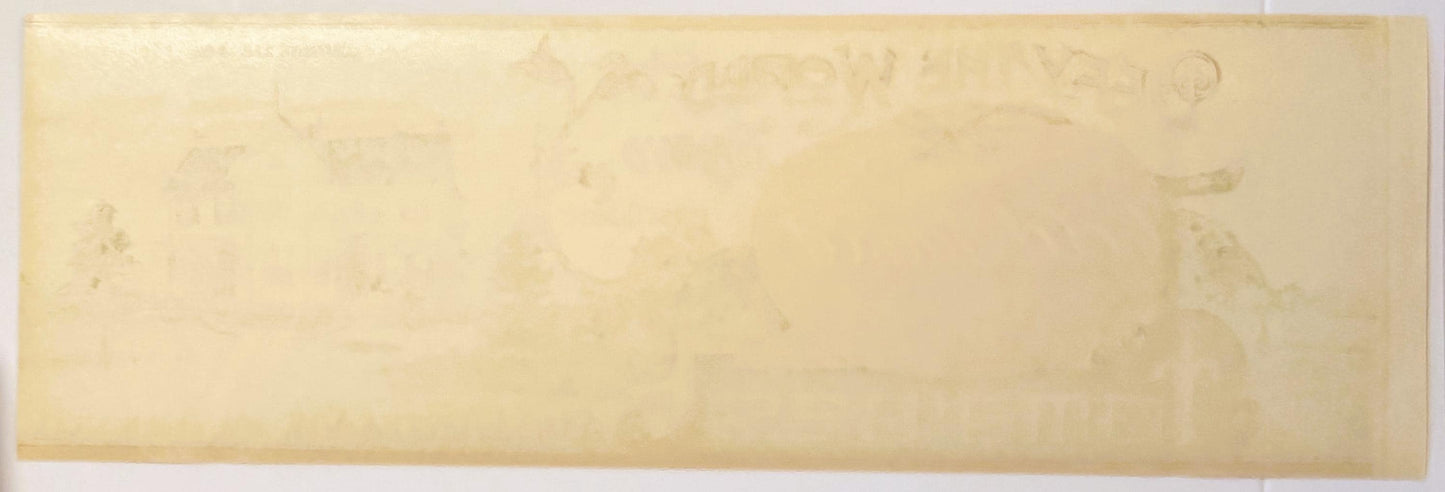
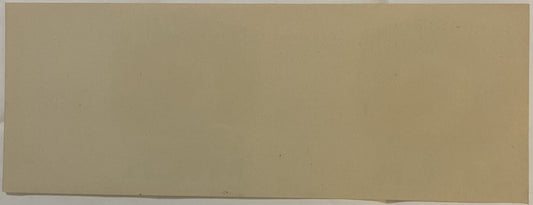
This label is unused stock. The verso is a clean, blank cream sheet showing only a ghost of the front-side printing -- no paste, no can rust, no soiling, no tears. The unprinted lap margin survives intact at the left edge, proof that it was never wrapped onto a can. No exact dimensions are stated here as verified fact; please judge scale from the photographs.

Can labels of this type faced a binary fate at the cannery: pasted onto a filled can and shipped to a grocer's shelf, or held back as surplus stock and left flat in a warehouse box. This sheet took the second path. That is precisely why the unprinted lap margin -- the strip that would have vanished under paste and can-curve the moment it was actually applied -- survives here fully intact and visible.


🧾 Original Versus Reproduction

Reproduction prints of vintage can and crate labels circulate in the marketplace, made from a scanned image and printed fresh on modern paper. This listing is an original sheet, printed decades ago for Sam'l L. Kelty & Son, never reprinted or touched up. Confirm which class any comparable listing is actually offering before assuming equivalence.


🖼️ Display Ideas

  • 🍅 Frame it flat to show the full wrap-around design, tomato and farmhouse together.
  • 🏛️ Pair it with other South Jersey or Salem County canning ephemera for a regional history theme.
  • 🏡 Group it with other early-20th-century American food-label engravings.
  • 🎁 Give it to a New Jersey history enthusiast or a collector of American canning ephemera.
  • 🖋️ Store it flat in an archival sleeve if preservation matters more than display.

🎁 Who Collects Labels Like This

  • 🍅 American can-label and food-advertising ephemera collectors.
  • 🏛️ New Jersey and Salem County regional history collectors.
  • 🏭 Collectors interested in the early American commercial canning industry.
  • 🎨 Early-20th-century commercial engraving and lithography enthusiasts.
  • 🎁 Gift-givers seeking authentic antique ephemera with real documented history.

🏭 Can Label Versus Crate Label

It is worth being precise about format, since the two are sometimes lumped together in casual searches. This is a can label -- a long wrap-around sheet made for a cylindrical tin can -- not a crate label made for a flat wooden box end panel. The two formats come from entirely different packing industries, are collected differently, and belong in different comparison bands. This label should never be priced or compared against crate-label listings.


❓ Honest Answers

Is this label from the 1890s?

No. The printed net-weight statement on the label postdates the 1913 Gould Amendment, and independent and prior-listing evidence both support a c.1910s-1920s date for this paper. The 1890s belongs to the Kelty cannery's own founding era, not to this specific sheet.

Is the Kelty cannery history real?

Yes -- Samuel Lewis Kelty's cannery on Beasley Neck Road, Quinton, is documented by the Salem County Cultural & Heritage Commission as one of the most successful in South Jersey in the 1890s. That history is genuine; it simply dates the business, not this label.

Is the farmhouse pictured the Kelty family home?

It is not confirmed. Nothing on the label identifies the building, and no independent source was found. It is described here as a well-executed engraving, not a documented Kelty property.

Was this label ever used on a can?

No. The clean, blank verso and the intact unprinted lap margin show it was printed and never wrapped onto a can.

What does "Cold Packed" mean?

It is a real period canning term: the tomatoes went into the can raw and were processed after sealing, rather than being cooked and hot-filled.

An honestly corrected, genuinely old piece of South Jersey canning history -- a real family firm, a real brand, and a date restored to what the paper itself actually supports, exactly as its own printed evidence has always quietly shown.

Shipping

🚚 Shipping & Handling

  • Shipping costs and timing are calculated at checkout.
  • Items curated and shipped directly by me include U.S. shipping at no additional cost, professionally packed to ensure safe arrival of your artifact.

Items from Vetted Pro Collectors
Shipping for items offered by vetted Pro Collectors is determined at checkout. All Pro Collector listings are reviewed to ensure fair, reasonable shipping practices.

For full details, please refer to our Shipping Policy.

Returns & Exchange

Take your time — you've got a full six months. If a piece isn't right for you, send it back the way it reached you and we're good.

In the first 30 days your money goes straight back the way you paid. After that it's store credit, so you can put it toward something you'd rather have.

Return shipping we sort out between us, case by case. I don't make this difficult.

If something arrives damaged, or it isn't what I said it was, send me a photo within 48 hours and I'll make it right.

Email info@vintageantiquesgifts.com or call 802-356-9872 — that's me answering, not a call center.

The only things I can't take back are custom or special-order pieces and gift cards.

View full details