Skip to product information
1 of 7

Vintage and Antique Gifts

Antique 1915 Chicago Rock Island & Pacific Railway Stock Certificate 🚂 Orange Border, The Rock

Antique 1915 Chicago Rock Island & Pacific Railway Stock Certificate 🚂 Orange Border, The Rock

Regular price 9.00 USD
Regular price Sale price 9.00 USD
Sale Sold out
Shipping calculated at checkout.
Quantity

🚂 What Was It Like to Hold a Piece of "The Rock" the Year the Railroad Itself Was Falling Apart? 🚂

There's a particular kind of quiet history that lives in old railroad paper — the kind that doesn't announce itself, but sits folded in a drawer or a lockbox for a century, holding onto a story nobody thought to write down. Somewhere along the line, a shareholder tucked a certificate like this one away — maybe as a nest egg, maybe as a keepsake of a family tie to the rails running through their town. What they may not have fully grasped is that they were holding paper from one of the great financial dramas of the American railroad age — a company at the very peak of its geographic reach, and simultaneously at the edge of collapse. That tension is baked right into the ink and engraving of this piece.

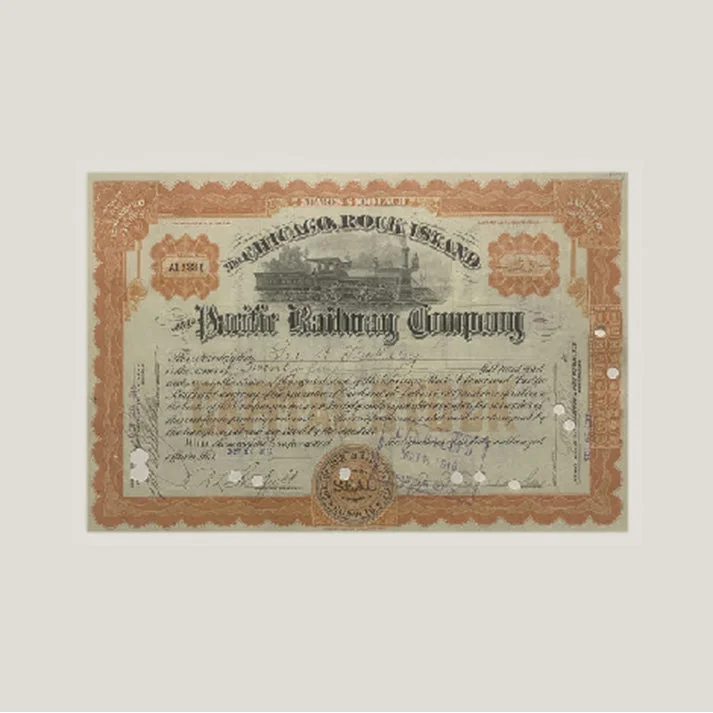
This is an original stock certificate issued by The Chicago, Rock Island and Pacific Railway Company, incorporated under the laws of Illinois and Iowa, with its corporate home in Chicago, Illinois. Measuring 11½" x 7¾" (roughly 29 x 20 cm), it represents shares of $100 par value capital stock and is a genuine, period-issued certificate from the company's own historic print run — an authentic original, never a reprint or facsimile. The design is pure early-twentieth-century American railroad security artistry: a bold orange scalloped border framing ornate Gothic lettering that spells out "The Chicago, Rock Island and Pacific Railway Company," with a beautifully engraved vignette at its center — a wood-cab steam locomotive named "America," tender in tow, smoke rolling from her stack while a conductor stands watch on the running board. Registrar and transfer-agent columns, a corporate seal, and hand-completed fields round out the certificate, marking it as a formally issued and countersigned security rather than a decorative reproduction. Certificates of this design were issued across the 1910s, the era squarely tied to one of the most turbulent chapters in the railroad's long history.

As a working financial document, a piece like this can carry its own record of handling: things like signatures and endorsements on the back, stamps from a transfer agent or registrar, tax or revenue stamps, cut or punch cancellations, staple holes, and pencil ledger marks. It is history on the page, not a condition problem, the kind of detail that separates a real financial artifact from a print.


🛤️ The Rock: From a Modest Illinois Charter to a Midwest Rail Giant

Long before "Rock Island Line" was a name people hummed, the Chicago, Rock Island and Pacific Railway was one of the true pioneers of American rail. Its lineage traces back to February 27, 1847, when it was chartered in Illinois under the almost quaint name of the Rock Island and LaSalle Rail Road Company — meant simply to connect two river towns, Rock Island and La Salle, on the Mississippi and Illinois Rivers. It became the Chicago and Rock Island Rail Road Company in 1851, then the Chicago, Rock Island and Pacific Railroad Company in 1866, and finally took the "Railway" form seen on this certificate after a reorganization in 1880.

The growth that followed was extraordinary. By 1866 its rails ran from Chicago all the way to Council Bluffs, Iowa — reaching that western terminus on May 11, 1869, just one day after the golden spike ceremony at Promontory Summit finished the Transcontinental Railroad. It pushed into Kansas City by 1879, and in 1885 it acquired the Burlington, Cedar Rapids & Northern to finally reach the Twin Cities. The Rock Island came to dominate its home state of Iowa so thoroughly that it operated over 2,000 miles of track there — nearly double its closest competitor. Around the turn of the century, ambition turned south: the company chartered the Chicago, Rock Island and Gulf Railway toward Texas and the Gulf Coast, absorbed the Choctaw, Oklahoma and Gulf Railroad, and stitched together more than thirty separate lines into a 700-mile Arkansas network hauling oil, coal, and lumber. At its height, Rock Island rails reached into Nebraska, Kansas, Colorado, Minnesota, and Tennessee.

But that same era of expansion carried the seeds of trouble. In 1901, control of the railroad passed to a group of financiers remembered in railroad histories simply as the Reid-Moore syndicate, whose appetite for overexpansion outran the company's finances. The result was a slide into federal receivership by 1914 — placing any certificate from this window of issue right at the heart of one of the defining crises of the American railroad age, a fact that gives paper like this a genuine story to tell rather than just a pretty vignette. The railroad clawed its way back through reinvestment and modernization in the decades that followed, becoming the first to run a diesel-powered streamliner into Arkansas — the Choctaw Rocket — in 1940. Decades later, a long-pursued merger with the Union Pacific dragged through the longest, most contentious hearing in the history of the Interstate Commerce Commission, leaving the physical railroad to decline while the case ground on. The Rock Island entered its final receivership in 1975, and after a crippling strike in 1979 the line was ordered liquidated in 1980 — at the time, the largest liquidation of any American company in history. The last train ran that March, closing the book on a railroad whose name had, by then, already worked its way into American folk memory through the traveling song "Rock Island Line," carried across generations by singers and storytellers long after the rails themselves went quiet.


🏙️ Chicago, Joliet, and the Towns "The Rock" Built

Chicago was the corporate seat and operating heart of the railway, the city whose name led every certificate and every timetable. But the railroad's early legend was made just outside it, in Joliet, Illinois. Local history holds that when the Rock Island's rails finally reached Joliet in October 1852, public excitement ran so high that the company ran its very first train over the unfinished route ahead of schedule — the forty-mile run from Chicago greeted along the way by trumpets, gunfire, ringing bells, and cheering crowds lining the right-of-way, an arrival still recalled by old-timers as one of the great spectacles of the young town's history. Decades later, in the years just before this certificate's era, Rock Island invested again in Joliet, helping build the Union Station and its interlocking tower in the early 1910s — a reminder that even as the company wrestled with receivership at the corporate level, it kept building the physical infrastructure that towns along its route depended on. Closer to home, Chicago-area commuters later gave an affectionate, gangland-era nickname — the "Capone cars" — to Rock Island's suburban coaches, a small piece of local color passed down among city rail buffs.


🧑‍✈️ The People Behind the Paper

Certificates like this one changed hands through the offices of a company shaped by a colorful cast of characters. Early leadership under men like John Tracy pushed the line hard toward its 1869 completion to Council Bluffs, while a change of command in 1883 brought Ransom Cable to the helm. The 1901 Reid-Moore syndicate takeover set the company on its rockiest course, and it was bankruptcy judge Frank J. McGarr of Chicago who, decades later, would order the railroad's final liquidation in 1980. Financial lore also remembers investors like Henry Crown, who — along with other bondholders willing to buy Rock Island debt for pennies during its lowest ebb — were ultimately vindicated when the railroad's assets proved far more valuable than the market had believed. It's the kind of quiet vindication that collectors of railroad securities like to point to: paper that looked worthless on the day of a receivership stamp can carry real value, real history, generations later.


🕰️ The Rock Island's Legacy Today

The original Chicago, Rock Island and Pacific Railway ceased to exist with its 1980 liquidation, but its name and memory have proven remarkably durable. A modern short-line freight operator now carries on the Chicago Rock Island & Pacific name in Mississippi and Kansas, a tribute to the old company rather than a continuation of it — the historic railroad's locomotives, track, and corporate identity belong entirely to the era this certificate comes from. For collectors of railroadiana, financial history, and American Midwestern industry, a Rock Island certificate is treasured precisely because it captures a company that was, at once, one of the boldest rail-builders of its century and a genuine cautionary tale of overreach — a combination that makes its old stock paper far more than décor. It's a tangible artifact of the "granger railroad" era, the age when farm towns across Illinois, Iowa, and the plains states lived and died by whether the rails reached them.


🖼️ Display Ideas

  • 🖋️ Framed alone in a simple black or wood frame to let the orange scalloped border and locomotive vignette carry the wall on their own
  • 🏛️ Matted alongside a vintage railroad map of Illinois and Iowa for a study or den gallery wall
  • 📚 Displayed on a bookshelf or mantel easel as a conversation-starting piece of Americana
  • 🎁 Given as a milestone or retirement gift to a lifelong railroad enthusiast or Chicago-area history buff
  • 🖼️ Grouped with other early-1900s financial ephemera — bonds, ledgers, timetables — for a themed collector's corner
  • 🚉 Paired with a locomotive photograph or model for a rail-room display honoring "The Rock"

🎁 Who Collects These

Scripophily collectors — those who collect historic stocks and bonds as art and history rather than as live securities — seek out Rock Island certificates for their engraving quality and their tie to a genuinely dramatic corporate story. Railroad history buffs, especially those with roots in Illinois, Iowa, or the greater Chicago area, prize them as tangible connections to a line their families may have ridden or worked for. Collectors of Americana and antique financial ephemera value the piece for its craftsmanship and its place at the intersection of American industry, folklore, and finance — a single sheet of paper that quietly outlasted the company that printed it.


❓ FAQ

Is this a real, issued stock certificate or a reproduction?
Yes — it is a genuine, original certificate from the company's own historic print run, not a modern reprint or facsimile.

Was this certificate actually used, or is it blank?
It is an authentic, issued certificate that saw real use — registered to a shareholder, formally cancelled when the shares transferred, and preserved ever since. The certificate number, the holder's name, the share count, and the exact 1915–16 dates vary from one original to the next, so you will receive an original comparable to the one photographed.

Is this certificate still valid as a security, or can it be redeemed?
No — the Chicago, Rock Island and Pacific Railway was liquidated in 1980, and certificates like this survive today purely as historical and collectible artifacts, not as active financial instruments.

What is depicted in the engraving on the certificate?
A steam locomotive named "America," shown with her tender and a conductor standing on the running board, rendered in the fine engraved detail typical of early-twentieth-century American bank-note artistry.

How old is this certificate?
It dates from the 1910s, the decade during which the company underwent one of its most significant corporate reorganizations.

Was the Chicago, Rock Island and Pacific Railway the same as today's company using that name?
No — a present-day short-line freight operator uses the historic name in Mississippi and Kansas, but it is a separate, modern entity with no equipment, track, or corporate lineage connecting it to the original 1847–1980 railroad.

What size is the certificate?
It measures 11½" x 7¾" (approximately 29 x 20 cm).

Condition, plainly: this is an issued and duly cancelled certificate — the punch holes and the 1916 CANCELLED stamp are part of its working life on Wall Street, not damage. The reverse carries transfer stamps from Shearson, Hammill & Co. and Hornblower & Weeks — two legendary houses — which is exactly how a share of the Rock Island actually traded. Certificate numbers, holders, share counts, dates, stamps and punch patterns vary from example to example across our originals, so the photographs show the type rather than the exact sheet that ships; you receive an original comparable to the one photographed.

Shipping

🚚 Shipping & Handling

  • Shipping costs and timing are calculated at checkout.
  • Items curated and shipped directly by me include U.S. shipping at no additional cost, professionally packed to ensure safe arrival of your artifact.

Items from Vetted Pro Collectors
Shipping for items offered by vetted Pro Collectors is determined at checkout. All Pro Collector listings are reviewed to ensure fair, reasonable shipping practices.

For full details, please refer to our Shipping Policy.

Returns & Exchange

Take your time — you've got a full six months. If a piece isn't right for you, send it back the way it reached you and we're good.

In the first 30 days your money goes straight back the way you paid. After that it's store credit, so you can put it toward something you'd rather have.

Return shipping we sort out between us, case by case. I don't make this difficult.

If something arrives damaged, or it isn't what I said it was, send me a photo within 48 hours and I'll make it right.

Email info@vintageantiquesgifts.com or call 802-356-9872 — that's me answering, not a call center.

The only things I can't take back are custom or special-order pieces and gift cards.

View full details
  • 5 stars: 4 (100%)
  • 4 stars: 0 (0%)
  • 3 stars: 0 (0%)
  • 2 stars: 0 (0%)
  • 1 star: 0 (0%)
n
n***7 (652)

Package properly arrived timely. Quality is like new condition. Can't complain. I got a good deal and I look forward to doing business again with this American family owned business. Until the next time.

s
s***y (1588)

As always, another winner! A steal for a beautiful stock in awesome shape!

m
m***i (59)

Excellent part of the past!

V
Vale Violet
Pretty

Train picture is sooo pretty on this one. Love it!

Hello Vale! A railway of thanks for your 5-star review on our Chicago Rock Island Pacific Railroad Stock Certificate! We are elated to hear that you love the artwork of the train. Your continued support is deeply valued, and we look forward to presenting you with more vintage treats in the future!