Skip to product information
1 of 7

Vintage and Antique Gifts

Antique 1930s 1950s Boston and Albany Railroad Stock Certificate Engraved Share American Bank Note Historic Wall Art 📜

Antique 1930s 1950s Boston and Albany Railroad Stock Certificate Engraved Share American Bank Note Historic Wall Art 📜

Regular price 10.00 USD
Regular price Sale price 10.00 USD
Sale Sold out
Shipping calculated at checkout.
Quantity

🚂 What Would a Boston Insurance Man Have Made of a Railroad Stretching All the Way to Albany?

There's something almost hypnotic about holding a piece of paper that once represented real ownership in the iron rails that stitched New England together. Long before anyone thought to frame a stock certificate for the wall, documents like this one sat quietly in bank vaults and law office files — proof that somebody, somewhere, had staked a claim in the Boston & Albany Rail Road. Old-timers in railroad circles still talk about the B&A with a certain reverence, the way you'd talk about a favorite uncle who worked hard his whole life and never got quite enough credit for it. This certificate is a genuine echo of that story.

This is an original Boston and Albany Rail Road Company stock certificate, engraved and printed by the American Bank Note Company — the country's premier security printer of its day. It measures a substantial 12 x 8 inches (about 30.5 x 20 cm), rendered in rich olive green and black ink on cream stock, and it is a genuine issued certificate: made out in ink, signed by the officers, and struck with a boxed CANCELLED handstamp and punch holes when the shares were surrendered.

The design is a small masterpiece of nineteenth-century engraving craft — a sweeping vignette across the top depicting a bustling waterfront city, complete with a railroad bridge carrying a steam train across the water, sailing vessels with full canvas rigged, smokestacks, and a distant skyline of church spires and civic domes.

At center sits an oval medallion bearing the crest of the Commonwealth of Massachusetts, its Native American figure standing with bow and arrow beneath a star, framed in ornate scrollwork. Below, a pair of allegorical figures — one bearing a staff, the other holding the scales of Justice — flank an eagle, the classic emblem of trust and permanence that bank note engravers reached for again and again on securities meant to represent real, lasting value.

The certificate specifies shares at $100 par value each, issued in denominations "for less than 100 shares," countersigned by State Street Trust as transfer agent, and stamped CANCELLED — the mark that tells you this particular certificate completed its working life and was formally retired from the company's books, exactly as it should be.


🛤️ The Boston & Albany — New England's Backbone on Rails

The Boston & Albany traces its roots to the very dawn of American railroading. Its oldest ancestor, the Boston & Worcester Railroad, opened its first stretch of track in 1834, running steam locomotives and carrying passengers between Boston and West Newton, Massachusetts — among the earliest such service anywhere in the country. Through a series of consolidations completed between 1867 and 1870, the Boston & Worcester, the Western Railroad, and the Albany & West Stockbridge line merged to form the Boston & Albany Rail Road Company whose name graces this certificate. The resulting through route, linking Boston all the way to Albany, New York, across the rugged spine of the Berkshires, was — at the time it was completed — the longest and most expensive point-to-point railroad yet built in the United States. That's not a small boast for an era when railroads were being thrown up across the continent at a breakneck pace; the B&A's Berkshire crossing required serious engineering muscle, grades, tunnels, and bridgework that pushed the limits of what was possible with mid-nineteenth-century tools.

By 1899, the railroad had outgrown its old Boston terminal and opened the grand new South Station, a building that instantly became one of the busiest rail terminals in the country and remains a Boston landmark to this day. In the early 1900s, control of the B&A passed to the New York Central and Hudson River Railroad under a remarkable 99-year lease beginning July 1, 1900 — meaning that even after this point, the Boston & Albany Rail Road Company continued to exist as a corporate entity, issuing stock and paying dividends to its shareholders, while day-to-day operations were run under the New York Central banner. That lease later passed formally to the New York Central Railroad itself. It's a detail that matters here: certificates like this one represent ownership in a company that, for much of its later existence, was a steady, income-producing security rather than an actively independent railroad — precisely the kind of conservative holding that trust departments, estates, and insurance companies favored for their portfolios.


🏙️ Boston, the Berkshires, and a Line That Shaped a Region

The B&A wasn't just a railroad — it was the connective tissue of industrial New England. It carried raw wool and finished cloth out of the Worcester mills, moved freight and passengers between the port of Boston and the inland manufacturing towns, and eventually stitched together commuter service across greater Boston after absorbing lines from the New York and New England Railroad in the 1880s. Collectors and local rail historians still swap stories about the grades over the Berkshire hills, about the way the line's engineers had to blast and grade their way westward toward Albany in an age before power equipment made such work routine. There's a particular pride New Englanders take in this railroad — it wasn't a transcontinental giant like the ones out west, but it was theirs, built stone by stone through their own hills.

The waterfront vignette engraved across the top of this certificate — the bridge, the train, the tall-masted sailing ships sharing the same harbor — captures exactly that world: a New England port city where rail and sail still worked side by side, where steam power was the newest marvel but sailcloth hadn't yet given up the water entirely. It's a scene an engraver of the American Bank Note Company would have composed deliberately, choosing imagery that told potential investors, at a glance, that this was a company literally connecting commerce by land and by sea.


🖋️ The Engraver's Art — American Bank Note Company

The American Bank Note Company, founded in 1795, grew to become the foremost engraving and security-printing house in the United States, producing currency, postage stamps, and — critically for collectors today — the ornate stock and bond certificates that Wall Street and regional exchanges alike came to depend on. After a series of mergers, including a major 1879 consolidation with the National Bank Note Company and Continental Bank Note Company, ABNC's reach only grew. In fact, the New York Stock Exchange itself required that listed securities be engraved by a "responsible" security printer to guard against counterfeiting — which is exactly why a certificate like this one carries such elaborate scrollwork, fine-line vignette engraving, and the ABNC imprint tucked discreetly at the bottom. This wasn't decoration for decoration's sake; it was the anti-counterfeiting technology of its day, executed with genuine artistic skill by engravers whose names, sadly, rarely made it onto the finished piece.

🏦 The Institutions Behind the Ledger

Certificates of this kind rarely stayed in the hands of small individual investors for long — insurance companies, trust departments, and estates were the natural long-term holders of steady, dividend-paying railroad shares like these. Boston's own John Hancock Mutual Life Insurance Company, founded in 1862 and named for the famous Massachusetts patriot, was exactly this kind of institution — a company built on conservative investing, favoring bonds, mortgages, and blue-chip railroad stock over speculative plays. It's worth noting, too, that John Hancock is one of only six life insurance companies founded that same year in the United States still operating in some form today. Shares like this one, transferable through Boston's own State Street Trust, would have moved between exactly this kind of institutional hand — a quiet, unglamorous form of wealth-holding that nonetheless kept New England's financial engine running for generations.


🚉 What Became of the Line — and Why It Still Matters

The Boston & Albany name eventually folded into the wider consolidation of American railroading: the New York Central merged into Penn Central in 1968, Amtrak assumed intercity passenger service in 1971, and Conrail took over Penn Central's freight operations in 1976. But the physical route the B&A built through the Berkshires never went quiet. Today it carries CSX freight, Amtrak's Lake Shore Limited passenger train, and the MBTA's Framingham/Worcester commuter rail line — meaning that, in a very real sense, trains still roll daily over rails the Boston & Albany laid down generations ago. Few pieces of paper connect so directly to a transportation corridor that's still very much alive.


🖼️ Display Ideas

  • 🚂 Framed above a home office desk or study, paired with a magnifying glass to invite a closer look at the engraving detail
  • 🏛️ Matted alongside a map of the Boston-to-Albany rail corridor for a themed transportation history wall
  • 💼 Displayed in a financial services office or bank lobby as a conversation-starting piece of Americana
  • 🎓 Used as a teaching piece for railroad or economic history, showing how 19th-century securities actually looked
  • 🖋️ Grouped with other engraved ephemera — old maps, letters, or period advertising — for a curated antique wall gallery
  • 🎁 Given as a milestone gift to a train enthusiast, Massachusetts native, or collector of financial history

🎁 Who Collects These

Scripophily — the collecting of historic stock and bond certificates — draws railroad buffs, Massachusetts and New England history collectors, engraving and printing enthusiasts, and anyone drawn to the golden age of American industry. Boston & Albany material appeals especially to collectors chasing New England transportation history, fans of American Bank Note Company engraving work, and those who simply love the visual romance of steam trains, sailing ships, and allegorical figures rendered in fine, old-world line work.


❓ FAQ

Is this an original certificate or a reproduction?

This is an original, engraved Boston & Albany Rail Road Company stock certificate, issued and later cancelled, printed by the American Bank Note Company.

What does "CANCELLED" mean on the certificate?

The CANCELLED stamp indicates the certificate completed its recorded life on the company's books and was formally retired — a normal and expected marking on historic stock certificates of this kind.

How old is this certificate?

No manufacture date is legibly marked on the piece itself, so we give the era as a wide, defensible range rather than a single guessed year. The design and printing style are consistent with the period the Boston & Albany operated under its long-term New York Central lease, spanning the early 1900s through the 1960s.

What is depicted in the artwork?

The top vignette shows a harbor city scene with a railroad bridge, steam train, and sailing vessels. The central medallion bears the seal of the Commonwealth of Massachusetts, and allegorical figures with an eagle appear near the bottom — classic imagery used by security engravers of the era to convey trust and permanence.

Is this suitable for framing?

Yes — its size, engraved detail, and historic subject matter make it a natural fit for framing and display.

Does the railroad still exist today?

The Boston & Albany's original route is still active, now carrying CSX freight, Amtrak's Lake Shore Limited, and MBTA commuter rail service between Boston and Worcester.

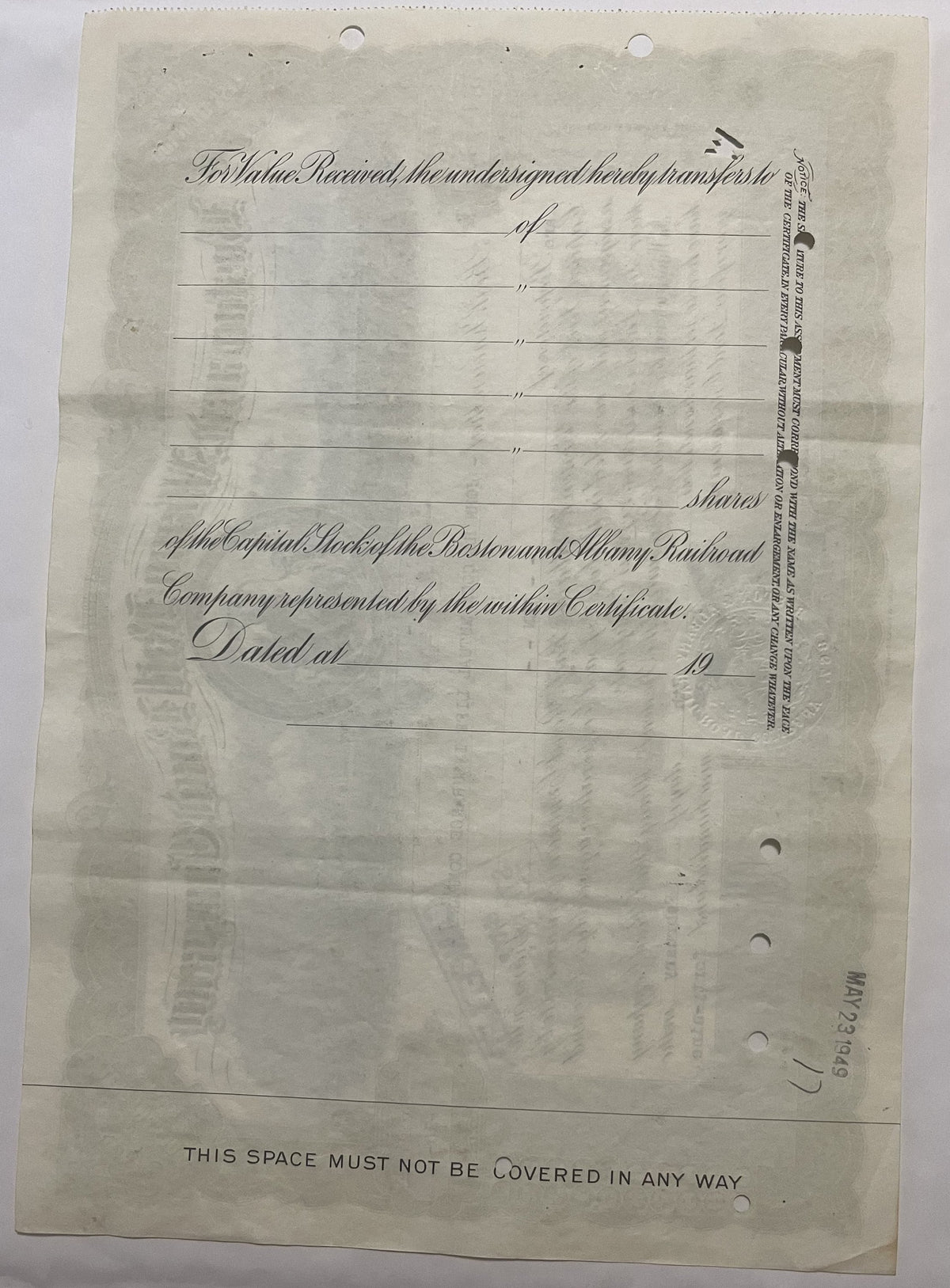
These are issued instruments rather than blanks. Certificates of this type were filled in for a holder in ink, countersigned by the transfer agent and registered by the registrar, then punch- or cut-cancelled when they were redeemed and retired. Expect financial writings, markings, stamps, hole punches and staple holes as part of the life of the instrument: endorsements and signatures, transfer-agent and registrar stamps, revenue or documentary tax stamps, cancellation punches, staple holes from being bound into a transfer book, pencil ledger notations. That is the paper trail of a security that actually did its job, and it is what separates a document that lived from a blank that never did. No two are alike: holder details, serial numbers, dates, signatures, stamps and punch patterns vary from example to example, so the photographs show the type rather than the exact sheet that ships.

Shipping

🚚 Shipping & Handling

  • Shipping costs and timing are calculated at checkout.
  • Items curated and shipped directly by me include U.S. shipping at no additional cost, professionally packed to ensure safe arrival of your artifact.

Items from Vetted Pro Collectors
Shipping for items offered by vetted Pro Collectors is determined at checkout. All Pro Collector listings are reviewed to ensure fair, reasonable shipping practices.

For full details, please refer to our Shipping Policy.

Returns & Exchange

Take your time — you've got a full six months. If a piece isn't right for you, send it back the way it reached you and we're good.

In the first 30 days your money goes straight back the way you paid. After that it's store credit, so you can put it toward something you'd rather have.

Return shipping we sort out between us, case by case. I don't make this difficult.

If something arrives damaged, or it isn't what I said it was, send me a photo within 48 hours and I'll make it right.

Email info@vintageantiquesgifts.com or call 802-356-9872 — that's me answering, not a call center.

The only things I can't take back are custom or special-order pieces and gift cards.

View full details
  • 5 stars: 2 (100%)
  • 4 stars: 0 (0%)
  • 3 stars: 0 (0%)
  • 2 stars: 0 (0%)
  • 1 star: 0 (0%)
h
h***8 (2062)

Nice items -- I have four of them (one of them is my own) and I'm satisfied with my little and cute scripophily collection.

7
7***3 (137)

Excellent service and fast delivery would do business again and package was well secure and the shipping costs are great and the item was as described in the description. Fantastic service and great seller.