Skip to product information
1 of 7

Vintage and Antique Gifts

🚂 Antique 1940s–1950s Erie Railroad Stock Certificate — Blue, Clean Vignette, American Bank Note Co.

🚂 Antique 1940s–1950s Erie Railroad Stock Certificate — Blue, Clean Vignette, American Bank Note Co.

Regular price 11.00 USD
Regular price Sale price 11.00 USD
Sale Sold out
Shipping calculated at checkout.

Description

🚂 Antique 1940s–1950s Erie Railroad Stock Certificate — Blue, 5% Preferred Stock, Clean Vignette 🚂

You're holding a piece of paper that once meant real ownership in one of the most storied, scandalous, and consequential railroads in American history.

The Erie Railroad. Chartered in 1832. Dead by 1960. And in between — 128 years of ambition, corruption, genius, bankruptcy, war, and the building of a nation.

This is a blue 5% Preferred Stock certificate, Series A, printed by the American Bank Note Company — one of the most prestigious security printers in American history, the same firm that printed U.S. currency, postage stamps, and stock certificates for thousands of publicly traded companies. Their work traces back to 1795, and their engraving techniques are considered the pinnacle of American printmaking.

━━━━━━━━━━━━━━━━━━━━

⚠️ ABOUT THIS CERTIFICATE — CLEAN VIGNETTE

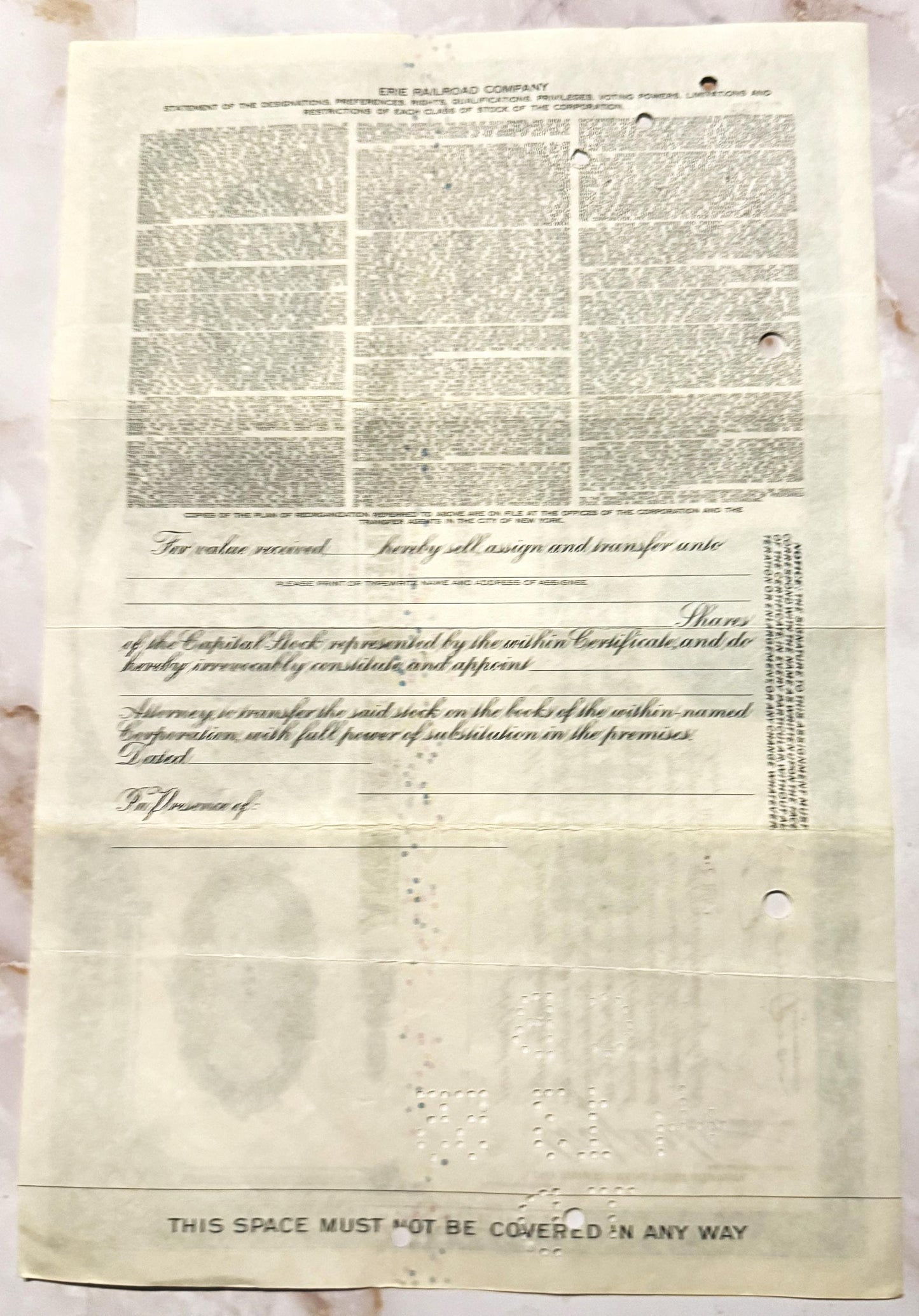
This is important: this certificate has no cancellation hole punches through the vignette (the ornate engraved artwork at the top). Most Erie Railroad certificates on the market have been cancelled — meaning holes were punched directly through the artwork when the stock was redeemed, damaging the most beautiful part of the certificate.

This one is clean. The vignette is intact and unmarred. That distinction matters enormously to collectors and to anyone who wants to frame this as wall art. A hole-punched certificate is a document. A clean vignette certificate is a work of art.

━━━━━━━━━━━━━━━━━━━━

🏛️ THE ERIE RAILROAD — 128 YEARS OF AMERICAN HISTORY

🌟 The Beginning (1832) — The Erie Railroad was chartered on April 24, 1832 by New York Governor Enos T. Throop. The problem it was built to solve was simple: the Erie Canal, completed in 1825, had transformed the cities along its northern route across New York state, but the entire Southern Tier — Binghamton, Elmira, Hornell, and dozens of smaller communities — was being left behind. The railroad would connect New York City to Lake Erie, opening the southern half of the state to commerce and growth.

Construction began in 1836. The line was built to a unique broad gauge — 6 feet between the rails instead of the standard 4 feet 8½ inches — deliberately designed so that no competing railroad could use Erie's tracks. It was bold, ambitious, and in hindsight, a decision that would haunt the company for decades.

The full route was completed in May 1851 — 446 miles of track. Upon completion, President Millard Fillmore himself traveled the entire new line with his cabinet. It was a national event.

🌟 The Erie War (1867–1868) — And then came the scandal that would make the Erie Railroad infamous on Wall Street forever.

Daniel Drew, a cattle drover turned banker, had acquired control of the Erie and was manipulating its stock price for personal profit. Cornelius Vanderbilt — the Commodore, the most powerful railroad baron in America — decided to take over the Erie by quietly buying up shares on the open market.

Drew brought in two allies: Jay Gould and James "Big Jim" Fisk. Together, the three of them pulled off one of the most brazen financial crimes in American history. To stop Vanderbilt's takeover, they illegally printed and sold 50,000 fraudulent shares of Erie stock — literally flooding the market with fake paper to dilute Vanderbilt's position.

Vanderbilt lost over $7 million. He obtained arrest warrants for all three men. Gould, Fisk, and Drew fled across the Hudson River to New Jersey with $6 million in cash stuffed in suitcases, setting up headquarters in a hotel they dubbed "Fort Taylor." They then used Erie's corporate funds to bribe the New York State Legislature — through Boss Tweed and Tammany Hall — to retroactively legalize the fraudulent shares.

Vanderbilt eventually settled, cutting his losses. Gould won control of the Erie, which he proceeded to loot. Drew, betrayed by his own partners, lost $1.5 million and died bankrupt in 1879.

The Erie War became one of the defining stories of the Gilded Age — a tale of greed, corruption, and the raw, lawless power of 19th-century Wall Street.

🌟 Growth and the Southern Tier — Despite the financial chaos at the top, the Erie Railroad was transformative for the communities along its route. The mainline proved instrumental in the development of New York's Southern Tier — Binghamton, Elmira, and Hornell all owed their economic growth to the railroad. Hornell became the site of the Erie's major repair shops and the town's largest employer. It was also where the mainline split: one route running northwest to Buffalo, the other west to Chicago.

In 1865, the Erie merged with the Atlantic and Great Western Railroad, extending its reach all the way to Chicago and making it one of the great east-west carriers in the country.

🌟 The Van Sweringen Era (1920s) — The Van Sweringen brothers took control in the mid-1920s and brought genuine operational improvements — standardizing locomotives, improving efficiency, and launching the Erie Limited, the railroad's flagship passenger service, in 1929.

🌟 The End (1960) — But the 20th century was unkind to the eastern railroads. Laden with increasing debt and facing competition from trucks and automobiles, the Erie went through multiple reorganizations. In 1960, it merged with the Delaware, Lackawanna & Western to form Erie-Lackawanna. The Erie Railroad name — 128 years old — was gone.

━━━━━━━━━━━━━━━━━━━━

🎨 THE ART — AMERICAN BANK NOTE COMPANY

This certificate was printed by the American Bank Note Company — an institution tracing its roots to 1795, founded in the earliest days of the American Republic. The same firm printed U.S. currency, postage stamps (including the famous 1893 Columbian issue), traveler's checks, and stock certificates for thousands of publicly traded companies.

The vignette on this certificate features two classical figures flanking the Erie Railroad shield — engraved using steel plate intaglio printing, the same technique used on U.S. paper currency. The ornate border work, fine-line undertints, and detailed engraving represent the highest level of security printing in American history.

These certificates were printed on heavy paper stock — stiffer and more durable than a dollar bill — designed to last. And they have. Over seven decades later, they retain their vibrancy, their detail, and their presence.

━━━━━━━━━━━━━━━━━━━━

📋 DETAILS

🔹 Company: Erie Railroad Company — Incorporated Under the Laws of the State of New York
🔹 Type: 5% Preferred Stock, Series A — Par Value $100 Per Share
🔹 Color: Blue
🔹 Era: 1940s–1950s (names and dates vary per certificate)
🔹 Printer: American Bank Note Company
🔹 Size: 12" x 8"
🔹 Condition: Clean vignette — no cancellation hole punches through the artwork. Printed on heavy paper stock. Embossed corporate seal intact.
🔹 Note: Each certificate features a unique individual shareholder name and date. Names and dates will vary as these are original, individually issued documents.

━━━━━━━━━━━━━━━━━━━━

✨ WHY THIS MATTERS

You're not buying a piece of paper.

You're holding 128 years of American history — the building of the Southern Tier, the Erie War that defined the Gilded Age, Jay Gould and Cornelius Vanderbilt fighting for control of Wall Street, the broad-gauge tracks that no competitor could use, the repair shops that built Hornell, and the slow decline that swallowed the eastern railroads whole.

This is printed by the same firm that printed American currency. It's engraved with the same techniques. It has survived over seven decades with its vignette clean and intact.

Imagine this framed on your wall — in an office, a study, a den, a man cave, a living room. It's 12 by 8 inches of American history, Wall Street history, and railroad history, all in one document.

History doesn't always survive. This piece did.

Thank you for helping preserve a story worth remembering. 🙏

Shipping

🚚 Shipping & Handling

  • Shipping costs and timing are calculated at checkout.
  • Items curated and shipped directly by me include U.S. shipping at no additional cost, professionally packed to ensure safe arrival of your artifact.

Items from Vetted Pro Collectors
Shipping for items offered by vetted Pro Collectors is determined at checkout. All Pro Collector listings are reviewed to ensure fair, reasonable shipping practices.

For full details, please refer to our Shipping Policy.

Returns & Exchange

Product Page Return Policy

  • 60-Day Returns – Items must be in original condition.
  • Refunds – Issued after inspection (excluding shipping costs).
  • Return Shipping – Customer is responsible unless item is damaged or incorrect.
  • Damaged/Incorrect Items – Contact us within 48 hours for a replacement or refund.
  • Easy Returns – Email info@vintageantiquesgifts.com or call 802-356-9872 to initiate a return.

For full details, visit our Refund Policy.

View full details