Skip to product information
1 of 5

Vintage and Antique Gifts

Antique 1930s Fido Brand Citrus Crate Label 🍊 Orosi Tulare County California

Antique 1930s Fido Brand Citrus Crate Label 🍊 Orosi Tulare County California

Regular price $14.00 USD
Regular price Sale price $14.00 USD
Sale Sold out
Shipping calculated at checkout.

Size: 12 1/4" x 8 3/4"

🚚 Free US Shipping — ships within one business day. International shipping calculated at checkout.

Quantity

Who Packed Fido Brand Citrus? 🐕 Fido, the Worried Puppy Who Never Rode a Crate

Size: 12 1/4" x 8 3/4" ~ Little to no storage wear.

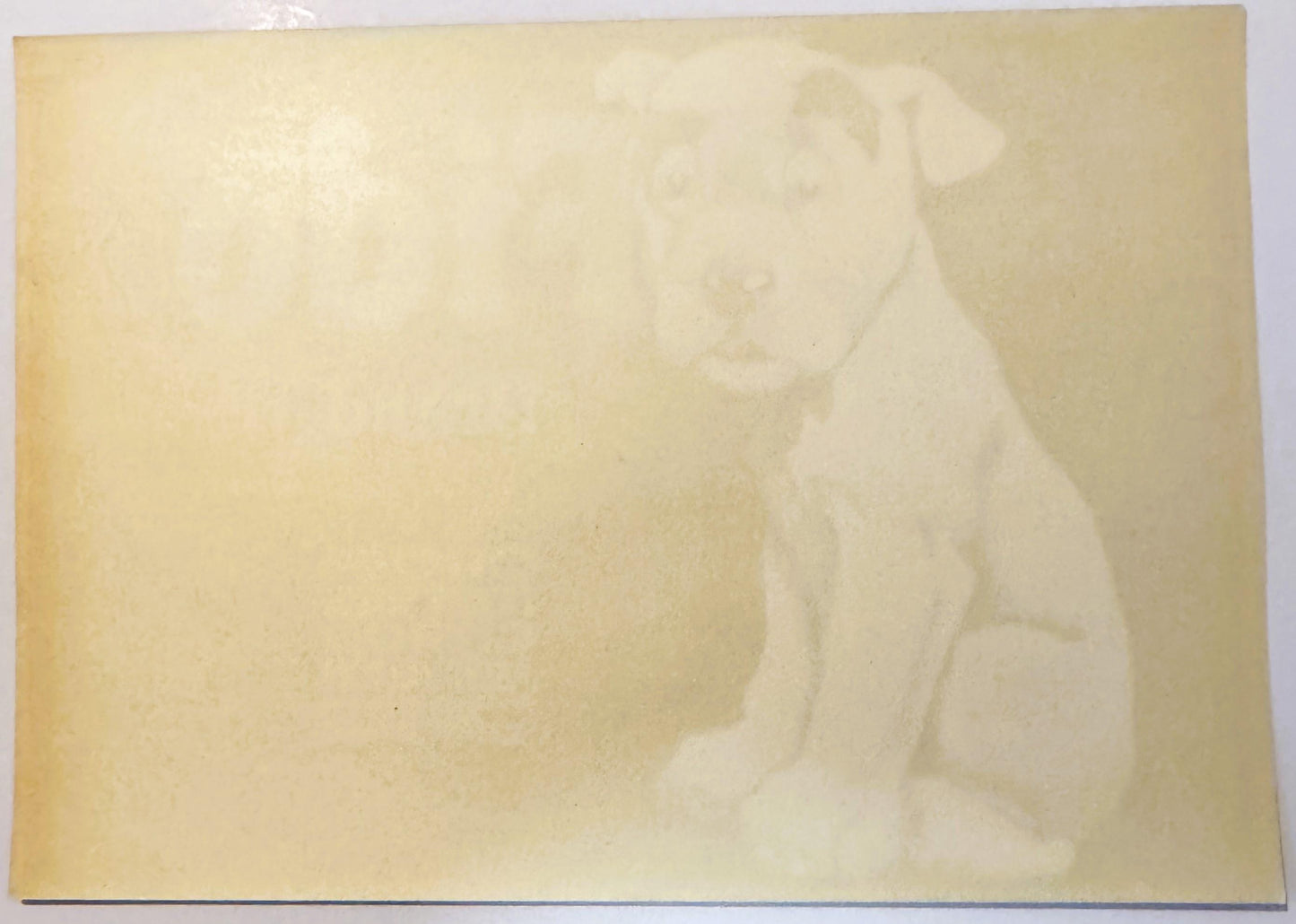
Cutest dog ever on a crate label, and he never did the job he was printed for. This 1930s Fido Brand citrus crate label was made to be pasted on the end of a wooden citrus box in Tulare County, California, shipped east and thrown out with the crate. Instead it stayed at the packing house with a few thousand others until the label trade found them decades later. Printed for the Orosi Foothill Citrus Association by the Schmidt Lithograph Company of San Francisco, it has never been used, and the colors are as loud as the day it came off the press.

What Is Printed on It

The label measures 12.25 x 8.75 inches. Beside the puppy it reads Fido Brand and then, in capitals:

OROSI
FOOTHILL
CITRUS
ASSOCIATION
OROSI, TULARE CO. CALIFORNIA.
SHIPPED THRU
LINDSAY-MERRYMAN CITRUS EXC.

Along the bottom left edge, in type small enough to miss, is the printer's imprint: SCHMIDT LITHO. CO. S.F. The back is blank cream paper with the puppy showing faintly through from the front. There is no glue on it; it was never pasted to a box.

Which Fruit?

The sheet itself never says which fruit went in the box — it prints CITRUS and leaves it there. The story in the trade is that the Fido labels went on lemon crates. I date it to the 1930s. Some call him a "Bonzo dog," and I can see why. Bonzo was the chubby white cartoon pup the British artist George Studdy drew for The Sketch magazine. The editor gave him his name in November 1922, and by the mid-1920s he was on postcards, toys, puzzles and advertising and starring in his own cartoons. Fido is his own dog, but he has that same droopy, worried face. The Huntington Library keeps a Fido Brand label with exactly the same wording in its Jay T. Last Collection of Graphic Arts and Social History, and the same association packed under other names too, Orosi Brand and Foothill Brand among them, which is why its name turns up on labels that look nothing like this one. A Fido Brand label from the Orosi Foothill Citrus Association is also held in the citrus label collection at the University of California, Riverside.

The Legend of the Packing House Find

Almost every crate label did exactly what it was made for and went out with the box. By the 1950s the pre-printed cardboard carton had replaced the wooden crate and its paper label, and the packing houses stopped ordering them. Fido took a different road. The story goes, in the label trade, that a few thousand Fido labels turned up still sitting at the packing house, printed and never used, and that find is the reason an unused Fido can be framed on a wall today instead of rotting on a dump.

A Name with a Story

Fido is about as classic a dog's name as you can pick, and it has a story of its own. Abraham Lincoln had a yellow mixed-breed dog named Fido, from around 1851 until 1865, and he's often cited as the reason Fido caught on as the everyday name for a pet dog, so popular it became a cliché. The label never mentions Lincoln, but I like knowing whose name this little guy is wearing.

Orosi: The Town Named for Gold

Orosi sits in northern Tulare County, in the citrus country that runs along the Sierra Nevada foothills from Lindsay north to Orange Cove. Daniel R. Shafer founded the town in 1888. The name comes from oro, Spanish for gold, for the golden California poppies that covered the fields around it, and a post office followed in 1892. Citrus, grapes and olives became its living. It is still farm country; the 2020 census counted 8,329 people, and the Orosi Branch Library is on the National Register of Historic Places.

Lindsay and the Exchange on the Label

The label says the fruit was shipped through the Lindsay-Merryman Citrus Exchange, which takes its name from Lindsay, south of Orosi along the same foothills. Captain Arthur J. Hutchinson arrived there in 1889, bought 2,000 acres and formed the Lindsay Land Company, naming the town for his wife, Sadie Lindsay Patton Hutchinson. The Southern Pacific Railroad came through the same year. A homesteader named Julius Orton is credited with planting the first orange trees in the Lindsay district. Orton was Ohio-born, and he tried the gold country first, riding security for a pack train headed for Placerville without striking it rich. In 1859 he, his wife and their two small daughters walked more than 200 miles, driving a small herd of cattle, to a homestead along the Tule River southwest of Lindsay, and in the 1880s he took up another 160 acres next to the pioneers Lewis and John Keeley. By 1905 about 700 acres were in oranges, packing houses went up to handle the fruit, and Lindsay incorporated on February 28, 1910. Six years later the Lindsay Olive company started up, and it grew into the largest olive processor in the world. The town still calls itself Central California's Citrus Center.

The exchange shipped for more than one packing house. The Huntington also has a Merit Brand label, grown and packed by the Lindsay Co-operative Citrus Association, with the Lindsay-Merryman Citrus Exchange printed as the shipper. And there's a Merryman in local memory, too: the story around Exeter is that Merryman was the original name of a stop on the Visalia Electric Railroad just outside town, with a famous packing house next door that packed the citrus.

How a Crate of California Citrus Got to Market

California citrus growers did not ship on their own. A grower belonged to a local packing association, which packed and labeled the fruit under its own brands, and the associations belonged to district exchanges that marketed it. That ladder of local associations, district exchanges and a central exchange is the structure the California Fruit Growers Exchange was built on. It began in 1893 as the Southern California Fruit Exchange, took the California Fruit Growers Exchange name in 1905 when it had 5,000 members and 45 percent of the industry, and adopted the name Sunkist in 1908. The Fido label puts two rungs of that ladder on one sheet of paper: the Orosi Foothill Citrus Association packed the fruit, and the Lindsay-Merryman Citrus Exchange shipped it.

Schmidt Litho. Co., San Francisco

The little imprint in the corner belongs to one of the biggest label printers in the West. Max Schmidt was born in Germany in 1850, left home at fourteen to work as a cabin boy for six years, and arrived in San Francisco in 1871 speaking little English. He was making pictorial newspaper cuts on zinc plates by 1874, founded M. Schmidt & Company in 1876 to print stock certificates and colored labels, and incorporated as the Schmidt Label & Lithographic Company in 1883. Fires hit the plant in 1884 and 1886. He was among the first on the West Coast to put lithography to work, and by the 1890s he had branches in Portland and Seattle, on the way to becoming the largest printing company on the West Coast, turning out fruit-crate labels, can labels and the salmon labels of the Pacific Northwest. In 1899 the firm combined with competitors as the Mutual Label & Lithographic Company, and the 1906 earthquake and fire destroyed its building at Second and Bryant Streets. Schmidt had the money to rebuild on the same corner, and when the new plant opened the business became the Schmidt Lithograph Company, the name on this label. Even before then he had bought a nearby paper factory, and production carried on practically uninterrupted.

San Francisco still has the building. A 180-foot clock tower went up in 1920 and 1921, and the old plant at 461 Second Street is now the Clocktower Lofts. Two pieces of lore about Max Schmidt come with it: his will called for a thermometer on the outside of the tower, which the board refused and later put up anyway, and when the Bay Bridge was being planned he threatened to move the plant, so the viaduct was routed around his property. Schmidt died in 1936. In 1966 Stecher-Traung bought the company to form Stecher-Traung-Schmidt, which ran until 1994.

The Legacy of a Throwaway Label

California's citrus crop grew tenfold between 1887 and 1901, and for the better part of a century each wooden box of it carried a paper label meant to catch a buyer's eye in a produce market thousands of miles away. When the cardboard carton took over, the labels stopped, and the ones that were left became a collecting field of their own. The dog on this one has outlasted the crates, the packing house and the exchange named on him.

Shipping

🚚 Shipping & Handling

  • Shipping costs and timing are calculated at checkout.
  • Items curated and shipped directly by me include U.S. shipping at no additional cost, professionally packed to ensure safe arrival of your artifact.

Items from Vetted Pro Collectors
Shipping for items offered by vetted Pro Collectors is determined at checkout. All Pro Collector listings are reviewed to ensure fair, reasonable shipping practices.

For full details, please refer to our Shipping Policy.

Returns & Exchange

Take your time — you've got a full six months. If a piece isn't right for you, send it back the way it reached you and we're good.

In the first 30 days your money goes straight back the way you paid. After that it's store credit, so you can put it toward something you'd rather have.

Return shipping we sort out between us, case by case. I don't make this difficult.

If something arrives damaged, or it isn't what I said it was, send me a photo within 48 hours and I'll make it right.

Email info@vintageantiquesgifts.com or call 802-356-9872 — that's me answering, not a call center.

The only things I can't take back are custom or special-order pieces and gift cards.

View full details

Rescuing American History Since 2007

— Travis & the Kids