Skip to product information
1 of 8

Vintage and Antique Gifts

Antique Qing Dynasty Ox Horn Budai Pendant 🧧 Laughing Buddha Talismanic Amulet Wealth

Antique Qing Dynasty Ox Horn Budai Pendant 🧧 Laughing Buddha Talismanic Amulet Wealth

Regular price 144.00 USD
Regular price Sale price 144.00 USD
Sale Sold out
Shipping calculated at checkout.

Description

There is a small object that has been traveling for centuries. It fits in your palm. It weighs almost nothing. And it was made, during the Qing Dynasty, to carry blessings so dense and so specific that its maker left nothing to chance — carving the figure on one side, the inscription on the other, the seal above, and the wealth symbols below, until there was no surface left uncommitted to joy. 🧧

This is an antique ox horn pendant from the Qing Dynasty (1644–1912), hand-engraved with one of the most beloved figures in Chinese spiritual culture: Budai — the Laughing Buddha. The ox horn is warm cream-amber in color, smooth with age, with the natural grain of the horn giving the piece a luminous, organic quality impossible to replicate in any synthetic material.

This is not a decorative object that happens to have Buddhist imagery. It is a devotional amulet made to be worn close to the body, carried through a life, and passed along with the blessings it carries. You are not buying a reproduction of something. You are holding the original.

---

🧧 THE FIGURE — BUDAI AND WHAT HE CARRIES

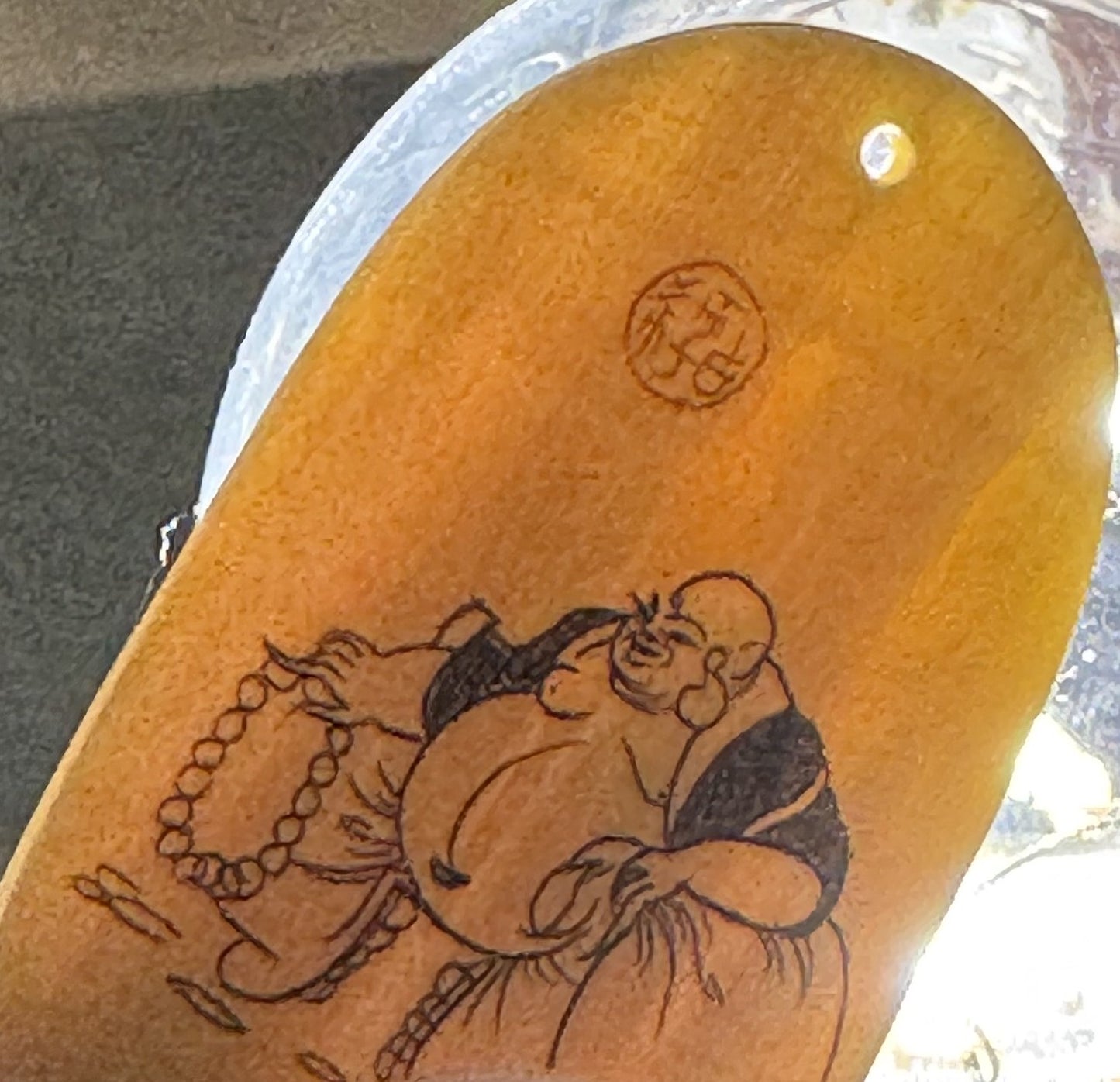
Budai (布袋, Bùdài — literally "cloth bag") is the laughing, round-bellied monk who became one of the most beloved figures in Chinese popular Buddhism. He is depicted here in his classic form: his massive abdomen exposed and rounded beneath robes that fall open at the chest. His head is bald, his earlobes long — a sign of wisdom in Buddhist tradition. His face is wide with laughter. He radiates an exuberant, infectious joy that has crossed every dynasty and every ocean.

In his left hand, Budai holds his Buddhist mālā — a strand of prayer beads that loops down and out from his grip, trailing to the left of the composition. Buddhist mālā have been used for meditation and prayer counting for millennia. In the hand of Budai, they mark him not merely as a folk figure but as a genuine Buddhist practitioner — a monk of spiritual depth beneath the laughter.

On his right side, his famous cloth bag (布袋 — the same characters as his own name) is gathered into an enormous mound of flowing fabric. This bag is everything. In every story told about Budai, it is central. The bag is said to be bottomless — capable of holding everything he finds on his wanderings, which he gives away just as freely as he receives. Candy for children. Food for the hungry. The bag is abundance made physical, and it is inseparable from who Budai is.

At his feet, scattered across the ground in every direction, are yuánbǎo (元宝) — the traditional gold sycee ingots of Chinese commerce and offering. These boat-shaped ingots appear throughout Chinese auspicious art as direct symbols of material wealth and prosperity. Here, Budai does not merely represent the spiritual blessings of joy and contentment. He stands in the middle of flowing material wealth, laughing because the abundance is real and infinite and already present. 💰

Above the figure, in the upper portion of the pendant, sits a circular seal engraved in four-character cursive script within a hand-drawn circular border — a hallmark of Qing devotional craftwork. The seal pigment, now oxidized to the warm amber-brown of aged cinnabar, glows against the cream horn background.

---

🏺 WHO IS BUDAI?

Budai is among the most beloved figures in East Asian popular Buddhism, and his origins are both historical and legendary.

The historical Budai — if he existed as a singular person — is believed to have been a wandering Chinese monk of the Tang or early Song dynasty, roughly the 9th–10th centuries CE, known for his eccentric behavior, his bottomless cloth sack, and his uncanny ability to predict the weather. He wandered the roads of southern China, giving away whatever he found in his bag, playing with children, laughing at everything, and refusing to explain himself.

When he died, his final words revealed — or so the legend holds — that he was Maitreya, the future Buddha, appearing in the world in a disguise so humble and joyful that almost no one recognized him.

This identification made Budai extraordinary. In Chinese and Japanese Buddhism, Maitreya is not merely a bodhisattva but the next fully enlightened Buddha — the one who will come after Shakyamuni to teach the Dharma in a future age. If Budai is Maitreya in human form, then his laugh is a transmission. Every moment spent in his company is a moment spent in the presence of the future Buddha.

This is why Budai became the figure placed at temple entrances throughout China — the first Buddha a visitor encounters, the one who greets you laughing, who makes it immediately clear that the path to enlightenment is not solemn and difficult but joyful and light.

And this is why Budai was carved onto pendants and worn close to the body. To carry Budai was to carry the future Buddha's blessing with you, everywhere, always. 📿

---

💰 YUÁNBǍO — THE WEALTH THAT SURROUNDS HIM

The oval ingots scattered at Budai's feet are yuánbǎo (元宝) — a symbol so embedded in Chinese visual culture that it appears across everything from temple decorations to lanterns to embroidery.

The yuánbǎo is a traditional Chinese sycee — a boat-shaped gold or silver ingot used as currency and ceremonial offering in China for centuries. The word 元宝 literally means "primary treasure." During the Qing Dynasty, yuánbǎo were offered at temple shrines, placed on family altars, and given as gifts at Chinese New Year. They symbolize concrete, actual abundance — money flowing into the household, fortune arriving and staying.

On this pendant, Budai stands surrounded by yuánbǎo. He does not carry them or guard them. They simply accumulate around him the way abundance naturally accumulates around a genuine source of joy. The image says: where Budai is, wealth follows. Carry him with you, and the wealth follows you.

---

📿 THE CLOTH BAG — ABUNDANCE WITHOUT LIMIT

布袋 (Bùdài) — cloth bag. It is both his name and his defining attribute, and on this pendant it is rendered with careful attention on his right side, gathered into a great mound of flowing fabric.

In every story told about Budai, the bag is central. He reaches in and produces exactly what the moment requires. He gives everything away and the bag never empties. For the wearer of this pendant, the bag is a continuous visual reminder that generosity and abundance are not opposites. The more freely one gives, the more fully the bag refills.

---

🖋️ THE ENGRAVING — HOW THIS WAS MADE

The imagery on this pendant was created through fine incised line engraving — channels cut with precise control into the horn's surface, then filled with ink to create the dark lines visible against the cream background.

This is not relief carving. Incised engraving is a more intimate technique — the artist works directly into the surface with a pointed tool, cutting each line with deliberate intention. The result is the fluid, expressive line quality you see here: the softness of Budai's belly and the crispness of his robes in the same hand, at a scale barely larger than a coin.

The ink used to fill the channels appears as the dark brown-black lines of the Budai figure throughout. The seal pigment — warm amber-brown from centuries of oxidation — was applied in what was originally a red cinnabar ink, the standard for Qing devotional seals. Genuine aged cinnabar seal impressions oxidize exactly to this amber-brown tone. ✋

---

🦴 OX HORN — THE MATERIAL AND ITS MEANING

Ox horn has been used in Chinese craft for at least two thousand years. Unlike jade, associated with imperial and aristocratic classes, horn was the material of the craftsman, the merchant, and the ordinary devotee — accessible, warm, beautiful, and believed to carry its own protective energy.

In Chinese folk belief, horn was thought to possess both protective and attracting qualities simultaneously. It was used for amulets specifically because of its believed power to ward off misfortune while attracting positive energy. The combination of Budai's joyful abundance with horn's inherent protective properties made this a doubly blessed object.

The warm cream-amber color of this pendant, the visible grain lines running through the material, and the translucent quality in good light are all hallmarks of genuine antique ox horn. This is organic material from the Qing Dynasty, slowly developing its patina over more than a century.

---

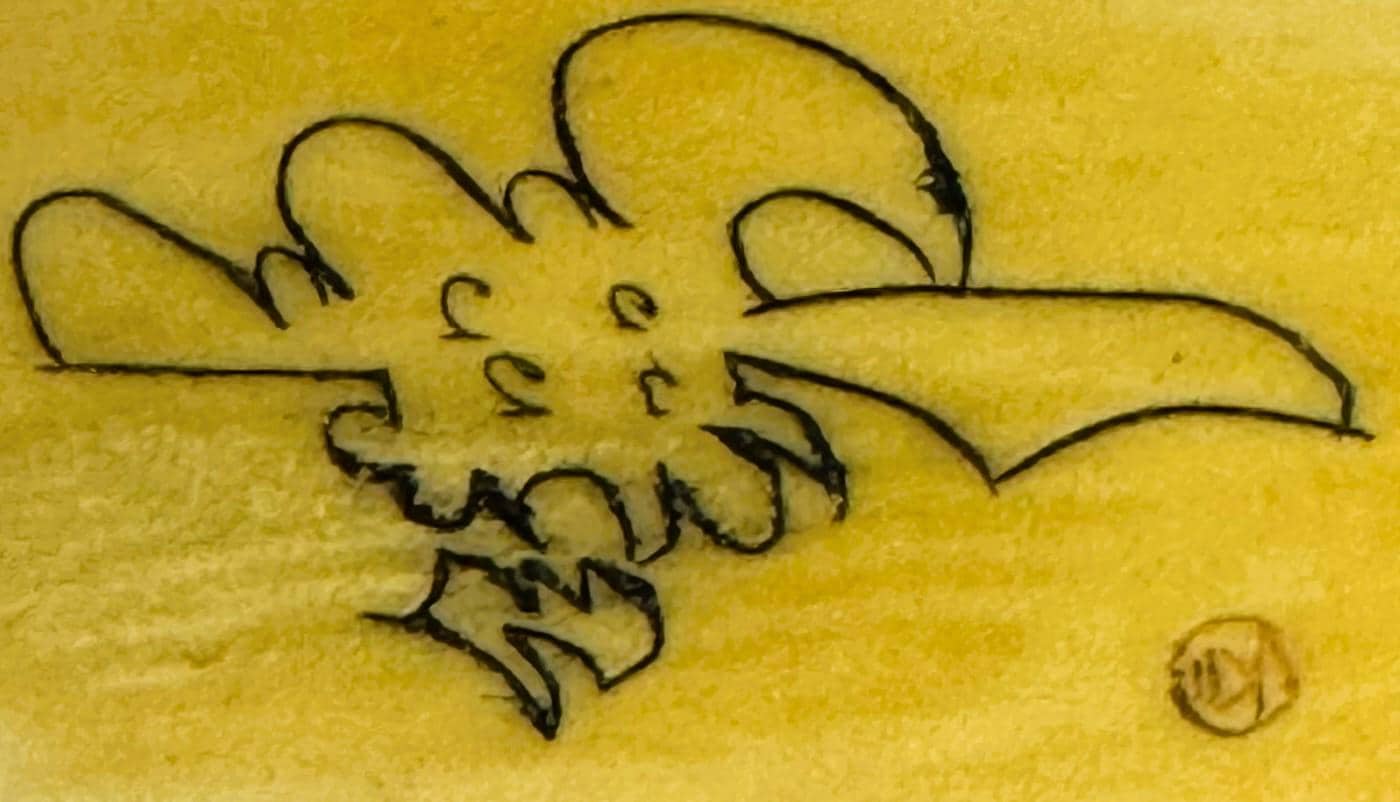
📜 THE REVERSE — LONGEVITY DOUBLED

Turn this pendant over and the talismanic program continues without pause.

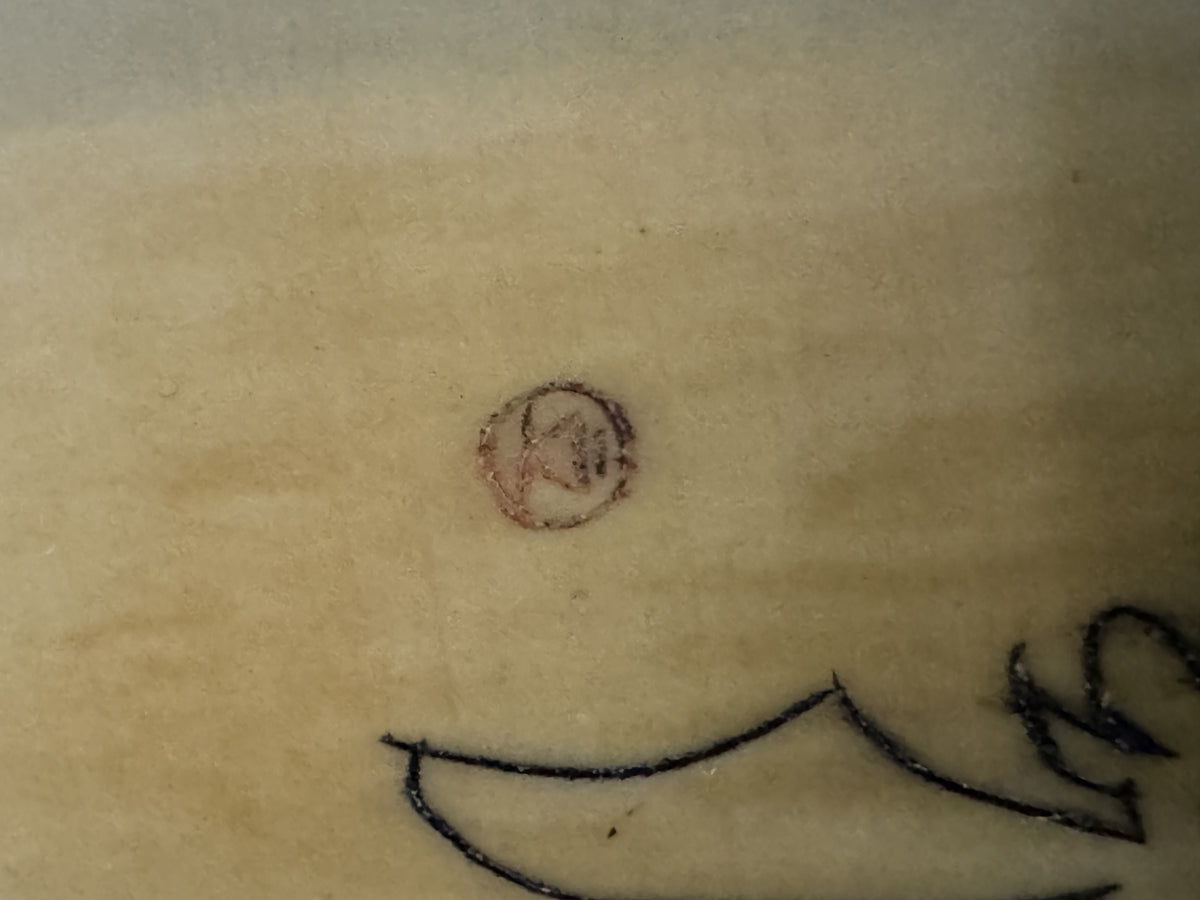
This is not a plainly written character. It is a calligraphic performance, with strokes that sweep and loop, transforming the character into a visual celebration of the concept it contains. Below it, a small secondary circular seal reinforces the auspicious program.

Every surface is carrying blessing. Nothing is wasted.

---

📐 PHYSICAL DETAILS

Shipping

🚚 Shipping & Handling

  • Shipping costs and timing are calculated at checkout.
  • Items curated and shipped directly by me include U.S. shipping at no additional cost, professionally packed to ensure safe arrival of your artifact.

Items from Vetted Pro Collectors
Shipping for items offered by vetted Pro Collectors is determined at checkout. All Pro Collector listings are reviewed to ensure fair, reasonable shipping practices.

For full details, please refer to our Shipping Policy.

Returns & Exchange

Product Page Return Policy

  • 60-Day Returns – Items must be in original condition.
  • Refunds – Issued after inspection (excluding shipping costs).
  • Return Shipping – Customer is responsible unless item is damaged or incorrect.
  • Damaged/Incorrect Items – Contact us within 48 hours for a replacement or refund.
  • Easy Returns – Email info@vintageantiquesgifts.com or call 802-356-9872 to initiate a return.

For full details, visit our Refund Policy.

View full details