Skip to product information
1 of 2

Rugistan

Antique Shahsavan Caucasian Hand-Knotted Wool Mafrash Panel Geometric

Regular price 400.00 USD
Regular price 650.00 USD Sale price 400.00 USD
Sale Sold out
Shipping calculated at checkout.

Description

🏔️ Voices From the Caucasus: An Antique Shahsavan Mafrash Panel from the 1900s

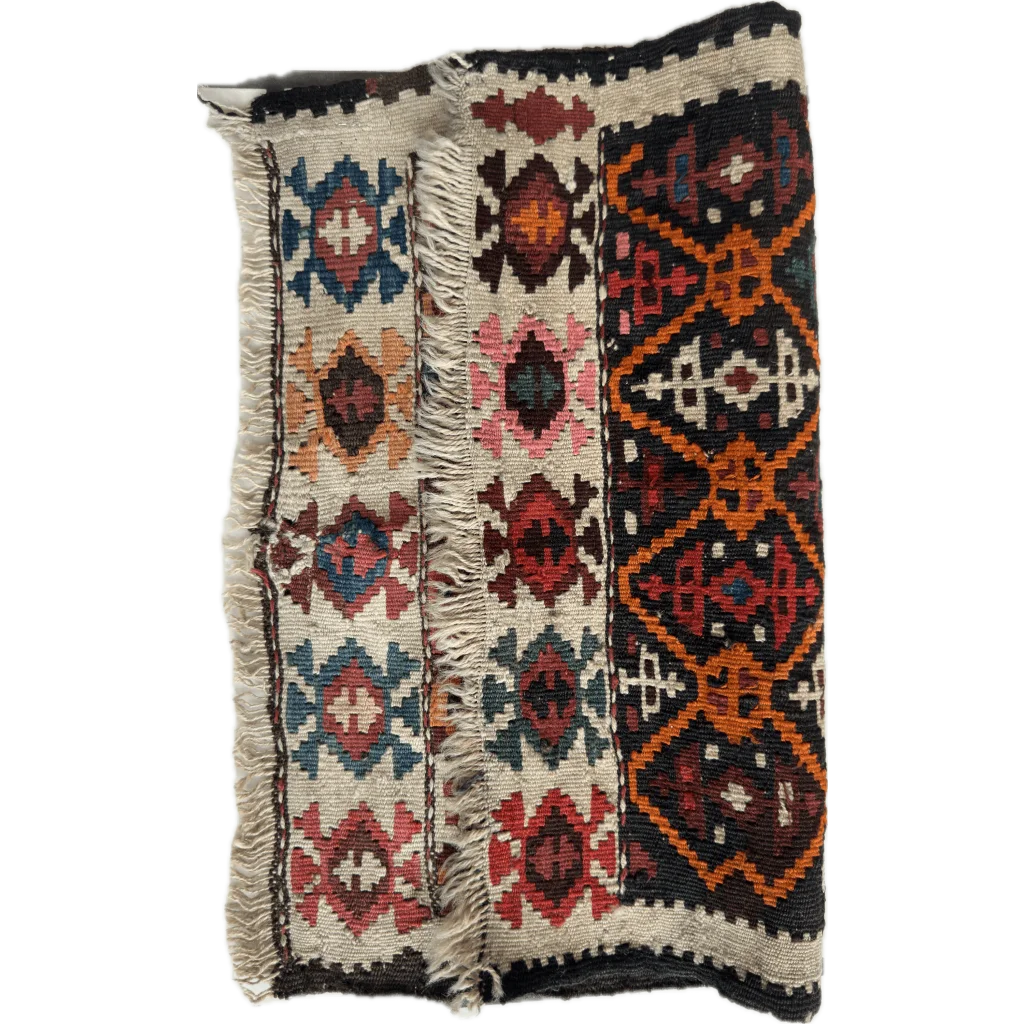
The Shahsavan confederation moved through the Caucasian highlands and the Moghan Steppe across centuries of nomadic life, carrying their world on the backs of pack animals through mountain passes and across seasonal grazing circuits. 🐑 What they wove to hold what they carried defines one of the great chapters of tribal textile history. This antique hand-knotted Shahsavan Caucasian mafrash panel, crafted from natural wool pile and foundation in the early 1900s and measuring 26 in by 18 in, is a direct artifact of that world — its geometric tribal patterns tied knot by knot into a structure that has held its integrity across more than a century of existence.

📦 The Mafrash: Architecture of the Nomadic Home

A mafrash is a woven storage bag — large, rigid-sided, essentially a portable chest — used by the Shahsavan and related Caucasian tribal groups to organize and protect their most valued possessions during seasonal migrations. 🎒 Made in pairs or sets, these bags served as the nomad's furniture: stacked in the tent to create seating platforms, arranged along the tent walls to define interior space, displayed face-outward so that their decorative panels functioned simultaneously as storage containers and interior design.

The panel of a mafrash — the face visible when the bag was in use — was always the weaving community's visual statement. 🎨 This was the surface that received the finest wool, the most carefully executed patterns, the most deliberate color combinations. Within the Shahsavan tradition, mafrash panels typically featured bold geometric compositions — medallions, stars, geometric animal forms, latticed fields — executed in a palette of saturated natural dyes that created maximum contrast against the ground.

The panel you are examining — Item KJ4 — carries that visual authority intact. 💪 Despite more than a century of existence, the geometric patterning reads clearly, the structural integrity of the knotting holds, and the presence of the piece retains the force of its original intention. This is a functional object that transcended its function — as all the best tribal textiles do.

🌍 The Shahsavan: Textile and Territory

The Shahsavan — those who love the Shah — were one of the most significant tribal confederations of the Caucasus and northwestern Iran, their territory ranging from the Moghan Steppe along the Aras River up into the highlands of what is now Azerbaijan and Georgia. 🗺️ Their weaving tradition developed within this geographic context: a landscape of dramatic contrasts — high summer pastures, low winter valleys, mountain passes that tested both humans and animals — that demanded textiles of extreme durability and aesthetic coherence.

The early 1900s represent the closing chapter of genuinely traditional Shahsavan tribal weaving. 📜 The political disruptions of the early 20th century — the final consolidation of the Caucasus under Russian and then Soviet authority, the gradual settlement of nomadic populations, the erosion of the seasonal migration circuits that had organized Shahsavan life for centuries — brought the golden age of this weaving tradition to a close. Pieces from this period are among the last produced entirely within the living tribal context, before commercial pressures and cultural disruption transformed what remained of the weaving tradition.

To acquire a mafrash panel from the early 1900s Shahsavan tradition is to acquire something from that closing chapter — the final expression of a textile culture at full maturity, before modernity interrupted the conversation. 🕰️

🧶 Material and Construction: The All-Wool Approach

This panel is hand-knotted — built knot by knot on the loom, creating a pile surface over a foundation structure. ✋ The pile is natural wool; the foundation is natural wool. This all-wool construction is characteristic of the finest Shahsavan tribal work, giving the piece a weight, warmth, and dimensional quality that distinguishes it from cotton-foundation and synthetic-fiber production that came later.

The wool from the hardy, high-elevation sheep of the Caucasian mountains carries the natural lanolin and fiber structure that makes antique Caucasian wool so resilient. 🐑 After more than a century, the pile retains its integrity because it was made from material built for the same demanding environment its weavers inhabited. The natural dyes — deep reds from madder, blues from indigo, neutral grounds from undyed wool — have proven their lightfastness across the century, warming as they age rather than bleaching, developing the tonal depth that makes natural-dye antique textiles so visually compelling.

📐 Scale and Display

At 26 in by 18 in, this panel is in the classic mafrash bag face format — a proportion that reflects the structural requirements of the bag it once formed part of. 📦 The rectangular format is ideal for display: large enough to read clearly from across a room, compact enough to be manageable in most display contexts, with proportions that work both horizontally and vertically depending on how the viewer chooses to orient it.

Framed behind conservation glass, this piece becomes a work of textile art that holds its own in any gallery context. 🖼️ The bold geometric patterning of Shahsavan work translates powerfully to the wall — the visual energy of the pattern is essentially the same whether the textile is viewed as a functional object or as art. Interior designers increasingly recognize this: an antique Caucasian mafrash panel on the wall of a modern interior creates the kind of material specificity and historical resonance that contemporary reproductions cannot generate.

On a collector's shelf or displayed flat on a surface, the panel functions as an artifact — something to be handled, examined, and studied. 🔍 The variations in dye tone from knot to knot become visible up close; the way the weaver handled pattern transitions and border work tells you something about the specific weaving community and individual that made this piece. That kind of evidence — written in wool and dye — is what makes antique tribal textiles so inexhaustible as collector objects.

🎁 Condition and Collector Value

This panel is in good condition — a meaningful baseline for a piece that has traveled across more than a century of existence. 🛡️ The natural materials have proven themselves: wool is extraordinarily durable when stored properly, and natural dyes on antique wool can outlast the synthetic fibers of pieces made decades later. The geometric patterning reads clearly, the foundation holds, and the overall presence of the piece is that of a surviving object rather than a damaged remnant.

For the collector, this panel offers something that cannot be manufactured or reproduced: authentic 1900s Shahsavan Caucasian tribal weaving, in a format that is displayable, livable, and historically significant. 💎 Mafrash panels from this period and tradition are sought by collectors worldwide who recognize the Shahsavan weaving tradition as one of the great chapters of world textile history, and who understand that genuine examples from the formative era represent both a privilege and a long-term value.

Item ID: KJ4 🏷️

Shipping

🚚 Shipping & Handling

  • Shipping costs and timing are calculated at checkout.
  • Items curated and shipped directly by me include U.S. shipping at no additional cost, professionally packed to ensure safe arrival of your artifact.

Items from Vetted Pro Collectors
Shipping for items offered by vetted Pro Collectors is determined at checkout. All Pro Collector listings are reviewed to ensure fair, reasonable shipping practices.

For full details, please refer to our Shipping Policy.

Returns & Exchange

Take your time — you've got a full six months. If a piece isn't right for you, send it back the way it reached you and we're good.

In the first 30 days your money goes straight back the way you paid. After that it's store credit, so you can put it toward something you'd rather have.

Return shipping we sort out between us, case by case. I don't make this difficult.

If something arrives damaged, or it isn't what I said it was, send me a photo within 48 hours and I'll make it right.

Email [email protected] or call 802-356-9872 — that's me answering, not a call center.

The only things I can't take back are custom or special-order pieces and gift cards.

View full details