Skip to product information
1 of 6

Vintage and Antique Gifts

🥄 Antique Gold-Plated Louisiana Purchase Commemorative Spoon | Wm. Rogers & Co. c.1904

🥄 Antique Gold-Plated Louisiana Purchase Commemorative Spoon | Wm. Rogers & Co. c.1904

Regular price 24.00 USD
Regular price Sale price 24.00 USD
Sale Sold out
Shipping calculated at checkout.

Description

In 1803, Thomas Jefferson spent $15 million and doubled the size of a country. 🗺️

He did it without clear constitutional authority, against the advice of much of his cabinet, and through a negotiation that moved faster than anyone expected. Napoleon Bonaparte needed money for his European campaigns and had concluded that his ambitions in the western hemisphere were finished. He offered Jefferson not just New Orleans — which the American president had been trying to secure — but the entire Louisiana Territory. James Monroe and Robert Livingston, negotiating in Paris, found themselves staring at an offer larger than anything they had been authorized to accept.

They signed the treaty anyway on April 30, 1803.

Exactly a century later, the city of St. Louis began planning the largest celebration in American history — the Louisiana Purchase Exposition, the 1904 World's Fair. Twenty million visitors. Sixty-two nations. Twelve hundred acres of history spread across Forest Park. And everywhere, commemoratives — mementos of the moment pressed into metal and ceramic and glass, so that people could hold the history in their hands and carry it home. 🎊

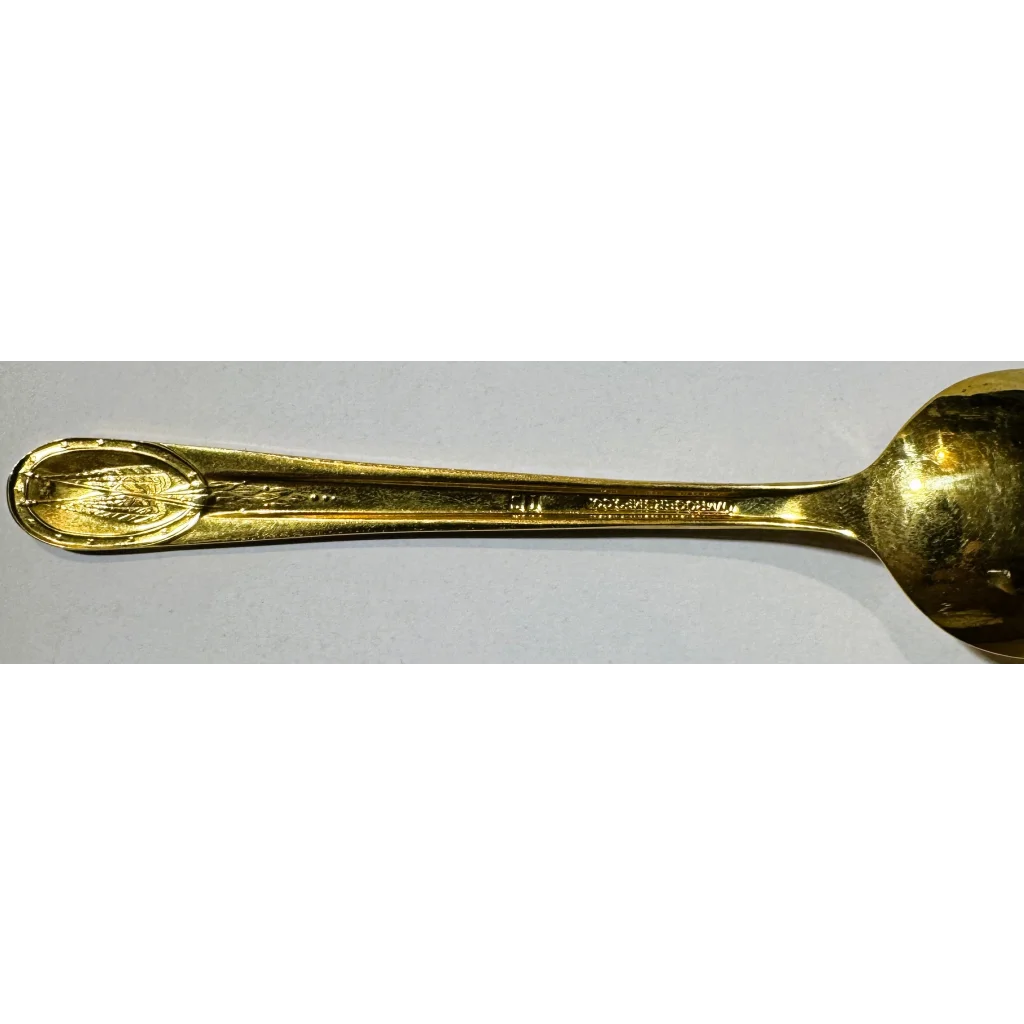
This is one of those objects. A gold-plated commemorative souvenir spoon by Wm. Rogers & Co., made for the centennial era of the Louisiana Purchase. The bowl carries the date 1803, a raised relief map of the United States, and the words LOUISIANA PURCHASE in relief lettering that has held through more than a century. The finial bears the portrait of Thomas Jefferson — the president who made the deal that doubled America. 🥄

---

🗺️ THE BOWL — READING THE MAP IN THE GOLD

The bowl of this spoon is where the history lives. In good light, three distinct elements emerge from the gold-plated surface, each telling part of the story.

At the very top of the bowl: 1803. The year Jefferson signed the treaty. The year the United States stopped being a coastal republic clinging to the Atlantic and committed to becoming something else — a continental nation, stretching toward a Pacific it hadn't yet mapped. That date, pressed into gold, carries everything. ✨

Below the date, filling the center of the bowl: a raised relief map of the United States. The country rendered in metal, its contours captured in low relief — the eastern seaboard, the Gulf Coast, the continental form that the Louisiana Purchase made possible. This is not a decorative motif chosen at random. This is a cartographic statement: here is what we became. Here is the shape of the nation that Jefferson's $15 million purchased into existence. Captured in gold, in the bowl of a spoon, made to remind its owner precisely how large an idea the United States had committed itself to becoming.

At the base of the bowl: LOUISIANA PURCHASE. The words themselves, in clean relief lettering that has held through more than a century of time. 🏙️

The gold plating over the bowl is bright and largely intact, showing the warm luster that gold-plated centennial-era flatware develops over time — richer and deeper than polished silver, with a warmth that comes from genuine gold application over quality base metal. The relief elements catch light differently from the surrounding field, giving the map and inscription a three-dimensional presence that photographs partially capture and holding in hand reveals fully.

---

🎊 THE 1904 ST. LOUIS WORLD'S FAIR — WHY THIS SPOON EXISTS

The Louisiana Purchase Exposition opened on April 30, 1904, in Forest Park, St. Louis, Missouri. The date was deliberate — it marked the 101st anniversary of the treaty signing, the symbolic anchor the fair's planners had held to even when construction delays pushed the opening from 1903 to 1904. 🌸

What they built was the largest World's Fair in American history to that point: 1,272 acres, more than 1,500 buildings, 62 countries represented, and 19.7 million visitors over seven months. The Palace of Agriculture alone covered twenty acres. The grand Cascades — a series of cascading fountains and waterways — stretched a quarter mile.

The fair's purpose was to answer a question: what had America done with 828,000 square miles of purchased wilderness in a hundred years? The answer, laid out across twelve hundred acres of Missouri parkland, was: states, cities, railroads, farms, industries, universities. The 1904 World's Fair was the Louisiana Purchase showing its receipts — the civilization that had grown up on the land Jefferson bought from Napoleon, assembled in one place to prove that every cent of the $15 million had been earned back ten thousand times over. 🏙️

Commemorative spoons from the 1903–1904 centennial period are among the most historically documented souvenirs in American collectibles history. The Wm. Rogers Louisiana Purchase spoon is exactly this tradition — a centennial-era commemorative made for collectors who understood that the Louisiana Purchase had made the American continent what it was. The gold-plated version was the premium expression. ✨

---

🏙️ THOMAS JEFFERSON AND THE DECISION THAT STRETCHED THE CONSTITUTION

The portrait at the tip of the handle — the carved face at the very top of the finial — is Thomas Jefferson, the president who made the Louisiana Purchase happen.

Jefferson had set out to buy New Orleans. Control of the Mississippi River mouth was critical to the American interior — the river was the commercial highway of the frontier west, and whoever controlled its mouth controlled access to the sea. Robert Livingston, negotiating in Paris, had been authorized to spend up to $10 million for New Orleans and the Floridas. What Napoleon offered instead was everything.

The entire Louisiana Territory — 828,000 square miles, stretching from the Mississippi to the Rockies, from the Gulf to Canada. The price was $11.25 million in direct payment plus the assumption of $3.75 million in French debts owed to American citizens. Fifteen million dollars total for land that would eventually become all or part of fifteen American states. 🗺️

Jefferson agonized over the constitutional question. The document he had helped write said nothing about the federal government's authority to purchase foreign territory. He drafted a constitutional amendment to authorize it, concluded there wasn't time to wait for ratification, and pushed the treaty through Congress anyway. He later wrote that the size of the opportunity demanded it. The fifteen states now occupying that purchased land — Louisiana, Missouri, Arkansas, Iowa, North Dakota, South Dakota, Nebraska, Kansas, Minnesota, Montana, Wyoming, Colorado, Oklahoma, New Mexico, and more — are home to tens of millions of Americans whose relationship to their land traces directly to that spring negotiation in Paris.

Jefferson knew he was making a decision that would echo for centuries. He was right. The portrait on the finial belongs to the man who made that call. ✨

---

🌿 LEWIS AND CLARK — THE EXPLORATION THAT FOLLOWED THE INK

The Louisiana Purchase gave the United States a territory it had never seen. Jefferson understood immediately that the Purchase required exploration — not just political mapping, but a systematic accounting of what America had actually acquired. Within months of the treaty signing, he began planning the Corps of Discovery. 🌄

Meriwether Lewis and William Clark set out from the St. Louis riverfront in May 1804 — just over a year after the Purchase — and didn't return until September 1806. Their journals described rivers, mountain ranges, plants, animals, and peoples that most Americans had never imagined. The expedition defined the territory the Purchase had opened: the Missouri River, the Rocky Mountains, the Continental Divide, the Columbia River basin, the Pacific Ocean itself.

The St. Louis departure point was not accidental. St. Louis was the gateway into the purchased territory — which is precisely why the 1904 World's Fair was held there, and precisely why commemoratives made for that fair are bound up with Lewis and Clark as much as with Jefferson. The 1803 pressed into the gold of this spoon's bowl is the year of the Purchase; the 1904 Exposition was the moment America looked back at a century of what Jefferson had set in motion. 🏙️

---

🏭 WM. ROGERS & CO. — THE SILVERWORK BEHIND THE SPOON

The mark on the back of this spoon — WM ROGERS — is one of the most significant in American commemorative flatware history. 🥄

William Rogers began his silverware career in Hartford, Connecticut in the 1840s, developing and patenting electroplating processes that brought quality silver-plated flatware within reach of American households that could never have afforded solid silver. The company he helped establish became one of the primary makers of the souvenir spoon boom that swept American collecting culture in the final decades of the nineteenth and opening years of the twentieth century.

By the time this Louisiana Purchase spoon was made — c. 1903–1904, for the centennial and the St. Louis World's Fair — the Rogers trademark was being carried by the International Silver Company, which had absorbed several Rogers enterprises in the 1890s. The trusted Rogers name continued in production, attached to commemorative pieces for every significant national occasion. The Louisiana Purchase centennial was exactly the kind of historical moment Rogers spoons were made to mark. ✨

The gold-plated version is the premium expression. Standard centennial versions were silver-plated; gold-plated required an additional manufacturing step, commanded a higher price at point of sale, and targeted buyers who wanted the finest statement of the commemorative tradition. The gold plating on this spoon has held through more than a century of time — not by chance, but because of the quality of gold application over quality base metal by craftsmen whose working reputation depended on exactly this kind of longevity. 💷

---

🥄 THE SOUVENIR SPOON TRADITION — GILDED AGE AMERICA'S DEFINING COLLECTIBLE

The souvenir spoon collecting boom of the 1890s through the 1910s is one of the most distinctly American collecting traditions in history. It emerged from a perfect alignment of circumstances: improved electroplating technology that made quality silver- and gold-plated flatware affordable; a growing middle class with disposable income and an appetite for material culture; a national railroad network that let Americans travel; and a souvenir industry that met them everywhere they went.

The craze is typically traced to 1890, when a Salem, Massachusetts jeweler produced a spoon depicting a witch — a reference to the 1692 trials — and sold it as a souvenir item. Within two years, spoon collecting had become a national phenomenon. Companies including Wm. Rogers, Gorham, Tiffany, and dozens of regional producers were making commemorative spoons by the thousands. 🏙️

By the early 1900s, souvenir spoon racks were standard fixtures in Victorian and Edwardian parlors. The Louisiana Purchase commemorative sits within this tradition as a specifically historical piece — not tied to a place a collector had visited, but to an event that had shaped the American nation itself. These were spoons for collectors who thought of themselves as keepers of national memory. This spoon was made for someone who wanted to hold 1803 in their hand and understand what it meant. ✨

---

✨ CONDITION

New Old Stock in excellent vintage condition. The gold plating over the bowl exterior — where the map, the 1803 date, and the LOUISIANA PURCHASE inscription live — is bright, warm, and substantially intact. The relief work reads clearly in light: the contours of the map, the engraved date, the inscription at the base. The bowl interior is equally well-preserved. The handle carries light surface marks consistent with honest age. The Thomas Jefferson portrait at the finial is sharp and well-defined. Structurally complete: no bends, no cracks, nothing missing. 💷

---

📐 PHYSICAL DESCRIPTION

🥄 Maker: Wm. Rogers & Co. (trademark used by International Silver Co. at time of production)
🥄 Mark: WM ROGERS stamped on handle reverse
🥄 Period: c. 1903–1904 — Louisiana Purchase Centennial and St. Louis World's Fair era
🥄 Finish: Gold-plated over base metal
🥄 Bowl obverse: Relief map of the United States — "1803" engraved at top, "LOUISIANA PURCHASE" inscribed at base
🥄 Handle finial: Thomas Jefferson portrait
🥄 Handle obverse: "LOUISIANA PURCHASE" engraved on stem
🥄 Handle reverse: WM ROGERS maker's stamp
🥄 Type: Souvenir / commemorative spoon
🥄 Condition: NOS — gold plating bright and largely intact; light surface wear consistent with age; structurally perfect

---

🎯 WHO COLLECTS THIS

🥄 Collectors of American historical commemoratives and souvenir spoons from the Gilded and Edwardian eras
🥄 Wm. Rogers and International Silver collectors and American silverplate historians
🥄 Louisiana Purchase, Jeffersonian America, and early American expansion enthusiasts
🥄 Gold-plated flatware and period decorative arts collectors
🥄 History lovers looking for a specific, meaningful, hand-holdable piece of American national memory
🥄 Gift buyers who want something genuinely old, genuinely American, and genuinely specific

One hundred and twenty years since this spoon was made for the centennial of the Purchase, the country it maps is still living with the consequences of the moment it commemorates. The 1803 pressed into the gold of the bowl is not ancient history. It is the beginning of the American West — and it fits in your hand. 🗺️

Shipping

🚚 Shipping & Handling

  • Shipping costs and timing are calculated at checkout.
  • Items curated and shipped directly by me include U.S. shipping at no additional cost, professionally packed to ensure safe arrival of your artifact.

Items from Vetted Pro Collectors
Shipping for items offered by vetted Pro Collectors is determined at checkout. All Pro Collector listings are reviewed to ensure fair, reasonable shipping practices.

For full details, please refer to our Shipping Policy.

Returns & Exchange

Product Page Return Policy

  • 60-Day Returns – Items must be in original condition.
  • Refunds – Issued after inspection (excluding shipping costs).
  • Return Shipping – Customer is responsible unless item is damaged or incorrect.
  • Damaged/Incorrect Items – Contact us within 48 hours for a replacement or refund.
  • Easy Returns – Email info@vintageantiquesgifts.com or call 802-356-9872 to initiate a return.

For full details, visit our Refund Policy.

View full details